1. Ana Sayfa
  2. IELTS
  3. Deneme sınavları
  4. Speaking
  5. Speaking Deneme Sınavı 10: Strangers

IELTS Speaking

IELTS Speaking Deneme Sınavı 10: Strangers

Describe a time when a stranger in a public place behaved in a way that surprised you.

  • 3 bölüm
  • 11–14 dk
  • Sınav görevlisi
  • Dört aday, tek test

Testi yapın

Sınav görevlisinin soruları tek tek çalar. Sınavdaki gibi sesli cevaplayın. Kayıt isteğe bağlıdır ve yalnızca bu tarayıcı sekmesinde kalır.

Kayıtlarınız yalnızca bu sekmede tutulur. Hiçbir şey yüklenmez. Saklamak isterseniz indirin.

Performansınızı puanlayın

Cevaplarınızı adaylarla karşılaştırın, sonra her kriter için size uyan bandı seçin.

6,0Tahmini bandınız
Fluency and coherence

Lexical resource

Grammatical range and accuracy

Pronunciation

Her aday farklı bir konuşmacı, bu yüzden hikâyeler ve görüşler farklı. Bantlar, herkese açık tanımlara göre bizim tahminimizdir; resmî sınav puanı değildir. Yazıya dökülmüş konuşma telaffuzu gösteremez. Bu bantlar telaffuzun diğer üç kriterle aynı düzeyde olduğunu varsayar.

Sorular, ipucu kartı ve örnek cevaplar

Bölüm 1: mülakat

Home town

  • Where is your home town?
  • What do people there usually do at the weekend?
  • Did you enjoy growing up there?
  • Would you like to live there in the future?

Drawing

  • Did you draw a lot when you were a child?
  • Do you ever draw now, for example when you're bored or on the phone?
  • Do you know anyone who's really good at drawing?
  • Would you like to learn to draw better?

Buses and trains

  • How often do you travel by bus or train?
  • What do you like to do on a long bus or train journey?
  • Which do you prefer, buses or trains? (Why?)

İpuçları

  • Your home town is the easiest topic in the test, so use it to settle in. Talk about what people there actually do, at the weekend or in the evening, rather than its population or history.
  • Two questions are about the past: growing up in your home town and drawing as a child. One small memory told with past forms is enough, and you can add how things are now if it comes naturally.
  • If you never draw, that is still an answer. Say so, then add what you do instead or someone you know who does draw. 'No, I'm bad at it' on its own is too short.

Bölüm 2: uzun konuşma (ipucu kartı)

Describe a time when a stranger in a public place behaved in a way that surprised you.

You should say:

  • where you were and what was going on
  • what the stranger did
  • how you and the people around you reacted

and explain whether you would have done the same in their place.

Ek soru

  • Have you ever seen that person again?
  • Do you often talk to strangers in your everyday life?

Güçlü bir adayın alabileceği notlar

  • bus stop, Monday, rush hour
  • teenager, headphones, looked rude
  • old man, couldn't read bus numbers
  • boy read out every number
  • missed his own bus
  • me: embarrassed, had judged him
  • others: eyes on phones
  • same? like to think so, doubt it

İpuçları

  • The card is about one moment, so you do not need a dramatic story. A small surprise works well: someone who stayed calm when you expected anger, a stranger who did a job nobody asked them to do, or one who turned down your help. Say what you expected first, so the listener understands why it surprised you.
  • Do not spend the whole time on the stranger. The third point asks how you and the people around you reacted, which gives you plenty to say: what you did, what you felt, and what everyone else did or did not do.
  • The explain line needs a past hypothetical: 'I think I would have ...', 'I'm not sure I'd have ...', 'In her place, I probably wouldn't have ...'. Be honest. Admitting you would not have done the same is a perfectly good answer, as long as you say why.

Bölüm 3: tartışma

Trust between strangers

  • Why do some people find it easier than others to trust someone they don't know? Açıklama
  • Is it easier to trust a stranger you meet in person or one you deal with online? Karşılaştırma
  • Do you think it's right to teach children never to talk to strangers? Değerlendirme

Community life in cities and villages

  • Why do people in villages often know their neighbours better than people in cities do? Açıklama
  • Do you think neighbourhoods in big cities will become friendlier or less friendly in the future? Gelecek hakkında tahmin
  • What could be done to help people who move to a big city feel part of a community? Öneri sunma

İpuçları

  • Several questions set two things side by side: people who trust easily and people who don't, meeting in person and online, villages and cities. Give each side a real reason before you choose, or say what your answer depends on.
  • The question about children asks you to judge a rule. You can agree with part of it: say when the rule makes sense and where it goes too far, with an example of each.
  • For the future question, start from something you can see happening now where you live, then say where you think it will lead. Words such as probably, I suspect and I'd guess show that you are speculating.

Dört aday, tek test

Dört farklı banttaki adayların her soruya verdiği cevaplar.

Bölüm 1Where is your home town?

Meknes. It's near Fes, the two cities are very close. But I don't live there now. I work in Tangier, in a factory, so I go back, er, one time in the month to see my parents.

Bölüm 1What do people there usually do at the weekend?

Er, the families go out, to the old city or to the... the big square. There are many people, music, food stalls. It's very animated in the evening. The young people, they go to the café and watch the football.

Bölüm 1Did you enjoy growing up there?

Yes, very much. My father has a small shop, he sells olives and, er, lemons in salt, I don't know how you say in English. After school I was helping him, so I know everybody in the street.

Bölüm 1Would you like to live there in the future?

Yes, I hope. Tangier is good for the work, but everything is expensive there, the rent, the food. And Meknes more calm, more slow. Maybe after some years, er, I go back and open something small, like my father.

Bölüm 1Did you draw a lot when you were a child?

Yes, a little. At school we had drawing, er, one hour in the week. I liked to draw the cars and the football players. My drawings were not very good, but I was happy to do it.

Bölüm 1Do you ever draw now, for example when you're bored or on the phone?

For the work, yes. Sometimes I draw a, er... a piece of the machine, for my chief, to show him what is broken. But for fun, no, never.

Bölüm 1Do you know anyone who's really good at drawing?

Yes, my little sister. She draws very well, er, faces of people, very real. She want to study in the... the school for art, but my father thinks it's not a real job.

Bölüm 1Would you like to learn to draw better?

Er... not really. I don't have the time, I work six days. Maybe for the work it's useful, to draw the plans more clean. But it's not my passion.

Bölüm 1How often do you travel by bus or train?

The bus, every day. The factory has a bus for the workers, it takes us in the morning at six. And the train when I go to Meknes, one time in the month, more or less.

Bölüm 1What do you like to do on a long bus or train journey?

I sleep, er... always. I start work very early, so when I sit in the train I'm tired. Sometimes I speak with the person next to me, if he is friendly.

Bölüm 1Which do you prefer, buses or trains? (Why?)

The train. It's more comfortable, you can walk, go to the toilet... and the bus is, er, too slow, it stop in every small town. The train is faster and, er, not so expensive.

Bölüm 2Describe a time when a stranger in a public place behaved in a way that surprised you.

OK. So, er, this happened in the train station in Tangier, last winter. I was going to Meknes for the weekend and I was late, I was running with my bag and a coffee in my hand. And I hit a man by accident, with my shoulder, and all the coffee go on his shirt. White shirt. He was wearing a jacket, er, like for the work, maybe he had a meeting. I was very scared. I think, er, now he will shout at me, or he want me to pay. But he didn't shout. He look at his shirt, and after... he laugh. He said, it's OK, it's only a shirt, go, go, you will miss your train. I propose to pay for the – to clean it, but he say no, no problem. The people around us was looking, er, I think they were waiting for a fight, and after they was surprised, like me. If it was me... I don't think I can be calm like this. Maybe I don't shout, but I'm angry, for sure. He has the patience, er, I don't have it. A white shirt, and he... he laugh. Er... yes.

Bölüm 2Have you ever seen that person again?

No, never. I don't know his name, nothing. Maybe he was only travelling, like me.

Bölüm 2Do you often talk to strangers in your everyday life?

Yes, it's normal here. In the taxi, in the café, people talk to you about the football, the prices...

Bölüm 3Why do some people find it easier than others to trust someone they don't know?

Er... I think it's the character. Some people are open, they smile, they talk with, er, with everybody. Other people more closed, more shy. Also, er, if somebody stole from you before, after that you don't trust anybody. It's normal, I think.

Bölüm 3Is it easier to trust a stranger you meet in person or one you deal with online?

In person it's more easy, because you see his face, his eyes, you know if he is honest or no. On internet you see only a photo, and maybe the photo is not... is not him. My friend bought a phone online and, er, he receive a box with only paper inside. So in person is better.

Bölüm 3Do you think it's right to teach children never to talk to strangers?

Yes, I think it's important. The children are small, they don't know who is good and who is bad. Some people can lie to a child, er, give him sweets, and the child believes. So the parents must say this, many times. But when the child is bigger, er... ten, twelve years, it's different, he can talk a little.

Bölüm 3Why do people in villages often know their neighbours better than people in cities do?

Because the village is small, er, everybody knows everybody. The families live there for many years, the grandfather, the father, the son, all in the same place. In the city the people come for the work and after they go. In my building in Tangier I don't know the names of my neighbours. Only, er... hello on the stairs.

Bölüm 3Do you think neighbourhoods in big cities will become friendlier or less friendly in the future?

Less friendly, I think. Because now everybody is with the phone, all the time, in the street, in the bus, they don't look at the people. And they work a lot, they are tired, they don't have time for the neighbours. So, er, I think more and more people will be... alone. Yes, less friendly.

Bölüm 3What could be done to help people who move to a big city feel part of a community?

Er, maybe the neighbours can invite them, for eat or for tea. When I came to Tangier, my colleague invited me to his home for lunch on Friday, with all his family, and I felt, er, less alone. Also the city can do, um... activities, like football for the young, or a festival in the street. Something like this.

Bu test için kelimeler

a complete stranger
someone you have never met or seen before
lose your temper
suddenly become angry and show it
keep calm
stay relaxed and controlled when something goes wrong
go out of your way
make a special effort to do something for someone
a bystander
someone who sees something happen but does not take part
be wary of
be careful because something or someone might be a risk
give someone the benefit of the doubt
believe someone is honest even though you cannot be sure
keep yourself to yourself
be polite but not share much of your life with people around you
a close-knit community
a group of people who know each other well and help each other
on first-name terms
friendly enough with someone to call them by their first name
anonymous
not known by name, as people can feel in a big city
small talk
short, light conversation about everyday things such as the weather

İşe yarar kalıplar

  • I was expecting ___, so when ___, I was really surprised.
  • What struck me most was that ___.
  • Nobody around us ___. Everyone just ___.
  • In his place, I'm not sure I would have ___.
  • I'd like to think I'd ___, but realistically ___.
  • It depends a lot on ___. If ___, then ___.
  • In a village ___, whereas in a city ___.
  • I can see why ___, but I think it goes too far when ___.
  • I suspect that in the future ___, mainly because ___.
  • One thing that would really help is ___.

Fleydo IELTS uygulama simgesi Fleydo: IELTS Hazırlık

Bu testleri telefonunuzda yanınızda taşıyın

Bu sayfalardaki her test, iPhone, iPad ve Android için Fleydo: IELTS Hazırlık uygulamasında da var; yanında sesli 2.000 IELTS kelimesiyle birlikte.

  • Test telefonunuza indikten sonra çevrimdışı çalışır
  • Sesli 2.000 IELTS kelimesi, aralıklı tekrar ve kısa alıştırmalar
  • Speaking cevaplarınızı kaydedip geri dinleyin
  • Hedef bandınıza ve sınav tarihinize göre günlük plan
App Store'dan indirinGoogle Play'den indirin
İndirmek için tarayınTelefonunuza göre App Store'u veya Google Play'i açar.

Hesap gerekmez. Uygulama hakkında

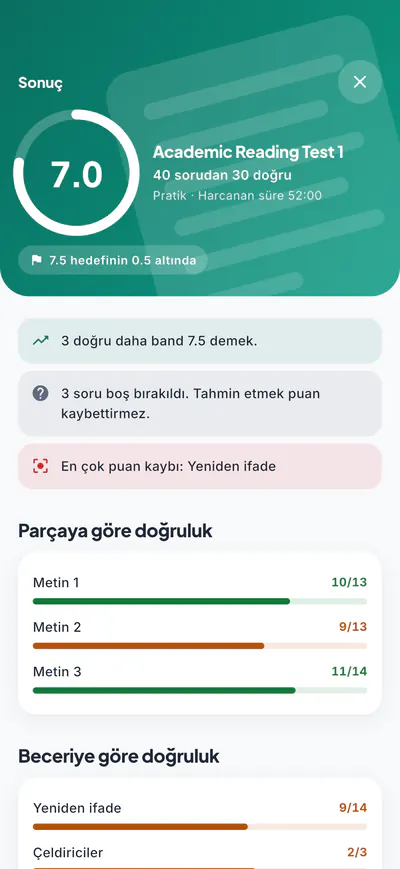
Fleydo: IELTS Hazırlık uygulamasında bir IELTS deneme sınavının sonucu: tahmini band ve her bölümün doğruluğu
Ücretsiz deneme dersi

Gerçek IELTS band puanınızı sınavdan önce öğrenin

Band 8.5+ sertifikalı IELTS uzmanı, anadili İngilizce bir öğretmenle ücretsiz bire bir online ders. Gerçek formatta bir Speaking tanılaması, dürüst bir band tahmini ve size puan kaybettiren ölçütlere yönelik bir plan alırsınız. Ödeme yok, taahhüt yok.

Online · Bire bir · Academic ve General Training

IELTS; British Council, IDP: IELTS Australia ve Cambridge University Press & Assessment kuruluşlarının tescilli markasıdır. Bu deneme sınavları Fleydo tarafından hazırlanmıştır; adı geçen kuruluşlarca onaylanmamış veya desteklenmemiştir.

Mobil Uygulama

Fleydo English School cebinizde

Fleydo öğrencileri ve velileri için dersler, ödevler, mesajlar ve oyunlar. iPhone ve Android'de ücretsiz.

App Store'dan indirinGoogle Play'den indirin
Uygulama hakkında daha fazlası
Fleydo English School uygulamasını App Store veya Google Play'de açan QR kodTaratın ve indirinTelefonunuza uygun mağazayı açar.fleydo.com/app
Fleydo IELTS uygulama simgesi
Fleydo: IELTS Hazırlık

IELTS'e mi hazırlanıyorsunuz?

Fleydo: IELTS Hazırlık, dört beceri için deneme sınavları sunan ayrı bir uygulamadır. Kullanmak için Fleydo hesabı gerekmez.

IELTS uygulamasını inceleyin
App Store'dan indirinGoogle Play'den indirin
IELTS deneme sınavları

Dört IELTS becerisini çalışın

Anında band puanı, açıklamalı cevaplar ve örnek cevaplarla 311 test. Üyelik gerekmez.

Tüm deneme sınavları
FleyPath

Çocuğunuzun kişisel yol haritası — 3, 6 veya 12 ay

🚀Başlangıç
👋Hello
😊Body
🦁Animals
🔢Numbers
🏆Özgüvenli İngilizce
Oyunlaştırılmış İngilizce pratiği

Tıpkı bir oyun gibi — ama gerçekten öğreniyorlar