1. Ana Sayfa
  2. IELTS
  3. Deneme sınavları
  4. Reading
  5. Reading Yes/No/Not Given alıştırması 1

IELTS Reading · Yes / No / Not Given

IELTS Reading Yes/No/Not Given alıştırması 1

Library late fines

  • 12 soru
  • 15 dk
  • Academic

Bu testte neler var

  1. PassageSorular 1–12Closing the book on fines

Soru tipleri

  • Yes / No / Not Given
ReadingIELTS Reading Yes/No/Not Given alıştırması 1
Kalan süre15:00

Passage

Closing the book on fines

A On 1 January 2019, public libraries across Ireland stopped charging borrowers for late returns, and existing fines were cleared. It was part of a national strategy aiming to almost double active membership by the end of 2022. Its authors argued that fines had been shown to discourage children and disadvantaged people from using libraries, and that there was little evidence they got books back on time. San Francisco, Chicago, San Diego and almost every public library in New Zealand have done the same. I believe they were right, and that libraries which still fine their users should follow them, though not every argument offered for the change is a good one.

B Defenders of fines deserve a hearing first. A fine is meant to make borrowers return items on time, and one long-time user of Baltimore's public library told a reporter in 2019 that the prospect of a fine did exactly that for him. I do not doubt him, but one reader's habits cannot settle policy for a whole city, and the evidence from libraries that have abandoned fines is not on his side. A manager at Denver Public Library, which went fine-free in 2019, said that its rate of on-time returns seemed to have stayed steady.

C The financial case is weaker still. In 2017-18, overdue fines provided about 0.2 per cent of San Francisco Public Library's operating budget, while collecting them took staff an estimated 1,155 to 3,464 hours a year. San Diego was spending close to $1 million a year to collect $675,000 in fines. Sums like these are not worth the trouble of chasing. I accept that the picture is less comfortable for small libraries. As a library science professor in Wellington has pointed out, large city systems absorb the lost revenue more easily than small ones. That is an argument for planning the change carefully, not for keeping the fine.

D What troubles me most is who ends up paying. San Francisco's own study suggested that borrowers missed return dates at much the same rate whatever their income, yet about 11 per cent of adult cardholders at the Bayview branch, which serves a poorer district, had their cards blocked, three times the rate at many branches in wealthier areas. In San Diego, nearly half of the patrons whose accounts were blocked over late fees lived in two of the city's poorest neighbourhoods. Lateness is spread fairly evenly; the penalty is not. A few cents a day is a nuisance to one household and a reason for another to stay away.

E Some campaigners add that readers come flooding back once fines go. Chicago's library service reported a 240 per cent rise in returns within three weeks of ending fines in 2019, and Christchurch recorded 8 per cent more members using its collections and services after following suit in 2022. I would treat such figures with caution. A jump in the first few weeks says little about how people will borrow over years, and New Zealand councils started removing fines just as pandemic restrictions were ending, when people were returning to libraries anyway. My own claim is narrower: dropping fines does not seem to have cost these libraries their books.

F None of this means borrowers may keep books for ever. San Francisco kept its charges for items lost, damaged or 30 days overdue, and Ireland's libraries said they would block the card of anyone whose books were still out when a third reminder was issued. I would keep rules of this kind everywhere, since they protect the collection without turning a forgotten book into a debt. Some books will come back later, and a few not at all. I would rather a library absorbed that loss than kept its doors half closed to the people least able to pay.

Sözlükçe
branch
one of several local libraries run by the same city library service
fine-free
not charging borrowers money when they return items late
PassageSorular 1–12
Sorular 1–12

Do the following statements agree with the claims of the writer in the text? YES if the statement agrees with the claims of the writer NO if the statement contradicts the claims of the writer NOT GIVEN if it is impossible to say what the writer thinks about this

1Irish libraries achieved the membership target set by the national strategy.
2Every argument put forward for ending library fines is convincing.
3A single borrower's account of how fines affected him is not a sound basis for library policy.
4The money raised through fines is too little to justify the work of collecting it.
5Small libraries are likely to find the loss of income from fines harder to cope with than large ones.
6Libraries that stop charging fines should be given extra public money to replace the lost income.
7Borrowers on low incomes return books late more often than wealthier borrowers.
8Children make up a large share of the borrowers whose cards are blocked.
9Chicago's results show that ending fines changes the way people borrow in the long term.
10The ending of pandemic restrictions makes it harder to judge the effect of removing fines in New Zealand.
11Sending reminders is a more effective way of getting books returned than charging fines.
12Borrowers who lose library books should no longer have to pay for them.

Cevaplar ve açıklamalar

Önce testi çözün: cevap anahtarı, cevapladıktan sonra çok daha faydalıdır.

Cevap anahtarını ve açıklamaları göster
  1. 1
    NOT GIVEN

    Paragraph A gives the aim of almost doubling membership by the end of 2022, but the writer never says whether this happened. Neither YES nor NO can be shown, so the answer is NOT GIVEN.

  2. 2
    NO

    The writer supports ending fines, which makes YES tempting. But paragraph A says 'not every argument offered for the change is a good one', so the statement contradicts the writer and the answer is NO.

  3. 3
    YES

    The writer believes the Baltimore reader but says 'one reader's habits cannot settle policy for a whole city'. Not a sound basis means the same as cannot settle, so the answer is YES.

  4. 4
    YES

    After giving the small amounts collected in San Francisco and San Diego, the writer says such sums 'are not worth the trouble of chasing'. The statement says the same in other words, so YES.

  5. 5
    YES

    The writer accepts the professor's point that large city systems absorb the lost revenue more easily than small ones. Agreeing with this view means the statement matches the writer's claim, so the answer is YES.

  6. 6
    NOT GIVEN

    Paragraph C says small libraries find lost revenue harder to absorb and the change needs careful planning, but the writer never says whether libraries should get extra public money. So it is NOT GIVEN, not YES.

  7. 7
    NO

    Poorer areas had more blocked cards, which makes YES tempting. But the study suggested borrowers were late at 'much the same rate whatever their income', and the writer concludes 'Lateness is spread fairly evenly', so NO.

  8. 8
    NOT GIVEN

    Paragraph D gives figures for poorer areas, and paragraph A mentions children, but the writer never says how many blocked cards belong to children. There is no information either way, so the answer is NOT GIVEN.

  9. 9
    NO

    The writer treats Chicago's rise with caution: a jump in the first weeks 'says little about how people will borrow over years'. The statement says the figures do show this, which the writer denies, so NO, not NOT GIVEN.

  10. 10
    YES

    The writer says fines went just as pandemic restrictions ended, when people were 'returning to libraries anyway'. So a rise in use may not be caused by the change alone, which agrees with the statement: YES.

  11. 11
    NOT GIVEN

    Paragraph F mentions Ireland's reminders, and the writer says such rules protect the collection, but never says reminders get books back better than fines do. It is impossible to say what the writer thinks, so NOT GIVEN, not YES.

  12. 12
    NO

    The writer approves of San Francisco's charges for lost items and Ireland's blocked cards, and says 'I would keep rules of this kind everywhere'. The statement contradicts this view, so the answer is NO.

Bu testin anahtar kelimeleri

Passage

disadvantaged
having less money or fewer chances in life than most people
revenue
money that an organisation receives
absorb
to deal with a cost or loss without serious harm
penalty
a punishment, such as a charge, for breaking a rule
caution
care taken to avoid mistakes or risk
Yes / No / Not Given soruları nasıl cevaplanırWork out what the writer claims, and keep it apart from what others say.

What the task looks like

You get a list of statements and this instruction:

Do the following statements agree with the claims of the writer in Reading Passage 2? YES if the statement agrees with the claims of the writer NO if the statement contradicts the claims of the writer NOT GIVEN if it is impossible to say what the writer thinks about this

The task tests whether you can identify the writer's views and claims, so it suits a text that argues a case. In our papers, the statements follow the order of the text.

Preparing for General Training? Our General Training papers do not include this type. Official sources do not all agree on whether the real General Training test can include it, so it is still worth knowing how it works.

Information or claims?

True/False/Not Given is about information: what does the text report? Yes/No/Not Given is about the writer: what does the writer claim or believe? So the question changes from 'Does the text mention this?' to 'Would the writer agree with this?'

Take this sentence: Some visitors say that museums should remove written labels, but this idea is misguided.

In a True/False task, 'Some visitors want labels removed' is TRUE, because the text reports it. In a Yes/No task, 'Museums should remove written labels' is NO, because the writer rejects it.

A claim is not only an opinion. If the writer states that something is so, that is a claim too, even when it sounds like a plain fact.

NO or NOT GIVEN: three questions

NO works like FALSE, except that the clash is with the writer's position. Ask these questions in order:

1. Does the writer say this, or clearly show this view? If so, the answer is YES.

2. Imagine the writer reading the statement. Would it go against what the writer has claimed? If so, the answer is NO.

3. Is the writer's view on this exact point impossible to tell? Perhaps the writer does not deal with it, or only reports what other people think. Then the answer is NOT GIVEN.

In short: NO means the writer has taken the opposite position. NOT GIVEN means the writer has not shown a position.

Yapın
  • Before you answer YES or NO, point to the words that show the writer's own position.

Worked example 1: who is speaking?

Text: Some visitors say that museums should remove written labels so that people can simply look. This is an appealing idea, but it is misguided. A label takes seconds to read, and without one an object can remain a mystery.

Statement: Museums ought to take away their written labels.

ZayıfYES. The first sentence says museums should remove labels, so the statement agrees with the text.
Daha iyiNO. Those are the words of 'some visitors'. The writer then calls the idea 'misguided', so the writer's own claim goes against the statement.

Words in the text are not always the writer's own view. First find out who is speaking.

Worked example 2: do not build a view for the writer

Same text. Statement: Museums with written labels attract more visitors.

ZayıfYES. The writer is clearly in favour of labels, so the writer must believe they bring in more people.
Daha iyiNOT GIVEN. The writer's reasons are about how quickly a label can be read and how it helps people understand an object. Nothing shows what the writer thinks about visitor numbers.

Knowing the writer's general attitude is not enough. The writer's view on this exact point must be clear.

Worked example 3: reporting without taking sides

Text: Some visitors enjoy audio guides, while others find them distracting. The museum now offers both audio guides and printed maps.

Statement: Audio guides are distracting.

ZayıfYES. The text says that people find them distracting.
Daha iyiNOT GIVEN. The writer reports two groups with opposite feelings and does not side with either. It is impossible to say what the writer thinks.

A reported view is not the writer's view. In a True/False task, 'Some visitors find audio guides distracting' would be TRUE. Here the question is about the writer, and the writer has not said.

A method to try

1. Skim the text for the writer's overall position. What is the writer arguing for or against?

2. Take a statement and find the part of the text that deals with its idea.

3. Sort the voices. 'Some argue', 'critics say' and 'it is often claimed' introduce other people's ideas. 'I believe', 'in fact', 'should' and 'this is mistaken' may show the writer's own.

4. Read on after a reported view. A word such as 'but' or 'however' may mean the writer is about to reply.

5. Ask the three questions.

The traps

A view rejected later: the writer may set out an idea fairly in one sentence and reject it in the next.

Your own opinion: you may agree strongly with a statement, but only the writer's view counts.

Attitude words: 'sadly', 'surprisingly', 'so-called' and 'merely' can show what the writer feels, even in a sentence that looks like plain information.

Half agreement: the writer may accept part of an idea. 'Labels help in small museums, but not in large ones' goes against a statement about all museums, so compare the whole statement.

Fleydo IELTS uygulama simgesi Fleydo: IELTS Hazırlık

Bu testleri telefonunuzda yanınızda taşıyın

Bu sayfalardaki her test, iPhone, iPad ve Android için Fleydo: IELTS Hazırlık uygulamasında da var; yanında sesli 2.000 IELTS kelimesiyle birlikte.

  • Test telefonunuza indikten sonra çevrimdışı çalışır
  • Sesli 2.000 IELTS kelimesi, aralıklı tekrar ve kısa alıştırmalar
  • Speaking cevaplarınızı kaydedip geri dinleyin
  • Hedef bandınıza ve sınav tarihinize göre günlük plan
App Store'dan indirinGoogle Play'den indirin
İndirmek için tarayınTelefonunuza göre App Store'u veya Google Play'i açar.

Hesap gerekmez. Uygulama hakkında

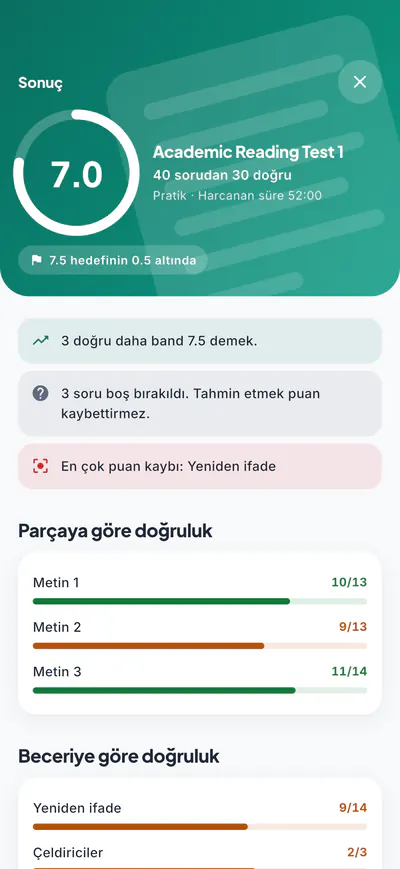
Fleydo: IELTS Hazırlık uygulamasında bir IELTS deneme sınavının sonucu: tahmini band ve her bölümün doğruluğu
Ücretsiz deneme dersi

Gerçek IELTS band puanınızı sınavdan önce öğrenin

Band 8.5+ sertifikalı IELTS uzmanı, anadili İngilizce bir öğretmenle ücretsiz bire bir online ders. Gerçek formatta bir Speaking tanılaması, dürüst bir band tahmini ve size puan kaybettiren ölçütlere yönelik bir plan alırsınız. Ödeme yok, taahhüt yok.

Online · Bire bir · Academic ve General Training

IELTS; British Council, IDP: IELTS Australia ve Cambridge University Press & Assessment kuruluşlarının tescilli markasıdır. Bu deneme sınavları Fleydo tarafından hazırlanmıştır; adı geçen kuruluşlarca onaylanmamış veya desteklenmemiştir.

Mobil Uygulama

Fleydo English School cebinizde

Fleydo öğrencileri ve velileri için dersler, ödevler, mesajlar ve oyunlar. iPhone ve Android'de ücretsiz.

App Store'dan indirinGoogle Play'den indirin
Uygulama hakkında daha fazlası
Fleydo English School uygulamasını App Store veya Google Play'de açan QR kodTaratın ve indirinTelefonunuza uygun mağazayı açar.fleydo.com/app
Fleydo IELTS uygulama simgesi
Fleydo: IELTS Hazırlık

IELTS'e mi hazırlanıyorsunuz?

Fleydo: IELTS Hazırlık, dört beceri için deneme sınavları sunan ayrı bir uygulamadır. Kullanmak için Fleydo hesabı gerekmez.

IELTS uygulamasını inceleyin
App Store'dan indirinGoogle Play'den indirin
IELTS deneme sınavları

Dört IELTS becerisini çalışın

Anında band puanı, açıklamalı cevaplar ve örnek cevaplarla 311 test. Üyelik gerekmez.

Tüm deneme sınavları
FleyPath

Çocuğunuzun kişisel yol haritası — 3, 6 veya 12 ay

🚀Başlangıç
👋Hello
😊Body
🦁Animals
🔢Numbers
🏆Özgüvenli İngilizce
Oyunlaştırılmış İngilizce pratiği

Tıpkı bir oyun gibi — ama gerçekten öğreniyorlar