1. Ana Sayfa
  2. IELTS
  3. Deneme sınavları
  4. Reading
  5. Reading Sentence Endings alıştırması 3

IELTS Reading · Cümle sonu eşleştirme

IELTS Reading Sentence Endings alıştırması 3

Heating Reykjavík

  • 9 soru
  • 15 dk
  • Academic

Bu testte neler var

  1. PassageSorular 1–9Hot water for a smoky bay

Soru tipleri

  • Cümle sonu eşleştirme
ReadingIELTS Reading Sentence Endings alıştırması 3
Kalan süre15:00

Passage

Hot water for a smoky bay

A Reykjavík's name is usually translated as "smoky bay", and the smoke in question is said to have been steam rising from hot springs. By the early 1930s the city had acquired a dirtier kind. Coal was then the main fuel for heating, and dark clouds commonly hung above the streets. The heat underground was no secret, however. Around 1908 a farmer in Mosfellssveit, not far from the city, had laid a pipe of about 500 metres from a hot spring to warm his house.

B Drilling started in 1928 beside the Thvottalaugar, springs once used for washing. Fourteen shallow wells yielded a modest 14 litres per second at 87°C. In 1930 a pipeline three kilometres long carried this water to a school, and a hospital, a second school, an indoor swimming pool and some dozens of houses were connected soon afterwards. Even so, only about 3 per cent of the city's population had been linked to the system by 1933.

C A bigger supply had to come from further away. Wells at Reykir, some 17 to 18 kilometres from the city, were piped in, and by the end of 1943 they were providing about 200 litres per second at 86°C, the water flowing from the wells without pumps. The next advance was mechanical. From 1958 a new type of rotary rig could sink wells both deeper and wider than earlier ones, while pumps inside the wells took over from natural pressure. At Laugarnes, the field around the original springs, output rose to 330 litres per second at up to 130°C. Reykir, redeveloped in a similar way after 1970, reached about 2,000.

D Finishing the job took policy as well as engineering. The network spread across the city from about 1960, and by 1970 nearly all its houses were connected. Elsewhere the picture was different: when the oil crisis of 1973-74 struck, oil still supplied about half of Iceland's space heating, and the government launched a major effort to replace it. The shock encouraged the spread of geothermal systems to neighbouring communities and later further afield. A 2015 article in the UN Chronicle argues that climate was not the reason for this transition: the need was for affordable energy that was secure from price swings abroad.

E The fields near the city were joined in 1990 by Nesjavellir, a high-temperature area to the east. Water from such areas, a paper by a member of staff at the city's heating utility explained in 2003, contains too much silica to go straight into a heating network, so its heat is used instead to warm cold fresh groundwater. That brings its own difficulty, since oxygen dissolved in the fresh water corrodes steel once it has been heated. The oxygen is therefore driven off by boiling at low pressure, and a little steam containing acid gases removes the last traces. Mixing this water with Reykjavík's geothermal water in 1990 caused magnesium silicate to form as scale, and the two were kept apart from then on.

F The same paper described how the network was run. In the coldest periods consumers used about 3,800 litres per second. When the fields could not quite match this, storage tanks usually made up the difference, as such spells are short. Where there was a double network, used water went back to pumping stations, where it was mixed with hotter geothermal water and cooled that water to the required 80°C. Elsewhere it simply drained into the sewers. It left buildings at 25-40°C, and was increasingly used to melt snow on pavements and driveways.

Sözlükçe
geothermal
using heat from inside the Earth
rotary rig
a drilling machine that cuts by turning
silica
a hard mineral found in sand and rock, which can dissolve in very hot water
magnesium silicate
a mineral that can form when magnesium and silica meet in water
scale
a hard layer of minerals that builds up inside pipes
double network
a pipe system that takes used water back as well as bringing hot water in
PassageSorular 1–9
Sorular 1–9

Complete each sentence with the correct ending, A-L, below.

Seçenekler
  • Agave fresh impetus to geothermal schemes beyond the capital.
  • Bremoved the need to pump water to the surface.
  • Cstill reached only a tiny share of residents three years later.
  • Dhelped to bring hotter water down to the right temperature.
  • Eleft a visible mark on the air over the city.
  • Fwas sent back underground to refill the fields.
  • Gwould attack steel if it stayed in the water after heating.
  • Hargued that money and secure supplies, not climate, explained the change.
  • Igenerally made up any shortage during cold spells.
  • Jcould make holes that went further down and were broader than before.
  • Kclaimed that cleaner air had been the main aim.
  • Lleft mineral deposits, and the practice was stopped.
1The coal burned for heating in the early 1930s
2The system started in 1930
3The rotary rig in use from 1958
4The oil crisis of 1973-74
5The 2015 article in the UN Chronicle
6The oxygen in Nesjavellir's fresh water
7The mixing of the two kinds of water in 1990
8The water held in storage tanks
9Used water returning through a double network

Cevaplar ve açıklamalar

Önce testi çözün: cevap anahtarı, cevapladıktan sonra çok daha faydalıdır.

Cevap anahtarını ve açıklamaları göster
  1. 1
    E

    Paragraph A says coal was the main heating fuel and 'dark clouds commonly hung above the streets'. Clouds that people could see are a visible mark on the air. Ending K also mentions air, but coal cannot claim anything.

  2. 2
    C

    Paragraph B says 'only about 3 per cent of the city's population' were linked by 1933, three years after 1930. Three per cent is a tiny share. Ending A fails, because spreading beyond the capital came decades later.

  3. 3
    J

    Paragraph C says the rig 'could sink wells both deeper and wider than earlier ones'. Further down means deeper, and broader means wider. Ending B reverses the text: pumps were added at this stage, so the need for them did not disappear.

  4. 4
    A

    Paragraph D says the shock 'encouraged the spread' of these systems to neighbouring communities and further afield, which is outside the capital. Ending H also concerns this period, but it reports what a 2015 article argues, not what the crisis did.

  5. 5
    H

    Paragraph D says the article argues 'climate was not the reason'; what mattered was affordable, secure energy. Money and secure supplies mean the same. Ending K fails: the smoke in paragraph A is not part of what the article argues.

  6. 6
    G

    Paragraph E says oxygen in the fresh water 'corrodes steel once it has been heated', so it is removed. To corrode is to attack metal. Ending L describes the later mixing of two waters, and the oxygen did not cause that.

  7. 7
    L

    Paragraph E says mixing 'caused magnesium silicate to form as scale', and the two waters were then kept apart. Scale is a mineral deposit. Ending D also involves mixing, but that is the used water in paragraph F, not this event.

  8. 8
    I

    Paragraph F says that when the fields fell short in the coldest periods, tanks 'usually made up the difference'. A shortfall in cold weather is the shortage in this ending. Ending F fails: the text never says stored water goes underground.

  9. 9
    D

    Paragraph F says returned water was mixed with hotter water and 'cooled that water to the required 80°C'. Ending F is tempting, but the text mentions pumping stations and sewers, and says nothing about refilling the fields.

Bu testin anahtar kelimeleri

Passage

yielded
produced or provided
modest
small, not large
transition
a change from one system or situation to another
corrodes
slowly damages metal by chemical action
dissolved
mixed into a liquid so that it becomes part of the liquid
Cümle sonu eşleştirme soruları nasıl cevaplanırJoin each sentence beginning to the ending that says what the text says.

What the task looks like

You get some sentence beginnings and a longer list of lettered endings. You join each beginning to one ending, to make a sentence that agrees with the text.

The task tests whether you understand the main ideas, not only whether two halves make good English. In our papers there are spare endings, so some are not used.

Preparing for General Training? Our General Training papers do not include this type. Official sources do not all agree on whether the real General Training test can include it, so it is still worth knowing how it works.

A method to try

1. Read one beginning, mark its main words, and find the part of the text that deals with this idea. The beginnings follow the order of the text, so each answer comes after the last one.

2. Before you look at the endings, say in your own words how the text would finish this sentence.

3. Look for the ending closest to your version. Rule out any that cannot follow the beginning grammatically.

4. Read the whole sentence and check it against the text. Good English is not enough.

The traps

Good grammar, wrong meaning: several endings may join the beginning neatly, so grammar alone may not decide.

True, but about something else: an ending may state something from the text that has nothing to do with this beginning.

Reversal: an ending may turn the text round, so that the cause becomes the result.

Borrowed words: an ending that repeats words from the text is not more likely to be right. The right one often says the idea in new words.

Worked example

Text: The town's ferry used to run only in summer. Demand from commuters led the operator to add a winter service, although rough weather still cancels some crossings. A larger boat, due next year, should reduce these cancellations.

Beginning: The winter ferry service began ... A because people travelling to work wanted it. B because a bigger boat had been delivered. C so that fewer crossings would be cancelled. D after the rough weather had come to an end.

ZayıfC. The text talks about reducing cancellations, and 'The winter ferry service began so that fewer crossings would be cancelled' reads well.
Daha iyiA. 'Demand from commuters led the operator to add a winter service.' Commuters are people travelling to work. C is what the larger boat should do, not why the service began.

All four endings are good English. Check the complete sentence against what the text says about this beginning.

Fleydo IELTS uygulama simgesi Fleydo: IELTS Hazırlık

Bu testleri telefonunuzda yanınızda taşıyın

Bu sayfalardaki her test, iPhone, iPad ve Android için Fleydo: IELTS Hazırlık uygulamasında da var; yanında sesli 2.000 IELTS kelimesiyle birlikte.

  • Test telefonunuza indikten sonra çevrimdışı çalışır
  • Sesli 2.000 IELTS kelimesi, aralıklı tekrar ve kısa alıştırmalar
  • Speaking cevaplarınızı kaydedip geri dinleyin
  • Hedef bandınıza ve sınav tarihinize göre günlük plan
App Store'dan indirinGoogle Play'den indirin
İndirmek için tarayınTelefonunuza göre App Store'u veya Google Play'i açar.

Hesap gerekmez. Uygulama hakkında

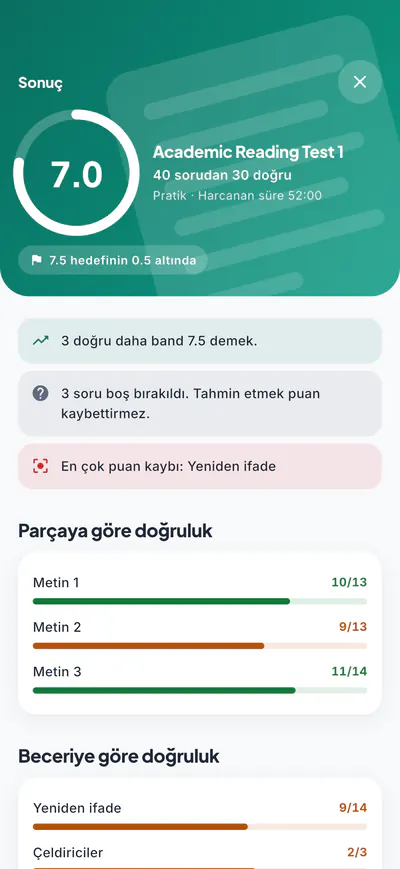
Fleydo: IELTS Hazırlık uygulamasında bir IELTS deneme sınavının sonucu: tahmini band ve her bölümün doğruluğu
Ücretsiz deneme dersi

Gerçek IELTS band puanınızı sınavdan önce öğrenin

Band 8.5+ sertifikalı IELTS uzmanı, anadili İngilizce bir öğretmenle ücretsiz bire bir online ders. Gerçek formatta bir Speaking tanılaması, dürüst bir band tahmini ve size puan kaybettiren ölçütlere yönelik bir plan alırsınız. Ödeme yok, taahhüt yok.

Online · Bire bir · Academic ve General Training

IELTS; British Council, IDP: IELTS Australia ve Cambridge University Press & Assessment kuruluşlarının tescilli markasıdır. Bu deneme sınavları Fleydo tarafından hazırlanmıştır; adı geçen kuruluşlarca onaylanmamış veya desteklenmemiştir.

Mobil Uygulama

Fleydo English School cebinizde

Fleydo öğrencileri ve velileri için dersler, ödevler, mesajlar ve oyunlar. iPhone ve Android'de ücretsiz.

App Store'dan indirinGoogle Play'den indirin
Uygulama hakkında daha fazlası
Fleydo English School uygulamasını App Store veya Google Play'de açan QR kodTaratın ve indirinTelefonunuza uygun mağazayı açar.fleydo.com/app
Fleydo IELTS uygulama simgesi
Fleydo: IELTS Hazırlık

IELTS'e mi hazırlanıyorsunuz?

Fleydo: IELTS Hazırlık, dört beceri için deneme sınavları sunan ayrı bir uygulamadır. Kullanmak için Fleydo hesabı gerekmez.

IELTS uygulamasını inceleyin
App Store'dan indirinGoogle Play'den indirin
IELTS deneme sınavları

Dört IELTS becerisini çalışın

Anında band puanı, açıklamalı cevaplar ve örnek cevaplarla 311 test. Üyelik gerekmez.

Tüm deneme sınavları
FleyPath

Çocuğunuzun kişisel yol haritası — 3, 6 veya 12 ay

🚀Başlangıç
👋Hello
😊Body
🦁Animals
🔢Numbers
🏆Özgüvenli İngilizce
Oyunlaştırılmış İngilizce pratiği

Tıpkı bir oyun gibi — ama gerçekten öğreniyorlar