1. Ana Sayfa
  2. IELTS
  3. Deneme sınavları
  4. Reading
  5. Reading Matching Information alıştırması 5

IELTS Reading · Bilgi eşleştirme

IELTS Reading Matching Information alıştırması 5

Testing honey

  • 12 soru
  • 15 dk
  • Academic

Bu testte neler var

  1. PassageSorular 1–12Proving what is in the jar

Soru tipleri

  • Bilgi eşleştirme
ReadingIELTS Reading Matching Information alıştırması 5
Kalan süre15:00

Passage

Proving what is in the jar

A Sugar syrup is a cheap way to stretch honey, and some syrups are tailored to mimic its sugar profile. Between November 2021 and February 2022, samples of imported honey were taken at EU borders, and 147 of the 320 tested, or 46 per cent, were suspected of breaking the rules. A review for the UK government, published in 2025, cautioned that "suspicious" should not be read as proof, and it suggested the wording "flag for further investigation".

B Microscope studies of the pollen in honey go back to 1895. Diluted honey is spun in a centrifuge to concentrate the grains, and at least 500 are identified against reference slides. The types present point to the plants the bees visited and to the region. A honey is generally classed as monofloral, or from one kind of flower, once a single type passes 45 per cent. Analysts must be experienced, because a wrong identification undermines everything built on it. The evidence can also be removed: among the tactics reported in the EU's 2021-22 action was taking out pollen to conceal a honey's geographical origin.

C Chemistry offers a second route. About 90 per cent of plants, the C3 group, fix carbon in one way, while grasses such as maize and sugar cane belong to the C4 group, and the two ways leave plants with different proportions of carbon's two stable isotopes. Honey comes from the nectar of C3 plants, so syrup from maize or cane changes its isotope profile. The standard test, AOAC 998.12, compares the value for the whole honey with that for protein extracted from it. A gap of more than one part per thousand suggests that the two have different origins.

D That test has a blind spot. It cannot detect syrups from C3 plants such as rice, wheat or sugar beet, and the EU's 2021-22 action used a different set of methods, with improved detection. An earlier EU exercise, in 2015-17, had found that 14 per cent of samples failed its criteria, and the European Commission said that the improved methods might explain the contrast.

E Manuka honey shows the opposite danger: pure honey failing. In a study published in 2013, authentic samples were taken straight from New Zealand hives and handled strictly enough to rule out later tampering, yet 37 per cent of the manuka honeys failed the C4 test. Removing pollen first, a proposed remedy, did not settle the matter, as 60 per cent of those failures still failed. A 2014 paper proposed that a chemical change in manuka, dihydroxyacetone turning into methylglyoxal with heating and storage, can make the test wrongly indicate added sugar.

F Deciding what counts as manuka is itself contested. Pollen counts are complicated here because kanuka, another New Zealand honey plant, has very similar pollen. A 2022 study did tell the two apart, but it used pollen from dried plant specimens, not honey. New Zealand's Ministry for Primary Industries built its export standard, in force from 2018, on four chemical markers from nectar plus DNA from manuka pollen. Industry critics objected that a further marker, leptosperin, had been left out. The ministry said that this marker could not separate single-flower from mixed-flower manuka honey and was unstable over time.

G Geography adds another quarrel, because honey sold as manuka is also harvested in Australia from related Leptospermum species. A New Zealand society has worked since 2015 to keep the name for its own country's honey, but in May 2023 New Zealand's intellectual property office turned down its application for a certification mark. The Australian Manuka Honey Association, which has fought the bid in several markets, has called it unscientific to apply the New Zealand definition to Australian honey. Its own criteria, announced in 2019, require methylglyoxal, dihydroxyacetone and leptosperin all to be present.

Sözlükçe
centrifuge
a machine that spins liquid very fast to separate what is in it
isotopes
forms of the same chemical element with slightly different weights
nectar
the sweet liquid that bees collect from flowers
marker
a substance whose presence shows where something came from
certification mark
a legally protected sign showing that a product meets set standards
Leptospermum
the group of plants that includes manuka
PassageSorular 1–12
Sorular 1–12

The text has seven paragraphs, A-G. Which paragraph contains the following information? Choose the correct letter, A-G. NB You may use any letter more than once.

Seçenekler
  • AParagraph A
  • BParagraph B
  • CParagraph C
  • DParagraph D
  • EParagraph E
  • FParagraph F
  • GParagraph G
1kinds of syrup that escape the usual carbon test
2a figure used to decide whether a honey comes mainly from one plant
3an unsuccessful effort to gain legal control over a product's name
4a warning against treating a test result as final
5genuine honey being wrongly judged to contain added sugar
6a comparison between a whole sample and one of its components
7why counting pollen is less straightforward for one particular honey
8a trick for hiding where a honey was produced
9a trade body's objection to being judged by another country's rules
10a possible reason why a later survey found more problems than an earlier one
11a chemical change put forward as the cause of misleading results
12a substance that some in the industry wanted included in an official standard

Cevaplar ve açıklamalar

Önce testi çözün: cevap anahtarı, cevapladıktan sonra çok daha faydalıdır.

Cevap anahtarını ve açıklamaları göster
  1. 1
    D

    Paragraph D says the test 'cannot detect syrups from C3 plants such as rice, wheat or sugar beet'. Paragraph C names maize and cane, but those are syrups the test does find.

  2. 2
    B

    Paragraph B says a honey is monofloral 'once a single type passes 45 per cent'. Paragraph F also mentions single-flower honey, but it gives no figure for deciding what counts as one.

  3. 3
    G

    A society wanted to keep the name for New Zealand honey, but the office 'turned down its application'. Paragraph F is about a government standard for identifying the honey, not about who owns the name.

  4. 4
    A

    A UK review 'cautioned that "suspicious" should not be read as proof'. Paragraph E says that some test results are wrong, but it reports a study's findings and gives no warning about how to read a label.

  5. 5
    E

    Authentic samples from hives still failed the test, so pure honey was judged to contain added sugar. Paragraph A reports suspected honey at borders, but those samples are not said to be genuine.

  6. 6
    C

    The test 'compares the value for the whole honey with that for protein extracted from it', and both come from one sample. Paragraph E reports how often honeys failed, but it does not describe the comparison.

  7. 7
    F

    Paragraph F says pollen counts for manuka are complicated because kanuka 'has very similar pollen'. Paragraph B explains pollen counting and its difficulties in general, without connecting them to any one kind of honey.

  8. 8
    B

    Paragraph B reports 'taking out pollen to conceal a honey's geographical origin'. Paragraph E also mentions removing pollen, but there scientists remove it to improve a test, and nobody is hiding anything.

  9. 9
    G

    The Australian association 'has called it unscientific to apply the New Zealand definition to Australian honey'. The critics in paragraph F also object, but they are criticising their own country's standard.

  10. 10
    D

    The Commission 'said that the improved methods might explain the contrast'. Paragraph A gives the later figure, 46 per cent, but it does not compare the two surveys or offer a reason for any rise.

  11. 11
    E

    A 2014 paper proposed that 'dihydroxyacetone turning into methylglyoxal' can make the test wrongly indicate sugar. Paragraph G names the same chemicals, but only as things the Australian criteria require to be present.

  12. 12
    F

    Critics 'objected that a further marker, leptosperin, had been left out' of the New Zealand standard. Paragraph G also names leptosperin, but there it already belongs to the Australian association's own criteria.

Bu testin anahtar kelimeleri

Passage

tailored
made specially for a particular purpose
cautioned
warned someone to be careful
conceal
to hide
authentic
real and not a copy or fake
contested
argued about and not agreed
Bilgi eşleştirme soruları nasıl cevaplanırFind which paragraph holds a particular detail, example, reason or comparison.

What the task looks like

You get a list of items, and you say which lettered paragraph contains each one. An item might be 'a reason for ...', 'an example of ...' or 'a comparison between ...'. In General Training, the letters may mark separate short texts.

The task tests whether you can locate specific information: details, examples, reasons and comparisons.

This is not the same as matching headings. You are not looking for the main idea. The answer may be one small part of a paragraph that is mainly about something else.

In our papers, the items do not follow the order of the text, and there may be more letters than items. If a letter can be used more than once, the instructions will say so.

A method to try

1. Consider leaving this task until after the other questions on the same text. By then you may know where things are.

2. Read the items. For each one, mark the kind of information it asks for, such as a reason or an example, and then its topic.

3. Think of other ways to say the topic words.

4. Read one paragraph at a time and check it against all the items you have left. This can be quicker than searching the whole text for one item at a time.

5. Before you choose a letter, point to the exact words that match. If you cannot, keep reading.

The traps

The right topic, the wrong kind: several paragraphs may mention a topic, but only one gives the reason or the example that the item asks for.

The matching word: a word from the item may appear in a paragraph that says something quite different about it.

Small words in the item: 'a failed attempt' is not just any attempt, and 'a recent change' is not just any change. These words decide the match.

Worked example

Text: [A] Ticket sales at the town theatre were lower last year than the year before. [B] The main cause was the closed footbridge from the station, which left people arriving by train with a long walk. [C] The bridge reopened in March, and the theatre has since added an extra weekday performance.

Item: an explanation for a fall in audience numbers. Which paragraph contains this?

ZayıfA. It talks about lower ticket sales, and that is the fall in audience numbers.
Daha iyiB. Paragraph A only reports the fall. Paragraph B gives the reason: the closed footbridge made the theatre harder to reach.

The item asks for an explanation, so finding the topic is not enough. Mark the kind of information first, then look for that kind.

Fleydo IELTS uygulama simgesi Fleydo: IELTS Hazırlık

Bu testleri telefonunuzda yanınızda taşıyın

Bu sayfalardaki her test, iPhone, iPad ve Android için Fleydo: IELTS Hazırlık uygulamasında da var; yanında sesli 2.000 IELTS kelimesiyle birlikte.

  • Test telefonunuza indikten sonra çevrimdışı çalışır
  • Sesli 2.000 IELTS kelimesi, aralıklı tekrar ve kısa alıştırmalar
  • Speaking cevaplarınızı kaydedip geri dinleyin
  • Hedef bandınıza ve sınav tarihinize göre günlük plan
App Store'dan indirinGoogle Play'den indirin
İndirmek için tarayınTelefonunuza göre App Store'u veya Google Play'i açar.

Hesap gerekmez. Uygulama hakkında

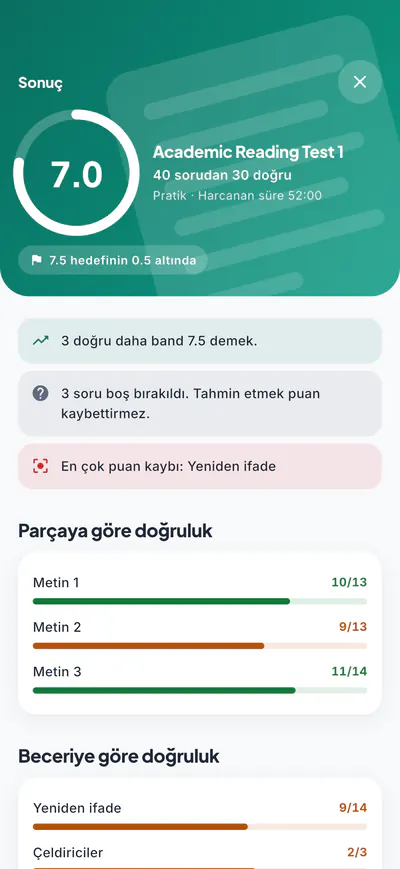
Fleydo: IELTS Hazırlık uygulamasında bir IELTS deneme sınavının sonucu: tahmini band ve her bölümün doğruluğu
Ücretsiz deneme dersi

Gerçek IELTS band puanınızı sınavdan önce öğrenin

Band 8.5+ sertifikalı IELTS uzmanı, anadili İngilizce bir öğretmenle ücretsiz bire bir online ders. Gerçek formatta bir Speaking tanılaması, dürüst bir band tahmini ve size puan kaybettiren ölçütlere yönelik bir plan alırsınız. Ödeme yok, taahhüt yok.

Online · Bire bir · Academic ve General Training

IELTS; British Council, IDP: IELTS Australia ve Cambridge University Press & Assessment kuruluşlarının tescilli markasıdır. Bu deneme sınavları Fleydo tarafından hazırlanmıştır; adı geçen kuruluşlarca onaylanmamış veya desteklenmemiştir.

Mobil Uygulama

Fleydo English School cebinizde

Fleydo öğrencileri ve velileri için dersler, ödevler, mesajlar ve oyunlar. iPhone ve Android'de ücretsiz.

App Store'dan indirinGoogle Play'den indirin
Uygulama hakkında daha fazlası
Fleydo English School uygulamasını App Store veya Google Play'de açan QR kodTaratın ve indirinTelefonunuza uygun mağazayı açar.fleydo.com/app
Fleydo IELTS uygulama simgesi
Fleydo: IELTS Hazırlık

IELTS'e mi hazırlanıyorsunuz?

Fleydo: IELTS Hazırlık, dört beceri için deneme sınavları sunan ayrı bir uygulamadır. Kullanmak için Fleydo hesabı gerekmez.

IELTS uygulamasını inceleyin
App Store'dan indirinGoogle Play'den indirin
IELTS deneme sınavları

Dört IELTS becerisini çalışın

Anında band puanı, açıklamalı cevaplar ve örnek cevaplarla 311 test. Üyelik gerekmez.

Tüm deneme sınavları
FleyPath

Çocuğunuzun kişisel yol haritası — 3, 6 veya 12 ay

🚀Başlangıç
👋Hello
😊Body
🦁Animals
🔢Numbers
🏆Özgüvenli İngilizce
Oyunlaştırılmış İngilizce pratiği

Tıpkı bir oyun gibi — ama gerçekten öğreniyorlar