1. Ana Sayfa
  2. IELTS
  3. Deneme sınavları
  4. Reading
  5. Reading Matching Headings alıştırması 5

IELTS Reading · Başlık eşleştirme

IELTS Reading Matching Headings alıştırması 5

Dry stone walls

  • 8 soru
  • 15 dk
  • Academic

Bu testte neler var

  1. PassageSorular 1–8Held up by nothing but stone

Soru tipleri

  • Başlık eşleştirme
ReadingIELTS Reading Matching Headings alıştırması 5
Kalan süre15:00

Passage

Held up by nothing but stone

A A dry stone wall contains nothing but stone. No mortar or cement binds the pieces, so the structure has to stay up by other means. Engineers at the University of Bath credit interlock and friction between the stones with keeping a wall in one piece, and its own weight with resisting any tendency to overturn. Little of the stone is shaped, so much depends on the waller's eye.

B Seen from the end, a typical free-standing wall resembles a capital A. A guide from Britain's Dry Stone Walling Association describes one narrowing to about 0.35 metres by the time it is 1.15 metres high. Large foundation stones come first, and every later stone should cover the joint between two below it. There are really two faces, with small stones known as hearting packed between them. Long through stones tie the faces together, and copestones finish the top.

C Leaving out mortar is more than a saving. According to the association, these walls are meant to flex and settle as weather and frost act on them, whereas frost can crack cement and bring a wall down. Stones should also sit at a slight angle, guidance from England's Cotswolds adds, so that rain runs out rather than freezing inside. Where a cap of mortar has been spread along a wall, it warns, movement is restricted and large sections can collapse together.

D Why build them at all? Many British walls began as a way of dealing with the fields themselves. Stones cleared from the land had to go somewhere, and stacked in a line they showed where one owner's ground ended. A wall made sense where rocky soil would not take fence posts or where wood was scarce. In the Cotswolds, most surviving walls date from the eighteenth and nineteenth centuries, when open land was enclosed for livestock.

E Fields are only part of the story, however. UNESCO says such structures help to prevent landslides, floods and avalanches, check soil erosion and create conditions in which crops can grow. Transport depends on them too. A 1999 paper estimated the length of masonry-faced retaining walls along Britain's roads at about 9,000 kilometres, give or take 2,000. Most of the UK's dry stone retaining walls went up in the nineteenth and early twentieth centuries to hold back the earth of cuttings and embankments.

F Such walls went almost untested for a long time. In 1834 the army engineer John Burgoyne built four granite walls to find the most efficient shape, and his were nearly the only physical tests on record when a University of Bath team began work in the 2000s. Having tested five full-scale walls 2.5 metres high, the researchers argued in 2012 that a bulge, often read as a sign of coming failure, can begin as the wall adjusting its shape to the load, and that a well-built wall may remain stable with one.

G Wildlife has its own uses for all this stonework. Long-established walls in England's Yorkshire Dales can be almost covered in lichens, and a legally protected moss known from just seven sites there grows on several walls. Inside, among the rubble, snails find shelter; wrens nest in the walls, and voles and weasels use them too. In the Cotswolds adders bask on the stones.

H Keeping the walls means keeping people able to repair them. In the second half of the twentieth century many Cotswold walls lost their purpose as livestock numbers fell, while fewer workers had the skills to look after them. The Dry Stone Walling Association, set up in 1968, now offers qualifications in stages, from rebuilding 2.5 square metres of wall at Level 1 to a Master Craftsman award that includes building on a slope of 30 degrees or more. UNESCO listed the craft as intangible heritage in 2018 for eight European countries, and widened the listing to thirteen in 2024.

Sözlükçe
copestones
the stones laid along the top of a wall
masonry-faced
having an outer surface of stone or brick
retaining walls
walls built to hold back the earth or rock behind them
cuttings
channels dug through high ground for a road or railway
embankments
raised banks of earth that carry a road or railway
lichens
simple plant-like growths that form patches on rock
intangible heritage
traditions and skills, rather than objects or buildings, that a community values and passes on
PassageSorular 1–8
Sorular 1–8

The text has eight paragraphs, A-H. Choose the correct heading for each paragraph from the list of headings below.

Seçenekler
  • iUses beyond the farm boundary
  • iiThe search for an ideal shape in the 1830s
  • iiiWhy a rigid bond would be a weakness
  • ivExperiments that question a familiar warning sign
  • vThe forces that keep a wall standing
  • viA rule for covering the gaps between stones
  • viiPassing on a skill under threat
  • viiiWhat a typical wall consists of
  • ixFrost damage to the stones themselves
  • xPractical reasons for building with field stone
  • xiRare mosses of one English region
  • xiiWalls as living spaces for other species
1Paragraph A
2Paragraph B
3Paragraph C
4Paragraph D
5Paragraph E
6Paragraph F
7Paragraph G
8Paragraph H

Cevaplar ve açıklamalar

Önce testi çözün: cevap anahtarı, cevapladıktan sonra çok daha faydalıdır.

Cevap anahtarını ve açıklamaları göster
  1. 1
    v

    Paragraph A explains that friction, interlock and the wall's own weight keep it standing when nothing binds the stones. Heading viii fails because this paragraph does not list parts of a wall such as faces or copestones.

  2. 2
    viii

    Paragraph B goes through the parts of a wall: foundation stones, two faces, hearting, through stones and copestones. Heading vi is too narrow, because covering joints is only one detail of this description.

  3. 3
    iii

    Paragraph C says a wall without mortar can flex and settle, and warns that a mortar cap can make large sections collapse. Heading ix fails: frost is only one supporting detail, and what it cracks here is cement, not the stones.

  4. 4
    x

    Paragraph D gives the practical reasons for walls: cleared stones needed a use, they marked ownership, and a wall suited places with rocky soil or little wood. Heading i fails because this paragraph stays with farm land.

  5. 5
    i

    Paragraph E moves away from fields to landslides, floods, erosion and the retaining walls beside roads. Heading x fails because why farmers built walls is the subject of paragraph D.

  6. 6
    iv

    Paragraph F reports tests suggesting that a bulge, often taken as a warning, need not mean failure. Heading ii picks up only the 1834 tests, which are background to the main point.

  7. 7
    xii

    Paragraph G lists what lives on and in walls: lichens, moss, snails, wrens, voles and adders. Heading xi is too narrow, because the protected moss is only one example.

  8. 8
    vii

    Paragraph H says fewer workers had the skills, then describes qualifications and UNESCO's listing. Heading x fails because the fall in livestock here explains why walls lost their purpose, not why they were built.

Bu testin anahtar kelimeleri

Passage

overturn
to turn over and fall
scarce
available only in small amounts
restricted
limited or kept within certain bounds
enclosed
surrounded by a wall or fence
efficient
working well without wasting anything
Başlık eşleştirme soruları nasıl cevaplanırFind each paragraph's main idea and choose the heading that covers all of it.

What the task looks like

You get a list of headings and a set of paragraphs or sections. You choose the right heading for each one.

The task tests whether you can tell a paragraph's main topic from its supporting ideas. A heading states the main idea of the whole paragraph.

In our papers, there are at least two spare headings, each heading is used only once, and the headings are not listed in the order of the text. Sometimes one paragraph is done for you as an example.

A method to try

1. Read the list of headings once, so that you know the choices. If there is an example, take its heading off your list.

2. Read one paragraph to the end. Before you look at the list again, say its main idea in a few words of your own.

3. Compare your words with the list. Look for the heading that is closest in meaning.

4. Test your choice. Go through the paragraph sentence by sentence and ask: does this sentence belong under that heading?

5. If two headings seem possible, note both beside the paragraph and move on. A later match may rule one out.

6. When you are sure of a match, take that heading off your list.

The traps

The detail: a wrong heading may fit one sentence or one example very well. It is still only a supporting idea.

The borrowed word: a wrong heading may repeat a striking word from the paragraph. A shared word does not make a match.

The first sentence: it may link back to the paragraph before, or the paragraph may change direction after a word such as 'however'. That is why you read to the end.

Two similar headings: look at the job each one describes. 'Causes' and 'effects' can share a topic, and so can 'a problem' and 'a solution'. Which job is this paragraph doing?

Worked example

Text: The market square floods after heavy rain because the old drains are too narrow. Last autumn, stall owners lost stock for the third time, and one bakery stall moved away for good. The council has now agreed to replace the drains next summer.

Headings: i. Why one trader left the market ii. A repeated problem and a plan to fix it iii. The early history of the square iv. How much new drains will cost

Which heading fits this paragraph?

Zayıfi. A bakery stall moved away, and that is the most striking thing in the paragraph.
Daha iyiii. The first sentence gives the problem, the second shows it has happened again and again, and the third gives the plan. Every sentence fits.

Check the heading against every sentence. Heading i fits only part of one sentence, so it is a detail. Heading iv borrows 'drains', but the paragraph gives no cost.

Fleydo IELTS uygulama simgesi Fleydo: IELTS Hazırlık

Bu testleri telefonunuzda yanınızda taşıyın

Bu sayfalardaki her test, iPhone, iPad ve Android için Fleydo: IELTS Hazırlık uygulamasında da var; yanında sesli 2.000 IELTS kelimesiyle birlikte.

  • Test telefonunuza indikten sonra çevrimdışı çalışır
  • Sesli 2.000 IELTS kelimesi, aralıklı tekrar ve kısa alıştırmalar
  • Speaking cevaplarınızı kaydedip geri dinleyin
  • Hedef bandınıza ve sınav tarihinize göre günlük plan
App Store'dan indirinGoogle Play'den indirin
İndirmek için tarayınTelefonunuza göre App Store'u veya Google Play'i açar.

Hesap gerekmez. Uygulama hakkında

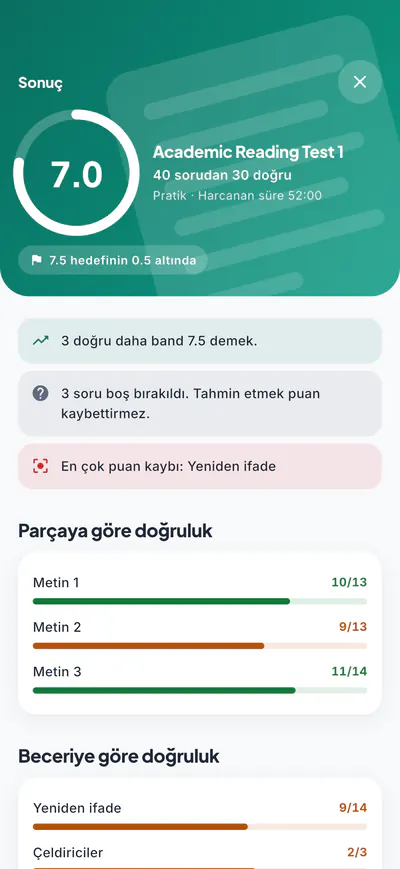
Fleydo: IELTS Hazırlık uygulamasında bir IELTS deneme sınavının sonucu: tahmini band ve her bölümün doğruluğu
Ücretsiz deneme dersi

Gerçek IELTS band puanınızı sınavdan önce öğrenin

Band 8.5+ sertifikalı IELTS uzmanı, anadili İngilizce bir öğretmenle ücretsiz bire bir online ders. Gerçek formatta bir Speaking tanılaması, dürüst bir band tahmini ve size puan kaybettiren ölçütlere yönelik bir plan alırsınız. Ödeme yok, taahhüt yok.

Online · Bire bir · Academic ve General Training

IELTS; British Council, IDP: IELTS Australia ve Cambridge University Press & Assessment kuruluşlarının tescilli markasıdır. Bu deneme sınavları Fleydo tarafından hazırlanmıştır; adı geçen kuruluşlarca onaylanmamış veya desteklenmemiştir.

Mobil Uygulama

Fleydo English School cebinizde

Fleydo öğrencileri ve velileri için dersler, ödevler, mesajlar ve oyunlar. iPhone ve Android'de ücretsiz.

App Store'dan indirinGoogle Play'den indirin
Uygulama hakkında daha fazlası
Fleydo English School uygulamasını App Store veya Google Play'de açan QR kodTaratın ve indirinTelefonunuza uygun mağazayı açar.fleydo.com/app
Fleydo IELTS uygulama simgesi
Fleydo: IELTS Hazırlık

IELTS'e mi hazırlanıyorsunuz?

Fleydo: IELTS Hazırlık, dört beceri için deneme sınavları sunan ayrı bir uygulamadır. Kullanmak için Fleydo hesabı gerekmez.

IELTS uygulamasını inceleyin
App Store'dan indirinGoogle Play'den indirin
IELTS deneme sınavları

Dört IELTS becerisini çalışın

Anında band puanı, açıklamalı cevaplar ve örnek cevaplarla 311 test. Üyelik gerekmez.

Tüm deneme sınavları
FleyPath

Çocuğunuzun kişisel yol haritası — 3, 6 veya 12 ay

🚀Başlangıç
👋Hello
😊Body
🦁Animals
🔢Numbers
🏆Özgüvenli İngilizce
Oyunlaştırılmış İngilizce pratiği

Tıpkı bir oyun gibi — ama gerçekten öğreniyorlar