1. Ana Sayfa
  2. IELTS
  3. Deneme sınavları
  4. Reading
  5. Reading Flow-Chart Completion alıştırması 3

IELTS Reading · Akış şeması tamamlama

IELTS Reading Flow-Chart Completion alıştırması 3

Silvering mirrors

  • 11 soru
  • 15 dk
  • Academic

Bu testte neler var

  1. PassageSorular 1–11The metal behind the glass

Soru tipleri

  • Akış şeması tamamlama
ReadingIELTS Reading Flow-Chart Completion alıştırması 3
Kalan süre15:00

Passage

The metal behind the glass

A What shines in a glass mirror is not the glass but a layer of metal behind it, and for some four hundred years that layer was made of tin and mercury. The method's first great centre was Venice, which already had the right material in cristallo, a clear, colourless glass. Around 1500, glassmakers on the island of Murano moved on from an earlier mixture of lead and antimony, which left a rough surface and a dim image, and turned to the new coating.

B The work was done on a very smooth table with a raised lip, typically of marble. Thin foil of tin, cut a little oversize, was brushed out flat on this surface, and liquid mercury was spread across it with brushes and woollen material. The tin dissolved, giving the alloy called an amalgam. Any impurities or corrosion on top were then cleared away with further brushes or linen cloths. By this stage the glass itself had been polished with a series of ever finer abrasives, a job originally done by hand.

C Now everything depended on a steady hand. The plate had to be set in place in one smooth motion, as a clumsy movement could tear the foil. Heavy weights were laid on top to force glass and amalgam together, and the table was tipped very slightly so that surplus mercury could pour away. Even then the mirror was far from ready. It went next to a drying table of wood, where, by one conservation centre's account, it was tilted slightly further every day for eighteen to thirty days until it stood upright. By that point most of the unwanted metal had run off or turned to vapour. It remained only to trim the foil and, in some cases, to varnish or paint the back.

D The people doing this work paid a high price. Once breathed in, mercury vapour passes easily into the blood and travels round the body, and enough of it will seriously injure the lungs, brain and kidneys. By the early 1700s a book on the diseases of workers was describing the misery of Murano's mirror makers. Nor were the mirrors themselves stable. In one hanging on a wall, the liquid part of the amalgam slowly sinks while metal crystals grow and corrode, which is why an old example may show dark specks and small holes, mainly in its lower half.

E A different route opened in 1835. The German chemist Justus von Liebig, reporting on what happens when alcohol is oxidised, noted that heating aldehyde with a silver compound released the silver, which coated the sides of the test-tube as a brilliant mirror. Making a business of this proved harder. A patent taken out by Drayton in 1843 failed in practice, because his mirrors developed spots with age, whereas one by Petitjean in 1855, using tartaric acid, appears to have succeeded commercially. Liebig returned to the subject in 1856 with a formula based on silver nitrate, an alkali and milk sugar.

F Many recipes followed. One printed in the Encyclopaedia Britannica of 1911, by then generally used for astronomical telescopes, shows what the work involved. Ammonia was added to silver nitrate in water until the liquid cleared, and this was later combined with a solution containing sugar. The mixture was poured on to the plate, which was gently rocked, and in about five minutes a thick deposit of silver had formed. None of this could begin until the glass was scrupulously clean: it had first been treated with nitric acid and potash, then rinsed in distilled water. Where silver formed the back of a mirror, it also needed protecting, so the film received a coat of varnish, followed by red-lead paint or a layer of copper. The two kinds of mirror were made side by side for many years, and silver's victory came only around 1900.

Sözlükçe
alloy
a metal made by mixing two or more metals
amalgam
an alloy that contains mercury
abrasives
hard materials used to rub a surface smooth
antimony
a brittle, silvery element
aldehyde
a chemical that can be made from alcohol
tartaric acid
an acid found in plants such as grapes
alkali
a chemical that is the opposite of an acid
potash
a chemical containing potassium, used for cleaning here
astronomical telescopes
large instruments used to study stars and planets
PassageSorular 1–11
Sorular 1–11 En fazla 2 kelime

Complete the flow-chart below. Choose NO MORE THAN TWO WORDS from the passage for each answer.

TIN AND MERCURY, THE VENETIAN METHOD
Foil is brushed flat on a smooth table, usually made of 1.
Mercury is spread on top, and the tin dissolves to give an alloy known as an 2.
The surface is cleaned with brushes or 3.
The polished glass is set in place in one movement, and 4 press it down while the extra mercury drains.
The mirror moves to a table made of 5 and is tilted a little more each day until it is 6.
SILVER, A RECIPE PRINTED IN 1911
The glass is cleaned with nitric acid and 7, then rinsed.
Silver nitrate solution is mixed with 8 until it turns clear.
Another solution, containing 9, is then mixed in, and the liquid is poured over the plate.
The plate is gently 10 while a silver deposit forms.
If the silver is on the back of the mirror, it is sealed with 11, then paint or copper.

Cevaplar ve açıklamalar

Önce testi çözün: cevap anahtarı, cevapladıktan sonra çok daha faydalıdır.

Cevap anahtarını ve açıklamaları göster
  1. 1
    marble

    Paragraph B says the table was 'typically of marble'. Wood is tempting, but paragraph C uses that word for the drying table, which comes later in the process.

  2. 2
    amalgam

    Paragraph B says 'The tin dissolved, giving the alloy called an amalgam'. The word alloy is already printed in the chart, so the gap needs the name of this alloy.

  3. 3
    linen cloths / cloths / linen

    Paragraph B says impurities were 'cleared away with further brushes or linen cloths'. Woollen material is tempting, but it was used earlier, to spread the mercury, not to clean the surface.

  4. 4
    heavy weights / weights

    Paragraph C says 'Heavy weights were laid on top to force glass and amalgam together'. The chart's words 'press it down' paraphrase this. Heavy may be left out, but weights must be there.

  5. 5
    wood

    Paragraph C says the mirror 'went next to a drying table of wood'. The first table was usually marble, so you must check which table this step of the process describes.

  6. 6
    stood upright / upright

    Paragraph C says the mirror was tilted further every day 'until it stood upright'. One account gives eighteen to thirty days, but the gap asks for the position it reached, not the time taken.

  7. 7
    potash

    Paragraph F says the glass 'had first been treated with nitric acid and potash'. The text mentions this after the mixing, but it happens first, so the chart begins here. Flow-chart answers need not follow the text.

  8. 8
    ammonia

    Paragraph F says 'Ammonia was added to silver nitrate in water until the liquid cleared', which the chart's 'turns clear' matches. The alkali in paragraph E belongs to Liebig's 1856 formula, not to the 1911 recipe in the chart.

  9. 9
    sugar

    Paragraph F says this was 'later combined with a solution containing sugar'. Tartaric acid and milk sugar appear in paragraph E, but they belong to the 1850s, not to the 1911 recipe in the chart.

  10. 10
    rocked

    Paragraph F says the mixture was poured on to the plate, 'which was gently rocked'. Gently is already printed in the chart, so only the verb is needed, and rocked fits 'is gently'.

  11. 11
    varnish

    Paragraph F says the film 'received a coat of varnish, followed by red-lead paint or a layer of copper'. The chart prints paint and copper as what comes next, so varnish is the first layer.

Bu testin anahtar kelimeleri

Passage

impurities
unwanted substances mixed into or lying on something
surplus
more than is needed
corrode
to be slowly damaged by chemical action
scrupulously
with very great care, so that nothing is missed
deposit
a layer of a substance left on a surface
Akış şeması tamamlama soruları nasıl cevaplanırFollow a sequence of steps, using time words, even when the text tells it out of order.

What the task looks like

You get a series of boxes joined by arrows, showing the stages of a process or a sequence of events. Some boxes have gaps, and there is a limit such as NO MORE THAN TWO WORDS.

The task tests details, main ideas and word type. You also need to follow how one stage leads to the next.

A method to try

1. Follow the arrows from start to finish, reading the boxes that are already complete. They tell you the story of the process.

2. Find where the text describes this process, and mark the time words: 'first', 'then', 'before', 'after', 'once', 'until', 'finally'.

3. Use the complete boxes as anchors. A gap between two of them must be a stage that comes between those two.

4. Use the wording of the box to decide what type of word the gap needs.

5. Read the whole chart in order with your answers in place. Does each stage lead sensibly to the next?

The traps

Text order: a text may mention the last stage first, or go back to explain an earlier one.

'Before' and 'after': 'Before the paint is applied, the wall is cleaned' names the paint first, but the cleaning happens first.

The neighbouring stage: a word from the sentence next door may fit the gap, but it belongs to a different stage.

Worked example

Text: Every loaf at the bakery ends up in a stone oven, but the work starts a day earlier. The flour is left overnight in a warm room, and the next morning it is mixed with water. The dough then rests under a damp cloth before the bakers shape it by hand.

Flow chart (the arrows run from box to box): Box 1: Flour placed in a ____ Box 2: Mixed with water Box 3: Dough rests under a damp cloth Box 4: Loaves shaped by hand Box 5: Loaves baked (NO MORE THAN TWO WORDS)

Zayıfstone oven. It comes first in the text, so it must belong in the first box.
Daha iyiwarm room. 'Ends up' shows that the oven is the last stage, and 'starts a day earlier' points to the next sentence, where the flour goes into a warm room.

A text does not have to tell the steps in order. Place each step by its time words, not by its position in the text.

Fleydo IELTS uygulama simgesi Fleydo: IELTS Hazırlık

Bu testleri telefonunuzda yanınızda taşıyın

Bu sayfalardaki her test, iPhone, iPad ve Android için Fleydo: IELTS Hazırlık uygulamasında da var; yanında sesli 2.000 IELTS kelimesiyle birlikte.

  • Test telefonunuza indikten sonra çevrimdışı çalışır
  • Sesli 2.000 IELTS kelimesi, aralıklı tekrar ve kısa alıştırmalar
  • Speaking cevaplarınızı kaydedip geri dinleyin
  • Hedef bandınıza ve sınav tarihinize göre günlük plan
App Store'dan indirinGoogle Play'den indirin
İndirmek için tarayınTelefonunuza göre App Store'u veya Google Play'i açar.

Hesap gerekmez. Uygulama hakkında

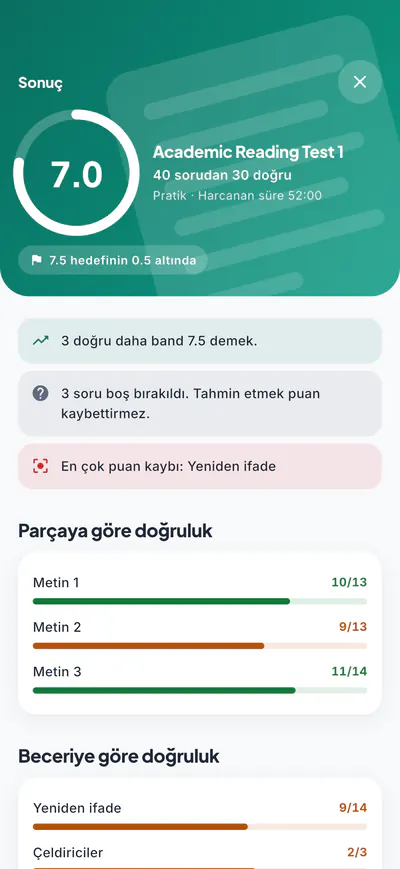
Fleydo: IELTS Hazırlık uygulamasında bir IELTS deneme sınavının sonucu: tahmini band ve her bölümün doğruluğu
Ücretsiz deneme dersi

Gerçek IELTS band puanınızı sınavdan önce öğrenin

Band 8.5+ sertifikalı IELTS uzmanı, anadili İngilizce bir öğretmenle ücretsiz bire bir online ders. Gerçek formatta bir Speaking tanılaması, dürüst bir band tahmini ve size puan kaybettiren ölçütlere yönelik bir plan alırsınız. Ödeme yok, taahhüt yok.

Online · Bire bir · Academic ve General Training

IELTS; British Council, IDP: IELTS Australia ve Cambridge University Press & Assessment kuruluşlarının tescilli markasıdır. Bu deneme sınavları Fleydo tarafından hazırlanmıştır; adı geçen kuruluşlarca onaylanmamış veya desteklenmemiştir.

Mobil Uygulama

Fleydo English School cebinizde

Fleydo öğrencileri ve velileri için dersler, ödevler, mesajlar ve oyunlar. iPhone ve Android'de ücretsiz.

App Store'dan indirinGoogle Play'den indirin
Uygulama hakkında daha fazlası
Fleydo English School uygulamasını App Store veya Google Play'de açan QR kodTaratın ve indirinTelefonunuza uygun mağazayı açar.fleydo.com/app
Fleydo IELTS uygulama simgesi
Fleydo: IELTS Hazırlık

IELTS'e mi hazırlanıyorsunuz?

Fleydo: IELTS Hazırlık, dört beceri için deneme sınavları sunan ayrı bir uygulamadır. Kullanmak için Fleydo hesabı gerekmez.

IELTS uygulamasını inceleyin
App Store'dan indirinGoogle Play'den indirin
IELTS deneme sınavları

Dört IELTS becerisini çalışın

Anında band puanı, açıklamalı cevaplar ve örnek cevaplarla 311 test. Üyelik gerekmez.

Tüm deneme sınavları
FleyPath

Çocuğunuzun kişisel yol haritası — 3, 6 veya 12 ay

🚀Başlangıç
👋Hello
😊Body
🦁Animals
🔢Numbers
🏆Özgüvenli İngilizce
Oyunlaştırılmış İngilizce pratiği

Tıpkı bir oyun gibi — ama gerçekten öğreniyorlar