1. Ana Sayfa
  2. IELTS
  3. Deneme sınavları
  4. Reading
  5. Reading Diagram Labelling alıştırması 2

IELTS Reading · Şema etiketleme

IELTS Reading Diagram Labelling alıştırması 2

A prairie dog burrow

  • 7 soru
  • 15 dk
  • Academic

Bu testte neler var

  1. PassageSorular 1–7Air through the tunnels

Soru tipleri

  • Şema etiketleme
ReadingIELTS Reading Diagram Labelling alıştırması 2
Kalan süre15:00

Passage

Air through the tunnels

A The mounds scattered across a colony of black-tailed prairie dogs could be taken for nothing more than waste soil from digging. They mark the doorways of burrows that are usually U-shaped, with tunnels joining a number of chambers. Sources disagree about how deep these run: the Smithsonian's National Zoo gives 2 to 4.5 metres, whereas a US National Park Service article puts the tunnels roughly one to two metres below ground.

B The chambers serve different ends. Close to an entrance lies a listening chamber, where an animal can check for predators before venturing out. The nesting chamber sits far deeper, near the bottom of the burrow, and is furnished with dry grass. One guide for young naturalists adds that side passages leading off the main tunnel form pockets, which may hold air if other parts of the system flood. More than one opening also gives the occupant a way out should a predator get inside.

C Richard Cincotta followed the development of mounds for three years, in a study published in 1989. In his sample, entrances where an animal had been seen digging into the ground became dome mounds, while those where one had dug its way out became crater mounds. The first kind is low and wide, made of loose soil from underground. The second is taller and narrower, a steep cone built of decayed and uprooted plant matter mixed with mineral soil and compacted by the animal's nose, and its top ends in a rim. Citing earlier work, Cincotta says that mounds may reach a metre in height, whereas a later Park Service report gives 0.76 metres.

D Why any of this might matter for breathing was the subject of a 1973 paper by Steven Vogel and two colleagues. They argued that diffusion alone appeared inadequate to refresh the air in so long and narrow a space. Wind crossing the ground is slower near the surface than further up, and they suggested that a burrow could exploit that difference. Typically, they reported, it has an opening at each end, surrounded by mounds of two different forms. When a breeze crosses them, air goes in at the lower of the two and comes out at the higher. In their wind-tunnel models, the flow inside the burrow rose almost in step with the flow across the mounds. The effect also appeared when model mounds differed in shape but not in height, with sharp rims proving better exits than rounded tops, so in a real burrow shape seems to add to the work done by height.

E Airflow may not be the whole story. Cincotta accepted that it could partly explain why mounds exist, but suggested that the contrast between domes and craters comes from energy constraints, since the building materials at the two kinds of entrance differ. Mounds also have other uses. The Park Service article describes them as lookout points and as barriers that stop water running into the burrow, and the National Zoo likewise credits them with helping to prevent floods. Some entrances have no mound at all, and these usually lie on sloping ground.

Sözlükçe
prairie dogs
ground squirrels of the North American grasslands that live in burrows
diffusion
the slow spreading of a gas from where there is more of it to where there is less
wind-tunnel
a tube in which air is blown past a model to test how it behaves
PassageSorular 1–7
Sorular 1–7 En fazla 2 kelime

Label the diagram below. Choose NO MORE THAN TWO WORDS from the passage for each answer.

Simplified side view of a black-tailed prairie dog burrow (not to scale)
1
2
3
4
5
6
7
breeze
air enters
air leaves
side passage

Cevaplar ve açıklamalar

Önce testi çözün: cevap anahtarı, cevapladıktan sonra çok daha faydalıdır.

Cevap anahtarını ve açıklamaları göster
  1. 1
    dome mound / dome / dome mounds / domes / a dome / the dome / loose soil

    Paragraph C names dome mounds first, then says the first kind is low and wide, made of loose soil. The label points to the low, rounded mound, the lower of the two, where paragraph D says air goes in.

  2. 2
    listening chamber

    Paragraph B places the listening chamber close to an entrance. The label points to the small room just below the surface, far above the nesting chamber at the bottom.

  3. 3
    nesting chamber

    Paragraph B says the nesting chamber is near the bottom of the burrow. The label points to the large room under the lowest part of the tunnel, not the listening chamber near the top.

  4. 4
    dry grass / grass / the grass

    Paragraph B says the nesting chamber is furnished with dry grass. The label points to the shaded layer on the floor of this deep room, so the answer is what the room contains, not its name.

  5. 5
    air pockets / air pocket / pockets / pocket / a pocket / the pockets / the pocket

    Paragraph B says side passages form pockets that may hold air in a flood. The diagram already names the side passage, and the label points to the closed space at its far end.

  6. 6
    crater mound / crater / crater mounds / craters / a crater / the crater / steep cone / cone / a cone / the cone / plant matter

    Paragraph C names crater mounds second, then says the second kind is taller and narrower, a steep cone. The label points to that tall, steep mound, the higher of the two, where paragraph D says air comes out.

  7. 7
    sharp rims / sharp rim / rims / rim / a rim / the rims / the rim

    Paragraph C says the top of the crater mound ends in a rim. The label points to the raised edge round the hole, and paragraph D adds that sharp rims make good exits for air.

Bu testin anahtar kelimeleri

Passage

colony
a group of animals of one kind living together
predators
animals that hunt and eat other animals
compacted
pressed together firmly
refresh
to replace something old or used with something new
constraints
limits on what can be done
Şema etiketleme soruları nasıl cevaplanırMatch a written description to a drawing, and name each part with the text's words.

What the task looks like

The instruction says 'Label the diagram below.' You get a drawing with some labels missing, and a word limit.

The task tests whether you can relate a written description to a diagram. You do not need to know the subject, because the answers are words from the text.

A method to try

1. Study the drawing first. What does it show? Read the labels that are already there, because they are your anchors.

2. Scan the text for those labels to find where the description is.

3. Follow the description across the drawing, part by part, and mark the position and movement words: 'above', 'below', 'beside', 'at the base of', 'inside', 'enters', 'passes through', 'leads to'.

4. For each gap, ask two questions. What is this part next to? What does it do?

5. A label names a thing, so you are usually looking for a noun. Take its exact words from the text.

6. Read the description again with your labels in place. Does the drawing now match it?

The traps

Where it is, or what it is: in 'a tap on the side', 'side' tells you the position and 'tap' is the name of the part.

The neighbour: the text may name the part next to your gap in the same sentence.

The order: the text does not have to describe the parts in the order of the label numbers.

Unknown words: you can label a part correctly without knowing exactly what the word means, as long as you copy it correctly.

Worked example

Text: The garden's rain barrel stands on a low brick base. Rain runs down a pipe from the shed roof and enters through a mesh screen on the lid, which keeps out leaves. Near the bottom of the barrel, a brass tap lets gardeners fill their cans.

Diagram: imagine a side view of a barrel with a pipe coming down to its lid. Label 1 points to the small part of the lid where the pipe ends.

Label 1: ____ (NO MORE THAN TWO WORDS)

Zayıflid. The label points to the top of the barrel, and the text says the lid is on top.
Daha iyimesh screen. The water 'enters through a mesh screen on the lid', so the screen is the part where the pipe ends. The lid is only where it sits.

'On the lid' tells you where the part is. The words before 'on' tell you what it is. You do not even need to know the word 'mesh': you only need to place it and copy it.

Fleydo IELTS uygulama simgesi Fleydo: IELTS Hazırlık

Bu testleri telefonunuzda yanınızda taşıyın

Bu sayfalardaki her test, iPhone, iPad ve Android için Fleydo: IELTS Hazırlık uygulamasında da var; yanında sesli 2.000 IELTS kelimesiyle birlikte.

  • Test telefonunuza indikten sonra çevrimdışı çalışır
  • Sesli 2.000 IELTS kelimesi, aralıklı tekrar ve kısa alıştırmalar
  • Speaking cevaplarınızı kaydedip geri dinleyin
  • Hedef bandınıza ve sınav tarihinize göre günlük plan
App Store'dan indirinGoogle Play'den indirin
İndirmek için tarayınTelefonunuza göre App Store'u veya Google Play'i açar.

Hesap gerekmez. Uygulama hakkında

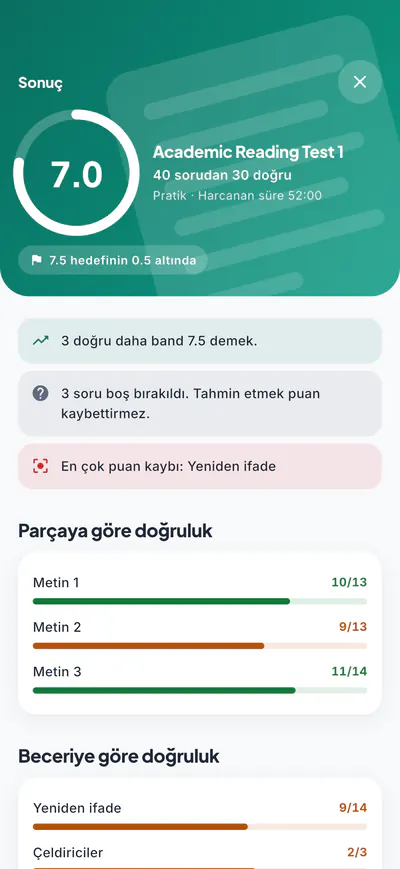
Fleydo: IELTS Hazırlık uygulamasında bir IELTS deneme sınavının sonucu: tahmini band ve her bölümün doğruluğu
Ücretsiz deneme dersi

Gerçek IELTS band puanınızı sınavdan önce öğrenin

Band 8.5+ sertifikalı IELTS uzmanı, anadili İngilizce bir öğretmenle ücretsiz bire bir online ders. Gerçek formatta bir Speaking tanılaması, dürüst bir band tahmini ve size puan kaybettiren ölçütlere yönelik bir plan alırsınız. Ödeme yok, taahhüt yok.

Online · Bire bir · Academic ve General Training

IELTS; British Council, IDP: IELTS Australia ve Cambridge University Press & Assessment kuruluşlarının tescilli markasıdır. Bu deneme sınavları Fleydo tarafından hazırlanmıştır; adı geçen kuruluşlarca onaylanmamış veya desteklenmemiştir.

Mobil Uygulama

Fleydo English School cebinizde

Fleydo öğrencileri ve velileri için dersler, ödevler, mesajlar ve oyunlar. iPhone ve Android'de ücretsiz.

App Store'dan indirinGoogle Play'den indirin
Uygulama hakkında daha fazlası
Fleydo English School uygulamasını App Store veya Google Play'de açan QR kodTaratın ve indirinTelefonunuza uygun mağazayı açar.fleydo.com/app
Fleydo IELTS uygulama simgesi
Fleydo: IELTS Hazırlık

IELTS'e mi hazırlanıyorsunuz?

Fleydo: IELTS Hazırlık, dört beceri için deneme sınavları sunan ayrı bir uygulamadır. Kullanmak için Fleydo hesabı gerekmez.

IELTS uygulamasını inceleyin
App Store'dan indirinGoogle Play'den indirin
IELTS deneme sınavları

Dört IELTS becerisini çalışın

Anında band puanı, açıklamalı cevaplar ve örnek cevaplarla 311 test. Üyelik gerekmez.

Tüm deneme sınavları
FleyPath

Çocuğunuzun kişisel yol haritası — 3, 6 veya 12 ay

🚀Başlangıç
👋Hello
😊Body
🦁Animals
🔢Numbers
🏆Özgüvenli İngilizce
Oyunlaştırılmış İngilizce pratiği

Tıpkı bir oyun gibi — ama gerçekten öğreniyorlar