- Ana Sayfa
- IELTS
- Deneme sınavları
- Listening
- Listening Deneme Sınavı 12
IELTS Listening
IELTS Listening Deneme Sınavı 12
Portrait session, apprenticeships, a ferry documentary, the ballpoint pen
- 40 soru
- 29 dk
- 4 bölüm
- Listening
Bu testte neler var
- Bölüm 1Sorular 1–10You will hear a woman phoning a photography studio to book a family portrait session.
- Bölüm 2Sorular 11–20You will hear a careers adviser talking to parents about apprenticeships.
- Bölüm 3Sorular 21–30You will hear two media students and their tutor planning a short documentary about a local ferry crossing.
- Bölüm 4Sorular 31–40You will hear a lecture about the ballpoint pen: how it works and how it was developed.
Soru tipleri
Konuşmacılar
Dinleyeceğiniz kayıtYou will hear a woman phoning a photography studio to book a family portrait session.
Complete the form below. Write ONE WORD AND/OR A NUMBER for each answer.
What does Shelby decide about each of the following extras? Choose FOUR answers from the box and write the correct letter, A-F, next to Questions 7-10.
- Apay for it now to get a discount
- Bmake a choice once she has seen the results
- Cleave it out
- Dconsult a family member first
- Emake her own arrangements
- Fgo for the less expensive version
Dinleyeceğiniz kayıtYou will hear a careers adviser talking to parents about apprenticeships.
Complete the sentences below. Write NO MORE THAN TWO WORDS for each answer.
Label the map below. Write the correct letter, A-I, next to Questions 15-20.
Dinleyeceğiniz kayıtYou will hear two media students and their tutor planning a short documentary about a local ferry crossing.
Complete the flow-chart below. Write ONE WORD ONLY for each answer.
Complete the final edit.
Choose the correct letter, A, B or C.
Dinleyeceğiniz kayıtYou will hear a lecture about the ballpoint pen: how it works and how it was developed.
Label the diagram below. Choose FOUR answers from the box and write the correct letter, A-G, next to Questions 31-34.
- Abarrel
- Bbutton
- Cchannel
- Dnib
- Eplug
- Fsocket
- Gtube
Complete the notes below. Write ONE WORD ONLY for each answer.
Cevaplar ve açıklamalar
Önce testi çözün: cevap anahtarı, cevapladıktan sonra çok daha faydalıdır.
Cevap anahtarını ve açıklamaları göster
- 1Varnum
Shelby spells her surname letter by letter: V-A-R-N-U-M. The spelling must be exact to score.
- 27 / seven
She first counts six (her husband, two sons, her parents and herself), but her brother has confirmed he is coming: "So it'll be seven of us."
- 3retirement
Everyone assumes the photos are for her parents' anniversary, but "actually it's to celebrate my dad's retirement". The form already gives "her father's", so one word is needed.
- 428 / 28th / twenty-eighth
She asks for the twenty-first, but it is "fully booked". Rupert offers the following Saturday and she says "Let's go for the twenty-eighth, then."
- 5logos / logo
Rupert's one request is that "nobody wears anything with logos on it", because logos pull the eye away from faces. Shelby then asks about stripes, but they are "absolutely fine", so stripes is wrong.
- 630 / £30 / thirty
The deposit is "thirty pounds". Shelby then asks about the whole session: ninety-five pounds altogether, with sixty-five paid on the day. Neither of those is the deposit. The pound sign is printed, so write 30.
- 7C
She likes the idea and says she will "check with my husband first" (D), but then remembers it will be freezing at the end of November and her father hates the cold: "No, let's not bother with that at all."
- 8D
Her mother has been nervous of the dog, so "I'd better see what she says before I promise anything": she will consult a family member first. Leaving him at home (C) would be simpler, but the boys would never forgive her, so she rejects it.
- 9E
Rupert offers ten per cent off if she books the stylist today (A), but her neighbour, a hairdresser, will do everyone's hair: "So I'll organise that myself."
- 10B
She does not know how many good shots there will be: "I'd rather look at the pictures first and choose after that." Rupert then offers to order the smaller album today (F), but she says "No, I'll wait".
- 11finance
Construction "came a close second", so it is not the answer. "The area that took the largest number of our leavers was finance": nine students joined accountancy firms and banks.
- 12travel costs / travel cost
Families naturally "look at the wage first", but Merrin asks them to "look carefully at travel costs as well": a better-paid job can be worth less if the journey is long. Equipment is raised after, but it "shouldn't cost you anything".
- 13attendance record / attendance
Merrin says "the thing they bring up far more than anything else is a student's attendance record". Exam results come after: parents expect them to matter most, and they do matter, "But they come up far less often."
- 14January
For the bigger employers "the closing date is in January". October is when applications open, and the summer is when many families wrongly think you apply. The sentence asks when they stop accepting applications.
- 15A
The hall's front doors open onto the drive. The building "directly across the drive from those doors" is the technology block, A, where the engineering employers are.
- 16I
B, next to the technology block, is the music block, which is locked. The building "at the far end of that row" is the canteen, I, where the careers team helps with application forms.
- 17F
Across the main path, "directly opposite the canteen, next to the library", is the science block, F. Health and care employers are there.
- 18H
From the top of the drive, by the library, you see two marquees on the playing field. "Construction is in the one on your right": H. The one on the left, G, is for refreshments.
- 19G
The canteen would normally serve food, but it is being used for applications tonight. Refreshments are in "the other marquee, over on the left, near the sports hall": G.
- 20E
The former students who are now apprentices are in the drama studio, "the small building between the sports hall and the drive": E.
- 21trust
The skipper is happy for them to film, but "it isn't his decision", and the council no longer runs the ferry. A community trust does, "so it's the trust we need to write to".
- 22dawn
The test will be "on the first sailing of the day, at dawn". The tutor then asks about sunset, the idea in their outline, but the last winter ferry runs in the dark, so sunset is wrong.
- 23café / cafe
They planned to film on deck, but the chains are too loud. They will "record all the interviews in the café instead", before it opens.
- 24headland
Delaney says they will "set up on the headland on the far side", where the whole crossing can be seen. Nolan would still rather borrow a drone, but the trust "doesn't allow drones over passengers".
- 25crew
Nolan wants to show the tutor first, but the tutor cannot check the facts. Delaney decides "the crew see the rough cut before anyone else does", because they would notice anything wrong.
- 26B
Delaney's reason is personal: "My grandfather was a deckhand on it for over thirty years." The newspaper story about closing came after they had decided (A), and they learned about its history only later (C).
- 27B
Dr Kerrigan says "Length isn't really my concern" (A). His worry is that "nearly every one of them opened with slow shots of water or sky": the idea is predictable. Moving the shot to the end (C) is Delaney's suggestion, and he leaves it open.
- 28C
The folk song was too expensive (A) and a music student could not write a piece in time (B). They have "decided not to have any music at all", only the gulls, the engine and the chains.
- 29A
Nolan says "We want the people we interview to tell the story themselves", even the facts. Delaney's voice-over (B) sounded like a school project, and on-screen text (C) would be too much.
- 30C
The café owner locking up (A) felt like "her story", and the dawn shot (B) would "feel a bit flat". The film ends with Delaney's grandfather, a former deckhand, "making the crossing one more time".
- 31F
In the magnified tip, "The ball sits in a brass socket", which holds it but lets it turn. A nib (D) is mentioned earlier, but it belongs to a fountain pen; the ballpoint uses a ball instead.
- 32C
"Inside the socket, there are tiny channels that carry the ink forward" to the ball. Gap 32 is the passage inside the tip; the tube (G) is the part behind it, in the body of the pen.
- 33A
Gap 33 points to the outer body of the pen. "The barrel around the tube is made of clear plastic, so you can see how much ink is left." The tube (G) is the narrow part inside that holds the ink: it "runs down the middle of the pen", with the barrel around it.
- 34E
A click pen would have a button (B) at this end, with a spring, but "This pen has neither": "The end of the barrel is simply closed with a plug."
- 35side
The lecturer says that on the barrel "you'll find a tiny hole in its side", and that this hole keeps the air pressure the same inside the pen as outside. Only the lecture tells you where the hole is.
- 36standard
The cap's hole is there mainly for safety, and "An international standard for pens that children might use" says a cap small enough to swallow must let a minimum amount of air through. "Worldwide" in the notes means international.
- 37thick
Newspaper ink "dried quickly without smudging", but in a fountain pen "it simply wouldn't flow. It was far too thick."
- 38leak
The RAF wanted the pens because "At high altitude, fountain pens tended to leak, but the new pens didn't." "At height" in the notes means at high altitude.
- 39watchmakers / watch-makers
To get the ball and the tube to fit together perfectly, Bich "used the skills of Swiss watchmakers". Write one word only: "Swiss watchmakers" is two words.
- 40refillable
"According to the company, those first Cristals were refillable." Today "most people think of it as a disposable pen", but the notes ask what the maker says about the first ones; plain and low-priced are already in the notes.
Kaydın tam metnini göster
Bölüm 1
Narrator Part 1. You will hear a woman phoning a photography studio to book a family portrait session. First, you have some time to look at questions 1 to 6.
Narrator Now listen carefully and answer questions 1 to 6.
Rupert Good afternoon, Quillbrook Portrait Studio, Rupert speaking.
Shelby Oh, hi. I'd like to book a family photo session, please. A friend of mine had her family done with you last spring, and the pictures were just gorgeous.
Rupert That's very kind of her. I'd be glad to help. Can I start with your name?
Shelby Sure. It's Shelby Varnum. That's V-A-R-N-U-M.
Rupert Thank you, Shelby. And how many people will be in the photos?
Shelby Well, that's been changing all week. It's me and my husband, our two boys, and my parents, so that's six. But my brother's flying over from Toronto, and he called last night to say he'll definitely be here. So it'll be seven of us.
Rupert Seven's no problem at all. The main studio's quite large, so we can fit up to ten people comfortably. And is this for a particular occasion?
Shelby It is. Everyone assumes it's for my parents' anniversary, because that's coming up as well, but actually it's to celebrate my dad's retirement. He's finishing in December, after thirty-five years as a school principal, and we want to give him a big framed picture of all of us.
Rupert What a lovely present. Do pass on my congratulations. So, when were you hoping to come in?
Shelby It has to be a Saturday this month, while my brother's still here. Do you have anything on the twenty-first?
Rupert Let me have a look. No, I'm sorry, the twenty-first is fully booked. But the following Saturday, the twenty-eighth, is completely free at the moment.
Shelby The twenty-eighth. My brother doesn't fly home until the Monday after, so that works. Let's go for the twenty-eighth, then.
Rupert Lovely. I'll pencil you in for ten in the morning. Now, people always ask about clothes, so let me give you a few tips. Plain colours work best, and it helps if everyone's colours go together, though there's no need for you all to match.
Shelby My mom will be relieved to hear that. She was talking about buying everyone the same sweater.
Rupert Please don't let her! The one thing I'd ask is that nobody wears anything with logos on it. They pull the eye away from people's faces.
Shelby Got it. My younger son practically lives in his hockey shirt, so I'll have to hide it that morning. What about stripes, though? My husband's got a striped sweater he loves.
Rupert Oh, stripes are absolutely fine. He can wear that. Now, to hold the date, we ask for a deposit of thirty pounds.
Shelby OK. And how much is the session itself?
Rupert It's ninety-five pounds altogether, so you'd pay the other sixty-five on the day.
Shelby That's fine. I'll pay the deposit now, by card.
Rupert Thank you. I'll take the details in just a moment.
Narrator Before you hear the rest of the conversation, you have some time to look at questions 7 to 10.
Narrator Now listen and answer questions 7 to 10.
Rupert While I've got you, there are a few extras you might like to think about. Quite a few families start in the studio and then spend twenty minutes outside, in the gardens down by the river. That's an extra thirty-five pounds.
Shelby Oh, that sounds lovely. The boys could run around, and it would look really natural. I'll just check with my husband first. Actually, hang on, it'll be the end of November, won't it? It'll probably be freezing, and my dad can't stand the cold. No, let's not bother with that at all.
Rupert Very wise. The studio's nice and warm, anyway. What about pets? Some families like to bring the dog along. There's no charge for that, as long as somebody's in charge of it.
Shelby We do have a dog, Pretzel. But my mom's been a little nervous around him ever since he knocked her over last summer. I'd better see what she says before I promise anything.
Rupert Of course. Just let me know by the Thursday before.
Shelby To be honest, it'd be simpler to leave him at home. But the boys would never forgive me if he wasn't in the picture.
Rupert Well, he'd be very welcome. Then there's hair and make-up. We have a stylist who comes in before the session. It's twenty pounds a person, and if you book it today, I can take ten per cent off.
Shelby That's tempting. But my neighbour's a hairdresser, and she's already offered to do all of us at her salon that morning. So I'll organise that myself, thanks.
Rupert No problem at all. And the last thing is prints. Most families order an album. The large one has thirty pages and costs a hundred and eighty pounds, and there's a smaller one with fifteen pages for ninety pounds.
Shelby With two kids and a dog, I've no idea how many good shots we'll get. I'd rather look at the pictures first and choose after that.
Rupert That's what most people do. You'll get a link to an online gallery about a week after the session. Although if you already know you'd like the smaller one, I can put the order through today.
Shelby No, I'll wait, thanks. Let's see how they turn out. Thanks so much, Rupert. See you on the twenty-eighth.
Rupert See you then. Goodbye.
Narrator That is the end of Part 1. You now have half a minute to check your answers.
Bölüm 2
Narrator Part 2. You will hear a careers adviser talking to parents about apprenticeships. First, you have some time to look at questions 11 to 14.
Narrator Now listen carefully and answer questions 11 to 14.
Merrin Good evening, everyone, and thanks for coming out on such a cold night. I'm Merrin Teague, the careers adviser here at Wyndhollow High. Tonight I want to talk about apprenticeships: what they involve, what they can lead to, and how your son or daughter can get one. Then, at the end, I'll show you on the map where to find everything at tonight's employers' fair, which is spread right around the school.
Merrin So, first of all, what exactly is an apprenticeship? Put simply, it's a real job with training built in. Apprentices work for an employer and earn a wage, and they spend part of each week studying for a qualification, usually at a college. By the end, they've got the qualification and, very often, a permanent job with the same company.
Merrin Now, a lot of parents still picture apprentices on building sites, and I understand why. Construction's always been popular with our students, and last year it came a close second. But the area that took the largest number of our leavers was finance. Nine students started with accountancy firms or with one of the banks in town, which surprised quite a few people in the staffroom, I can tell you.
Merrin Next, money. Apprentices are paid from their very first day, but I'll be honest with you: the starting wage isn't high, and it varies a lot from one employer to another. So when an offer comes in, it's natural to look at the wage first. But please look carefully at travel costs as well.
Merrin An offer that pays a little more can easily end up being worth less if it means two buses and a train every morning. Equipment, on the other hand, shouldn't cost you anything. Every employer here tonight provides the tools and safety clothing.
Merrin So what are employers looking for? Every year I ask the businesses we work with, and the thing they bring up far more than anything else is a student's attendance record. A young person who turns up every day, and on time, at school is likely to do the same at work. Parents are often surprised by that. They expect the answer to be exam results, and those do matter, of course, especially for the engineering and finance places. But they come up far less often.
Merrin And finally, timing, because this is where families most often get caught out. For most of the bigger employers, the closing date is in January. Applications open in October, so that's when to start looking. A lot of families assume you apply in the summer, once exams are over, but by then those places have long gone. There are still openings with smaller firms, but the choice is far narrower.
Narrator Before you hear the rest of the talk, you have some time to look at questions 15 to 20.
Narrator Now listen and answer questions 15 to 20.
Merrin Right, if you'd like to look at the map on the back of your programme. We're here in the main hall, close to the main gate. When you go out through the front doors, you'll come straight out onto the drive. Directly across the drive from those doors, you'll find the engineering employers, in the technology block.
Merrin Next to the technology block is the music block, but that's locked this evening, so please don't go looking for anyone in there. Carry on past it to the building at the far end of that row. That's the canteen, and our careers team will be in there all evening, helping students with their application forms.
Merrin Then cross over the main path. Directly opposite the canteen, next to the library, is the science block, and that's where you'll find health and care: the hospital, the ambulance service and several aged-care providers.
Merrin Construction firms like plenty of space for their demonstrations, so they're outside. Walk back to the drive and up past the library to the path that runs along the edge of the playing field. You'll see two marquees there. Construction is in the one on your right.
Merrin They're running a bricklaying demonstration every half hour, and it's well worth a look, even if your child has no interest in building. Now, on a night like this the canteen would normally do the food. But as it's being used for applications, refreshments are in the other marquee, over on the left, near the sports hall. Our Year 11 students are serving tea, coffee and sausage rolls.
Merrin And finally, some of the most useful people to talk to tonight are our former students who are halfway through apprenticeships right now. You'll find them in the drama studio. That's the small building between the sports hall and the drive, so you can call in on your way back down.
Merrin Right, that's everything from me. Enjoy the evening, and do come and find me if you've got any questions.
Narrator That is the end of Part 2. You now have half a minute to check your answers.
Bölüm 3
Narrator Part 3. You will hear two media students and their tutor planning a short documentary about a local ferry crossing. First, you have some time to look at questions 21 to 25.
Narrator Now listen carefully and answer questions 21 to 25.
Dr Kerrigan Come in, Nolan, Delaney. So, the ferry documentary. I've read your outline, but how are you actually going to make it? Where do you start?
Nolan Permission, first. We can't film on board without it. I talked to the skipper last week, and he was happy for us to come, but he said it isn't his decision.
Delaney Because the council doesn't run the ferry any more. It handed it over to a community trust about five years ago, so it's the trust we need to write to. We'll send them a letter this week.
Dr Kerrigan Good. And get the answer in writing. A friendly chat on the slipway won't help you if something goes wrong. Then what?
Nolan Then a test shoot. We're going to do it on the first sailing of the day, at dawn. If the light's good, we'll shoot our main sequence then as well.
Dr Kerrigan Not the last crossing? Your outline said sunset, with the lights coming on in the village behind.
Delaney It did. But then we checked the winter timetable. The last ferry leaves at half past five, and by then it's completely dark.
Dr Kerrigan Fair enough. Now, the interviews. Who are you talking to?
Delaney The skipper, two regular passengers, and the woman who runs the café on the slipway.
Nolan We'd planned to film all of them on deck, during the crossing, so you'd see the river moving behind them. But on our first trip we realised you can hardly hear yourself think out there. It's a chain ferry, so it pulls itself across on two chains, and they clank over the wheels the whole way.
Dr Kerrigan And you'll never clean that out in the edit.
Delaney So we're going to record all the interviews in the café instead, before it opens in the morning. The owner's offered us the table by the window, so we'll still have the river in the background.
Dr Kerrigan Good. And the crossing itself? You'll want wide shots that show the whole thing, from one bank to the other.
Delaney We're going to set up on the headland on the far side. From up there you can see the ferry the whole way across, and both landings.
Nolan I'd still rather use a drone. My cousin's got one he said we could borrow.
Delaney But the trust doesn't allow drones over passengers, Nolan. We've been through this.
Dr Kerrigan A fixed camera will give you a steadier shot anyway. And once you've done a rough edit?
Nolan We thought we'd show the rough cut to you first, and then to the rest of the class.
Dr Kerrigan By all means show me. But I can't tell you whether you've got the facts right. I've never even been on the thing. Who could?
Delaney The crew, obviously. They'd notice straight away if we said something wrong about the chains or the tides. OK, so the crew see the rough cut before anyone else does, and then we do the final edit.
Narrator Before you hear the rest of the discussion, you have some time to look at questions 26 to 30.
Narrator Now listen and answer questions 26 to 30.
Dr Kerrigan Right, now the film itself. Remind me why you chose this ferry.
Delaney It's personal, mostly. My grandfather was a deckhand on it for over thirty years, and I grew up hearing his stories.
Nolan People keep assuming we picked it because of that story in the local paper about the ferry closing. But that came out after we'd already decided.
Dr Kerrigan And the history? It's been running since the eighteen-nineties, hasn't it?
Delaney It has. But honestly, we only found that out once we'd started reading up on it.
Dr Kerrigan OK. Now, your outline says the film opens with a long, slow shot of the river at dawn, with nothing but the sound of the water, for about a minute and a half.
Nolan Is that too long? We could easily trim it.
Dr Kerrigan Length isn't really my concern. Ninety seconds can work if the image is strong enough. What worries me is that I've watched about thirty student documentaries this year, and nearly every one of them opened with slow shots of water or sky. Whoever marks this will have seen it a hundred times.
Delaney Oh. So maybe we keep the dawn shot, but save it for the end?
Dr Kerrigan Possibly. Let's decide that once you've seen your footage. What about music?
Delaney We found a beautiful old recording of a folk song about the river. But the record company wanted a fee we couldn't possibly afford.
Nolan Then we thought about asking someone in the music department to write us something. But they're all busy with their own end-of-year pieces, so we'd get it a week before our deadline.
Delaney So in the end, we've decided not to have any music at all. Just what the crossing sounds like: the gulls, the engine, the chains. It's almost musical anyway.
Dr Kerrigan I think that's brave. And probably right. Will there be a narrator?
Nolan No. We want the people we interview to tell the story themselves. Everything the audience learns should come from them.
Dr Kerrigan Even the facts? Dates, that sort of thing?
Delaney I did offer to record a voice-over, just for the facts. But every time we tried it, it sounded like a school project.
Nolan We also talked about putting the facts up on screen as text. But there'd be so much of it. If the skipper says the ferry first ran in 1894, that's enough.
Dr Kerrigan Fine, as long as somebody actually says it. And how does it end?
Delaney At first we wanted to end with the café owner locking up for the night. But it felt like her story rather than the ferry's.
Nolan So we're finishing with Delaney's grandfather making the crossing one more time. He hasn't been on board since he retired, and the skipper's invited him along one Sunday morning.
Dr Kerrigan And the dawn shot? Could that be your final image?
Delaney We did wonder. But after Grandpa's crossing, it would feel a bit flat. I think we'll leave it out.
Dr Kerrigan Good. Send me the letter before it goes to the trust.
Narrator That is the end of Part 3. You now have half a minute to check your answers.
Bölüm 4
Narrator Part 4. You will hear a lecture about the ballpoint pen: how it works and how it was developed. First, you have some time to look at questions 31 to 40.
Narrator Now listen carefully and answer questions 31 to 40.
Dr Pemberton Good morning, everyone. Today I'm going to talk about something most of you have in your bag: the ballpoint pen. It looks simple, but it took inventors more than half a century to make one that worked reliably. I'll start with how it works, using the diagram on your handout, and then I'll look at how it was developed.
Dr Pemberton First, the problem it solved. Before the ballpoint, people wrote in ink with dip pens or fountain pens, which had to be refilled and were often messy. A fountain pen has a metal nib, and its ink has to be thin enough to flow through it. A ballpoint uses something quite different: a thick, oily paste that dries on the paper almost at once. A paste like that won't flow through a nib, so the pen needs another way of getting the ink onto the page.
Dr Pemberton So, look at the magnified tip at the bottom of the diagram. The ball sits in a brass socket, which grips it firmly enough to stop it falling out, but still lets it turn freely in any direction. The ball itself is tiny, often about a millimetre across. Early balls were made of steel, but many today are tungsten carbide, which is much harder.
Dr Pemberton Inside the socket, there are tiny channels that carry the ink forward from the tube behind to the back of the ball. As you write, the ball rolls across the paper, picking up ink on the side facing into the pen and laying it down on the page. And when you stop, the tip acts as a barrier between the ink and the outside air, so the ink doesn't dry out inside the pen.
Dr Pemberton Now look at the whole pen, at the top of the diagram. The ink is stored in a long, narrow plastic tube that runs down the middle of the pen. In the best-selling pen of all, that tube holds less than half a gram of ink, yet that's enough to write up to three kilometres. Gravity, helped by capillary action, keeps the ink moving down towards the ball, which is why most ballpoints don't work well upside down.
Dr Pemberton The barrel around the tube is made of clear plastic, so you can see how much ink is left. And it has six sides, like a pencil, so it's comfortable to grip and it won't roll off the desk.
Dr Pemberton At the far end, a click pen would have a button, with a spring that helps pull the point back in. This pen has neither. The end of the barrel is simply closed with a plug. It's the same colour as the ink, so you can tell at a glance which colour the pen writes in.
Dr Pemberton There's one more detail on the barrel that's easy to miss. If you look closely, you'll find a tiny hole in its side. That hole keeps the air pressure the same inside the pen as outside. Without it, the ink wouldn't flow so easily to the tip, and the pen would be more likely to leak.
Dr Pemberton The cap has a hole in it, too, and you might assume it does the same job. In fact, the main reason for it is safety. If a child accidentally swallows a cap and it gets stuck, the hole can still let air through. An international standard for pens that children might use says that any cap small enough to swallow must let a minimum amount of air pass through.
Dr Pemberton Right, so how did we get here? The basic idea is surprisingly old. In 1888, an American, John Loud, patented a pen with a small rotating ball at its tip. He wanted it for marking rough surfaces, such as wood. But it was far too coarse for writing letters, and it was never a commercial success.
Dr Pemberton In the decades that followed, inventors kept running into the same problem: the ink. Too thin, and it leaked. Too thick, and it clogged. The breakthrough came in the 1930s from László Bíró, a Hungarian journalist. He noticed that the ink used to print newspapers dried quickly without smudging. But when he tried it in a fountain pen, it simply wouldn't flow. It was far too thick.
Dr Pemberton So Bíró designed a pen around the ink, with a ball at the tip instead of a nib. His brother, who knew a good deal of chemistry, helped him develop a suitable ink, and in 1938 they patented the design. Then, during the Second World War, the brothers moved to Argentina, where they filed a new patent.
Dr Pemberton Meanwhile, in Britain, the Miles aircraft company began making the pens under licence for the Royal Air Force. The RAF wanted them for a very practical reason. At high altitude, fountain pens tended to leak, but the new pens didn't.
Dr Pemberton The pen that put the ballpoint in almost everyone's hands, though, came from France. A businessman called Marcel Bich acquired the rights to Bíró's design and spent several years improving it. He improved the ink formula, and to get the ball and the tube to fit together perfectly, he used the skills of Swiss watchmakers.
Dr Pemberton The result was the Cristal, which left his factory near Paris in December 1950. Its design was simple, and it was cheap. And, according to the company, those first Cristals were refillable. Today, of course, most people think of it as a disposable pen.
Dr Pemberton So, to sum up. More than a hundred billion Cristals had been sold by 2006, and the design is now in the permanent collection of the Museum of Modern Art in New York. Next week, we'll move on to the typewriter.
Narrator That is the end of Part 4. You now have half a minute to check your answers.
Narrator That is the end of the Listening test.
Bu testin anahtar kelimeleri
Bölüm 1
- fully booked
- with no free places or times left
- pencil someone in
- make a booking that can still be changed
- hold the date
- keep a day reserved for someone
- pull the eye
- make people look at something
- online gallery
- a web page where you can look at a set of photos
Bölüm 2
- apprenticeship
- a job in which you are paid while you train for a skill or qualification
- leaver
- a student who is finishing school
- get caught out
- have a problem because you did not expect something
- marquee
- a large tent used for outdoor events
- aged care
- care for elderly people (Australian English)
Bölüm 3
- skipper
- the person in charge of a small boat or ferry
- slipway
- a slope where boats come in and out of the water
- deckhand
- a member of a boat's crew who does practical work on deck
- rough cut
- the first, unfinished edit of a film
- voice-over
- a voice in a film that speaks over the pictures
Bölüm 4
- smudge
- to make writing messy by rubbing it before it is dry
- capillary action
- the way a liquid moves along a very narrow space without being pumped
- coarse
- rough, not fine or smooth
- patent
- an official right to be the only one who makes or sells an invention for a time
- under licence
- with official permission to make or sell someone else's invention
- altitude
- height above sea level
 Fleydo: IELTS Hazırlık
Bu testleri telefonunuzda yanınızda taşıyın
Bu sayfalardaki her test, iPhone, iPad ve Android için Fleydo: IELTS Hazırlık uygulamasında da var; yanında sesli 2.000 IELTS kelimesiyle birlikte.
- Test telefonunuza indikten sonra çevrimdışı çalışır
- Sesli 2.000 IELTS kelimesi, aralıklı tekrar ve kısa alıştırmalar
- Speaking cevaplarınızı kaydedip geri dinleyin
- Hedef bandınıza ve sınav tarihinize göre günlük plan


 İndirmek için tarayınTelefonunuza göre App Store'u veya Google Play'i açar.
Hesap gerekmez. Uygulama hakkında
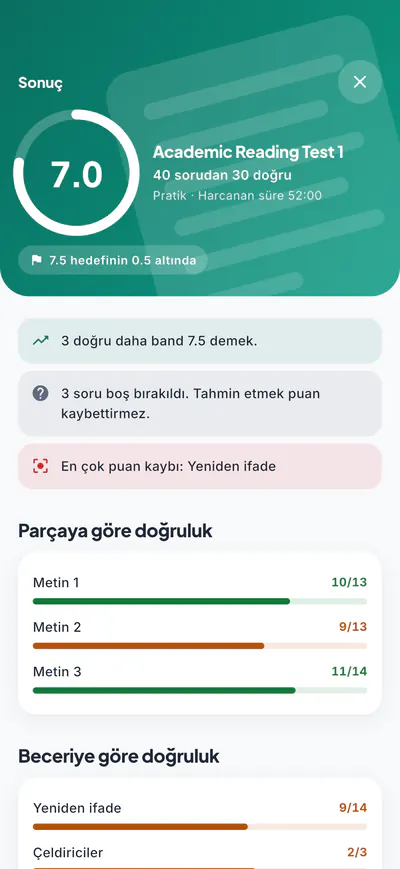
Gerçek IELTS band puanınızı sınavdan önce öğrenin
Band 8.5+ sertifikalı IELTS uzmanı, anadili İngilizce bir öğretmenle ücretsiz bire bir online ders. Gerçek formatta bir Speaking tanılaması, dürüst bir band tahmini ve size puan kaybettiren ölçütlere yönelik bir plan alırsınız. Ödeme yok, taahhüt yok.
Online · Bire bir · Academic ve General TrainingIELTS; British Council, IDP: IELTS Australia ve Cambridge University Press & Assessment kuruluşlarının tescilli markasıdır. Bu deneme sınavları Fleydo tarafından hazırlanmıştır; adı geçen kuruluşlarca onaylanmamış veya desteklenmemiştir.

 Taratın ve indirin
