- Ana Sayfa
- IELTS
- Deneme sınavları
- Listening
- Listening Flow-Chart Completion alıştırması 3
IELTS Listening · Akış şeması tamamlama
IELTS Listening Flow-Chart Completion alıştırması 3
Bottle to bottle
- 8 soru
- 6 dk
- Listening
Bu testte neler var
- Bölüm 1Sorular 1–8You will hear part of a lecture on how used glass bottles are recycled into new ones.
Soru tipleri
Konuşmacılar
Dinleyeceğiniz kayıtYou will hear part of a lecture on how used glass bottles are recycled into new ones.
Complete the flow-chart below. Write ONE WORD ONLY for each answer.
The glass is broken up and sorted by size.
Every bottle is checked by machine.
Cevaplar ve açıklamalar
Önce testi çözün: cevap anahtarı, cevapladıktan sonra çok daha faydalıdır.
Cevap anahtarını ve açıklamaları göster
- 1magnets
Steel lids and cans are "the easy part, because magnets simply pull them out of the stream". The eddy current system is for aluminium, which "isn't magnetic"; the flow-chart says aluminium is removed separately.
- 2vacuum
Bigger pieces of paper and plastic are picked out by hand, which leaves "tiny scraps, like bits of label". Then "a vacuum system sucks those up". "The smallest scraps" in the flow-chart stands for "tiny scraps".
- 3cameras
The falling pieces "pass in front of cameras connected to computers"; "linked to" in the flow-chart paraphrases "connected to". A jet of air then removes anything that isn't glass.
- 4viscosity
The lecturer rules out colour ("the problem there isn't its color") and says "It's the viscosity of that glass", meaning how runny or thick it is when hot. In a furnace hot enough to melt bottle glass it is "still far too thick", so its viscosity is too high for it to blend in. Check the spelling: V-I-S-C-O-S-I-T-Y.
- 5flint
Clear glass is what "people in the industry call flint". Amber is the brown glass in what is left, the coloured glass, so it does not fit "clear glass".
- 6batch
The lecturer suggests thinking of the mixture as "a recipe", but "in the industry, it has its own name. It's called the batch." "Technically known as" in the flow-chart asks for the industry's name, not the everyday comparison.
- 7gobs
As the molten glass flows out, "a blade slices it into gobs". A gob is "a solid cylinder of glass, still soft enough to shape"; the flow-chart already says "cylinder", so the gap needs the name, gobs. "Cut" in the flow-chart stands for "slices".
- 8stresses / stress
If a bottle cools unevenly, "stresses get locked into the glass". Cracking is what might happen later because of them, so "cracks" does not answer "so that no ___ remain in the glass".
Kaydın tam metnini göster
Bölüm 1
Narrator You will hear part of a lecture on how used glass bottles are recycled into new ones. First, you have some time to look at questions 1 to 8.
Narrator Now listen carefully and answer questions 1 to 8.
Dr Larkin Good morning, everyone. This week we're looking at how packaging is recycled, and today it's the turn of glass. Glass is something of a success story. Bottles and jars can be recycled again and again with no loss in quality, so the glass in a bottle you throw away today could, in principle, come back as a new bottle, over and over.
Dr Larkin Now, I don't mean that the bottle is washed and refilled. That's reuse, which is a different topic. I mean that the glass itself is melted down and made into a brand-new bottle. So let's follow some bottles through a typical modern processing plant, step by step.
Dr Larkin The glass arrives from curbside collections, from bottle banks, and from bars and restaurants. And the first job is to remove anything that isn't glass, starting with metal. Steel lids and cans are the easy part, because magnets simply pull them out of the stream.
Dr Larkin Aluminum is trickier, because it isn't magnetic. For that, the plant uses an eddy current system, which pushes the aluminum off the line. After that, the glass is broken up and screened, which means it's sorted by size. From here on, people in the industry call it cullet, which simply means broken glass for recycling.
Dr Larkin Next, workers pick out the bigger pieces of paper and plastic by hand. But that still leaves lots of tiny scraps, like bits of label. So a vacuum system sucks those up.
Dr Larkin By now, what's left is nearly all glass, but not quite. Then comes the clever part. As the pieces of glass fall, they pass in front of cameras connected to computers. If the computer spots something that isn't glass, a jet of air knocks it out of the stream.
Dr Larkin So what are the cameras looking for? Mainly ceramics, stones and porcelain. Think of a broken coffee mug, or a piece of a plate. You might expect these to melt along with the glass, but they melt at higher temperatures than glass does. So even a piece of china smaller than five millimeters can end up as a defect in a new bottle.
Dr Larkin Heat-resistant glass, the kind used in ovenproof dishes, must be kept out as well. And the problem there isn't its color. It's the viscosity of that glass, in other words, how runny or how thick it is when it's hot. In a furnace hot enough to melt bottle glass, heat-resistant glass is still far too thick. So it doesn't blend in properly, and it can leave lumps and streaks in the new glass.
Dr Larkin The last sorting step is color, because glass keeps its color when it's melted. A green bottle can't become a clear one. So the machines separate out the clear glass, which people in the industry call flint. What's left is colored glass, often amber, the brown you see on beer bottles.
Dr Larkin So now we have clean cullet, sorted by color, and it goes off to be melted. First, it's mixed with the raw materials for new glass: sand, soda ash and limestone. You could think of this mixture as a recipe. But in the industry, it has its own name. It's called the batch.
Dr Larkin The batch is fed into a furnace that runs at around fifteen hundred degrees Celsius. And this is where cullet really pays off. It melts more easily than the raw materials, and as a rule of thumb, every ten percent more cullet saves two to three percent of the energy needed for melting.
Dr Larkin At the far end of the furnace, a stream of molten glass flows out, and a blade slices it into gobs. A gob is just a solid cylinder of glass, still soft enough to shape. Each one drops down a chute into a mold, where it's blown into the shape of a bottle.
Dr Larkin But a new bottle can't simply be left to cool down on its own. If the outside cools faster than the inside, stresses get locked into the glass, and later the bottle might crack at the slightest knock. So the bottles pass through an oven called a lehr, where they're reheated and then cooled slowly and evenly.
Dr Larkin Finally, every bottle is inspected by machine, and any faulty ones are rejected. Waste glass from the factory itself goes back into the furnace too. And that's the loop closed: bottles in, bottles out. Next time, we'll see how aluminum cans compare.
Narrator That is the end of the recording. You now have half a minute to check your answers.
Bu testin anahtar kelimeleri
Bölüm 1
- stream
- here, a steady flow of material moving along a line in a factory
- screened
- passed over a mesh so that pieces are sorted by size
- cullet
- broken glass collected so that it can be melted again
- molten
- melted, because it is extremely hot
- runny
- flowing easily, like a thin liquid
- pays off
- brings a clear benefit
Akış şeması tamamlama soruları nasıl cevaplanırFollow the stages of a process from box to box, listening for order words.
What the task looks like
The instruction follows the usual pattern: 'Complete the flow-chart below.' You see boxes joined by arrows, showing the stages in a process, and some boxes have gaps.
Sometimes you write words you hear, within a word limit. Sometimes you choose each answer from a list of words or phrases instead, as in an official computer sample.
The task tests whether you can follow a sequence: what happens first, what comes next, and what comes last.
A method to try
Before you listen: 1. Read the chart from start to finish, including the complete boxes. Together they tell the story of the process. 2. For each gap, predict the type of word from the words around it. 3. If there is a list, read it and think of other ways to say each item. The speaker may use different words.
While you listen: 4. Listen for order words: 'first', 'after that', 'once', 'before', 'then', 'finally'. 5. Use the complete boxes as signposts. A gap between two of them must be a stage that comes between those two. 6. Read the chart again with your answers in place. Does each stage lead to the next?
The traps
'Before' and 'after': 'Before you plant the seeds, soak them overnight' mentions planting first, but soaking happens first.
Skipped steps: a speaker may describe a step that other people take, then say that they do not take it.
The neighbouring stage: a word from the step before or after may fit the gap, but it belongs to a different box.
Worked example
Recording: Volunteer: When the bottles arrive, we sort them by colour. Lots of centres put them through a washer next, but we skip that step to save water. So they go straight into the crusher, and the broken glass is sold to a factory.
Flow chart: Bottles arrive -> Sorted by colour -> Put into the ____ -> Glass sold to a factory (ONE WORD ONLY)
A step can be mentioned and then rejected. Follow what this place actually does, and check that your box leads to the next one: crushed glass can be sold.
 Fleydo: IELTS Hazırlık
Bu testleri telefonunuzda yanınızda taşıyın
Bu sayfalardaki her test, iPhone, iPad ve Android için Fleydo: IELTS Hazırlık uygulamasında da var; yanında sesli 2.000 IELTS kelimesiyle birlikte.
- Test telefonunuza indikten sonra çevrimdışı çalışır
- Sesli 2.000 IELTS kelimesi, aralıklı tekrar ve kısa alıştırmalar
- Speaking cevaplarınızı kaydedip geri dinleyin
- Hedef bandınıza ve sınav tarihinize göre günlük plan


 İndirmek için tarayınTelefonunuza göre App Store'u veya Google Play'i açar.
Hesap gerekmez. Uygulama hakkında
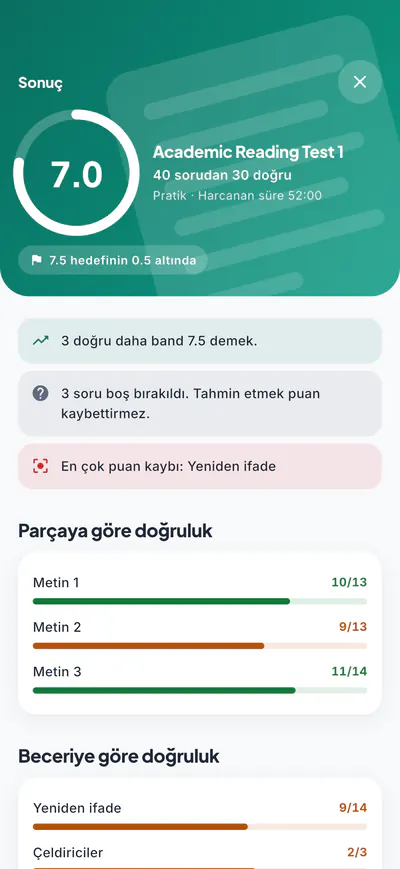
Gerçek IELTS band puanınızı sınavdan önce öğrenin
Band 8.5+ sertifikalı IELTS uzmanı, anadili İngilizce bir öğretmenle ücretsiz bire bir online ders. Gerçek formatta bir Speaking tanılaması, dürüst bir band tahmini ve size puan kaybettiren ölçütlere yönelik bir plan alırsınız. Ödeme yok, taahhüt yok.
Online · Bire bir · Academic ve General TrainingIELTS; British Council, IDP: IELTS Australia ve Cambridge University Press & Assessment kuruluşlarının tescilli markasıdır. Bu deneme sınavları Fleydo tarafından hazırlanmıştır; adı geçen kuruluşlarca onaylanmamış veya desteklenmemiştir.

 Taratın ve indirin
