1. Strona główna
  2. IELTS
  3. Testy próbne
  4. Writing
  5. Open-book exams

IELTS Writing · Task 2

IELTS Writing Task 2: Open-book exams

  • Dyskusja
  • 40 min
  • Słowa: 250
  • Academic i General Training

WRITING TASK 2

You should spend about 40 minutes on this task.

Some people believe students should be allowed to use their books and notes during exams, since nobody in real life has to work from memory alone. Others think that an exam only shows what a student has really learned if nothing can be brought into the room. Discuss both these views and give your own opinion. Give reasons for your answer and include any relevant examples from your own knowledge or experience.

Write at least 250 words.

40:00
0 / 250 słów

Oceń swoją odpowiedź

Najpierw przeczytaj wzorcowe odpowiedzi. Potem w każdym kryterium wybierz band, który pasuje do Twojej odpowiedzi. Twój wynik to średnia zaokrąglona do najbliższej połowy band.

6,0Twój szacowany band
Task response

Coherence and cohesion

Lexical resource

Grammatical range and accuracy

Każdy wzór jest napisany tak, jak napisałby go inny kandydat, więc szczegóły i opinie się różnią. Bandy to nasz szacunek według publicznych deskryptorów, a nie oficjalne oceny egzaminatora.

Wzorcowe odpowiedzi na czterech poziomach band

Każdy wzór jest napisany tak, jak napisałby go inny kandydat. Wyniki band to nasz szacunek według publicznych deskryptorów band.

Wzór na band 5,5Słowa: 277

Exams are very important for every student, and people have different ideas about how to do them. Some say students can open the book when they write the answer, but other people do not agree with this.

People who like open book exams think it is more close to real work. For example, a doctor or a office worker can check the computer or ask his friend when he did not know something. Nobody will ask him to remenber every formular. Also students will feel less nervous, because they know the answer is in the book. Before the exam many students cry and cannot sleep because they are afraid, this is not good for young people.

However, other people think students must learn everything by heart. If they can bring the book, they will not study before the test. They will only play games and then find the answer in the exam room. Although the exam is finish, but they learned nothing. It is also not fair, because a student who studyed hard and a lazy student can get the same mark.

In my view, the second opinion is better. In my country we have many big exams and all student must study hard, it is a hard time but after it we really remenber the things. Basic things should be in the head, not only in the book. If a doctor have to open a book every time he see patient, nobody will trust him.

So I think an exam without books is still the best way. Maybe the teacher can give some open book test in the class, but the important exam should be closed.

Dlaczego ten band

  • Both views are there and the opinion is clear: 'an exam without books is still the best way'.
  • The ideas are ordinary and short, such as 'They will only play games', and the doctor at the end is the only point with any force.
  • Tense and plural endings are the main habits: 'when he did not know', 'all student', 'he see patient'. 'Although the exam is finish, but they learned nothing' uses two linkers where one is enough.

Kryterium po kryterium

Task response
All parts are answered, with a position at the end. The reasons on both sides are named rather than explained, and the suggestion of an 'open book test in the class' comes too late to be developed.
Coherence and cohesion
A plain plan: one view, the other view, then 'In my view'. 'book' and 'exam' repeat throughout, and the last paragraph mostly says again what the one before it said.
Lexical resource
Simple words that carry the meaning: 'by heart' is well used, but 'more close to real work' and 'Basic things' show the limits. 'remenber', 'formular' and 'studyed' are spelt by sound.
Grammatical range and accuracy
Mostly short sentences, with an error in about half. 'all student must study hard, it is a hard time' and 'are afraid, this is not good' are comma splices, and 'a office worker' has the wrong article.

Jak osiągnąć kolejny band

Check the verb ending after 'he' and the plural after 'all' or 'many'. Then use 'Although' or 'but', never both, and give the point about fairness one more sentence saying what goes wrong for the hard-working student.

Zaplanuj, zanim zaczniesz pisać

Czego wymaga polecenie

This is a choice between two kinds of exam, not a question about whether exams are good at all. You must explain both views fairly and then decide. The first trap is drifting into exams against coursework, which nobody asked about. The second is assuming that a student with a book needs to do no work, when the real difference may be in the kind of question that can be set.

Twoja główna myśl

Decide what an exam is for, and let that choose the format. One workable message: basic knowledge has to be in the head, so closed papers suit early stages, while open-book papers suit advanced work where applying ideas matters more. You may also favour one format for most subjects; the 5.5 and 7.5 answers prefer closed papers, the 6.5 answer prefers open books, and the 8.5 answer divides them by level.

Akapit po akapicie

  1. IntroductionDescribe the disagreement in your own words and, if you wish, say where you stand. You can also hold your view back until the end, as long as your opening shows that you will give one.
  2. First viewExplain why books and notes might be allowed: work outside school, less memorising, harder questions, less panic. Keep examples general, such as a job most readers can picture.
  3. Second viewExplain why some want nothing in the room: knowledge needed at once, regular study, equal conditions for everyone.
  4. Your opinionState your view and why it beats the other one. If it depends on the subject or the level, say on what, and still decide.

Częste błędy

  • Discussing exams against coursework or continuous assessment. The question compares two kinds of exam.
  • Giving your own view all the way through and never explaining the view you reject.
  • Assuming that open-book exams are easy. They may mean harder questions and less time to search, and a good answer notices this.
  • Using only one example, such as a doctor, for both sides. Choose examples that really fit the point being made.
  • Writing 'it depends' and stopping there. Say what it depends on and which format you would choose in which case.

Słownictwo tematyczne

open-book exam
an exam in which candidates may use books or notes
to memorise
to learn something so that you can repeat it exactly
to cram
to study a lot in a very short time just before an exam
to look something up
to find a fact in a book or on a screen
recall
the ability to bring a fact back to mind
to apply knowledge
to use what you know in a new situation
revision
studying again what you have already learned
invigilator
a person who watches candidates during an exam

Przydatne zwroty

  • Those who favour ... point out that ...
  • This view assumes that ...
  • Being able to ... is not the same as being able to ...
  • ... may suit ..., whereas ... is better for ...
  • In subjects where ..., students need to ...
  • If ... are allowed, the questions would have to ...
  • My own view is that the format should depend on ...

Ikona aplikacji Fleydo IELTS Fleydo: Przygotowanie do IELTS

Zabierz te testy ze sobą na telefon

Każdy test z tych stron jest też w aplikacji Fleydo: Przygotowanie do IELTS na iPhone’a, iPada i Androida, razem z 2 000 słówek IELTS z nagraniami.

  • Działa offline, gdy test jest już na telefonie
  • 2 000 słówek IELTS z nagraniami, powtórki rozłożone w czasie i krótkie ćwiczenia
  • Nagrywaj swoje odpowiedzi w Speaking i odsłuchuj je
  • Plan na każdy dzień pod Twój docelowy band i datę egzaminu
Pobierz w App StorePobierz z Google Play
Zeskanuj, aby pobraćOtwiera App Store lub Google Play, zależnie od Twojego telefonu.

Konto nie jest potrzebne. O aplikacji

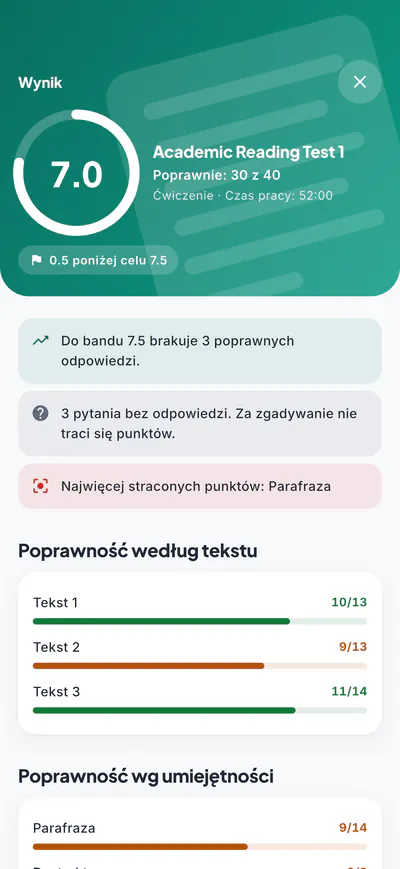
Wynik testu próbnego IELTS w aplikacji Fleydo: Przygotowanie do IELTS: szacowany band i poprawność w każdej części
Bezpłatna lekcja próbna

Poznaj swój prawdziwy wynik IELTS, zanim zrobi to egzamin

Bezpłatna indywidualna lekcja online z nauczycielem native speakerem, certyfikowanym specjalistą IELTS z wynikiem Band 8.5+. Otrzymasz diagnozę Speaking w prawdziwym formacie, uczciwą ocenę szacowanego wyniku i plan pracy nad dokładnie tymi kryteriami, które kosztują Cię punkty. Bez płatności, bez zobowiązań.

Online · Indywidualnie · Academic i General Training

IELTS jest zastrzeżonym znakiem towarowym British Council, IDP: IELTS Australia oraz Cambridge University Press & Assessment. Te testy próbne zostały przygotowane przez Fleydo i nie są przez te organizacje zatwierdzone ani rekomendowane.

Aplikacja mobilna

Fleydo English School w Twojej kieszeni

Lekcje, prace domowe, wiadomości i gry dla uczniów Fleydo i ich rodziców. Bezpłatna na iPhone’a i Androida.

Pobierz w App StorePobierz z Google Play
Więcej o aplikacji
Kod QR otwierający aplikację Fleydo English School w App Store lub Google PlayZeskanuj i pobierzOtwiera właściwy sklep dla Twojego telefonu.fleydo.com/app
Ikona aplikacji Fleydo IELTS
Fleydo: Przygotowanie do IELTS

Przygotowujesz się do IELTS?

Fleydo: Przygotowanie do IELTS to osobna aplikacja z testami próbnymi ze wszystkich czterech umiejętności. Nie potrzebujesz konta Fleydo, żeby z niej korzystać.

Zobacz aplikację IELTS
Pobierz w App StorePobierz z Google Play
Testy próbne IELTS

Ćwicz wszystkie cztery umiejętności IELTS

Wybieraj spośród 311 testów z natychmiastowym wynikiem band, wyjaśnieniami i wzorcowymi odpowiedziami. Bez rejestracji.

Wszystkie testy próbne
FleyPath

Osobista mapa drogowa Twojego dziecka — 3, 6 lub 12 miesięcy

🚀Start
👋Hello
😊Body
🦁Animals
🔢Numbers
🏆Pewny angielski
Zgrywalizowane ćwiczenie angielskiego

Jak gra — tylko że naprawdę się uczą