1. Strona główna
  2. IELTS
  3. Testy próbne
  4. Writing
  5. Night-time deliveries

IELTS Writing · Task 2

IELTS Writing Task 2: Night-time deliveries

  • Dyskusja
  • 40 min
  • Słowa: 250
  • Academic i General Training

WRITING TASK 2

You should spend about 40 minutes on this task.

Some people believe that lorries and vans should be allowed to bring goods into city centres only at night, when the streets are empty. Others argue that shops and other businesses should be able to receive deliveries at any hour of the day. Discuss both these views and give your own opinion. Give reasons for your answer and include any relevant examples from your own knowledge or experience.

Write at least 250 words.

40:00
0 / 250 słów

Oceń swoją odpowiedź

Najpierw przeczytaj wzorcowe odpowiedzi. Potem w każdym kryterium wybierz band, który pasuje do Twojej odpowiedzi. Twój wynik to średnia zaokrąglona do najbliższej połowy band.

6,0Twój szacowany band
Task response

Coherence and cohesion

Lexical resource

Grammatical range and accuracy

Każdy wzór jest napisany tak, jak napisałby go inny kandydat, więc szczegóły i opinie się różnią. Bandy to nasz szacunek według publicznych deskryptorów, a nie oficjalne oceny egzaminatora.

Wzorcowe odpowiedzi na czterech poziomach band

Każdy wzór jest napisany tak, jak napisałby go inny kandydat. Wyniki band to nasz szacunek według publicznych deskryptorów band.

Wzór na band 5,5Słowa: 261

Many cities have a big problem with the trucks that bring things to the shops. Some people say these trucks must come only in the night, but other people think the owner of the shop should decide the time. I agree with the first opinion.

In my city the roads in the centre very narrow. Every morning a truck stops in front of a shop for half an hour and the driver takes out the boxes, so the cars and the buses cannot pass. People arrive late to work and the students also late for school, everybody is angry. Later the roads are free so the truck can finish quickly and it uses less petrol.

On the other hand, the second opinion also has a good reason. A restaurent need fresh vegitables and meat every day. If the truck comes at two o'clock in the night, somebody must wait for it and the owner must pay him extra money, for a small restaurent this is very hard. So the owner prefer the day because he is there.

The restaurent can have a small van in the morning only for the fresh food, it is not big like the truck and it does not stop the road. All other things, for example clothes and furniture, should come after the shops close.

To sum up, the trafic in the day is bad for all the people in the city but the problem of the shop owner is only for few people. For this reason the government must make a rule about the night.

Dlaczego ten band

  • It takes a side and draws on one real street: 'a truck stops in front of a shop for half an hour'. The second view gets one reason, explained through the restaurant.
  • The same habits return: 'is' goes missing in 'the roads in the centre very narrow', 'in the night' is used where English needs a different small word, and verbs lose their -s in 'A restaurent need'.
  • Spelling follows the sound in 'trafic', 'vegitables' and 'restaurent', but the reader always understands.

Kryterium po kryterium

Task response
Both views appear and the position is plain: 'I agree with the first opinion'. The small van is offered as a compromise with no explanation of how it would work, and 'it uses less petrol' is as far as the second benefit goes.
Coherence and cohesion
A simple plan that is easy to follow, with basic links such as 'On the other hand', 'So' and 'To sum up'. 'the truck' and 'the restaurent' keep coming back because the writer has few other ways to refer to them.
Lexical resource
Everyday words, with 'truck' and 'things' doing most of the work. 'it does not stop the road' is the wrong verb, and 'the people in the city' is the only way this writer has of saying who is affected.
Grammatical range and accuracy
Mostly simple sentences, with an error in about half of them, as in 'the owner prefer' and 'only for few people'. Longer attempts come apart at a comma: 'pay him extra money, for a small restaurent this is very hard'.

Jak osiągnąć kolejny band

Put 'is' or 'are' into every sentence like 'the roads very narrow', and write 'at night'. Then explain how your compromise solves the problem you described, so that the last idea has a reason as well as a name.

Zaplanuj, zanim zaczniesz pisać

Czego wymaga polecenie

Two rules are set against each other: goods arrive only at night, or goods arrive whenever a business wants them. Explain why people hold each view before you give yours. The trap is writing about city traffic in general. Congestion is only part of this question, and the other side's reasons, such as who is there to take in the goods, are easy to leave out.

Twoja główna myśl

Say which rule you would choose and who would pay for it. One workable message: night deliveries free the daytime streets, but one rule for all goods and all streets moves the burden onto residents and small traders, so limits should depend on the vehicle or the street. Backing either rule outright is just as acceptable, and the 5.5 and 6.5 answers here do that. A clear reason counts for more than the side you pick.

Akapit po akapicie

  1. IntroductionSet out the conflict over when delivery vehicles use the centre, in your own words, and say where you stand. If you favour neither rule, say so here.
  2. The case for night onlyWho gains when lorries leave the daytime streets? Pick one or two: blocked buses, danger at junctions, dirty air on crowded pavements, shorter journeys for drivers. Say what changes for those people.
  3. The case for any hourGive this view real reasons of its own: goods that cannot wait, premises with nobody there at night, deliveries that need workers on site, the sleep of people living nearby.
  4. Your opinionGive your view and a reason for it. A rule based on vehicle size or on the type of street is fine, as long as you say how it would work and whom it would protect.

Częste błędy

  • Writing about traffic in general, or about banning private cars, instead of the timing of deliveries.
  • Treating 'at any hour' as a view with no reasons behind it. It needs arguments, such as goods that cannot wait or a shop with nobody on the premises at night.
  • Accepting that night streets are empty and silent because the question says so. People live above shops, and many centres stay busy late, so you can challenge this.
  • Leaving your opinion to one line at the end. The question asks for three things, and your view needs a reason of its own.
  • Repeating 'deliveries' and 'lorries' in every line when 'goods', 'suppliers', 'these vehicles' and 'vans' are available.

Słownictwo tematyczne

freight
goods carried by road, rail, sea or air
kerb
the edge of the pavement next to the road
to unload
to take goods off a vehicle
loading bay
a marked space where a vehicle stops to load or unload
perishable
going bad quickly, like fresh food
supplier
a business that provides goods to another business
shift
a fixed period of work, such as a night's work for a driver
congestion
too much traffic on the roads, so that vehicles move slowly

Przydatne zwroty

  • Those who want ... restricted to ... point out that ...
  • A rule of this kind would free ... for ...
  • The cost of such a rule would fall mainly on ...
  • Not every ... can wait until ...
  • This matters less for ... than for ..., because ...
  • Rather than one rule for ..., I would favour ...
  • My own view depends on ...: where ..., ...

Ikona aplikacji Fleydo IELTS Fleydo: Przygotowanie do IELTS

Zabierz te testy ze sobą na telefon

Każdy test z tych stron jest też w aplikacji Fleydo: Przygotowanie do IELTS na iPhone’a, iPada i Androida, razem z 2 000 słówek IELTS z nagraniami.

  • Działa offline, gdy test jest już na telefonie
  • 2 000 słówek IELTS z nagraniami, powtórki rozłożone w czasie i krótkie ćwiczenia
  • Nagrywaj swoje odpowiedzi w Speaking i odsłuchuj je
  • Plan na każdy dzień pod Twój docelowy band i datę egzaminu
Pobierz w App StorePobierz z Google Play
Zeskanuj, aby pobraćOtwiera App Store lub Google Play, zależnie od Twojego telefonu.

Konto nie jest potrzebne. O aplikacji

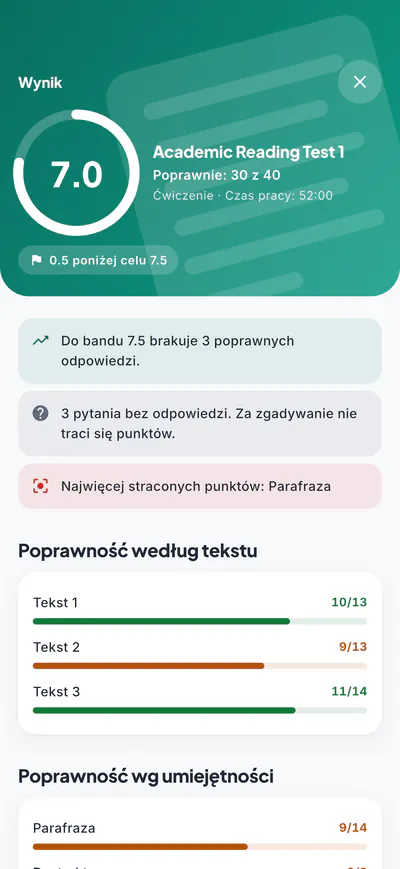
Wynik testu próbnego IELTS w aplikacji Fleydo: Przygotowanie do IELTS: szacowany band i poprawność w każdej części
Bezpłatna lekcja próbna

Poznaj swój prawdziwy wynik IELTS, zanim zrobi to egzamin

Bezpłatna indywidualna lekcja online z nauczycielem native speakerem, certyfikowanym specjalistą IELTS z wynikiem Band 8.5+. Otrzymasz diagnozę Speaking w prawdziwym formacie, uczciwą ocenę szacowanego wyniku i plan pracy nad dokładnie tymi kryteriami, które kosztują Cię punkty. Bez płatności, bez zobowiązań.

Online · Indywidualnie · Academic i General Training

IELTS jest zastrzeżonym znakiem towarowym British Council, IDP: IELTS Australia oraz Cambridge University Press & Assessment. Te testy próbne zostały przygotowane przez Fleydo i nie są przez te organizacje zatwierdzone ani rekomendowane.

Aplikacja mobilna

Fleydo English School w Twojej kieszeni

Lekcje, prace domowe, wiadomości i gry dla uczniów Fleydo i ich rodziców. Bezpłatna na iPhone’a i Androida.

Pobierz w App StorePobierz z Google Play
Więcej o aplikacji
Kod QR otwierający aplikację Fleydo English School w App Store lub Google PlayZeskanuj i pobierzOtwiera właściwy sklep dla Twojego telefonu.fleydo.com/app
Ikona aplikacji Fleydo IELTS
Fleydo: Przygotowanie do IELTS

Przygotowujesz się do IELTS?

Fleydo: Przygotowanie do IELTS to osobna aplikacja z testami próbnymi ze wszystkich czterech umiejętności. Nie potrzebujesz konta Fleydo, żeby z niej korzystać.

Zobacz aplikację IELTS
Pobierz w App StorePobierz z Google Play
Testy próbne IELTS

Ćwicz wszystkie cztery umiejętności IELTS

Wybieraj spośród 311 testów z natychmiastowym wynikiem band, wyjaśnieniami i wzorcowymi odpowiedziami. Bez rejestracji.

Wszystkie testy próbne
FleyPath

Osobista mapa drogowa Twojego dziecka — 3, 6 lub 12 miesięcy

🚀Start
👋Hello
😊Body
🦁Animals
🔢Numbers
🏆Pewny angielski
Zgrywalizowane ćwiczenie angielskiego

Jak gra — tylko że naprawdę się uczą