1. Strona główna
  2. IELTS
  3. Testy próbne
  4. Writing
  5. How households watch video

IELTS Writing · Task 1

IELTS Academic Writing Task 1: How households watch video

  • Wykres kołowy
  • 20 min
  • Słowa: 150
  • Academic

ACADEMIC WRITING TASK 1

You should spend about 20 minutes on this task.

The two pie charts below show how households in one country divided their video viewing time between different sources in 2015 and 2025. Summarise the information by selecting and reporting the main features, and make comparisons where relevant.

Write at least 150 words.

Share of household video viewing time in one country, 2015 and 2025
  • Broadcast TV
  • Recorded and catch-up TV
  • Paid streaming
  • Free video-sharing sites
  • DVDs and downloads
  • Other
Broadcast TV: 58%Recorded and catch-up TV: 15%Paid streaming: 9%Free video-sharing sites: 6%DVDs and downloads: 7%Other: 5%58%15%9%5%7%6%
Broadcast TV: 24%Recorded and catch-up TV: 13%Paid streaming: 31%Free video-sharing sites: 22%DVDs and downloads: 5%Other: 5%24%13%31%22%5%5%
Liczby są wymyślone na potrzeby ćwiczenia.
20:00
0 / 150 słów

Oceń swoją odpowiedź

Najpierw przeczytaj wzorcowe odpowiedzi. Potem w każdym kryterium wybierz band, który pasuje do Twojej odpowiedzi. Twój wynik to średnia zaokrąglona do najbliższej połowy band.

6,0Twój szacowany band
Task achievement

Coherence and cohesion

Lexical resource

Grammatical range and accuracy

Każdy wzór jest napisany tak, jak napisałby go inny kandydat, więc szczegóły i opinie się różnią. Bandy to nasz szacunek według publicznych deskryptorów, a nie oficjalne oceny egzaminatora.

Wzorcowe odpowiedzi na czterech poziomach band

Każdy wzór jest napisany tak, jak napisałby go inny kandydat. Wyniki band to nasz szacunek według publicznych deskryptorów band.

Wzór na band 5,5Słowa: 159

The two pie charts are about how famillies in one country watch video in 2015 and 2025. There are six kinds.

In 2015 the broadcast TV was the biggest with 58%, it is more than half. The second was recorded and catch-up TV with 15%. Paid streaming had 9%, DVDs and downloads had 7%, and free video sites had 6%. The other sources were only 5%.

In 2025 there were many changes in the chart. Broadcast TV was decrease to 24%, so it lost more than half of his part. Paid streaming became the first with 31% because it was increase very much. Free video sites also grow to 22%, it is more than three times of the first number. Recorded and catch-up TV changed only a little to 13%.

To conclude in 2025 peoples are watching less broadcast TV and more streaming than 2015 and the diffrence between the two charts is very big especially for broadcast TV.

Dlaczego ten band

  • The answer describes the 2015 pie and then the 2025 pie, so the comparison only starts halfway through, in 'Broadcast TV was decrease to 24%', and the 2025 figures for DVDs and downloads and for other sources are never given.
  • The closing summary picks the right features, but 'peoples are watching less broadcast TV' treats a share of viewing as if it were an amount.
  • The same mistake returns with verbs of change, 'was decrease' and 'was increase', and 'his part' uses a person's pronoun for a thing.

Kryterium po kryterium

Task achievement
The figures given are correct and the new leader is noticed in 'Paid streaming became the first', but DVDs and downloads and other sources disappear from the 2025 report, which looks like running out of time rather than selecting. The overview waits until the last sentence.
Coherence and cohesion
A clear two-part plan, one paragraph per year, with 'In 2015', 'In 2025' and 'To conclude' as signposts. The second paragraph is a series of separate reports with few links between them.
Lexical resource
A very small stock of words: 'biggest', 'part', 'very much'. 'lost more than half of his part' is a wrong word choice, and 'famillies' and 'diffrence' are misspelt.
Grammatical range and accuracy
Short sentences are often right, as in 'The second was recorded and catch-up TV with 15%', but about half of the sentences have an error. Typical are the comma splice in '58%, it is more than half', the verb form in 'Free video sites also grow to 22%' and a closing sentence that runs on without commas. The reader still understands.

Jak osiągnąć kolejny band

Put both figures for a slice in one sentence, such as broadcast TV falling from 58% to 24%, instead of reporting each chart separately, and include the two small slices you left out of 2025. Then fix your verbs of change: 'decreased' and 'increased', with no 'was' in front.

Zaplanuj, zanim zaczniesz pisać

Czego wymaga polecenie

Two pies with the same categories, ten years apart, so the real question is how each slice changed. The first trap is describing the 2015 pie and then the 2025 pie as two separate lists. The second is forgetting that pies show shares, not hours. You know that broadcast TV's share fell, but you do not know whether households watched fewer hours of it, because total viewing time is not given.

Twoje podsumowanie

Broadcast TV's share fell from well over half to under a quarter, and it lost first place to paid streaming. Together, paid streaming and free video-sharing went from a small minority to more than half of viewing time.

Akapit po akapicie

  1. IntroductionOne sentence in your own words: what the two pies divide up, where, and in which two years.
  2. OverviewThe move away from broadcast TV, the change in first place, and the combined growth of paid streaming and free video-sharing. Keep detailed figures for later.
  3. The falling shareBroadcast TV's two figures, compared with the next largest slice in 2015. Add recorded and catch-up TV, which fell only slightly.
  4. The growing shares and the small slicesPaid streaming and free video-sharing, with both figures and their new ranks. Cover DVDs and downloads and Other in one short clause.

Częste błędy

  • Describing 2015 and then 2025 as two separate lists. Follow each category across both pies so that every sentence makes a comparison.
  • Writing 'people watched less broadcast TV'. The charts show shares only, so keep to 'share', 'proportion' or 'accounted for'.
  • Saying broadcast TV fell by 34%. From 58% to 24% is a fall of 34 percentage points, which is more than half of its earlier share.
  • Giving DVDs and downloads and Other as much space as the big slices. A short clause is enough for categories that barely changed.
  • Naming real services or companies, or explaining the shift with faster internet or smartphones. Neither appears in the charts.

Słownictwo tematyczne

broadcast TV
programmes shown at set times on television channels
catch-up TV
television programmes watched some time after they were first shown
paid streaming
watching video over the internet through a paid service
video-sharing site
a website where users upload and watch videos
share
the part of a total that belongs to one category
to account for
to make up a particular part of a total
percentage point
the unit for the difference between two percentages
dominant
much larger or stronger than the others
catch-all
including everything not listed elsewhere

Przydatne zwroty

  • ... accounted for ...% of ... in ..., but only ...% ten years later.
  • The balance of ... moved away from ... and towards ...
  • ... was overtaken by ..., which by ... made up ...%.
  • ... more than tripled, from ...% to ...%, and took first place.
  • Together, ... and ... grew from ... to ...
  • ... barely moved, dipping from ...% to ...%, although ...
  • ... slipped from second to fourth place as ...
  • The smallest slices changed little: ... edged down from ... to ...

Ikona aplikacji Fleydo IELTS Fleydo: Przygotowanie do IELTS

Zabierz te testy ze sobą na telefon

Każdy test z tych stron jest też w aplikacji Fleydo: Przygotowanie do IELTS na iPhone’a, iPada i Androida, razem z 2 000 słówek IELTS z nagraniami.

  • Działa offline, gdy test jest już na telefonie
  • 2 000 słówek IELTS z nagraniami, powtórki rozłożone w czasie i krótkie ćwiczenia
  • Nagrywaj swoje odpowiedzi w Speaking i odsłuchuj je
  • Plan na każdy dzień pod Twój docelowy band i datę egzaminu
Pobierz w App StorePobierz z Google Play
Zeskanuj, aby pobraćOtwiera App Store lub Google Play, zależnie od Twojego telefonu.

Konto nie jest potrzebne. O aplikacji

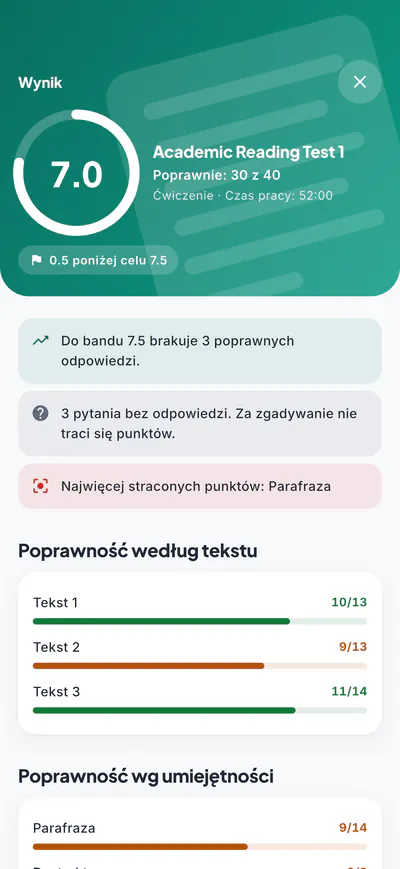
Wynik testu próbnego IELTS w aplikacji Fleydo: Przygotowanie do IELTS: szacowany band i poprawność w każdej części
Bezpłatna lekcja próbna

Poznaj swój prawdziwy wynik IELTS, zanim zrobi to egzamin

Bezpłatna indywidualna lekcja online z nauczycielem native speakerem, certyfikowanym specjalistą IELTS z wynikiem Band 8.5+. Otrzymasz diagnozę Speaking w prawdziwym formacie, uczciwą ocenę szacowanego wyniku i plan pracy nad dokładnie tymi kryteriami, które kosztują Cię punkty. Bez płatności, bez zobowiązań.

Online · Indywidualnie · Academic i General Training

IELTS jest zastrzeżonym znakiem towarowym British Council, IDP: IELTS Australia oraz Cambridge University Press & Assessment. Te testy próbne zostały przygotowane przez Fleydo i nie są przez te organizacje zatwierdzone ani rekomendowane.

Aplikacja mobilna

Fleydo English School w Twojej kieszeni

Lekcje, prace domowe, wiadomości i gry dla uczniów Fleydo i ich rodziców. Bezpłatna na iPhone’a i Androida.

Pobierz w App StorePobierz z Google Play
Więcej o aplikacji
Kod QR otwierający aplikację Fleydo English School w App Store lub Google PlayZeskanuj i pobierzOtwiera właściwy sklep dla Twojego telefonu.fleydo.com/app
Ikona aplikacji Fleydo IELTS
Fleydo: Przygotowanie do IELTS

Przygotowujesz się do IELTS?

Fleydo: Przygotowanie do IELTS to osobna aplikacja z testami próbnymi ze wszystkich czterech umiejętności. Nie potrzebujesz konta Fleydo, żeby z niej korzystać.

Zobacz aplikację IELTS
Pobierz w App StorePobierz z Google Play
Testy próbne IELTS

Ćwicz wszystkie cztery umiejętności IELTS

Wybieraj spośród 311 testów z natychmiastowym wynikiem band, wyjaśnieniami i wzorcowymi odpowiedziami. Bez rejestracji.

Wszystkie testy próbne
FleyPath

Osobista mapa drogowa Twojego dziecka — 3, 6 lub 12 miesięcy

🚀Start
👋Hello
😊Body
🦁Animals
🔢Numbers
🏆Pewny angielski
Zgrywalizowane ćwiczenie angielskiego

Jak gra — tylko że naprawdę się uczą