1. Strona główna
  2. IELTS
  3. Testy próbne
  4. Speaking
  5. Test próbny IELTS Speaking 9: Rules

IELTS Speaking

Test próbny IELTS Speaking 9: Rules

Describe a rule at school, at work or at home that seemed unfair to you at first.

  • 3 części
  • 11–14 min
  • Egzaminator
  • Czterech kandydatów, jeden test

Przystąp do testu

Pytania egzaminatora są odtwarzane jedno po drugim. Odpowiadaj na głos, tak jak na egzaminie. Nagrywanie jest opcjonalne i zostaje w tej karcie przeglądarki.

Twoje nagrania są przechowywane tylko w tej karcie. Nic nie jest wysyłane. Pobierz je, jeśli chcesz je zachować.

Oceń swoją wypowiedź

Porównaj swoje odpowiedzi z odpowiedziami kandydatów, a potem w każdym kryterium wybierz band, który do Ciebie pasuje.

6,0Twój szacowany band
Fluency and coherence

Lexical resource

Grammatical range and accuracy

Pronunciation

Każdy kandydat to inna osoba, więc historie i opinie się różnią. Bandy to nasz szacunek według publicznych deskryptorów, a nie oficjalne oceny egzaminatora. Transkrypcja nie pokazuje wymowy. Te bandy zakładają, że jest ona na tym samym poziomie co pozostałe trzy kryteria.

Pytania, karta zadania i przykładowe odpowiedzi

Part 1: wywiad

The area where you live

  • Where do you live at the moment?
  • Is it a quiet area, or is there usually a lot going on?
  • Did you grow up in a similar kind of area?
  • Would you like to live there for a long time? (Why?)

Being on time

  • Are you usually on time for things?
  • How do you feel when someone keeps you waiting?
  • Were you ever late for school when you were a child?
  • What do you do to make sure you're not late for something important?

Borrowing things

  • Do you often borrow things from other people?
  • Is there anything you would never borrow from someone else?
  • Have you ever borrowed something and forgotten to give it back?

Wskazówki

  • The area where you live is about your daily life, not a guidebook. Say what you see, hear and do there, and if it comes naturally, one way it is different from the place where you grew up.
  • Being on time and borrowing are small topics. One true detail, such as how many alarms you set or the thing you never gave back, is worth more than a general statement, and a short answer with that detail is enough.
  • Listen for the tense: 'Were you ever late ... when you were a child' wants past forms, 'Have you ever borrowed ...' takes the present perfect for the yes or no and the past simple for the story, and 'Would you like to live there ...' needs would.

Part 2: dłuższa wypowiedź (karta zadania)

Describe a rule at school, at work or at home that seemed unfair to you at first.

You should say:

  • what the rule was and who made it
  • why it seemed unfair to you
  • what it was like having to follow it

and explain whether you still feel the same way about it.

Pytanie dodatkowe

  • Did other people feel the same way about it?
  • Do you usually follow rules, even ones you don't agree with?

Notatki, które mógłby zrobić mocny kandydat

  • uni library, no food or drink
  • even water, bottles left at the door
  • library staff, signs everywhere
  • unfair? exam weeks, ten hours inside
  • spilt coffee on a library laptop
  • now: fair for food, not water

Wskazówki

  • The card has two times in it: how you felt then and how you feel now. Save at least thirty seconds for now, because the explain line is where you compare and reflect. Many candidates spend the whole two minutes on the story.
  • If no big rule comes to mind, a small one works: a bedtime at home, a rule in a shared flat, at a sports club, in a library or at a part-time job. You do not have to have changed your mind. If you still think it is unfair, say so and say why.
  • Say who made the rule early, in a few words. It gives you an easy way into fairness later: did they explain it, and did they follow it themselves?

Part 3: dyskusja

Rules in families and schools

  • Why do some parents set far more rules for their children than others do? Wyjaśnianie
  • Are family rules stricter or less strict now than when your parents were children? Porównywanie
  • Should students have a say in the rules at their school? Ważenie argumentów

Everyday rules in public places

  • Why do you think some people ignore small rules in public places? Wyjaśnianie
  • What's the best way to get people to follow rules in places like parks or on public transport? Proponowanie
  • Do you think there'll be more rules in public places in the future, or fewer? Spekulowanie o przyszłości

Wskazówki

  • These questions move from your own family and school to people in general. Your own example is a good start, but then say whether you think most people are the same, and why.
  • For the then-and-now question, look for one way things are less strict and one way they are stricter or simply different. That gives you something to develop instead of a plain yes or no.
  • For the future question, choose a direction and base it on something you can see happening now. You can admit you are unsure, but give a reason for your best guess.

Czterech kandydatów, jeden test

Jak na każde pytanie odpowiadały osoby z czterema różnymi bandami.

Part 1Where do you live at the moment?

In Córdoba, in Argentina. I live with my brother in a small flat, in a neighbourhood a bit far from the centre. It's mostly houses there, not big buildings.

Part 1Is it a quiet area, or is there usually a lot going on?

Quiet, yes. In the week nobody is in the street, only the dogs, um, many dogs. But at the weekend the neighbours have barbecue in the garden, with the music very loud, so... not so quiet.

Part 1Did you grow up in a similar kind of area?

No, very different. I grew up in the countryside, in a little town, er, with farms all around. There everybody knows you, your family, everything. I came to Córdoba five years ago, because in my town there was no work.

Part 1Would you like to live there for a long time? (Why?)

Er... not for long, no. The flat is small, and the bus to my work take almost one hour. I prefer to live close to my work. Or maybe one day, er, go back to my town.

Part 1Are you usually on time for things?

At work, yes, always, because if you arrive late they discount from your pay. But with friends... no. Nobody is on time with friends. If we say nine o'clock, we meet at ten.

Part 1How do you feel when someone keeps you waiting?

It depends who. If it's a friend, no problem, I look at my phone, I wait. But at the doctor, when you wait two hours for, er, for nothing... that makes me very angry.

Part 1Were you ever late for school when you were a child?

Not much. My school was very near, only two blocks, and I went walking with my sister. She was always late, because she takes a long time to... to get ready, so sometimes I went alone.

Part 1What do you do to make sure you're not late for something important?

I put two alarms in the phone. And I check the bus the night before, because here the buses are... they don't come on time. Sometimes I go one hour early.

Part 1Do you often borrow things from other people?

Not very often. Sometimes tools from my neighbour, a drill or the ladder. He's an old man, he has everything, and he likes to help.

Part 1Is there anything you would never borrow from someone else?

Er... clothes, I think. It's not, um, hygienic? My brother always takes my T-shirts without asking me, and we fight for this every week.

Part 1Have you ever borrowed something and forgotten to give it back?

Yes... a book. A friend borrow me a book in the secondary school, and I still have it, er, in my parents' house. Ten years! I think he forgot about it.

Part 2Describe a rule at school, at work or at home that seemed unfair to you at first.

Er, this rule is from my job. I work in a warehouse of a company that sells things on the internet, and my work is to prepare the orders, er, put the products in the boxes. When I started, two years ago, the supervisor told me, here you cannot use headphones. Never, all the day. And I thought, this is not fair. Because the work is very... very repetitive, eight hours the same thing, and with music you don't feel the hours. In my last job, in a supermarket, I could listen music, no problem. Also the other guys, the young ones, they was angry too, and some of them used one headphone, er, hidden under the cap. So one day I did the same, only one. And a man was driving the – the machine, how do you say, for move the pallets, and he was behind me and he shout, and I didn't hear him. Nothing happened, he stopped, but, um, my heart... After that I understand the rule. The warehouse is very noisy, you need the ears. So now I think it's fair, for the safety. But it's boring, er, still boring. Maybe they can put the radio for everybody, like in the supermarket, I don't know. Er... yes, that's the rule.

Part 2Did other people feel the same way about it?

Yes, everybody. Only the supervisor say it's a good rule, of course.

Part 2Do you usually follow rules, even ones you don't agree with?

Er... in the work, yes, always. In the street, er, not always, like everybody.

Part 3Why do some parents set far more rules for their children than others do?

Er... I think it depends of the parents, how old they are. Young parents are more relaxed, because they remember when they was young. My mother was, um, more old when she had me, and she was very strict, I couldn't go to the river with my friends, never. And if they have only one child, they control more, because all the attention is for him.

Part 3Are family rules stricter or less strict now than when your parents were children?

Less strict, for sure. When my father was small, er, he couldn't talk at the table, only the adults. And if he come home late, he can't go out for one month. Now is very different, the parents talk with the children, they explain everything. It's better, but sometimes, um, the children don't respect nothing.

Part 3Should students have a say in the rules at their school?

Er, yes, a little bit, I think. The older students, in the secondary school, they can say, er, this rule is stupid, we want to change it. But the small children, no, because if you ask them, they want no homework, no classes, only, um, playing.

Part 3Why do you think some people ignore small rules in public places?

Because nobody controls. If there is no police, no, er, guard, the people think, ah, it's not important, nobody see me. For example, in my neighbourhood there is a sign, don't leave the garbage in the corner, and everybody leaves the garbage there, every day. Because they are lazy, I think, and also because nobody, er, gives them a fine.

Part 3What's the best way to get people to follow rules in places like parks or on public transport?

Er... money. The fines. Because if you have to pay, you remember the next time. For example in the bus, if you don't pay the ticket and they catch you, you pay a lot more. And maybe more signs, more, um, clear, because some people really don't know the rule.

Part 3Do you think there'll be more rules in public places in the future, or fewer?

More, I think. Because there is more people every year in the cities, more cars, more noise, and the people don't, er, respect the others. So the government make more rules, more and more. I don't like it very much, but... yes, I think more.

Słówka do tego testu

strict
making people follow rules closely, with little freedom
bend the rules
allow something that is not quite allowed, usually in a small way
stick to the rules
follow the rules exactly
get away with something
do something wrong without being caught or punished
have a say (in something)
have the right to give your opinion and have it taken into account
a curfew
a time by which someone has to be home or inside
a fine
money you have to pay as a punishment
enforce a rule
make sure that people actually obey it
see the point of something
understand why something is done or needed
fair enough
used in conversation to accept that something is reasonable
run late
be later than you planned
borrow / lend
you borrow something from someone; you lend something to someone

Przydatne zwroty

  • At first I thought ___ was unfair, because ___.
  • I didn't see the point of ___ until ___.
  • Now that I'm older, I can see why ___, but I still think ___.
  • I'm not against ___, as long as ___.
  • It's one thing to ___, but it's quite another to ___.
  • When I was a child, ___, whereas these days ___.
  • If it were up to me, I'd ___.
  • I'm usually the kind of person who ___.
  • Part of the reason is ___, and part of it is ___.

Ikona aplikacji Fleydo IELTS Fleydo: Przygotowanie do IELTS

Zabierz te testy ze sobą na telefon

Każdy test z tych stron jest też w aplikacji Fleydo: Przygotowanie do IELTS na iPhone’a, iPada i Androida, razem z 2 000 słówek IELTS z nagraniami.

  • Działa offline, gdy test jest już na telefonie
  • 2 000 słówek IELTS z nagraniami, powtórki rozłożone w czasie i krótkie ćwiczenia
  • Nagrywaj swoje odpowiedzi w Speaking i odsłuchuj je
  • Plan na każdy dzień pod Twój docelowy band i datę egzaminu
Pobierz w App StorePobierz z Google Play
Zeskanuj, aby pobraćOtwiera App Store lub Google Play, zależnie od Twojego telefonu.

Konto nie jest potrzebne. O aplikacji

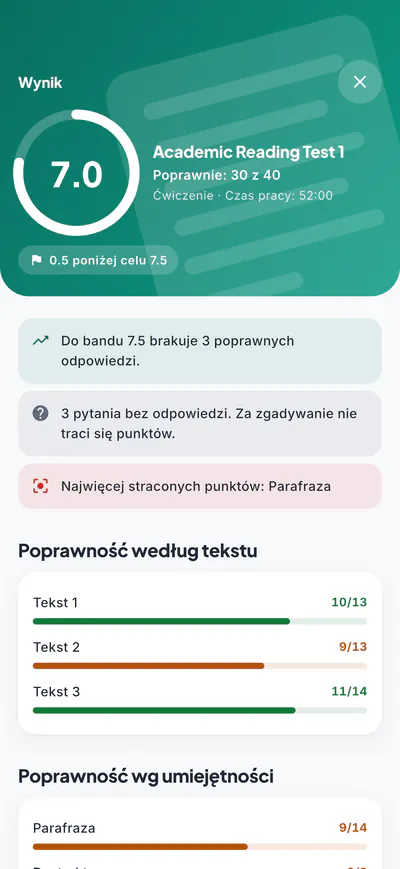
Wynik testu próbnego IELTS w aplikacji Fleydo: Przygotowanie do IELTS: szacowany band i poprawność w każdej części
Bezpłatna lekcja próbna

Poznaj swój prawdziwy wynik IELTS, zanim zrobi to egzamin

Bezpłatna indywidualna lekcja online z nauczycielem native speakerem, certyfikowanym specjalistą IELTS z wynikiem Band 8.5+. Otrzymasz diagnozę Speaking w prawdziwym formacie, uczciwą ocenę szacowanego wyniku i plan pracy nad dokładnie tymi kryteriami, które kosztują Cię punkty. Bez płatności, bez zobowiązań.

Online · Indywidualnie · Academic i General Training

IELTS jest zastrzeżonym znakiem towarowym British Council, IDP: IELTS Australia oraz Cambridge University Press & Assessment. Te testy próbne zostały przygotowane przez Fleydo i nie są przez te organizacje zatwierdzone ani rekomendowane.

Aplikacja mobilna

Fleydo English School w Twojej kieszeni

Lekcje, prace domowe, wiadomości i gry dla uczniów Fleydo i ich rodziców. Bezpłatna na iPhone’a i Androida.

Pobierz w App StorePobierz z Google Play
Więcej o aplikacji
Kod QR otwierający aplikację Fleydo English School w App Store lub Google PlayZeskanuj i pobierzOtwiera właściwy sklep dla Twojego telefonu.fleydo.com/app
Ikona aplikacji Fleydo IELTS
Fleydo: Przygotowanie do IELTS

Przygotowujesz się do IELTS?

Fleydo: Przygotowanie do IELTS to osobna aplikacja z testami próbnymi ze wszystkich czterech umiejętności. Nie potrzebujesz konta Fleydo, żeby z niej korzystać.

Zobacz aplikację IELTS
Pobierz w App StorePobierz z Google Play
Testy próbne IELTS

Ćwicz wszystkie cztery umiejętności IELTS

Wybieraj spośród 311 testów z natychmiastowym wynikiem band, wyjaśnieniami i wzorcowymi odpowiedziami. Bez rejestracji.

Wszystkie testy próbne
FleyPath

Osobista mapa drogowa Twojego dziecka — 3, 6 lub 12 miesięcy

🚀Start
👋Hello
😊Body
🦁Animals
🔢Numbers
🏆Pewny angielski
Zgrywalizowane ćwiczenie angielskiego

Jak gra — tylko że naprawdę się uczą