1. Strona główna
  2. IELTS
  3. Testy próbne
  4. Reading
  5. Reading Summary Completion: ćwiczenie 5

IELTS Reading · Uzupełnianie streszczenia

IELTS Reading Summary Completion: ćwiczenie 5

Colours in fireworks

  • 12 pytań
  • 15 min
  • Academic

Co jest w tym teście

  1. PassagePytania 1–12Metal in the sky

Typy pytań

  • Uzupełnianie streszczenia
ReadingIELTS Reading Summary Completion: ćwiczenie 5
Pozostały czas15:00

Passage

Metal in the sky

A The small pellets that colour a firework display are called stars, and they begin rather like dough. A mixture of chemicals is rolled and cut, or pressed in a mould, into pieces anything from an oat flake to a golf ball in size. A typical star holds four kinds of ingredient: a fuel, an oxidiser to supply oxygen for burning, a binder to keep everything together, and the salts that produce the colour.

B Those salts contain metals, and the colour is a matter of electrons. Heat from the burning star drives an electron in a metal atom farther from the nucleus, into what chemists call an excited state. When it falls back, the extra energy leaves as light. Because the size of this energy step differs from metal to metal, each has a colour of its own: strontium and lithium give red, calcium orange, sodium yellow, barium green and copper blue. White has a separate origin, the brilliant glow of reactive metals such as magnesium or aluminium as they burn.

C The metal is often not enough by itself. Some of the emitters are in fact molecules formed in the flame, in which the metal is joined to chlorine, and in many cases makers must add a chlorine donor to reach a deep colour. The other part of a salt has little direct effect on the shade, although it can alter the temperature of the flame.

D Heat is thus both essential and dangerous. Hot solid particles in the flame glow across a broad range of wavelengths and wash out the colours. At very high temperatures atoms can also lose electrons, and the resulting ions may emit light of the wrong kind: barium ions, for instance, emit in the blue, a fault that adding potassium can suppress.

E Nowhere is the balance finer than with blue. Copper chloride, the source of the richest blue, is unstable, and according to Jacqueline Akhavan of Cranfield University it breaks apart if the flame grows too hot, so the composition has to stay cool long enough for the colour to be seen. Blue is widely regarded as the hardest colour to achieve, and it is often said that a whole display can be judged by the quality of its blue. Purple is also awkward, since it usually requires compounds to be mixed and blue compositions combine poorly with others.

F Getting the stars into the sky is a separate piece of engineering. A display shell is a casing of heavy paper or cardboard placed in a launch tube called a mortar. At its base sits a lift charge of black powder. The shell is not a rocket: the charge does nothing but explode, and as its gases expand they force the shell out of the tube. The launch also lights a slow-burning time fuse that leads into the shell. Near the top of the climb, the fuse reaches the burst charge at the centre, which breaks the casing open, ignites the stars and throws them outward.

G The picture in the sky is decided before launch. For a particular shape, the stars can be fixed to a sheet of paper in the pattern wanted, and the chemist John Conkling stressed how much testing their placing demands. A star that changes colour contains compositions that burn in turn, red and then green, say; one method rolls a pellet in two or three chemical mixtures to create layers. Many stars also receive a coating of gunpowder to help them catch light.

Słowniczek
oxidiser
a chemical that supplies oxygen so that a fuel can burn
nucleus
the central part of an atom
chlorine donor
a substance that releases chlorine when it burns
wavelengths
measures of light waves; different wavelengths are seen as different colours
ions
atoms that have lost or gained electrons
black powder
another name for gunpowder
PassagePytania 1–12
Pytania 1–12 Maks. 2 słowa

Complete the summary below. Choose NO MORE THAN TWO WORDS from the passage for each answer.

A firework's colours come from stars, pellets that contain a fuel, an oxidiser, a 1 and metal salts. Heat moves an 2 in a metal atom away from the centre of the atom, and light is given off when it returns. Each metal has its own colour, so a green star normally contains 3. Some of the substances that emit the light are molecules containing both the metal and 4. Too much heat causes trouble: glowing solid 5 can make colours look faded, and blue is especially difficult because 6 does not survive in an overheated flame. Before launch, stars may be attached to a sheet of 7 to make a chosen picture, and some that change colour are rolled in two or three mixtures to form 8. The shell is fired from a tube known as a 9 by the explosion of a 10 charge of black powder, and a slower 11 then sets off the 12 charge in the middle of the shell.

Odpowiedzi i wyjaśnienia

Najpierw rozwiąż test: klucz bardziej się przyda, gdy masz już swoje odpowiedzi.

Pokaż klucz odpowiedzi i wyjaśnienia
  1. 1
    binder

    Paragraph A lists a star's four ingredients, and the summary already gives the fuel, the oxidiser and the salts. The one left is 'a binder to keep everything together', so the answer is binder.

  2. 2
    electron

    Paragraph B says heat 'drives an electron in a metal atom farther from the nucleus'. The nucleus is the centre of the atom. The word an before the gap shows that the singular, electron, is needed.

  3. 3
    barium

    Paragraph B lists the metals and their colours, and 'barium green' pairs the two. Barium ions in paragraph D are a trap: they emit blue, and that is described there as a fault.

  4. 4
    chlorine

    Paragraph C describes 'molecules formed in the flame, in which the metal is joined to chlorine'. Containing both the metal and another element means the same, so the missing word is chlorine.

  5. 5
    particles

    Paragraph D says hot solid particles glow and 'wash out the colours'. Faded colours are washed-out colours. The summary already gives glowing and solid, so the word that completes it is particles.

  6. 6
    copper chloride

    Paragraph E says copper chloride 'breaks apart if the flame grows too hot'. Copper alone is not enough, because the passage says this about the compound. Does not survive means breaks apart.

  7. 7
    paper

    Paragraph G says stars 'can be fixed to a sheet of paper in the pattern wanted'. Attached means fixed. The heavy paper in paragraph F is a trap: that forms the casing, so it has nothing to do with this picture.

  8. 8
    layers

    Paragraph G says one method rolls a pellet in two or three chemical mixtures 'to create layers'. To form means to create. Mixtures are already named in the summary, so the missing word is layers.

  9. 9
    mortar

    Paragraph F says the shell is 'placed in a launch tube called a mortar'. Known as means called. Casing is a trap: that is the outer part of the shell, not the tube it is fired from.

  10. 10
    lift charge / lift

    Paragraph F says a lift charge of black powder sits at the base, and its explosion drives the shell out. The word charge is already in the summary. The burst charge is the trap: it acts later, near the top of the climb.

  11. 11
    time fuse / fuse

    Paragraph F mentions 'a slow-burning time fuse' that is lit at launch. Slower in the summary matches slow-burning, so write time fuse or just fuse. All three words together would break the word limit.

  12. 12
    burst charge / burst

    Paragraph F says 'the fuse reaches the burst charge at the centre'. In the middle means at the centre. The lift charge is the trap: it sits at the base and has already exploded.

Słowa kluczowe z tego testu

Passage

ingredient
one of the things that a mixture is made from
emit
to send out light, heat or gas
suppress
to stop something from happening
unstable
likely to change or break down
casing
a cover that protects what is inside
Uzupełnianie streszczenia: jak odpowiadać na te pytaniaUnderstand the summary first, then find each missing word in the text.

What the task looks like

The instruction says 'Complete the summary below.' You get a short paragraph that rewords ideas from the text, with gaps in it, and a limit such as ONE WORD ONLY. The answers are words from the text. Some Academic summaries work differently: you choose each word from a list instead, and the list often uses different words from the text, so you match the meaning.

The task tests details and main ideas, and whether you can tell what type of word each gap needs.

A method to try

1. Read the whole summary first, ignoring the gaps. What is it about? Which part of the text does it seem to cover?

2. Find that part of the text, using what you learned when you skimmed.

3. For each gap, decide the type of word and guess the general meaning. 'Rose by ____' needs an amount, for example.

4. Compare the summary with the text, idea by idea. A summary can join ideas from different sentences or change their order, so do not rely on the gaps following the order of the text.

5. Read the finished summary from start to finish. It should make sense as a whole.

The traps

Linking words: 'but', 'although', 'instead of' and 'rather than' show how ideas relate. A gap after 'rather than' needs the thing that was not chosen.

Size words: 'most', 'a small part', 'mainly' and 'the rest' tell you which of two facts the gap wants.

The likely answer: a word can fit the gap and sound sensible, yet not be what the text says at this point.

Worked example

Text: The museum's new roof was paid for mainly by local businesses. A small grant from the council covered the rest. Ticket prices, which some visitors had expected to rise, stayed the same.

Summary: Most of the money for the new roof came from ____. Visitors did not have to pay more to enter. (NO MORE THAN TWO WORDS)

Słabothe council. A grant is money, and it sounds likely that a council would pay for a museum roof.
Lepiejlocal businesses. 'Most of' is a paraphrase of 'mainly', and the text says businesses 'mainly' paid. The council's grant was 'small' and only 'covered the rest'.

Both answers fit the grammar, so grammar cannot decide. Follow the size words to see which fact the summary wants.

Ikona aplikacji Fleydo IELTS Fleydo: Przygotowanie do IELTS

Zabierz te testy ze sobą na telefon

Każdy test z tych stron jest też w aplikacji Fleydo: Przygotowanie do IELTS na iPhone’a, iPada i Androida, razem z 2 000 słówek IELTS z nagraniami.

  • Działa offline, gdy test jest już na telefonie
  • 2 000 słówek IELTS z nagraniami, powtórki rozłożone w czasie i krótkie ćwiczenia
  • Nagrywaj swoje odpowiedzi w Speaking i odsłuchuj je
  • Plan na każdy dzień pod Twój docelowy band i datę egzaminu
Pobierz w App StorePobierz z Google Play
Zeskanuj, aby pobraćOtwiera App Store lub Google Play, zależnie od Twojego telefonu.

Konto nie jest potrzebne. O aplikacji

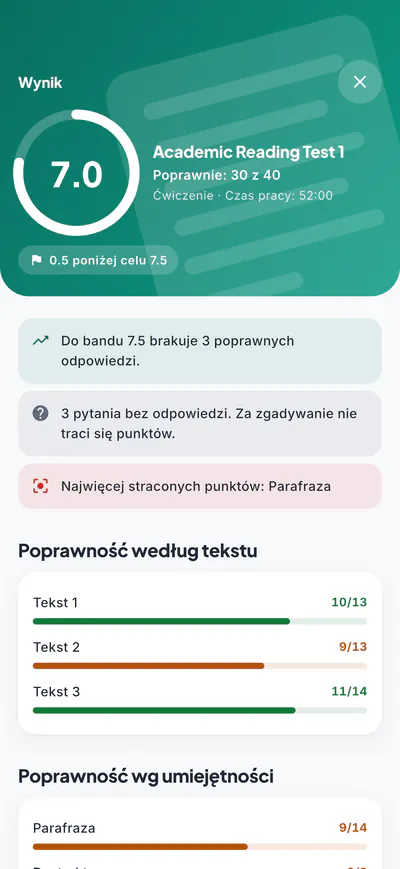
Wynik testu próbnego IELTS w aplikacji Fleydo: Przygotowanie do IELTS: szacowany band i poprawność w każdej części
Bezpłatna lekcja próbna

Poznaj swój prawdziwy wynik IELTS, zanim zrobi to egzamin

Bezpłatna indywidualna lekcja online z nauczycielem native speakerem, certyfikowanym specjalistą IELTS z wynikiem Band 8.5+. Otrzymasz diagnozę Speaking w prawdziwym formacie, uczciwą ocenę szacowanego wyniku i plan pracy nad dokładnie tymi kryteriami, które kosztują Cię punkty. Bez płatności, bez zobowiązań.

Online · Indywidualnie · Academic i General Training

IELTS jest zastrzeżonym znakiem towarowym British Council, IDP: IELTS Australia oraz Cambridge University Press & Assessment. Te testy próbne zostały przygotowane przez Fleydo i nie są przez te organizacje zatwierdzone ani rekomendowane.

Aplikacja mobilna

Fleydo English School w Twojej kieszeni

Lekcje, prace domowe, wiadomości i gry dla uczniów Fleydo i ich rodziców. Bezpłatna na iPhone’a i Androida.

Pobierz w App StorePobierz z Google Play
Więcej o aplikacji
Kod QR otwierający aplikację Fleydo English School w App Store lub Google PlayZeskanuj i pobierzOtwiera właściwy sklep dla Twojego telefonu.fleydo.com/app
Ikona aplikacji Fleydo IELTS
Fleydo: Przygotowanie do IELTS

Przygotowujesz się do IELTS?

Fleydo: Przygotowanie do IELTS to osobna aplikacja z testami próbnymi ze wszystkich czterech umiejętności. Nie potrzebujesz konta Fleydo, żeby z niej korzystać.

Zobacz aplikację IELTS
Pobierz w App StorePobierz z Google Play
Testy próbne IELTS

Ćwicz wszystkie cztery umiejętności IELTS

Wybieraj spośród 311 testów z natychmiastowym wynikiem band, wyjaśnieniami i wzorcowymi odpowiedziami. Bez rejestracji.

Wszystkie testy próbne
FleyPath

Osobista mapa drogowa Twojego dziecka — 3, 6 lub 12 miesięcy

🚀Start
👋Hello
😊Body
🦁Animals
🔢Numbers
🏆Pewny angielski
Zgrywalizowane ćwiczenie angielskiego

Jak gra — tylko że naprawdę się uczą