1. Strona główna
  2. IELTS
  3. Testy próbne
  4. Reading
  5. Reading Short Answer: ćwiczenie 3

IELTS Reading · Krótka odpowiedź

IELTS Reading Short Answer: ćwiczenie 3

Arabic numerals in Europe

  • 12 pytań
  • 15 min
  • Academic

Co jest w tym teście

  1. PassagePytania 1–12Nine figures and a sign

Typy pytań

  • Krótka odpowiedź
ReadingIELTS Reading Short Answer: ćwiczenie 3
Pozostały czas15:00

Passage

Nine figures and a sign

A As a boy, Leonardo of Pisa, now better known as Fibonacci, was sent for by his father, who had been appointed to the customs house at Bugia, a port in what is today Algeria, to act for the Pisan merchants trading there. In the preface to his later book he recalls that lessons in the numerals of India so appealed to him that he carried on studying them during business journeys to Egypt, Syria, Greece, Sicily and Provence.

B That book, the Liber Abaci of 1202, is a Latin work of about 600 pages. Its first chapter sets out nine figures and the sign 0, with which, it explains, any number may be written. Later sections turn to such commercial business as converting currencies and measures and working out profit and interest. No copy of the 1202 text is known. A revised version appeared in 1228, and the book stayed in manuscript until an edition was printed in 1857.

C Fibonacci was not the first to show such figures to Europeans. A manuscript copied in Spain in 976, the Codex Vigilanus, contains the numerals one to nine, though not zero, and Gerbert of Aurillac, the future Pope Sylvester II, used his position to spread knowledge of them. Even so, people long went on relying on Roman numerals and on counting boards.

D How far Fibonacci's own book altered this is disputed. The mathematician and author Keith Devlin claims that it changed the world, while the historian Jens Høyrup argues that it was not central to the commercial arithmetic that followed, which he traces to wider contact with everyday Arabic practice. Another line of research looks at who used the numerals. According to the economic historian Raffaele Danna, merchant-bankers realised that they suited their needs better than Roman ones, and by the late thirteenth century practical arithmetic manuals were appearing in central Italy. Danna has traced this tradition through more than 1,280 such manuals.

E Not every authority welcomed the change. In 1299 the statutes of the guild of bankers and money-changers in Florence forbade its members to use the new numerals in their books, though some modern accounts describe a wider ban on merchants or on contracts. Members were obliged to use Roman numerals or, by one account, to write numbers out as words. Fear of forgery is one suggested reason, since a tail added to a zero could turn it into a 6 or a 9.

F From Italy the manuals spread slowly northwards. A commercial arithmetic was printed at Treviso in 1478, and the printing press brought a sharp acceleration in the sixteenth century. Even then, northern Germany and England were late adopters, taking up such texts only in the second half of that century. Bookkeeping changed later still: Roman numerals remained in wide use in European accounts until the eighteenth century, and only by about 1800 had the new figures almost completely replaced them.

Słowniczek
customs house
an office at a port where taxes on goods are collected
Liber Abaci
the Latin title of Fibonacci's book, roughly 'book of calculation'
counting boards
boards on which sums were done by moving counters
guild
an association of people who work in the same trade
PassagePytania 1–12
Pytania 1–12 Maks. 3 słowa

Answer the questions below. Choose NO MORE THAN THREE WORDS AND/OR A NUMBER from the text for each answer.

1In what kind of building was Fibonacci's father employed?
2In which language was the Liber Abaci written?
3Apart from measures, what does the book teach readers to convert?
4In which year was a revised version of the book produced?
5Which numeral is missing from those shown in the Codex Vigilanus?
6What equipment did people long continue to depend on for their sums?
7Which professional group, according to Danna, found the new numerals more useful than the old ones?
8In which part of Italy were practical arithmetic manuals appearing by the late 1200s?
9How many manuals has Danna used to trace this tradition?
10What mark, if added to one numeral, could make it look like another?
11Which invention greatly speeded up the spread of the manuals in the 1500s?
12Along with northern Germany, which country was late in taking up the manuals?

Odpowiedzi i wyjaśnienia

Najpierw rozwiąż test: klucz bardziej się przyda, gdy masz już swoje odpowiedzi.

Pokaż klucz odpowiedzi i wyjaśnienia
  1. 1
    the customs house / customs house / a customs house

    His father 'had been appointed to the customs house at Bugia'. Bugia is the town and Pisa the merchants' home city, so neither names the building. Stop at 'house': adding 'at Bugia' would make four words, over the limit.

  2. 2
    in Latin / Latin

    Paragraph B calls the book 'a Latin work of about 600 pages'. The word 'Arabic' appears later in the passage, but only for the everyday practice that Høyrup discusses, not for the language of the book.

  3. 3
    currencies / currency

    The book turns to 'converting currencies and measures'. The question has already given measures, so currencies is what remains. Profit and interest are things it works out, not things it converts.

  4. 4
    in 1228 / 1228

    Paragraph B says 'A revised version appeared in 1228'. The year 1202 belongs to the first version and 1857 is when an edition was printed, so check which event the question asks about.

  5. 5
    the zero / zero / 0

    The manuscript 'contains the numerals one to nine, though not zero'. The number 976 in the same sentence is the date it was copied, so it has nothing to do with the missing numeral.

  6. 6
    the counting boards / the counting board / counting boards / counting board / a counting board

    People 'went on relying on Roman numerals and on counting boards'. Roman numerals are a way of writing numbers, not equipment, so only the boards fit. A manuscript is something to read, not a tool for sums.

  7. 7
    the merchant-bankers / merchant-bankers / the merchant bankers / merchant bankers

    Danna says 'merchant-bankers realised' that the numerals suited their needs better. Devlin and Høyrup are also named in the paragraph, but they are modern writers on the subject, not people who took up the numerals at the time.

  8. 8
    in central Italy / in central / central Italy / central

    The manuals 'were appearing in central Italy' by the late thirteenth century, which means the late 1200s. Florence is named in the next paragraph, but only as the place of the rule made in 1299.

  9. 9
    more than 1,280 manuals / more than 1,280 / 1,280 manuals / 1,280 / more than 1280 manuals / more than 1280 / 1280 manuals / 1280 / one thousand two hundred and eighty

    Danna traced the tradition 'through more than 1,280 such manuals'. Other numbers in the passage, such as 976 and 1299, are years, so they do not count anything.

  10. 10
    a tail / tail / the tail

    A 'tail added to a zero could turn it into a 6 or a 9'. The zero, the 6 and the 9 are the numerals involved. The tail is the mark that changes one into another.

  11. 11
    the printing press / printing press / a printing press / printing

    Paragraph F says 'the printing press brought a sharp acceleration in the sixteenth century'. Treviso is a place where one book was printed earlier, in 1478, so it does not name an invention.

  12. 12
    England

    Paragraph F says 'northern Germany and England were late adopters'. The question already gives northern Germany, so England is what remains. Italy is where the manuals began, and Treviso is the town where one of them was printed.

Słowa kluczowe z tego testu

Passage

appointed
chosen for an official job
manuscript
a book written by hand
disputed
argued about and not agreed
forgery
changing or copying something in order to deceive
tradition
a way of doing something that is passed on over time
Krótka odpowiedź: jak odpowiadać na te pytaniaAnswer factual questions in a few exact words from the text, in text order.

What the task looks like

The instruction says 'Answer the questions below.' You also get a limit, such as: Choose NO MORE THAN THREE WORDS AND/OR A NUMBER from the text for each answer.

The task tests specific factual detail. The answers come in the order of the text, so each one should appear after the one before. You do not write a full sentence.

A method to try

1. Mark the question word. 'Who' needs a person or group, 'where' a place, 'when' a time and 'how many' a number.

2. Mark any words that narrow the question down, such as 'in winter', 'first' or 'after the repairs'.

3. Scan for a name, number or topic word, starting after your last answer.

4. Read the sentence carefully, and check that your answer fits the narrowing words too.

5. Write the shortest answer that does the job, using the text's words, and count them.

The traps

Right information, too many words: small words such as 'at' and 'the' still count.

The wrong version of the fact: the text may give two times or two prices, one for summer and one for winter. Check which one the question wants.

Reworded questions: the question may say 'how long', when the text says 'lasts'. Look for the meaning, as you would in any other task.

Worked example

Text: The island's ferry crosses to the mainland three times a day. In winter the last crossing leaves at four in the afternoon, an hour earlier than in summer. Passengers with bicycles must buy their tickets at the harbour office, as bicycles cannot be booked online.

Question: Where do passengers with bicycles have to get their tickets? (NO MORE THAN THREE WORDS)

Słaboat the harbour office. The information is right, and it sounds like natural English.
Lepiejharbour office. These two words answer 'where'. Adding 'at the' makes four words, and going over the limit loses the mark.

Natural English is not the aim here. Give the fewest words that answer the question, then count them.

Ikona aplikacji Fleydo IELTS Fleydo: Przygotowanie do IELTS

Zabierz te testy ze sobą na telefon

Każdy test z tych stron jest też w aplikacji Fleydo: Przygotowanie do IELTS na iPhone’a, iPada i Androida, razem z 2 000 słówek IELTS z nagraniami.

  • Działa offline, gdy test jest już na telefonie
  • 2 000 słówek IELTS z nagraniami, powtórki rozłożone w czasie i krótkie ćwiczenia
  • Nagrywaj swoje odpowiedzi w Speaking i odsłuchuj je
  • Plan na każdy dzień pod Twój docelowy band i datę egzaminu
Pobierz w App StorePobierz z Google Play
Zeskanuj, aby pobraćOtwiera App Store lub Google Play, zależnie od Twojego telefonu.

Konto nie jest potrzebne. O aplikacji

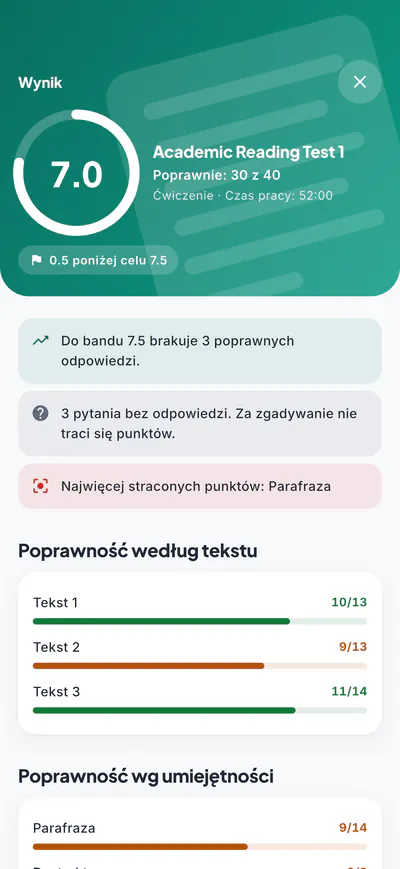
Wynik testu próbnego IELTS w aplikacji Fleydo: Przygotowanie do IELTS: szacowany band i poprawność w każdej części
Bezpłatna lekcja próbna

Poznaj swój prawdziwy wynik IELTS, zanim zrobi to egzamin

Bezpłatna indywidualna lekcja online z nauczycielem native speakerem, certyfikowanym specjalistą IELTS z wynikiem Band 8.5+. Otrzymasz diagnozę Speaking w prawdziwym formacie, uczciwą ocenę szacowanego wyniku i plan pracy nad dokładnie tymi kryteriami, które kosztują Cię punkty. Bez płatności, bez zobowiązań.

Online · Indywidualnie · Academic i General Training

IELTS jest zastrzeżonym znakiem towarowym British Council, IDP: IELTS Australia oraz Cambridge University Press & Assessment. Te testy próbne zostały przygotowane przez Fleydo i nie są przez te organizacje zatwierdzone ani rekomendowane.

Aplikacja mobilna

Fleydo English School w Twojej kieszeni

Lekcje, prace domowe, wiadomości i gry dla uczniów Fleydo i ich rodziców. Bezpłatna na iPhone’a i Androida.

Pobierz w App StorePobierz z Google Play
Więcej o aplikacji
Kod QR otwierający aplikację Fleydo English School w App Store lub Google PlayZeskanuj i pobierzOtwiera właściwy sklep dla Twojego telefonu.fleydo.com/app
Ikona aplikacji Fleydo IELTS
Fleydo: Przygotowanie do IELTS

Przygotowujesz się do IELTS?

Fleydo: Przygotowanie do IELTS to osobna aplikacja z testami próbnymi ze wszystkich czterech umiejętności. Nie potrzebujesz konta Fleydo, żeby z niej korzystać.

Zobacz aplikację IELTS
Pobierz w App StorePobierz z Google Play
Testy próbne IELTS

Ćwicz wszystkie cztery umiejętności IELTS

Wybieraj spośród 311 testów z natychmiastowym wynikiem band, wyjaśnieniami i wzorcowymi odpowiedziami. Bez rejestracji.

Wszystkie testy próbne
FleyPath

Osobista mapa drogowa Twojego dziecka — 3, 6 lub 12 miesięcy

🚀Start
👋Hello
😊Body
🦁Animals
🔢Numbers
🏆Pewny angielski
Zgrywalizowane ćwiczenie angielskiego

Jak gra — tylko że naprawdę się uczą