1. Strona główna
  2. IELTS
  3. Testy próbne
  4. Reading
  5. Reading Sentence Endings: ćwiczenie 5

IELTS Reading · Dopasowanie zakończeń zdań

IELTS Reading Sentence Endings: ćwiczenie 5

Noise-cancelling headphones

  • 9 pytań
  • 15 min
  • Academic

Co jest w tym teście

  1. PassagePytania 1–9From a pipe to a pair of headphones

Typy pytań

  • Dopasowanie zakończeń zdań
ReadingIELTS Reading Sentence Endings: ćwiczenie 5
Pozostały czas15:00

Passage

From a pipe to a pair of headphones

A Sound travels through air as a wave of pressure. A noise-cancelling headphone samples that wave with a microphone beside the ear, inverts the signal and plays it back, so that the outside noise and this "antinoise" largely wipe each other out. The principle is far older than the product. Paul Lueg, in Germany, applied for a patent on it in January 1933, and the American version, granted in 1936, describes, among other arrangements, a microphone and a loudspeaker in a pipe. By adjusting the distance between them, the reproduced sound could be given the opposite phase to the original. According to a 2004 paper for the Acoustical Society of America, Lueg may have tested the concept, but the equipment of the day apparently did not lend itself to a commercial product.

B Interest revived in the 1950s. Harry Olson's "electronic sound absorber" was meant to create a zone of quiet around a listener's head, although fairly small changes in the position of the head altered the noise a good deal. In 1954 Lawrence Fogel filed an American patent for very loud vehicles such as aircraft, whose noise made intercoms hard to understand: his earphones would produce an inverted copy of the surrounding noise, chiefly at low frequencies. Later in the decade W. F. Meeker of RCA experimented with "active ear defenders" for the Wright Air Development Center, which had an interest in reducing pilots' exposure to noise.

C Bose Corporation's involvement began, by the company's own account, in 1978, when its founder, Amar Bose, tried headphones on a transatlantic flight and found that aircraft noise spoiled the sound. Its timeline says he worked out the mathematics before landing. Dan Gauger, a retired Bose engineer interviewed in 2026, said that his team "independently invented" the method, unaware of the earlier patents and research. By the early 1980s he and a colleague had built prototypes, which military test pilots tried, but he recalled that the intercom programme they belonged to was cancelled in early 1986 because of its overall cost.

D Later that year, Bose supplied prototypes to Dick Rutan and Jeana Yeager for their nine-day nonstop flight around the world in the aircraft Voyager. The 2004 paper describes this as the first civilian use of such a system to attract wide public attention. Yet Gauger said that humidity corroded some of his poor solder joints, so that the units did not perform as well as they should have, although they still blocked sound passively.

E Bose put a headset for pilots on sale in 1989, although a 2023 survey notes that Sennheiser had created one for airline pilots in 1987. Aviation International News reported in 2026 that Bose took the nearly 200 it had made by then to an aviation convention that summer, at an introductory $795, and that they sold out before the event closed. More rivals soon followed. Air travellers got QuietComfort headphones in 2000, and in 2003 Technology Review listed a Bose pair at $299 and a Sony model at $79.

F Cancellation is only as good as its timing. According to Julius Smith of Stanford University, quoted in Technology Review, antinoise must be accurate in phase to about a quarter of a wavelength; beyond that, it adds to the background sound instead of removing it. For a 250-hertz tone, with a wavelength of about 1.4 metres, the bubble of quiet is roughly 35 centimetres. Higher pitches have shorter waves, which are harder to handle, so these systems do best on constant low sounds such as aircraft engines, and higher frequencies are left mainly to the padding of the earcup.

Słowniczek
phase
the point a wave has reached in its cycle; waves in opposite phase rise and fall at opposite times
wavelength
the distance from one peak of a wave to the next
solder joints
electrical connections made with a soft metal that is melted and left to harden
hertz
a unit showing how many sound waves pass each second; a lower number means a lower sound
prototypes
first models of a new product, built for testing
intercom
a system that lets people talk to each other inside a vehicle or building
passively
here, by padding alone, with no electronics
PassagePytania 1–9
Pytania 1–9

Complete each sentence with the correct ending, A-L, below.

Opcje
  • Awould make the background sound louder rather than quieter.
  • Bled directly to a commercial product in the 1930s.
  • Cis named by the company as the origin of its own work.
  • Dproved very sensitive to small movements of the listener.
  • Ewas abandoned after test pilots rejected the prototypes.
  • Fcomes from a retired engineer who helped to build the prototypes.
  • Gdescribed altering the gap between two devices to reverse the phase of a sound.
  • Hwere priced for ordinary travellers rather than pilots.
  • Iwas dropped because of the expense of the whole scheme.
  • Jworked less well than intended, according to one of their makers.
  • Kwas meant to make speech clearer in very noisy vehicles.
  • Lhad all been sold before the end of the convention where they were offered.
1The American patent granted to Lueg in 1936
2Olson's electronic sound absorber
3The system described in Fogel's patent application of 1954
4The flight Amar Bose took in 1978
5The statement that Bose's team invented the method independently
6According to Gauger, the military intercom programme
7The prototypes carried on Voyager
8The headsets Bose offered for sale in 1989
9A phase error larger than roughly a quarter of a wavelength

Odpowiedzi i wyjaśnienia

Najpierw rozwiąż test: klucz bardziej się przyda, gdy masz już swoje odpowiedzi.

Pokaż klucz odpowiedzi i wyjaśnienia
  1. 1
    G

    Paragraph A says that 'adjusting the distance' between microphone and loudspeaker gave the sound the opposite phase. The gap is that distance. Ending B reverses the text, which says the equipment 'did not lend itself to a commercial product'.

  2. 2
    D

    Paragraph B says 'fairly small changes in the position of the head altered the noise a good deal'. Small head movements having a large effect means the device was sensitive. Ending K belongs to Fogel's patent, which concerned vehicles, not a listener's position.

  3. 3
    K

    Paragraph B says the patent was for 'very loud vehicles' whose noise made intercoms hard to understand. Clearer speech solves this problem. Ending D belongs to Olson's device, and nothing is said about Fogel's system and head movements.

  4. 4
    C

    Paragraph C says Bose's involvement began, 'by the company's own account', on this flight. So the story comes from the company itself, as this ending says. Ending F also gives a source, but it concerns a different claim.

  5. 5
    F

    Paragraph C gives this claim to Dan Gauger, a retired engineer who, with a colleague, built prototypes. So the claim is one person's account. Ending C fails: the company's own account concerns the 1978 flight, not this statement.

  6. 6
    I

    Paragraph C says the programme was 'cancelled in early 1986 because of its overall cost'. Dropped means cancelled. Ending E is tempting since test pilots tried the prototypes, but the text gives cost as the reason and reports no rejection by the pilots.

  7. 7
    J

    Paragraph D says Gauger, who worked on them, admitted that the units 'did not perform as well as they should have'. Ending L fails, because the Voyager sets were prototypes for one flight, not goods on sale at a convention.

  8. 8
    L

    Paragraph E says Bose took nearly 200 to a convention and 'they sold out before the event closed'. So all were sold in time. Ending H fails, as these were headsets 'for pilots'; travellers got different headphones in 2000.

  9. 9
    A

    Paragraph F says that beyond this margin antinoise 'adds to the background sound instead of removing it'. Adding to a sound makes it louder. Ending D also concerns position and sensitivity, but it belongs to Olson's device in paragraph B.

Słowa kluczowe z tego testu

Passage

inverts
turns something the other way up or into its opposite
concept
an idea of how something could work
exposure
being in a situation where something can affect you
humidity
the amount of water in the air
constant
staying the same over time
Dopasowanie zakończeń zdań: jak odpowiadać na te pytaniaJoin each sentence beginning to the ending that says what the text says.

What the task looks like

You get some sentence beginnings and a longer list of lettered endings. You join each beginning to one ending, to make a sentence that agrees with the text.

The task tests whether you understand the main ideas, not only whether two halves make good English. In our papers there are spare endings, so some are not used.

Preparing for General Training? Our General Training papers do not include this type. Official sources do not all agree on whether the real General Training test can include it, so it is still worth knowing how it works.

A method to try

1. Read one beginning, mark its main words, and find the part of the text that deals with this idea. The beginnings follow the order of the text, so each answer comes after the last one.

2. Before you look at the endings, say in your own words how the text would finish this sentence.

3. Look for the ending closest to your version. Rule out any that cannot follow the beginning grammatically.

4. Read the whole sentence and check it against the text. Good English is not enough.

The traps

Good grammar, wrong meaning: several endings may join the beginning neatly, so grammar alone may not decide.

True, but about something else: an ending may state something from the text that has nothing to do with this beginning.

Reversal: an ending may turn the text round, so that the cause becomes the result.

Borrowed words: an ending that repeats words from the text is not more likely to be right. The right one often says the idea in new words.

Worked example

Text: The town's ferry used to run only in summer. Demand from commuters led the operator to add a winter service, although rough weather still cancels some crossings. A larger boat, due next year, should reduce these cancellations.

Beginning: The winter ferry service began ... A because people travelling to work wanted it. B because a bigger boat had been delivered. C so that fewer crossings would be cancelled. D after the rough weather had come to an end.

SłaboC. The text talks about reducing cancellations, and 'The winter ferry service began so that fewer crossings would be cancelled' reads well.
LepiejA. 'Demand from commuters led the operator to add a winter service.' Commuters are people travelling to work. C is what the larger boat should do, not why the service began.

All four endings are good English. Check the complete sentence against what the text says about this beginning.

Ikona aplikacji Fleydo IELTS Fleydo: Przygotowanie do IELTS

Zabierz te testy ze sobą na telefon

Każdy test z tych stron jest też w aplikacji Fleydo: Przygotowanie do IELTS na iPhone’a, iPada i Androida, razem z 2 000 słówek IELTS z nagraniami.

  • Działa offline, gdy test jest już na telefonie
  • 2 000 słówek IELTS z nagraniami, powtórki rozłożone w czasie i krótkie ćwiczenia
  • Nagrywaj swoje odpowiedzi w Speaking i odsłuchuj je
  • Plan na każdy dzień pod Twój docelowy band i datę egzaminu
Pobierz w App StorePobierz z Google Play
Zeskanuj, aby pobraćOtwiera App Store lub Google Play, zależnie od Twojego telefonu.

Konto nie jest potrzebne. O aplikacji

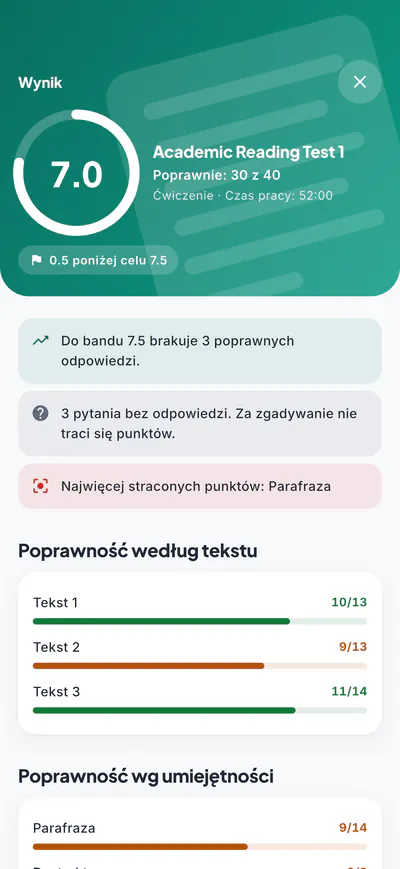
Wynik testu próbnego IELTS w aplikacji Fleydo: Przygotowanie do IELTS: szacowany band i poprawność w każdej części
Bezpłatna lekcja próbna

Poznaj swój prawdziwy wynik IELTS, zanim zrobi to egzamin

Bezpłatna indywidualna lekcja online z nauczycielem native speakerem, certyfikowanym specjalistą IELTS z wynikiem Band 8.5+. Otrzymasz diagnozę Speaking w prawdziwym formacie, uczciwą ocenę szacowanego wyniku i plan pracy nad dokładnie tymi kryteriami, które kosztują Cię punkty. Bez płatności, bez zobowiązań.

Online · Indywidualnie · Academic i General Training

IELTS jest zastrzeżonym znakiem towarowym British Council, IDP: IELTS Australia oraz Cambridge University Press & Assessment. Te testy próbne zostały przygotowane przez Fleydo i nie są przez te organizacje zatwierdzone ani rekomendowane.

Aplikacja mobilna

Fleydo English School w Twojej kieszeni

Lekcje, prace domowe, wiadomości i gry dla uczniów Fleydo i ich rodziców. Bezpłatna na iPhone’a i Androida.

Pobierz w App StorePobierz z Google Play
Więcej o aplikacji
Kod QR otwierający aplikację Fleydo English School w App Store lub Google PlayZeskanuj i pobierzOtwiera właściwy sklep dla Twojego telefonu.fleydo.com/app
Ikona aplikacji Fleydo IELTS
Fleydo: Przygotowanie do IELTS

Przygotowujesz się do IELTS?

Fleydo: Przygotowanie do IELTS to osobna aplikacja z testami próbnymi ze wszystkich czterech umiejętności. Nie potrzebujesz konta Fleydo, żeby z niej korzystać.

Zobacz aplikację IELTS
Pobierz w App StorePobierz z Google Play
Testy próbne IELTS

Ćwicz wszystkie cztery umiejętności IELTS

Wybieraj spośród 311 testów z natychmiastowym wynikiem band, wyjaśnieniami i wzorcowymi odpowiedziami. Bez rejestracji.

Wszystkie testy próbne
FleyPath

Osobista mapa drogowa Twojego dziecka — 3, 6 lub 12 miesięcy

🚀Start
👋Hello
😊Body
🦁Animals
🔢Numbers
🏆Pewny angielski
Zgrywalizowane ćwiczenie angielskiego

Jak gra — tylko że naprawdę się uczą