1. Strona główna
  2. IELTS
  3. Testy próbne
  4. Reading
  5. Reading Sentence Endings: ćwiczenie 1

IELTS Reading · Dopasowanie zakończeń zdań

IELTS Reading Sentence Endings: ćwiczenie 1

How mussels hold on

  • 8 pytań
  • 15 min
  • Academic

Co jest w tym teście

  1. PassagePytania 1–8The mussel's anchor

Typy pytań

  • Dopasowanie zakończeń zdań
ReadingIELTS Reading Sentence Endings: ćwiczenie 1
Pozostały czas15:00

Passage

The mussel's anchor

A Moisture defeats most manufactured glues, yet a mussel can stay fastened to a rock while waves break over it. Its anchor is the byssus, a bundle of protein threads spreading out from the foot. In an adult each thread measures two to six centimetres and finishes in a flattened pad, the plaque, which does the gripping.

B The foot builds these threads one at a time, spending between 30 seconds and eight minutes on each, with young mussels the quickest. Its tip is first pressed down to seal off a small patch of surface. A hollow on the underside then expands, and the suction this creates gives a temporary hold while proteins are delivered into the enclosed space. As the foot lifts away, seawater reaches the new structure, and this exposure is what makes it solidify.

C Much of the attention has gone to one ingredient, DOPA, an unusual amino acid. The first proteins released on to a rock are rich in it: DOPA accounts for about 20 per cent of the amino acids in one and 30 per cent in another. It can hold on to a surface at two points rather than one, and the authors of a 2011 paper calculated that on the mineral mica such a bond should last around a million times longer.

D DOPA also has a weakness. Seawater, at about pH 8 and rich in oxygen, strongly favours its oxidation, which reduces adhesion to test surfaces by at least 80 per cent. The mussel's defence is to change the chemistry under its foot. It makes the enclosed space acidic and supplies a protein rich in the amino acid cysteine, which in laboratory tests restored the adhesion that oxidation had taken away. Exactly how acidic is unclear: electrodes gave an average of about pH 5.5, whereas a dye fixed to a surface indicated a low point near 2.5. The gap probably reflects when and where each reading was made.

E DOPA is not the whole story, however. Herbert Waite of the University of California, Santa Barbara, argued in a 2017 review that mussels do not depend on any single molecule. Salt on a wet surface, for example, is a further barrier. In a 2015 study from the same university, modified molecules from microbes, which like mussel proteins pair a DOPA-like group with the amino acid lysine, were tested between mica surfaces in salty water. Versions with both groups gripped firmly, those without lysine did not, and the authors concluded that lysine clears away salt ions so that the other group can bind. Work on the Asian green mussel points to a separate step: one protein always emerges first and seems to act as a primer, pushing water off the surface before the others arrive.

F Other parts of the system count too. Each thread has a stiff section and a softer, stretchier one. Researchers at the Massachusetts Institute of Technology reported in 2013 that the stiff section made up about 80 per cent of the length of the threads they studied, and in their simulations this proportion, of those tried, produced the smallest reaction force. A 2021 study of blue mussels reported that iron and vanadium are stored in tiny particles inside cells and only later combined with proteins, in a network of fine channels in the foot, forming bonds that reinforce the byssus. As for the plaque, Waite's review described a mature one as a porous solid. Such materials often toughen adhesives, but he wrote that what the plaque's structure adds to its performance had yet to be determined.

Słowniczek
amino acid
one of the small units that proteins are built from
pH
a scale of acidity: the lower the number, the more acidic a liquid is
mica
a shiny mineral that splits into thin sheets
oxidation
a chemical change, often caused by oxygen, as when iron rusts
primer
a first layer that prepares a surface for what is put on top of it
reaction force
the force that pushes back on a structure when it is pulled or struck
vanadium
a kind of metal
PassagePytania 1–8
Pytania 1–8

Complete each sentence with the correct ending, A-K, below.

Opcje
  • Agave the lowest force of the combinations tried in simulations.
  • Btriggers the hardening of the new material.
  • Cproved that one ingredient could explain most of the mussel's hold.
  • Dindicated that metals are kept in reserve until needed.
  • Eis probably due to differences in the timing and position of testing.
  • Fapparently prepares a surface by driving off water.
  • Gmakes the space under the foot more acidic.
  • Hwas calculated to extend the life of a bond enormously.
  • Imight make it tougher, but its effect had not been established.
  • Jsuggested that salts must be moved aside before bonding can take place.
  • Khas so far been observed only in young animals.
1The arrival of seawater as the foot withdraws
2The capacity of DOPA to attach at two points
3The disagreement between two measures of acidity
4The 2015 study of modified microbial molecules
5The protein released first by the Asian green mussel
6The balance of stiff and stretchy material in a thread
7The 2021 study of blue mussels
8The porous structure of a mature plaque

Odpowiedzi i wyjaśnienia

Najpierw rozwiąż test: klucz bardziej się przyda, gdy masz już swoje odpowiedzi.

Pokaż klucz odpowiedzi i wyjaśnienia
  1. 1
    B

    Paragraph B says that when the foot lifts, seawater reaches the new structure and 'this exposure is what makes it solidify'. Hardening means becoming solid. Ending G fails, because the acidity under the foot comes from the mussel, not from seawater.

  2. 2
    H

    Paragraph C says a 2011 paper calculated that a two-point bond on mica 'should last around a million times longer': an enormous increase in its life. Ending A also reports a result, but it belongs to the thread simulations.

  3. 3
    E

    Paragraph D reports two different acidity readings and says the gap 'probably reflects when and where each reading was made'. 'Timing and position' means the same. Ending G also concerns acidity, but it says what the mussel does, not why the readings differ.

  4. 4
    J

    Paragraph E says the authors concluded that lysine 'clears away salt ions so that the other group can bind'. So salt must be moved first. Ending F is about water and belongs to the Asian green mussel, not to this study.

  5. 5
    F

    Paragraph E says this protein seems to act as a primer, 'pushing water off the surface before the others arrive'. That is driving off water to prepare the surface. Ending J fails, because salts belong to the lysine study.

  6. 6
    A

    Paragraph F says that in simulations this proportion, 'of those tried, produced the smallest reaction force'. 'Lowest' matches 'smallest', and 'combinations' matches the proportions tried. Ending I fails, because it describes the plaque, not the thread.

  7. 7
    D

    Paragraph F says iron and vanadium are stored in tiny particles and 'only later combined with proteins'. Storing them first means keeping them in reserve. Ending C fails: the study adds metals to the picture and names no single explanation.

  8. 8
    I

    Paragraph F says porous materials often toughen adhesives, but what the plaque's structure adds 'had yet to be determined'. So it might make the plaque tougher, but this was not shown. Ending H is about DOPA bonds, not the plaque's structure.

Słowa kluczowe z tego testu

Passage

solidify
to become hard or solid
barrier
something that stops a thing from happening or moving forward
concluded
decided that something is true after looking at the evidence
proportion
a part of a whole, compared with the whole
reinforce
to make something stronger
Dopasowanie zakończeń zdań: jak odpowiadać na te pytaniaJoin each sentence beginning to the ending that says what the text says.

What the task looks like

You get some sentence beginnings and a longer list of lettered endings. You join each beginning to one ending, to make a sentence that agrees with the text.

The task tests whether you understand the main ideas, not only whether two halves make good English. In our papers there are spare endings, so some are not used.

Preparing for General Training? Our General Training papers do not include this type. Official sources do not all agree on whether the real General Training test can include it, so it is still worth knowing how it works.

A method to try

1. Read one beginning, mark its main words, and find the part of the text that deals with this idea. The beginnings follow the order of the text, so each answer comes after the last one.

2. Before you look at the endings, say in your own words how the text would finish this sentence.

3. Look for the ending closest to your version. Rule out any that cannot follow the beginning grammatically.

4. Read the whole sentence and check it against the text. Good English is not enough.

The traps

Good grammar, wrong meaning: several endings may join the beginning neatly, so grammar alone may not decide.

True, but about something else: an ending may state something from the text that has nothing to do with this beginning.

Reversal: an ending may turn the text round, so that the cause becomes the result.

Borrowed words: an ending that repeats words from the text is not more likely to be right. The right one often says the idea in new words.

Worked example

Text: The town's ferry used to run only in summer. Demand from commuters led the operator to add a winter service, although rough weather still cancels some crossings. A larger boat, due next year, should reduce these cancellations.

Beginning: The winter ferry service began ... A because people travelling to work wanted it. B because a bigger boat had been delivered. C so that fewer crossings would be cancelled. D after the rough weather had come to an end.

SłaboC. The text talks about reducing cancellations, and 'The winter ferry service began so that fewer crossings would be cancelled' reads well.
LepiejA. 'Demand from commuters led the operator to add a winter service.' Commuters are people travelling to work. C is what the larger boat should do, not why the service began.

All four endings are good English. Check the complete sentence against what the text says about this beginning.

Ikona aplikacji Fleydo IELTS Fleydo: Przygotowanie do IELTS

Zabierz te testy ze sobą na telefon

Każdy test z tych stron jest też w aplikacji Fleydo: Przygotowanie do IELTS na iPhone’a, iPada i Androida, razem z 2 000 słówek IELTS z nagraniami.

  • Działa offline, gdy test jest już na telefonie
  • 2 000 słówek IELTS z nagraniami, powtórki rozłożone w czasie i krótkie ćwiczenia
  • Nagrywaj swoje odpowiedzi w Speaking i odsłuchuj je
  • Plan na każdy dzień pod Twój docelowy band i datę egzaminu
Pobierz w App StorePobierz z Google Play
Zeskanuj, aby pobraćOtwiera App Store lub Google Play, zależnie od Twojego telefonu.

Konto nie jest potrzebne. O aplikacji

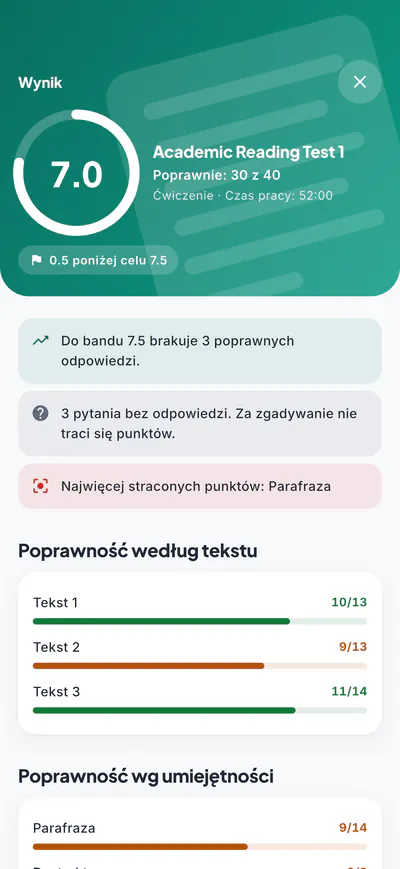
Wynik testu próbnego IELTS w aplikacji Fleydo: Przygotowanie do IELTS: szacowany band i poprawność w każdej części
Bezpłatna lekcja próbna

Poznaj swój prawdziwy wynik IELTS, zanim zrobi to egzamin

Bezpłatna indywidualna lekcja online z nauczycielem native speakerem, certyfikowanym specjalistą IELTS z wynikiem Band 8.5+. Otrzymasz diagnozę Speaking w prawdziwym formacie, uczciwą ocenę szacowanego wyniku i plan pracy nad dokładnie tymi kryteriami, które kosztują Cię punkty. Bez płatności, bez zobowiązań.

Online · Indywidualnie · Academic i General Training

IELTS jest zastrzeżonym znakiem towarowym British Council, IDP: IELTS Australia oraz Cambridge University Press & Assessment. Te testy próbne zostały przygotowane przez Fleydo i nie są przez te organizacje zatwierdzone ani rekomendowane.

Aplikacja mobilna

Fleydo English School w Twojej kieszeni

Lekcje, prace domowe, wiadomości i gry dla uczniów Fleydo i ich rodziców. Bezpłatna na iPhone’a i Androida.

Pobierz w App StorePobierz z Google Play
Więcej o aplikacji
Kod QR otwierający aplikację Fleydo English School w App Store lub Google PlayZeskanuj i pobierzOtwiera właściwy sklep dla Twojego telefonu.fleydo.com/app
Ikona aplikacji Fleydo IELTS
Fleydo: Przygotowanie do IELTS

Przygotowujesz się do IELTS?

Fleydo: Przygotowanie do IELTS to osobna aplikacja z testami próbnymi ze wszystkich czterech umiejętności. Nie potrzebujesz konta Fleydo, żeby z niej korzystać.

Zobacz aplikację IELTS
Pobierz w App StorePobierz z Google Play
Testy próbne IELTS

Ćwicz wszystkie cztery umiejętności IELTS

Wybieraj spośród 311 testów z natychmiastowym wynikiem band, wyjaśnieniami i wzorcowymi odpowiedziami. Bez rejestracji.

Wszystkie testy próbne
FleyPath

Osobista mapa drogowa Twojego dziecka — 3, 6 lub 12 miesięcy

🚀Start
👋Hello
😊Body
🦁Animals
🔢Numbers
🏆Pewny angielski
Zgrywalizowane ćwiczenie angielskiego

Jak gra — tylko że naprawdę się uczą