1. Strona główna
  2. IELTS
  3. Testy próbne
  4. Reading
  5. Reading Sentence Completion: ćwiczenie 4

IELTS Reading · Uzupełnianie zdań

IELTS Reading Sentence Completion: ćwiczenie 4

Lake Baikal

  • 12 pytań
  • 15 min
  • Academic

Co jest w tym teście

  1. PassagePytania 1–12The deep life of Lake Baikal

Typy pytań

  • Uzupełnianie zdań
ReadingIELTS Reading Sentence Completion: ćwiczenie 4
Pozostały czas15:00

Passage

The deep life of Lake Baikal

A Lake Baikal, in south-eastern Siberia, reaches 1,642 metres at its deepest and holds about a fifth of the planet's liquid fresh water, roughly as much as all the Great Lakes of North America put together. The lake fills a classic continental rift, where the Earth's crust is slowly pulling apart, and the sediment beneath it is estimated to be more than 9 kilometres thick in some areas around the delta of the River Selenga. The Selenga alone provides over half of the surface inflow. Only one river, the Angara, drains the lake.

B Researchers describe Baikal as the world's oldest lake, with its age usually put at 25 to 30 million years. A 2009 review in the journal BioScience said that it holds more species than any other lake, and put the number of animal species at about 2,500. An assessment by the International Union for Conservation of Nature, finalised in 2025, gives at least 2,640 animal species, about 56 per cent of them endemic, and around 1,000 plant species, about 15 per cent endemic.

C Age is only part of the 2009 review's explanation for this richness. The other part is oxygen. The review calls oxygen all the way down a trait shared with the ocean but unique among lakes more than 800 metres deep, and sees it as the reason why multicellular animals, most of them endemic, can live in the greatest depths. The gas is carried down by a process often linked to wind. In the ice-free season, when the surface water is cold and unstable, strong winds can trigger coastal downwelling: surface water plunges into the deep layer below it. These intrusions stay near the shore and last from a day to two weeks, yet the review says they renew around 12.5 per cent of the permanent deep water each year. Not every event follows this pattern: a 13-year study found that spring intrusions showed no link with the wind.

D Among the animals of the deep are amphipods, crustaceans represented in Baikal by well over 300 species. Some of them are giants of their kind, and the review links this gigantism to the oxygen-rich water. Genetic studies suggest that the group reached the lake in two independent invasions. A 2017 analysis of 64 species adds that features such as body armour evolved separately in several lines.

E In the open water, two species of translucent fish called golomyanka are the most numerous fish in the lake and make up the bulk of the fish biomass there. At night they rise from depths of 300 to 1,600 metres into the top 50 metres to feed on a small crustacean, the copepod Epischura. Golomyanka are in turn the preferred prey of the Baikal seal, one of very few seals confined to fresh water. Its pups are born on the ice and reared in caves of snow and ice, out of sight of predators.

F How the seal reached a landlocked lake is still unsettled. A 2023 study of its genome notes that scientists are sure only of its Arctic origin. Rivers do connect Baikal with the Arctic Ocean, and the favoured view has the animals following the Yenisei or crossing glacial and ice-dammed lakes. Estimates of when they arrived, however, range from about 3 million to 400,000 years ago.

Słowniczek
sediment
sand, mud and other material that settles on the bottom of water
endemic
found in one place and nowhere else
multicellular
made up of many cells
crustacean
an animal with a hard outer shell and many legs, usually living in water
biomass
the total weight of living things in an area
genome
all of the genetic material of a living thing
PassagePytania 1–12
Pytania 1–12 Maks. 2 słowa

Complete the sentences below. Choose NO MORE THAN TWO WORDS AND/OR A NUMBER from the passage for each answer.

1Baikal contains about the same amount of fresh water as the of North America.
2In parts of the area near the Selenga delta, sediment may reach a thickness of over kilometres.
3The one river that takes water out of Baikal is the .
4According to the 2025 assessment, about per cent of Baikal's plant species exist nowhere else.
5The 2009 review says that, unlike any other lake over 800 metres deep, Baikal contains at every level.
6Surface water can be driven into the depths by wind through a process known as .
7According to the review, brief intrusions of surface water replace about per cent of the water in the permanent deep layer annually.
8The large size of certain amphipods, known as , has been linked to the chemistry of the deep water.
9One feature that appears to have developed independently in several lines of amphipod is .
10The fish that Baikal seals most like to eat are called .
11Seal pups are hidden from predators in formed from snow and ice.
12The 2023 study says the one certain fact about the seal's past is that it came from the .

Odpowiedzi i wyjaśnienia

Najpierw rozwiąż test: klucz bardziej się przyda, gdy masz już swoje odpowiedzi.

Pokaż klucz odpowiedzi i wyjaśnienia
  1. 1
    Great Lakes

    Paragraph A says Baikal holds 'roughly as much as all the Great Lakes of North America put together'. Both words are needed, because lakes alone does not say which lakes are meant.

  2. 2
    9 / nine

    Paragraph A says the sediment is 'more than 9 kilometres thick' around the delta. Over means more than. The other large figure, 1,642, is the lake's depth in metres, so it does not fit.

  3. 3
    Angara

    Paragraph A says 'Only one river, the Angara, drains the lake'. The Selenga is the tempting wrong answer, but it brings water in, providing 'over half of the surface inflow'. It does not take water out.

  4. 4
    15 / fifteen

    Paragraph B says the assessment gives 'around 1,000 plant species, about 15 per cent endemic', and endemic means found nowhere else. The figure of 56 per cent is about animals, so it does not fit.

  5. 5
    oxygen

    Paragraph C says the review calls 'oxygen all the way down' unique among such lakes. All the way down means at every level. The ocean shares this feature but is not a lake.

  6. 6
    coastal downwelling / downwelling

    Paragraph C says 'strong winds can trigger coastal downwelling', and explains that surface water then plunges down. Downwelling or coastal downwelling is correct. 'Intrusions' are the moving bodies of water, not the name of the process.

  7. 7
    12.5 / twelve point five

    Paragraph C says the intrusions 'renew around 12.5 per cent' of the deep water each year. Annually means each year and replace means renew. The 800 and 1,642 figures are depths in metres, and 13 is the length of a study in years.

  8. 8
    gigantism

    Paragraph D says the review 'links this gigantism to the oxygen-rich water'. 'Giants' is the tempting wrong answer, but it names the animals, and the gap needs the name of the condition.

  9. 9
    body armour / armour / body armor / armor

    Paragraph D says 'features such as body armour evolved separately in several lines'. Body armour or armour is correct. 'Gigantism' is linked to oxygen in the text, and it is not described as evolving separately.

  10. 10
    golomyanka

    Paragraph E says golomyanka are 'the preferred prey of the Baikal seal'. Epischura is the animal that golomyanka eat, not the seal's food, and the spelling of golomyanka must be copied exactly.

  11. 11
    caves

    Paragraph E says pups are 'reared in caves of snow and ice, out of sight of predators'. Hidden means out of sight. The gap is followed by 'snow and ice', so only caves is needed.

  12. 12
    Arctic Ocean / Arctic

    Paragraph F says scientists 'are sure only of its Arctic origin'. Arctic is correct, with or without Ocean. The Yenisei is only part of the favoured view of the route, so it is not certain.

Słowa kluczowe z tego testu

Passage

inflow
the water that flows into a place
estimate
to judge the size or amount of something without measuring it exactly
trigger
to cause something to start
renew
to replace something old with something new
unsettled
not yet decided or explained
Uzupełnianie zdań: jak odpowiadać na te pytaniaComplete a sentence with exact words from the text, and read the result.

What the task looks like

You get sentences with a gap in each, and an instruction such as: Choose NO MORE THAN TWO WORDS from the passage for each answer.

The sentence rewords the text, and your answer is the missing word or words, taken from the text. The task tests whether you can find a specific detail.

In our papers, the sentences follow the order of the text, and the answer appears word for word in the text.

A method to try

1. Check the limit. NO MORE THAN TWO WORDS allows one word or two. It is a limit, not a target.

2. Read the whole sentence and decide what the gap needs. A noun, a verb, an adjective or a number? Singular or plural? The words on each side of the gap are your clues.

3. Work out what the sentence means, then find the same idea in the text. Expect different words.

4. Copy the answer as it is written in the text. You should not need to change its form. If you feel you must, for example from 'decided' to 'decision', you may be reading the wrong sentence.

5. Read the finished sentence. It should be correct English, and it should say what the text says.

The traps

Too many words: you copy a whole phrase when the sentence needs only part of it.

Good grammar, wrong meaning: a word from the right paragraph can fit the gap and still make the sentence untrue.

The nearest word: the word next to your clue may not be the answer. Read to the end of the sentence in the text.

Words already printed: do not repeat a word that is already there just before or after the gap.

Worked example

Text: The bakery began as a market stall selling only bread. Its owners later opened a small café in the same street, and the profits paid for a second oven. Today, customers often queue for its cakes.

Sentence: Money earned by the café allowed the owners to buy an additional ____. (NO MORE THAN TWO WORDS)

Słabosecond oven. These words come straight after 'paid for a', and the limit allows two words.
Lepiejoven. 'Additional' already does the work of 'second', so the gap needs only one word. 'An additional oven' is correct English and says what the text says.

'An additional second oven' repeats itself. Reading the finished sentence shows you this, and you do not have to use every word the limit allows.

Ikona aplikacji Fleydo IELTS Fleydo: Przygotowanie do IELTS

Zabierz te testy ze sobą na telefon

Każdy test z tych stron jest też w aplikacji Fleydo: Przygotowanie do IELTS na iPhone’a, iPada i Androida, razem z 2 000 słówek IELTS z nagraniami.

  • Działa offline, gdy test jest już na telefonie
  • 2 000 słówek IELTS z nagraniami, powtórki rozłożone w czasie i krótkie ćwiczenia
  • Nagrywaj swoje odpowiedzi w Speaking i odsłuchuj je
  • Plan na każdy dzień pod Twój docelowy band i datę egzaminu
Pobierz w App StorePobierz z Google Play
Zeskanuj, aby pobraćOtwiera App Store lub Google Play, zależnie od Twojego telefonu.

Konto nie jest potrzebne. O aplikacji

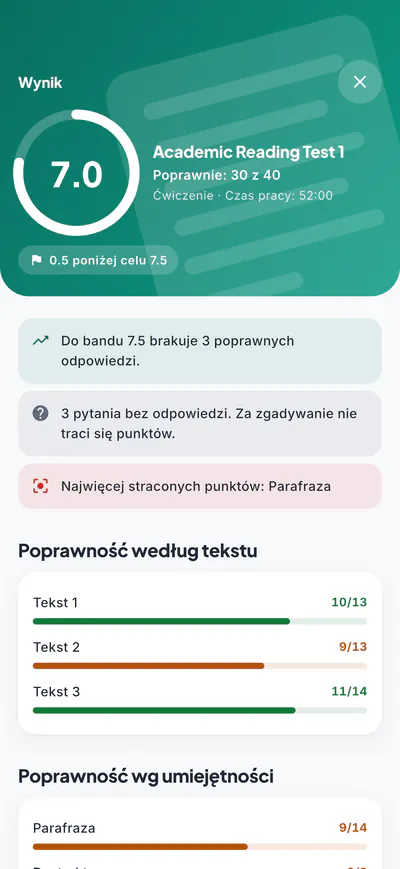
Wynik testu próbnego IELTS w aplikacji Fleydo: Przygotowanie do IELTS: szacowany band i poprawność w każdej części
Bezpłatna lekcja próbna

Poznaj swój prawdziwy wynik IELTS, zanim zrobi to egzamin

Bezpłatna indywidualna lekcja online z nauczycielem native speakerem, certyfikowanym specjalistą IELTS z wynikiem Band 8.5+. Otrzymasz diagnozę Speaking w prawdziwym formacie, uczciwą ocenę szacowanego wyniku i plan pracy nad dokładnie tymi kryteriami, które kosztują Cię punkty. Bez płatności, bez zobowiązań.

Online · Indywidualnie · Academic i General Training

IELTS jest zastrzeżonym znakiem towarowym British Council, IDP: IELTS Australia oraz Cambridge University Press & Assessment. Te testy próbne zostały przygotowane przez Fleydo i nie są przez te organizacje zatwierdzone ani rekomendowane.

Aplikacja mobilna

Fleydo English School w Twojej kieszeni

Lekcje, prace domowe, wiadomości i gry dla uczniów Fleydo i ich rodziców. Bezpłatna na iPhone’a i Androida.

Pobierz w App StorePobierz z Google Play
Więcej o aplikacji
Kod QR otwierający aplikację Fleydo English School w App Store lub Google PlayZeskanuj i pobierzOtwiera właściwy sklep dla Twojego telefonu.fleydo.com/app
Ikona aplikacji Fleydo IELTS
Fleydo: Przygotowanie do IELTS

Przygotowujesz się do IELTS?

Fleydo: Przygotowanie do IELTS to osobna aplikacja z testami próbnymi ze wszystkich czterech umiejętności. Nie potrzebujesz konta Fleydo, żeby z niej korzystać.

Zobacz aplikację IELTS
Pobierz w App StorePobierz z Google Play
Testy próbne IELTS

Ćwicz wszystkie cztery umiejętności IELTS

Wybieraj spośród 311 testów z natychmiastowym wynikiem band, wyjaśnieniami i wzorcowymi odpowiedziami. Bez rejestracji.

Wszystkie testy próbne
FleyPath

Osobista mapa drogowa Twojego dziecka — 3, 6 lub 12 miesięcy

🚀Start
👋Hello
😊Body
🦁Animals
🔢Numbers
🏆Pewny angielski
Zgrywalizowane ćwiczenie angielskiego

Jak gra — tylko że naprawdę się uczą