1. Strona główna
  2. IELTS
  3. Testy próbne
  4. Reading
  5. Reading Sentence Completion: ćwiczenie 1

IELTS Reading · Uzupełnianie zdań

IELTS Reading Sentence Completion: ćwiczenie 1

Penguin huddles

  • 10 pytań
  • 15 min
  • Academic

Co jest w tym teście

  1. PassagePytania 1–10A huddle on the move

Typy pytań

  • Uzupełnianie zdań
ReadingIELTS Reading Sentence Completion: ćwiczenie 1
Pozostały czas15:00

Passage

A huddle on the move

A Emperor penguins breed in the depths of the Antarctic winter, when air temperatures can sink below -45°C and winds can reach 50 metres per second. Incubation falls entirely to the male, who goes without food for around 110 to 120 days. Huddling is generally seen as the key to this endurance: according to one estimate, he could otherwise fast for only about 60 days.

B Huddles were once pictured as dense formations that held together for hours or even days. A study published in 2006 revised that view. At Pointe Géologie, a colony in Adélie Land, researchers glued data loggers to the feathers of eight marked birds to follow huddling through pairing and incubation. Huddling proved to be broken up into short episodes of variable length, averaging 1.6 hours, and the three males tracked across both stages spent about 38 per cent of their time this way. Although the air outside averaged -17°C, huddling raised the temperature around the birds above freezing, and in tight groups readings climbed as high as 37.5°C, close to the birds' body temperature.

C Such crowding creates a physical problem. At around 21 birds per square metre, no penguin can step out of line on its own. If the density rises too far, rearrangement stops altogether, and birds on the edge are shut out from the warmer centre. Physicists call a comparable effect in tightly compacted particles jamming.

D To find out how emperors escape it, Daniel Zitterbart, then a PhD student at the University of Erlangen-Nuremberg, and his colleagues filmed a colony of some 2,000 birds near the German Neumayer research station. On 3 August 2008, in air between -33°C and -43°C, a camera positioned 12 metres up and 115 metres away took a high-resolution image every 1.3 seconds for four hours. Most of the birds were carrying an egg, and a yellow and white patch on each face allowed individuals to be tracked.

E Most of the time, the huddles stood still. Yet every 30 to 60 seconds, all the birds took a small step of 5 to 10 centimetres, and the movement ran through the group as a wave at about 12 centimetres per second. Penguins generally kept the same neighbours and did not push their way in or out. The authors, writing in 2011, proposed that these tiny steps have three effects. They compress the huddle as new birds come in, much as tapping a bag settles the loose grains inside it. They carry the whole formation forward, in the direction most birds were facing, so that small huddles can merge. And over time they slowly reorganise the group. Birds, for their part, tended to arrive at the rear and depart from the front.

F A second paper, in 2013, with Zitterbart among its authors, asked how a wave begins. Using time-lapse images from the same colony alongside video from Pointe Géologie, the team adapted a mathematical model of traffic. In it, a bird steps forward once the gap ahead of it passes a threshold, which they estimated roughly at 2 centimetres. That is comparable to twice the thickness of the compressible layer of feathers, hinting that huddled birds are in only slight contact. Queues of cars send waves backwards from the front. In the huddle, by contrast, any bird can set one off, it can travel forwards or backwards, and when two are set off at about the same time in different places, they merge rather than passing through each other. The model needs no leading bird to set the pace.

Słowniczek
incubation
keeping an egg warm until it hatches
pairing
the part of the breeding season when birds form couples
data logger
a small device that records measurements automatically
PassagePytania 1–10
Pytania 1–10 Maks. 2 słowa

Complete the sentences below. Choose NO MORE THAN TWO WORDS AND/OR A NUMBER from the passage for each answer.

1It has been estimated that, if he did not huddle, a male penguin's fast could last only about days.
2In the study published in 2006, recording devices were attached to the birds' .
3Birds did not huddle without a break: their huddling lasted 1.6 hours on average.
4The warmest air recorded around birds in a tight huddle nearly matched their own .
5Birds at the outer edge might never reach the warmer middle of a huddle because of the effect known as .
6Individual birds could be followed because each had a coloured on its face.
7The way the steps press the birds together was likened to tapping a bag containing .
8Forward movement means that separate small huddles are able to .
9In the traffic-based model, a penguin moves when the space in front of it goes beyond a .
10The size of the gap suggests there is only slight between penguins standing in a huddle.

Odpowiedzi i wyjaśnienia

Najpierw rozwiąż test: klucz bardziej się przyda, gdy masz już swoje odpowiedzi.

Pokaż klucz odpowiedzi i wyjaśnienia
  1. 1
    60 / sixty

    Paragraph A says that without huddling he 'could otherwise fast for only about 60 days'. The figure of 110 to 120 days is how long he really goes without food, so it does not fit.

  2. 2
    feathers

    Paragraph B says researchers 'glued data loggers to the feathers' of the birds. Data loggers are recording devices and glued means attached, so feathers is the word that fits.

  3. 3
    episodes

    Paragraph B says huddling was 'broken up into short episodes' that averaged 1.6 hours. 'Groups' and 'formations' also appear, but they mean the birds, not the periods of time, so only episodes fits.

  4. 4
    body temperature / temperature

    Paragraph B says readings reached 37.5°C, 'close to the birds' body temperature'. Nearly matched means the same as close to. Temperature or body temperature is correct, but body alone is wrong, because air cannot match a body.

  5. 5
    jamming

    Paragraph C says that when density rises too far, edge birds are 'shut out from the warmer centre', and it gives the effect's name as jamming. 'Crowding' is mentioned, but it is not the name of this effect.

  6. 6
    patch

    Paragraph D says 'a yellow and white patch on each face allowed individuals to be tracked'. The gap asks for the coloured thing itself, and followed means the same as tracked. Yellow and white are the colours.

  7. 7
    loose grains / grains

    Paragraph E says the steps compress the huddle 'much as tapping a bag settles the loose grains inside it'. Grains or loose grains is what the bag contains. The penguins are only being compared with them, so they do not fit.

  8. 8
    merge

    Paragraph E says the steps carry the formation forward 'so that small huddles can merge'. Merge means come together as one. Paragraph F also uses this word, but about waves, not huddles.

  9. 9
    threshold

    Paragraph F says a bird steps forward 'once the gap ahead of it passes a threshold'. Space means gap and goes beyond means passes. The 2 centimetres is the threshold's size, and it cannot follow 'a' here.

  10. 10
    contact

    Paragraph F says the threshold is about twice the thickness of the compressible feathers, 'hinting that huddled birds are in only slight contact'. So neighbours probably barely touch. Feathers are only used to judge the gap's size, so they do not fit.

Słowa kluczowe z tego testu

Passage

endurance
the ability to keep going through something difficult
density
how closely things are packed together in a space
compress
to press something so that it takes up less space
reorganise
to arrange something in a new way
variable
changing; not always the same
Uzupełnianie zdań: jak odpowiadać na te pytaniaComplete a sentence with exact words from the text, and read the result.

What the task looks like

You get sentences with a gap in each, and an instruction such as: Choose NO MORE THAN TWO WORDS from the passage for each answer.

The sentence rewords the text, and your answer is the missing word or words, taken from the text. The task tests whether you can find a specific detail.

In our papers, the sentences follow the order of the text, and the answer appears word for word in the text.

A method to try

1. Check the limit. NO MORE THAN TWO WORDS allows one word or two. It is a limit, not a target.

2. Read the whole sentence and decide what the gap needs. A noun, a verb, an adjective or a number? Singular or plural? The words on each side of the gap are your clues.

3. Work out what the sentence means, then find the same idea in the text. Expect different words.

4. Copy the answer as it is written in the text. You should not need to change its form. If you feel you must, for example from 'decided' to 'decision', you may be reading the wrong sentence.

5. Read the finished sentence. It should be correct English, and it should say what the text says.

The traps

Too many words: you copy a whole phrase when the sentence needs only part of it.

Good grammar, wrong meaning: a word from the right paragraph can fit the gap and still make the sentence untrue.

The nearest word: the word next to your clue may not be the answer. Read to the end of the sentence in the text.

Words already printed: do not repeat a word that is already there just before or after the gap.

Worked example

Text: The bakery began as a market stall selling only bread. Its owners later opened a small café in the same street, and the profits paid for a second oven. Today, customers often queue for its cakes.

Sentence: Money earned by the café allowed the owners to buy an additional ____. (NO MORE THAN TWO WORDS)

Słabosecond oven. These words come straight after 'paid for a', and the limit allows two words.
Lepiejoven. 'Additional' already does the work of 'second', so the gap needs only one word. 'An additional oven' is correct English and says what the text says.

'An additional second oven' repeats itself. Reading the finished sentence shows you this, and you do not have to use every word the limit allows.

Ikona aplikacji Fleydo IELTS Fleydo: Przygotowanie do IELTS

Zabierz te testy ze sobą na telefon

Każdy test z tych stron jest też w aplikacji Fleydo: Przygotowanie do IELTS na iPhone’a, iPada i Androida, razem z 2 000 słówek IELTS z nagraniami.

  • Działa offline, gdy test jest już na telefonie
  • 2 000 słówek IELTS z nagraniami, powtórki rozłożone w czasie i krótkie ćwiczenia
  • Nagrywaj swoje odpowiedzi w Speaking i odsłuchuj je
  • Plan na każdy dzień pod Twój docelowy band i datę egzaminu
Pobierz w App StorePobierz z Google Play
Zeskanuj, aby pobraćOtwiera App Store lub Google Play, zależnie od Twojego telefonu.

Konto nie jest potrzebne. O aplikacji

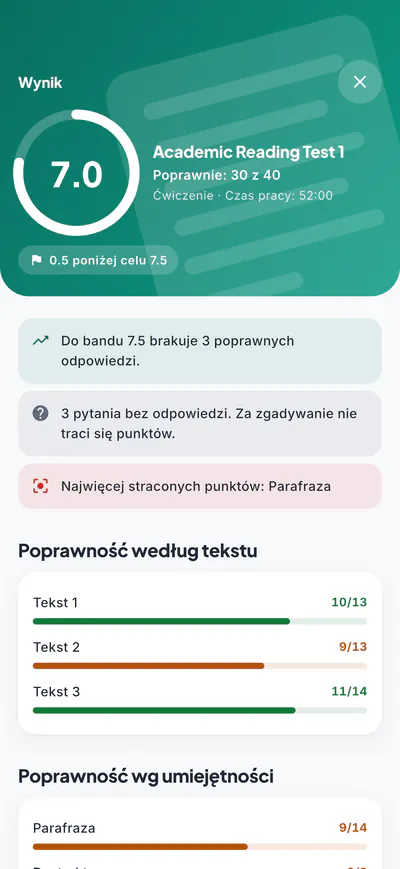
Wynik testu próbnego IELTS w aplikacji Fleydo: Przygotowanie do IELTS: szacowany band i poprawność w każdej części
Bezpłatna lekcja próbna

Poznaj swój prawdziwy wynik IELTS, zanim zrobi to egzamin

Bezpłatna indywidualna lekcja online z nauczycielem native speakerem, certyfikowanym specjalistą IELTS z wynikiem Band 8.5+. Otrzymasz diagnozę Speaking w prawdziwym formacie, uczciwą ocenę szacowanego wyniku i plan pracy nad dokładnie tymi kryteriami, które kosztują Cię punkty. Bez płatności, bez zobowiązań.

Online · Indywidualnie · Academic i General Training

IELTS jest zastrzeżonym znakiem towarowym British Council, IDP: IELTS Australia oraz Cambridge University Press & Assessment. Te testy próbne zostały przygotowane przez Fleydo i nie są przez te organizacje zatwierdzone ani rekomendowane.

Aplikacja mobilna

Fleydo English School w Twojej kieszeni

Lekcje, prace domowe, wiadomości i gry dla uczniów Fleydo i ich rodziców. Bezpłatna na iPhone’a i Androida.

Pobierz w App StorePobierz z Google Play
Więcej o aplikacji
Kod QR otwierający aplikację Fleydo English School w App Store lub Google PlayZeskanuj i pobierzOtwiera właściwy sklep dla Twojego telefonu.fleydo.com/app
Ikona aplikacji Fleydo IELTS
Fleydo: Przygotowanie do IELTS

Przygotowujesz się do IELTS?

Fleydo: Przygotowanie do IELTS to osobna aplikacja z testami próbnymi ze wszystkich czterech umiejętności. Nie potrzebujesz konta Fleydo, żeby z niej korzystać.

Zobacz aplikację IELTS
Pobierz w App StorePobierz z Google Play
Testy próbne IELTS

Ćwicz wszystkie cztery umiejętności IELTS

Wybieraj spośród 311 testów z natychmiastowym wynikiem band, wyjaśnieniami i wzorcowymi odpowiedziami. Bez rejestracji.

Wszystkie testy próbne
FleyPath

Osobista mapa drogowa Twojego dziecka — 3, 6 lub 12 miesięcy

🚀Start
👋Hello
😊Body
🦁Animals
🔢Numbers
🏆Pewny angielski
Zgrywalizowane ćwiczenie angielskiego

Jak gra — tylko że naprawdę się uczą