1. Strona główna
  2. IELTS
  3. Testy próbne
  4. Reading
  5. Reading Multiple Choice: ćwiczenie 4

IELTS Reading · Wielokrotny wybór

IELTS Reading Multiple Choice: ćwiczenie 4

The axolotl

  • 11 pytań
  • 15 min
  • Academic

Co jest w tym teście

  1. PassagePytania 1–11Plenty in the tank, scarce in the canal

Typy pytań

  • Wielokrotny wybór
ReadingIELTS Reading Multiple Choice: ćwiczenie 4
Pozostały czas15:00

Passage

Plenty in the tank, scarce in the canal

A An axolotl that loses a limb can grow a complete replacement over a period of months. This salamander from Mexico can also rebuild parts of its heart, liver, eyes and brain. It is odd in another respect too: it reaches sexual maturity without going through metamorphosis, so the adult keeps its external gills and spends its whole life in water.

B Regrowth starts quickly. A clot stops the bleeding, and a layer of cells spreads over the cut surface to form a wound epidermis. Beneath it, other cells divide rapidly and pile up into a cone-shaped mass called a blastema. These cells come from the limb's own tissues, and were widely thought to lose their identity and behave like all-purpose stem cells. Tracking experiments reported in 2009 suggested otherwise: each tissue supplies cells of limited potential, and those from muscle became only muscle. As the mass grows, it flattens into a copy of the lost limb, complete with connected nerves and blood vessels. Scarring, normal in human wound healing, is unusual here.

C How does a blastema know whether to rebuild a whole arm or only a hand? Its cells carry so-called positional information, and a signalling chemical, retinoic acid, helps to set it: the signal is stronger in blastemas close to the body and weaker in those further away. A study published in 2025 linked this difference to an enzyme, CYP26B1, which breaks the acid down and whose gene was more active in blastemas from cuts further from the body. When the researchers blocked the enzyme with a drug, such cuts regrew as though they lay higher up the limb, producing a duplicated upper section.

D The species reached the laboratory by a roundabout route. In 1864, 34 living axolotls were brought from Mexico City to Paris, meant for a zoo rather than for science, but six went to the herpetologist Auguste Duméril, who bred them successfully. He later reported a colony of 800, and at least until 1914 all axolotls in Europe were direct descendants of the Paris animals. Their appeal today is partly practical: they are easy to breed and keep, and their genome, about ten times the size of the human one, has been sequenced. They are also four-limbed vertebrates, and so offer a closer comparison with humans and mice than distant regenerators such as flatworms do.

E Those captive animals are not simply a reserve of wild stock. In the 1960s, a cross with a tiger salamander was used to bring an albino gene into laboratory axolotls, and a 2017 genetic study estimated that animals at one American stock centre carry about 6 per cent tiger salamander DNA on average. Its authors argued that they should be regarded as a distinct hybrid strain.

F The axolotl's only natural home is now the canals of Xochimilco, in Mexico City, and the International Union for Conservation of Nature classes it as critically endangered. Surveys estimated about 6,000 animals per square kilometre in 1998 and only about 36 in 2014. Early results of a survey reported in 2025 found none in nets, although traces of DNA showed that the animals were still present. The pressures researchers name include urban growth, untreated wastewater, farm runoff and invasive fish, which prey on young axolotls and compete with them for food.

G Could captive animals simply be put back? In a trial reported in 2025, 18 captive-bred axolotls fitted with radio transmitters were released in a restored part of Xochimilco and in an artificial pond. They survived and foraged during five to six weeks of tracking, but two were later taken by birds, and the authors point out that animals raised in captivity do not learn to recognise predators. Mexican researchers and farmers are working on the habitat as well, setting up canal refuges with filters of gravel and plants, designed to clean the water and keep invasive fish out.

Słowniczek
metamorphosis
a complete change of body form as an animal becomes an adult
stem cells
cells that can develop into other types of cell
retinoic acid
a chemical that helps to control how body parts form
enzyme
a protein that speeds up a chemical change in a living thing
herpetologist
a scientist who studies reptiles and amphibians
genome
all the genetic material of a living thing
hybrid
the result of breeding two different species or kinds
PassagePytania 1–11
Pytania 1–11

Choose the correct letter, A, B, C or D.

1What second unusual feature of the axolotl does paragraph A describe?
2What is a blastema?
3What limit on blastema cells is mentioned?
4How does the retinoic acid signal vary?
5What happened when the enzyme was blocked in the 2025 study?
6Why were 34 axolotls brought to Paris in 1864?
7What advantage do axolotls have over flatworms as research animals?
8What did the authors of the 2017 study argue about the animals at the stock centre?
9What did the survey reported in 2025 show?
10What weakness of captive-bred animals do the trial authors point to?
11Why does the writer mention the filters used in the canal refuges?

Odpowiedzi i wyjaśnienia

Najpierw rozwiąż test: klucz bardziej się przyda, gdy masz już swoje odpowiedzi.

Pokaż klucz odpowiedzi i wyjaśnienia
  1. 1
    B

    It becomes sexually mature without metamorphosis, the change of body form, so the adult keeps young features such as external gills. Option A reverses the text, which says it 'spends its whole life in water'.

  2. 2
    D

    The blastema is the mass of dividing cells beneath the wound epidermis. Option A describes the covering layer itself, which is in the same paragraph but has a different name, the wound epidermis.

  3. 3
    A

    Each tissue supplies cells of 'limited potential', and cells from muscle became 'only muscle', so a cell's origin limits its future. Option B fails because muscle is just the example: the limit is described for each tissue.

  4. 4
    C

    The signal is 'stronger' close to the body and 'weaker' further away, so it falls with distance. Option A is wrong because blastemas close to the body have the stronger signal, not none.

  5. 5
    D

    Cuts further from the body regrew 'as though they lay higher up', with a 'duplicated upper section'. Option C is tempting, but the limbs did regrow; they grew the wrong pattern. Blocking breakdown leaves more acid, so option B fails too.

  6. 6
    B

    They were 'meant for a zoo', a place where the public sees animals. Options A and C are tempting because the animals later became laboratory animals, but the text says they were not first brought for science.

  7. 7
    C

    Axolotls are four-limbed vertebrates and so compare better with humans and mice. Option D is tempting because they are 'easy to breed and keep', but the text does not compare their cost with that of flatworms.

  8. 8
    A

    A 'distinct hybrid strain' is a separate line with mixed ancestry. Option B is too strong, because the tiger salamander share is only 'about 6 per cent', which is far from most of the DNA.

  9. 9
    B

    Nets found 'none', but DNA showed the animals 'were still present'. Option A is the trap: an empty net might suggest they had gone, yet the DNA traces show otherwise.

  10. 10
    A

    Captive animals 'do not learn to recognise predators', meaning animals that hunt them. Option B reverses the text, because the released axolotls 'survived and foraged', which means they did find food.

  11. 11
    C

    The filters belong to refuges meant to clean the water and keep out invasive fish, which is work on the habitat. Option A is tempting because the release trial comes just before, but the filters are not part of it.

Słowa kluczowe z tego testu

Passage

replacement
something new that takes the place of what was lost
descendants
later generations that come from a particular ancestor
reserve
a supply kept for use when it is needed
invasive
coming from elsewhere and spreading in a harmful way
foraged
searched for food
Wielokrotny wybór: jak odpowiadać na te pytaniaChoose one answer or several, and find out why each wrong option fails.

What the task looks like

You get a question or an unfinished sentence, with lettered options. It may test a specific point or a main idea.

In our papers, a one-answer question has four options, and the questions follow the order of the text.

Some tasks ask you to choose more than one letter, such as two letters from five, with wording such as 'Which TWO ...?'. In our papers, each letter you choose has its own question number and its own mark, and the order of your letters does not matter.

A method to try

1. Read the question before the options. Mark what it asks for: a 'why' question needs a reason, not just a true fact.

2. Find the part of the text that deals with it, and read it carefully.

3. Say your own answer before you look at the options, so that they do not lead you.

4. Check every option. For each one you reject, find the reason.

5. If two remain, compare them word by word against the text. One word is often the difference.

The traps

True, but not what is asked: the option says something the text does say, but it does not answer the question.

In the text, but about something else: the words are there, but they describe another person or thing.

Too strong: the option says 'all', 'never' or 'only', and the text says 'some', 'often' or 'may'.

Reversal: the option turns a cause and a result round, or says the opposite of the text.

Length: do not choose an option because it is the longest or the most detailed.

Worked example: one answer

Text: The village school moved its sports day from June to September. Parents had asked for the change because many families were away in June. September also proved cooler, which pleased the younger children.

Question: Why did the school move its sports day? A September is cooler for the younger children. B Many families were absent at the earlier date. C All parents refused to come in June. D The school had no free dates in June.

SłaboA. The text says September proved cooler and the younger children liked it, so this looks like the reason.
LepiejB. 'Because' in the second sentence gives the reason. 'Proved' shows that the cooler weather was only discovered afterwards, so it cannot explain the decision.

An option can be true and still be wrong, because it must answer the question asked. C is too strong ('all'), and D is not in the text.

Worked example: two answers

Text: The community hall's new heating system costs less to run than the old boiler. It also takes up less room, which has made space for a small kitchen. Some users complain that the hall now takes longer to warm up in the morning.

Question: Which TWO benefits of the new system are mentioned? A lower running costs B quicker warming in the morning C quieter operation D more usable space in the hall E a lower purchase price

SłaboA and E. The text says the system 'costs less', so both options about money look right.
LepiejA and D. 'Costs less to run' supports A, but the text says nothing about the price of buying it, so E fails. 'Takes up less room' supports D. B reverses a complaint, and C is not mentioned.

Judge each option on its own against the text. Two options can sound alike when only one is supported. If you are sure of just one letter, still give a second.

Ikona aplikacji Fleydo IELTS Fleydo: Przygotowanie do IELTS

Zabierz te testy ze sobą na telefon

Każdy test z tych stron jest też w aplikacji Fleydo: Przygotowanie do IELTS na iPhone’a, iPada i Androida, razem z 2 000 słówek IELTS z nagraniami.

  • Działa offline, gdy test jest już na telefonie
  • 2 000 słówek IELTS z nagraniami, powtórki rozłożone w czasie i krótkie ćwiczenia
  • Nagrywaj swoje odpowiedzi w Speaking i odsłuchuj je
  • Plan na każdy dzień pod Twój docelowy band i datę egzaminu
Pobierz w App StorePobierz z Google Play
Zeskanuj, aby pobraćOtwiera App Store lub Google Play, zależnie od Twojego telefonu.

Konto nie jest potrzebne. O aplikacji

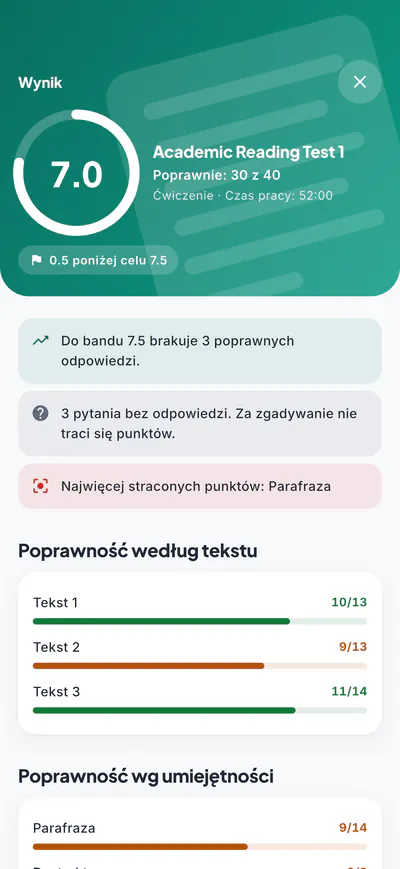
Wynik testu próbnego IELTS w aplikacji Fleydo: Przygotowanie do IELTS: szacowany band i poprawność w każdej części
Bezpłatna lekcja próbna

Poznaj swój prawdziwy wynik IELTS, zanim zrobi to egzamin

Bezpłatna indywidualna lekcja online z nauczycielem native speakerem, certyfikowanym specjalistą IELTS z wynikiem Band 8.5+. Otrzymasz diagnozę Speaking w prawdziwym formacie, uczciwą ocenę szacowanego wyniku i plan pracy nad dokładnie tymi kryteriami, które kosztują Cię punkty. Bez płatności, bez zobowiązań.

Online · Indywidualnie · Academic i General Training

IELTS jest zastrzeżonym znakiem towarowym British Council, IDP: IELTS Australia oraz Cambridge University Press & Assessment. Te testy próbne zostały przygotowane przez Fleydo i nie są przez te organizacje zatwierdzone ani rekomendowane.

Aplikacja mobilna

Fleydo English School w Twojej kieszeni

Lekcje, prace domowe, wiadomości i gry dla uczniów Fleydo i ich rodziców. Bezpłatna na iPhone’a i Androida.

Pobierz w App StorePobierz z Google Play
Więcej o aplikacji
Kod QR otwierający aplikację Fleydo English School w App Store lub Google PlayZeskanuj i pobierzOtwiera właściwy sklep dla Twojego telefonu.fleydo.com/app
Ikona aplikacji Fleydo IELTS
Fleydo: Przygotowanie do IELTS

Przygotowujesz się do IELTS?

Fleydo: Przygotowanie do IELTS to osobna aplikacja z testami próbnymi ze wszystkich czterech umiejętności. Nie potrzebujesz konta Fleydo, żeby z niej korzystać.

Zobacz aplikację IELTS
Pobierz w App StorePobierz z Google Play
Testy próbne IELTS

Ćwicz wszystkie cztery umiejętności IELTS

Wybieraj spośród 311 testów z natychmiastowym wynikiem band, wyjaśnieniami i wzorcowymi odpowiedziami. Bez rejestracji.

Wszystkie testy próbne
FleyPath

Osobista mapa drogowa Twojego dziecka — 3, 6 lub 12 miesięcy

🚀Start
👋Hello
😊Body
🦁Animals
🔢Numbers
🏆Pewny angielski
Zgrywalizowane ćwiczenie angielskiego

Jak gra — tylko że naprawdę się uczą