1. Home
  2. IELTS
  3. Test di esercitazione
  4. Speaking
  5. Test di esercitazione IELTS Speaking 35: Light

IELTS Speaking

Test di esercitazione IELTS Speaking 35: Light

Describe a place you know, indoors or outdoors, that looks its best at one particular time of day.

  • 3 parti
  • 11–14 min
  • Esaminatore
  • Quattro candidati, un test

Fai il test

Le domande dell'esaminatore partono una alla volta. Rispondi ad alta voce come faresti all'esame. La registrazione è facoltativa e resta in questa scheda del browser.

Le tue registrazioni restano solo in questa scheda. Non viene caricato nulla. Scaricale se vuoi conservarle.

Valuta la tua prova

Confronta le tue risposte con quelle dei candidati, poi scegli per ogni criterio la band che ti corrisponde.

6,0La tua band stimata
Fluency and coherence

Lexical resource

Grammatical range and accuracy

Pronunciation

Ogni candidato è una persona diversa, quindi storie e opinioni cambiano. Le band sono una nostra stima basata sui descrittori pubblici, non voti ufficiali di un esaminatore. Una trascrizione non può mostrare la pronuncia. Queste band presuppongono che sia allo stesso livello degli altri tre criteri.

Domande, scheda argomento e risposte di esempio

Part 1: intervista

Work or studies

  • Do you work or are you a student?
  • Is it what you expected it to be when you started?
  • Do you spend most of your day with other people, or on your own?
  • When you were at school, did you have a clear idea of what you wanted to do?

Takeaway food

  • How often do you have takeaway food?
  • What was the last takeaway meal you had?
  • Did your family ever get takeaways when you were a child?
  • Would you rather collect a takeaway yourself or have it delivered? (Why?)

Friends

  • Are most of your friends people you've known for a long time?
  • What do you usually do when you get together?
  • Have you made any new friends in the last year or two?

Consigli

  • 'Is it what you expected?' can be answered with yes or no, so add the one thing that surprised you: something that turned out harder, easier or different from what you imagined. That detail is your answer.
  • The takeaway questions move through the tenses: the last meal you had (past simple), what your family did when you were a child (used to, would) and a preference (I'd rather). Let the question tell you which form to use.
  • Friends is a topic where it is easy to give a list. Pick one friend or one habit and say something specific about it instead, and stop when you have said it.

Part 2: monologo (scheda argomento)

Describe a place you know, indoors or outdoors, that looks its best at one particular time of day.

You should say:

  • where it is and how often you see it
  • what it looks like at most other times
  • what is different about it at that time of day

and explain whether you ever go there at that time on purpose.

Domanda aggiuntiva

  • Have you ever tried to take a photo of it at that time?
  • Does the weather make much difference to how it looks?

Appunti che potrebbe prendere un candidato forte

  • covered market, near my flat
  • walk through it most days
  • midday: crowded, noisy, dim
  • 7 a.m. Saturday: sun through roof
  • beams of light, dust, steam from coffee
  • stalls half open, quiet voices
  • on purpose? yes, early Saturdays

Consigli

  • It does not have to be a view or a sunset. An ordinary place works well, a bus stop, a kitchen, a corridor, a car park, as long as you can say what changes at that time: the light, the people, the sounds, the temperature.
  • The second point is where many candidates lose marks. They describe only the best moment. Spend some time on what the place is like the rest of the day, because the contrast is what makes the special time worth describing.
  • The explain line is a yes-or-no question with room in it. If you never go there on purpose, say so and say why: you are there anyway at that time, or you only noticed it by chance.

Part 3: discussione

Lighting in towns and cities

  • Why do you think some towns and cities light up their important buildings at night? Spiegare
  • Do you think people who grow up in the countryside feel differently about the dark from people who grow up in a city? Confrontare
  • What could towns and cities do to use less energy on lighting at night? Dare suggerimenti

Daylight and working hours

  • How important is it for people to have daylight where they work? Esprimere un'opinione
  • Is it a good idea for schools and workplaces to change their hours in winter, when the days are shorter? Valutare pro e contro
  • Do you think people will spend even more of their day under artificial light in the future? Fare ipotesi sul futuro

Consigli

  • Lighting questions have two sides that people really argue about, such as beauty and cost, or safety and waste. You do not need facts or figures: say what you have seen in your own town and what you think follows from it.
  • The countryside and city question asks you to compare two groups of people. Picture one real street in each place after dark: how much light there is, who is out, how people get home. Then say what is different and why, using whereas or while.
  • When you speculate about the future, start from something already happening, such as more people working from home or more time spent on screens, and use might, could, I imagine or I wouldn't be surprised if.

Quattro candidati, un test

Come hanno risposto a ogni domanda candidati di quattro band diverse.

Part 1Do you work or are you a student?

I'm a student, second year. I study tourism management in Bukhara. My family is in a village, er, forty minutes from the city, so in the week I live in the dormitory, and at the weekend I go home.

Part 1Is it what you expected it to be when you started?

Not really. I thought it will be more practice, er, like going with tourists in the old city. But first two years is only theory, a lot of lectures, economics... it's little bit boring for me.

Part 1Do you spend most of your day with other people, or on your own?

With people, all the time. In the university with my groupmates, and in the dormitory we are three girls in one room, so... I am never alone. Sometimes I want, but, um, it's not possible.

Part 1When you were at school, did you have a clear idea of what you wanted to do?

No. When I was small I want to be a doctor, in our village doctor is very respected. But in, er, ninth class I understand biology is too difficult, and English I like more. So I change to – I chose tourism.

Part 1How often do you have takeaway food?

Not often. Maybe two, three times in a month, because for students it's, er, expensive. In the dormitory we cannot cook much, there is only one kitchen for all the floor.

Part 1What was the last takeaway meal you had?

Lavash. It's like a thin bread, and inside is meat, tomato, chips and sauce. Last week we ordered three, er, one for each girl, but it was very big, I didn't finish, I keep it for the breakfast.

Part 1Did your family ever get takeaways when you were a child?

No, never. In our village there was no delivery, nothing. My mother cooked every day, and for my father, buy food from outside is, er... not normal, like you are lazy. Now it's changing little bit.

Part 1Would you rather collect a takeaway yourself or have it delivered? (Why?)

Delivered. Our dormitory is far from the centre, and the guard doesn't let us go out after ten. So the delivery man brings it to the gate, and one of us go down, er, to take it.

Part 1Are most of your friends people you've known for a long time?

Not really. My best friend from school, she is married now, er, she lives in Navoi with her husband, so we only write messages. Most of my friends now is from university, from my group.

Part 1What do you usually do when you get together?

We go walking in the old city, it's beautiful. There are many tourists, so sometimes we, er, we try to speak English with them, for practice. Or we just sit in café, drink tea and talk about everything.

Part 1Have you made any new friends in the last year or two?

Yes, many, because of the dormitory. My roommate Madina, she is from Khorezm, it's very far, and before I never met people from there. Her, um, her accent is different, very funny for me.

Part 2Describe a place you know, indoors or outdoors, that looks its best at one particular time of day.

OK. I will talk about the yard of our house, in my village. There is a, um, grape tree... grape vine? It goes over the – it makes like a roof, and under it there is a wide wooden place, like a bed but outside, er, for sitting and eating. I see it every weekend when I go home. In the day it's not so nice. It's very hot, there is dust, chickens, my little brothers are shouting, and my mother hangs the washing everywhere, so... But in the evening, about seven o'clock in summer, it's – everything is change. My mother put water on the ground, so the dust go down, and it smells fresh, like after rain. The sun is low and the light comes between the leaves, it's orange, er... very soft. Then we put the food there and all family sit together and drink tea. On Saturday I try to take the early bus from Bukhara, because the – the late bus is always full, er, sometimes you stand one hour, and the driver stops everywhere, for everybody... So I take the early bus. And on purpose, er... yes, I think I go home for this time. In the dormitory there is nothing like this.

Part 2Have you ever tried to take a photo of it at that time?

Yes, many times, but on the phone it looks, er, normal. Not the same.

Part 2Does the weather make much difference to how it looks?

Er, in summer it's always sunny. In autumn, when is cloudy, it's not so nice.

Part 3Why do you think some towns and cities light up their important buildings at night?

For tourists, mostly. In Bukhara now the old buildings has lights at night, er, different colours, and tourists walk around and take photo. So the cafés can stay open until late. Also for people who live there it's nice, in summer evening it's cool, so families go out and walk, er, with children. But it needs a lot of electricity, I think, for this.

Part 3Do you think people who grow up in the countryside feel differently about the dark from people who grow up in a city?

Yes, I think. In the village people are, er, used to it. My little brothers play outside until late, no problem, nobody is afraid. But people in the city always live with light, so when it's dark they feel... not comfortable. For me it's – I am in the middle. The road from the bus stop to our house is very dark, no lamps, so my father always comes to meet me, also in winter.

Part 3What could towns and cities do to use less energy on lighting at night?

Er... maybe after, um, midnight they can switch off some lamps, one yes, one no, because nobody is in the street. Also they can use the lamps with the sun, er, solar. I saw in one village, the lamps with small panel on the top, and they don't need electricity. It's cheap, and also no bill for electricity.

Part 3How important is it for people to have daylight where they work?

Very important, I think. Our lecture room has no window, er, only lamps, and after two lectures I want to sleep, I cannot listen. In the library there is big windows, so I can sit there more long, er... three, four hours. With the sun people have more energy, and they are more happy also, I think.

Part 3Is it a good idea for schools and workplaces to change their hours in winter, when the days are shorter?

Er, for schools, yes, maybe. In winter the children go to school when it's still dark, and it's cold, and for small children it's, er, dangerous on the road. Start one hour later is better. But for work... I don't know. People need to work eight hours, so if you start late, you finish late, so... it's the same problem.

Part 3Do you think people will spend even more of their day under artificial light in the future?

Yes, I think more. Now people work in office, in shopping centre, and at home they – they look at phone, computer... all day inside. In the future, um, more jobs will be with computer, so people go outside less and less. It's not good for health, but I think it will be like this.

Parole per questo test

dusk
the time just after the sun goes down, when it is getting dark
first light
the very start of the day, when the sky begins to get light
floodlights
very bright lamps that light up a sports ground or the outside of a building
glow
a soft, steady light, as in the windows glowing at night
harsh light
bright, cold light that is unpleasant and makes things look worse
natural light
light from the sun rather than from lamps
light pollution
so much artificial light at night that the sky never gets properly dark
pitch dark
completely dark, so that you cannot see anything
dim (verb)
make a light less bright without switching it off
a night shift
a period of work at night, for example from ten in the evening to six in the morning
a takeaway
a hot meal you buy from a restaurant and eat somewhere else
catch up (with someone)
meet a friend after some time and talk about what has happened since

Espressioni utili

  • Most of the time it's just ___, but around ___ it ___.
  • What changes everything is ___.
  • It only lasts ___, so ___.
  • I don't go there specially, but ___.
  • When I was a child we hardly ever ___, whereas now ___.
  • I've known most of my friends since ___.
  • It's not so much ___ as ___.
  • The problem with switching off ___ is that ___.
  • If things carry on like this, I imagine ___.
  • People who grow up in ___ tend to ___, whereas ___.

Icona dell'app Fleydo IELTS Fleydo: Preparazione IELTS

Porta questi test con te sul telefono

Tutti i test di queste pagine sono anche nell'app Fleydo: Preparazione IELTS per iPhone, iPad e Android, insieme a 2.000 parole IELTS con audio.

  • Funziona offline una volta scaricato il test sul telefono
  • 2.000 parole IELTS con audio, ripetizione spaziata ed esercizi brevi
  • Registra le tue risposte di Speaking e riascoltale
  • Un piano giornaliero per la tua band obiettivo e la data dell'esame
Scarica su App StoreDisponibile su Google Play
Inquadra per scaricareApre App Store o Google Play, a seconda del telefono.

Non serve un account. Scopri l'app

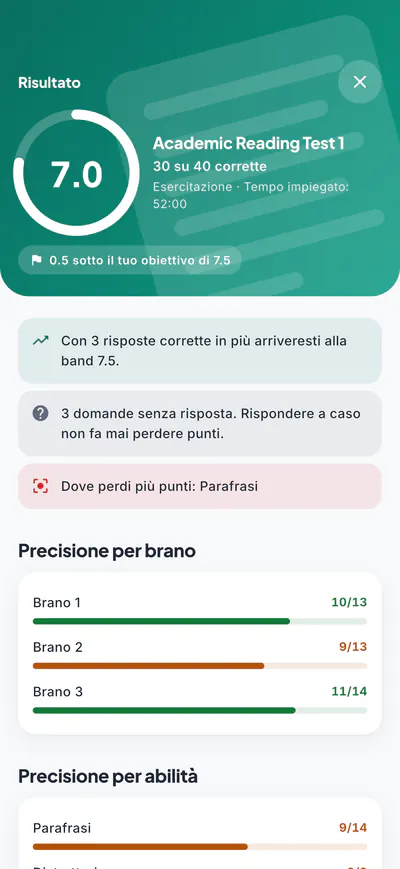
Risultato di un test di esercitazione IELTS nell'app Fleydo: Preparazione IELTS: band stimata e precisione per ogni parte
Lezione di prova gratuita

Scopri il tuo vero band IELTS prima dell'esame

Una lezione individuale online gratuita con un insegnante madrelingua inglese, specialista IELTS certificato Band 8.5+. Ricevi una diagnosi dello Speaking nel formato reale, una stima onesta del tuo band e un piano mirato ai criteri che ti costano punti. Nessun pagamento, nessun impegno.

Online · Individuale · Academic e General Training

IELTS è un marchio registrato del British Council, di IDP: IELTS Australia e di Cambridge University Press & Assessment. Questi test di esercitazione sono scritti da Fleydo e non sono approvati né sostenuti da queste organizzazioni.

App mobile

Fleydo English School in tasca

Lezioni, compiti, messaggi e giochi per gli studenti Fleydo e i loro genitori. Gratuita su iPhone e Android.

Scarica su App StoreDisponibile su Google Play
Scopri di più sull'app
Codice QR che apre l'app Fleydo English School su App Store o Google PlayInquadra per scaricareApre lo store giusto per il tuo telefono.fleydo.com/app
Icona dell'app Fleydo IELTS
Fleydo: Preparazione IELTS

Ti prepari all'IELTS?

Fleydo: Preparazione IELTS è un'app separata con simulazioni per tutte e quattro le abilità. Per usarla non ti serve un account Fleydo.

Scopri l'app IELTS
Scarica su App StoreDisponibile su Google Play
Test di esercitazione IELTS

Esercitati in tutte e quattro le abilità IELTS

311 test con band immediata, soluzioni spiegate e risposte modello. Senza registrazione.

Tutti i test di esercitazione
Il FleyPath

La roadmap personale di tuo figlio — 3, 6 o 12 mesi

🚀Partenza
👋Hello
😊Body
🦁Animals
🔢Numbers
🏆Inglese sicuro
Pratica di inglese gamificata

Come un gioco — solo che stanno davvero imparando