1. Home
  2. IELTS
  3. Test di esercitazione
  4. Reading
  5. Reading Table Completion: esercizio 1

IELTS Reading · Completare la tabella

IELTS Reading Table Completion: esercizio 1

Birds' nests

  • 10 domande
  • 15 min
  • Academic

In questo test

  1. PassageDomande 1–10Five ways to make a nest

Tipi di domanda

  • Completare la tabella
ReadingIELTS Reading Table Completion: esercizio 1
Tempo rimasto15:00

Passage

Five ways to make a nest

A A male southern masked weaver may put up dozens of nests in a single breeding season, working alone in a tree or reed bed and weaving each one from grass or similar material. The female's part comes at the end: if she accepts a nest, she lines it with leaves and feathers. That surplus of nests appealed to researchers from three Scottish universities, working with scientists from Botswana, because the attempts of a single bird could be compared. Reporting in 2011, they described males changing their technique from nest to nest and, as they gained experience, letting fall fewer blades of grass. Building, they suggested, is not simply a matter of instinct: experience plays a part too.

B The sociable weaver of the Kalahari, a bird of about 27 grams, works on another scale. Using stiff grasses, these birds raise massive shared structures in trees and sometimes on telephone poles. A single structure may hold anywhere from two to 250 chambers, each reached through its own entrance tunnel on the underside, and with regular upkeep it can last for decades. Readings from a South African reserve, in a study published in 2020, showed the chambers staying cooler than the outside air during summer's highest temperatures and warmer during winter's lowest. Those near the middle of a colony, and those with long tunnels, were the best insulated.

C The white-nest swiftlet of South-East Asia produces its building material in its own body. Swiftlets build with sticky saliva from a pair of glands under the tongue. Most species mix it with feathers and plant fibres, but the nest of this one is chiefly pure saliva, the main ingredient of bird's nest soup. Clinging to a vertical surface, the birds add layer upon layer, forming a shallow cup over about 30 days, with most of the work done at night. Both sexes are known to contribute, although one pair filmed in Sarawak did not share the labour evenly. Wild colonies nest in places such as limestone caves, but farmers now also put up empty buildings, called swiftlet houses, to attract them.

D A hornbill begins with a ready-made hole in a tree or rock, so its building work amounts to a single wall. The female, sometimes with her mate's help, closes the entrance with mud, droppings and fruit pulp, leaving a slit that may be only a centimetre wide. Through it he brings food to her and later to the chicks, and she depends on him for at least 40 days in the smallest species and up to about 130 in the largest. In most species she also moults while shut inside. Why hornbills seal their nests is still debated, but the wall makes attacks by predators very rare. The ground hornbills, however, do not seal their nests.

E Long-tailed tits spend longer on the job than most small songbirds: a pair may work for up to three weeks, often low in a thorny bush. They produce an oval shell of moss and plant fibres bound with spider silk, a mesh in which moss leaves catch on threads of silk, hook and loop, much like Velcro. In a study of some 40 nests published in 1996, Mike Hansell reported lichen flakes and spider cocoons on the outside, and he proposed that pale material of this kind serves as camouflage by breaking up the nest's dark shape. Inside, out of sight, lie roughly 1,000 to 2,000 small feathers.

Glossario
glands
parts of the body that produce a liquid such as saliva
moults
loses old feathers so that new ones can grow
lichen
a small, flat growth found on rocks and trees, formed by a fungus and an alga living together
cocoons
silk cases, such as those spiders make around their eggs
PassageDomande 1–10
Domande 1–10 Max 3 parole

Complete the table below. Choose NO MORE THAN THREE WORDS AND/OR A NUMBER from the text for each answer.

Bird Site Materials Notable point
Hornbillhole in tree or rockmud, droppings, 1female fed by male for up to about 2 days
Long-tailed titoften low in thorny bushshell of 3 and plant fibres, held by spider silkpale flakes of 4 may camouflage it
Masked weavertree or reed bedgrass; lining of leaves and 5drops fewer 6 of grass over time
Sociable weavertrees or 7stiff grassesup to 8 chambers
White-nest swiftletcaves, swiftlet housesmainly 9built largely at 10

Soluzioni e spiegazioni

Prima prova a fare il test: le soluzioni sono più utili dopo che hai risposto.

Mostra le soluzioni e le spiegazioni
  1. 1
    fruit pulp / pulp

    Paragraph D says the entrance is closed 'with mud, droppings and fruit pulp'. The first two are printed in the table, so the missing material is fruit pulp. Pulp alone is also accepted, as it is the same material.

  2. 2
    130 / one hundred and thirty / one hundred thirty

    Paragraph D says the female depends on the male for at least 40 days in the smallest species and 'up to about 130 in the largest'. 'Up to' in the table asks for the longest time, so 40 is wrong.

  3. 3
    moss leaves / moss

    Paragraph E describes 'an oval shell of moss and plant fibres'. Plant fibres and spider silk are printed in the table, so moss is missing; moss leaves is also accepted. Lichen goes on the outside of the shell, and feathers go inside.

  4. 4
    lichen

    Paragraph E reports 'lichen flakes and spider cocoons on the outside' and says such pale material may serve as camouflage. The table's word 'flakes' points to lichen, because the cocoons are not described as flakes.

  5. 5
    feathers

    Paragraph A says the female 'lines it with leaves and feathers'. Leaves are already printed in the table, so the missing word is feathers. Grass is what the male builds with, not the lining.

  6. 6
    blades

    Paragraph A says that, with experience, males were 'letting fall fewer blades of grass'. 'Drops' means 'letting fall' and 'over time' matches gaining experience. 'Of grass' is already printed, so only blades is needed.

  7. 7
    telephone poles / poles

    Paragraph B says the structures go up 'in trees and sometimes on telephone poles'. Trees are already printed, so the other site is telephone poles. Poles alone is also accepted, because it names the same site.

  8. 8
    250 / two hundred and fifty / two hundred fifty

    Paragraph B gives the range 'two to 250 chambers'. 'Up to' in the table asks for the top of that range, so 250 is right. Two is the lowest number, and 27 is the bird's weight in grams.

  9. 9
    pure saliva / saliva / sticky saliva

    Paragraph C says this bird's nest 'is chiefly pure saliva', and 'chiefly' matches 'mainly' in the table. Sticky saliva is also accepted, as it is the same material. Feathers and plant fibres are what most other swiftlet species add.

  10. 10
    night

    Paragraph C says the cup forms 'with most of the work done at night'. 'Built largely' matches 'most of the work', so night is right. The 30 days is how long building takes, not when it happens.

Parole chiave di questo test

Passage

surplus
more of something than is needed
instinct
behaviour an animal is born with and does not have to learn
upkeep
the work of keeping something in good condition
insulated
protected from heat or cold
ingredient
one of the things used to make a food or other product
Completare la tabella: come rispondereRead each gap by its row and its column, then find the fact that belongs there.

What the task looks like

You get a table with some cells empty, and a limit such as NO MORE THAN TWO WORDS AND/OR A NUMBER. That means up to two words, a number, or both.

A table sets out information more neatly than the text does. The text may give it in sentences, with facts from different rows mixed together. You are tested on details, main ideas and word type.

A method to try

1. Read the title, the column headings and the row labels. What is being compared, and on what points?

2. Look at the filled cells in the same column as a gap. They show the kind of answer that fits: a price, a date, a noun.

3. Put each gap into words, using its row and its column: 'the length of the beginners' course'.

4. Scan the text for the row label, then read that part carefully. The same row may be discussed in more than one place.

5. Look at what is already in the cell. If it shows '____ weeks', you only need the number.

The traps

The nearest number: two similar facts may sit side by side, so check who or what each one belongs to.

The order of the rows: the text may deal with the second row before the first.

Words already printed: repeating a unit that the cell already shows can take you over the limit.

Worked example

Text: The sports centre runs two swimming courses for adults. The improvers' course lasts eight weeks, compared with six for beginners. Beginners pay £40, and improvers pay £55.

Table: Course | Length | Fee Beginners | (1) ____ weeks | £40 Improvers | (2) ____ weeks | £55 (NO MORE THAN TWO WORDS AND/OR A NUMBER)

What goes in gap 1?

Deboleeight. It comes right before 'weeks' in the text, so it looks like the answer.
Miglioresix (or 6). Gap 1 is in the Beginners row and the Length column, and the text says 'compared with six for beginners'. Eight belongs in gap 2.

Use both labels. A fact is right only if it belongs to this row and this column, however close it sits to a word from the table.

Icona dell'app Fleydo IELTS Fleydo: Preparazione IELTS

Porta questi test con te sul telefono

Tutti i test di queste pagine sono anche nell'app Fleydo: Preparazione IELTS per iPhone, iPad e Android, insieme a 2.000 parole IELTS con audio.

  • Funziona offline una volta scaricato il test sul telefono
  • 2.000 parole IELTS con audio, ripetizione spaziata ed esercizi brevi
  • Registra le tue risposte di Speaking e riascoltale
  • Un piano giornaliero per la tua band obiettivo e la data dell'esame
Scarica su App StoreDisponibile su Google Play
Inquadra per scaricareApre App Store o Google Play, a seconda del telefono.

Non serve un account. Scopri l'app

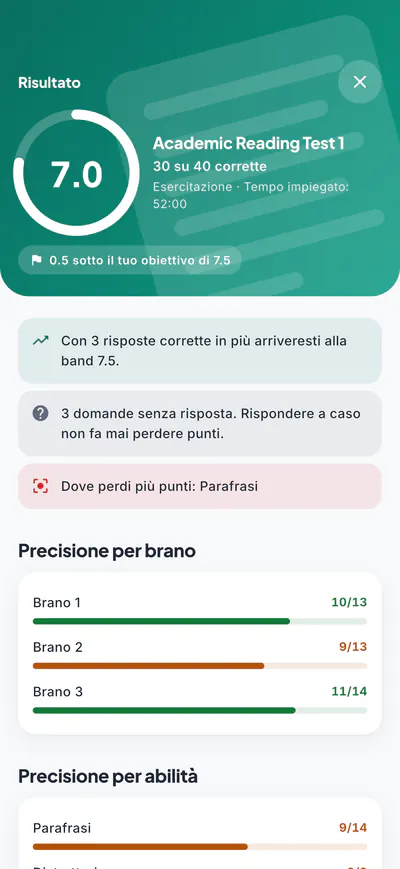
Risultato di un test di esercitazione IELTS nell'app Fleydo: Preparazione IELTS: band stimata e precisione per ogni parte
Lezione di prova gratuita

Scopri il tuo vero band IELTS prima dell'esame

Una lezione individuale online gratuita con un insegnante madrelingua inglese, specialista IELTS certificato Band 8.5+. Ricevi una diagnosi dello Speaking nel formato reale, una stima onesta del tuo band e un piano mirato ai criteri che ti costano punti. Nessun pagamento, nessun impegno.

Online · Individuale · Academic e General Training

IELTS è un marchio registrato del British Council, di IDP: IELTS Australia e di Cambridge University Press & Assessment. Questi test di esercitazione sono scritti da Fleydo e non sono approvati né sostenuti da queste organizzazioni.

App mobile

Fleydo English School in tasca

Lezioni, compiti, messaggi e giochi per gli studenti Fleydo e i loro genitori. Gratuita su iPhone e Android.

Scarica su App StoreDisponibile su Google Play
Scopri di più sull'app
Codice QR che apre l'app Fleydo English School su App Store o Google PlayInquadra per scaricareApre lo store giusto per il tuo telefono.fleydo.com/app
Icona dell'app Fleydo IELTS
Fleydo: Preparazione IELTS

Ti prepari all'IELTS?

Fleydo: Preparazione IELTS è un'app separata con simulazioni per tutte e quattro le abilità. Per usarla non ti serve un account Fleydo.

Scopri l'app IELTS
Scarica su App StoreDisponibile su Google Play
Test di esercitazione IELTS

Esercitati in tutte e quattro le abilità IELTS

311 test con band immediata, soluzioni spiegate e risposte modello. Senza registrazione.

Tutti i test di esercitazione
Il FleyPath

La roadmap personale di tuo figlio — 3, 6 o 12 mesi

🚀Partenza
👋Hello
😊Body
🦁Animals
🔢Numbers
🏆Inglese sicuro
Pratica di inglese gamificata

Come un gioco — solo che stanno davvero imparando