1. Home
  2. IELTS
  3. Test di esercitazione
  4. Reading
  5. Reading Matching Information: esercizio 3

IELTS Reading · Abbinare le informazioni

IELTS Reading Matching Information: esercizio 3

Life in Çatalhöyük

  • 13 domande
  • 15 min
  • Academic

In questo test

  1. PassageDomande 1–13A town crossed by its rooftops

Tipi di domanda

  • Abbinare le informazioni
ReadingIELTS Reading Matching Information: esercizio 3
Tempo rimasto15:00

Passage

A town crossed by its rooftops

A To anyone passing today, Çatalhöyük in south-central Turkey looks like a large grassy hill on a plain. Beneath the soil lies a settlement whose people kept abandoning old houses, filling them in and building new ones on top, until a mound some 21 metres high had formed. The excavation project's older guidebook says this went on for about 1,400 years, starting around 7400 BC, whereas a 2019 study of the human remains gives roughly 1,150 years, from 7100 to 5950 BC. James Mellaart's team dug about 160 buildings between 1961 and 1965, and Ian Hodder's project ran from 1993 to 2018, yet the excavation's head said in 2022 that only 6 to 10 per cent of the site had been dug.

B A visitor looking for a street there would usually have been disappointed. Houses stood so tightly together that there were few streets, and people got about by walking across the roofs, then climbing down a wooden ladder through an opening into each home. Houses had neither doors nor windows. Each did have outer walls of its own, pressed against those of the building next door, and this allowed a family to take down and rebuild a house without affecting the neighbours.

C At the foot of the ladder was a main room in which, the project team believes, a household of perhaps five to ten people cooked, ate, made things and slept, with side rooms for storage. The oven sat under the roof opening, which also let out smoke. Soot stained the walls, so they were whitewashed again and again, a chore that also helped them to reflect what light came in. Excavated floors look relatively free of debris, yet microscopic study has found appreciable amounts of animal and human waste in walls and floors, and rubbish areas and animal pens lay close by.

D Many houses held graves too, usually beneath raised platforms that may have been used for sleeping. It had long been assumed that those buried in one house were relatives. The 2019 study doubted this, but a 2025 analysis of 131 ancient genomes suggests that the answer changed with time: in the early centuries people buried together were often close relatives, whereas later they were often unrelated. Throughout, it found, the genetic links within a building ran mainly through mothers.

E Cereals lay at the heart of the diet. Plant remains show mainly emmer and einkorn wheats, along with barley, rye, peas and lentils, and the grain was pounded and ground to make bread and porridge, soft foods of a kind that often encourage tooth decay. Among the animal bones, sheep dominate throughout, with goats also present, while domesticated cattle appear only in the later centuries. Deer, hares and fish were eaten too. Men and women, chemical analysis of their bones suggests, had broadly similar diets.

F Pots offer a second line of evidence, though from a neighbouring mound and a later date. In 2018 a team reported proteins recovered from fragments of vessels found on the West Mound and dated to between 5900 and 5800 BC. They identified cereals, pulses, dairy products and meat, with more than one food in five vessels, while one jar yielded milk proteins only from whey, the watery part of milk. Lentils, common among preserved plant remains, did not show up at all, and the authors caution that the method depends heavily on the reference databases available.

G The project team found no sign of a ruling class. Houses were similar in size and had the same limited storage space, and no upper-class quarters, ceremonial buildings or administrative centres have been identified, which is why the team describes a mostly egalitarian community. Daily routines did change, however: leg bones suggest that in the later periods young people as well as adults were working harder and travelling further, perhaps partly because flocks grazed more widely.

Glossario
emmer and einkorn
two early kinds of wheat
pulses
edible seeds such as peas, beans and lentils
whitewashed
painted with a thin white mixture
genomes
complete sets of the genetic material of living things
PassageDomande 1–13
Domande 1–13

The text has seven paragraphs, A-G. Which paragraph contains the following information? Choose the correct letter, A-G. NB You may use any letter more than once.

Opzioni
  • AParagraph A
  • BParagraph B
  • CParagraph C
  • DParagraph D
  • EParagraph E
  • FParagraph F
  • GParagraph G
1a household task that served two purposes
2a container apparently used for a single product
3conflicting figures for how long the settlement was lived in
4a feature that let one home be replaced on its own
5a comparison of what the two sexes ate
6the absence of any sign of a privileged group
7a result that challenges an old belief about family ties
8a way of getting around that did not involve the ground
9a contrast between how clean homes seemed and what closer study showed
10how repeated rebuilding created a high hill
11a food that one scientific method failed to detect
12signs of an increasing physical burden on younger members of the community
13a dental problem linked to what people ate

Soluzioni e spiegazioni

Prima prova a fare il test: le soluzioni sono più utili dopo che hai risposto.

Mostra le soluzioni e le spiegazioni
  1. 1
    C

    Paragraph C says whitewashing covered soot stains and 'also helped them to reflect what light came in'. That is one job with two benefits. Paragraph B describes taking down and rebuilding a house, but gives no second benefit of that work.

  2. 2
    F

    Paragraph F says 'one jar yielded milk proteins only from whey'. That suggests one product in one container. Paragraph E also discusses food, but it says nothing about what any particular container held.

  3. 3
    A

    Paragraph A sets 'about 1,400 years' from an older guidebook against 'roughly 1,150 years' from a 2019 study. Paragraph F gives dates as well, but only for some pots, not for how long people lived there.

  4. 4
    B

    Paragraph B says each house had its own outer walls, so a family could rebuild 'without affecting the neighbours'. Paragraph A mentions rebuilding too, but not how one house could be replaced alone.

  5. 5
    E

    Paragraph E says 'Men and women' had 'broadly similar diets'. Paragraph D mentions mothers, but it is about family links, not about what anyone ate.

  6. 6
    G

    Paragraph G says the team 'found no sign of a ruling class'. Paragraph B says houses were tightly packed, but it draws no conclusion about rank or power.

  7. 7
    D

    Paragraph D says it had 'long been assumed' that people buried together were relatives, but later burials were often unrelated. Paragraph A also reports a 2019 study, but on how long the site was occupied.

  8. 8
    B

    Paragraph B says people 'got about by walking across the roofs' because there were few streets. Paragraph G mentions travelling further, but that concerns journeys for work, not moving around the town.

  9. 9
    C

    Paragraph C says floors 'look relatively free of debris', yet microscopic study found waste. Paragraph F also reports laboratory results, but those concern food in pots, not how clean homes were.

  10. 10
    A

    Paragraph A says people kept building on top of old houses 'until a mound some 21 metres high had formed'. Paragraph B describes rebuilding too, but not its effect on the height of the site.

  11. 11
    F

    Paragraph F says lentils 'did not show up at all' in the protein results. Paragraph E mentions lentils as well, but there they are found among plant remains, so that evidence did reveal them.

  12. 12
    G

    Paragraph G says that in later periods young people were 'working harder and travelling further'. Paragraph C lists household jobs, but it says nothing about young people or about change over time.

  13. 13
    E

    Paragraph E says soft foods 'often encourage tooth decay'. That is a problem with teeth linked to diet. Paragraph G also draws on evidence from the body, but from leg bones, and it concerns work rather than food.

Parole chiave di questo test

Passage

abandoning
leaving a place or thing for good
dominate
to be the largest or most noticeable part of something
caution
to warn someone to be careful
egalitarian
treating all people as equal
appreciable
large enough to be noticed
Abbinare le informazioni: come rispondereFind which paragraph holds a particular detail, example, reason or comparison.

What the task looks like

You get a list of items, and you say which lettered paragraph contains each one. An item might be 'a reason for ...', 'an example of ...' or 'a comparison between ...'. In General Training, the letters may mark separate short texts.

The task tests whether you can locate specific information: details, examples, reasons and comparisons.

This is not the same as matching headings. You are not looking for the main idea. The answer may be one small part of a paragraph that is mainly about something else.

In our papers, the items do not follow the order of the text, and there may be more letters than items. If a letter can be used more than once, the instructions will say so.

A method to try

1. Consider leaving this task until after the other questions on the same text. By then you may know where things are.

2. Read the items. For each one, mark the kind of information it asks for, such as a reason or an example, and then its topic.

3. Think of other ways to say the topic words.

4. Read one paragraph at a time and check it against all the items you have left. This can be quicker than searching the whole text for one item at a time.

5. Before you choose a letter, point to the exact words that match. If you cannot, keep reading.

The traps

The right topic, the wrong kind: several paragraphs may mention a topic, but only one gives the reason or the example that the item asks for.

The matching word: a word from the item may appear in a paragraph that says something quite different about it.

Small words in the item: 'a failed attempt' is not just any attempt, and 'a recent change' is not just any change. These words decide the match.

Worked example

Text: [A] Ticket sales at the town theatre were lower last year than the year before. [B] The main cause was the closed footbridge from the station, which left people arriving by train with a long walk. [C] The bridge reopened in March, and the theatre has since added an extra weekday performance.

Item: an explanation for a fall in audience numbers. Which paragraph contains this?

DeboleA. It talks about lower ticket sales, and that is the fall in audience numbers.
MiglioreB. Paragraph A only reports the fall. Paragraph B gives the reason: the closed footbridge made the theatre harder to reach.

The item asks for an explanation, so finding the topic is not enough. Mark the kind of information first, then look for that kind.

Icona dell'app Fleydo IELTS Fleydo: Preparazione IELTS

Porta questi test con te sul telefono

Tutti i test di queste pagine sono anche nell'app Fleydo: Preparazione IELTS per iPhone, iPad e Android, insieme a 2.000 parole IELTS con audio.

  • Funziona offline una volta scaricato il test sul telefono
  • 2.000 parole IELTS con audio, ripetizione spaziata ed esercizi brevi
  • Registra le tue risposte di Speaking e riascoltale
  • Un piano giornaliero per la tua band obiettivo e la data dell'esame
Scarica su App StoreDisponibile su Google Play
Inquadra per scaricareApre App Store o Google Play, a seconda del telefono.

Non serve un account. Scopri l'app

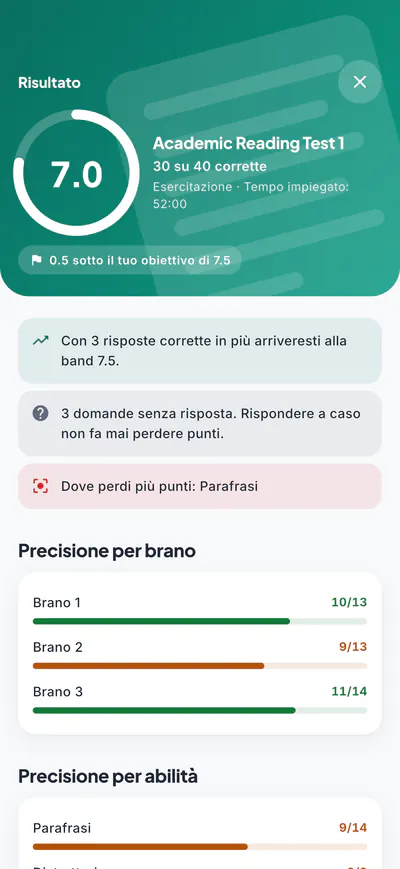
Risultato di un test di esercitazione IELTS nell'app Fleydo: Preparazione IELTS: band stimata e precisione per ogni parte
Lezione di prova gratuita

Scopri il tuo vero band IELTS prima dell'esame

Una lezione individuale online gratuita con un insegnante madrelingua inglese, specialista IELTS certificato Band 8.5+. Ricevi una diagnosi dello Speaking nel formato reale, una stima onesta del tuo band e un piano mirato ai criteri che ti costano punti. Nessun pagamento, nessun impegno.

Online · Individuale · Academic e General Training

IELTS è un marchio registrato del British Council, di IDP: IELTS Australia e di Cambridge University Press & Assessment. Questi test di esercitazione sono scritti da Fleydo e non sono approvati né sostenuti da queste organizzazioni.

App mobile

Fleydo English School in tasca

Lezioni, compiti, messaggi e giochi per gli studenti Fleydo e i loro genitori. Gratuita su iPhone e Android.

Scarica su App StoreDisponibile su Google Play
Scopri di più sull'app
Codice QR che apre l'app Fleydo English School su App Store o Google PlayInquadra per scaricareApre lo store giusto per il tuo telefono.fleydo.com/app
Icona dell'app Fleydo IELTS
Fleydo: Preparazione IELTS

Ti prepari all'IELTS?

Fleydo: Preparazione IELTS è un'app separata con simulazioni per tutte e quattro le abilità. Per usarla non ti serve un account Fleydo.

Scopri l'app IELTS
Scarica su App StoreDisponibile su Google Play
Test di esercitazione IELTS

Esercitati in tutte e quattro le abilità IELTS

311 test con band immediata, soluzioni spiegate e risposte modello. Senza registrazione.

Tutti i test di esercitazione
Il FleyPath

La roadmap personale di tuo figlio — 3, 6 o 12 mesi

🚀Partenza
👋Hello
😊Body
🦁Animals
🔢Numbers
🏆Inglese sicuro
Pratica di inglese gamificata

Come un gioco — solo che stanno davvero imparando