1. Home
  2. IELTS
  3. Test di esercitazione
  4. Reading
  5. Reading Matching Features: esercizio 1

IELTS Reading · Abbinare le caratteristiche

IELTS Reading Matching Features: esercizio 1

Pioneers of forecasting

  • 11 domande
  • 15 min
  • Academic

In questo test

  1. PassageDomande 1–11From storm cones to computers

Tipi di domanda

  • Abbinare le caratteristiche
ReadingIELTS Reading Matching Features: esercizio 1
Tempo rimasto15:00

Passage

From storm cones to computers

A Robert FitzRoy is remembered first as captain of HMS Beagle on Charles Darwin's famous voyage. In 1854, however, he took charge of a small British government department created to study ocean weather and so protect lives and property at sea. A storm in October 1859, which destroyed 133 ships, altered the course of his work. He argued that it could have been tracked, and the government let him try out a national warning system. Reports reached London by telegraph, and cones and drums hoisted on the coast alerted crews. The first warning was issued in February 1861, and that August The Times carried his first public forecast.

B Those forecasts looked only a day or two ahead and were very general, yet many scientists of the day criticised him, doubting that weather could be predicted at all. After FitzRoy died in 1865, a report urged that his office should limit itself to collecting data. Public demand soon brought the storm warnings back, but public forecasts did not return until 1879.

C The Norwegian physicist Vilhelm Bjerknes wanted meteorology to become an exact science. In a paper of 1904 he argued that if the atmosphere obeys physical laws, its future can in principle be worked out, given two things: an accurate description of its present state and accurate knowledge of those laws. For solving the resulting equations he favoured methods that relied wholly or partly on drawing. On settling in Bergen in 1917, however, he judged that he lacked the resources to pursue the theory there, and with government backing he arranged a nearly tenfold increase in observing stations in southern Norway. A summer forecasting service for agriculture began in 1918. Bjerknes took no part in the map work himself; that fell to assistants, including his son Jacob, whose model of moving cyclones described the boundaries between warm and cold air now called fronts.

D Lewis Fry Richardson, a British mathematician, took a harder road and tried to calculate the changes directly from the full equations. During the First World War he used observations from 1910 to work out by hand how conditions would change over six hours at two points in central Europe. He put the labour at nearly six weeks, although one modern expert believes it was spread over about two years. The result, a rise in surface pressure of 145 hectopascals, was wildly unrealistic. He published it regardless in his 1922 book, which also imagined 64,000 people calculating side by side to keep pace with the weather. A computer reconstruction described in 2006 reached almost the same figure, so the arithmetic was not to blame. The root cause lay in the starting data: once these were balanced, the predicted change shrank to less than 1 hectopascal.

E Carl-Gustaf Rossby, a Swede, spent two years in Bergen from 1919, where he heard Bjerknes lecture. On reaching the United States Weather Bureau in 1926 he met unexpected hostility to the theories developed in Bergen. He fared better elsewhere. In 1928 he organised an experimental weather service for flights between San Francisco and Los Angeles, and that same year he took charge of a new meteorology course at the Massachusetts Institute of Technology. Papers of 1939 and 1940, perhaps his most important, explained the long waves in high-level westerly winds and led to a formula for their speed.

F The 1939 study relied on a very simple equation that treats the atmosphere as a single layer, and scientific opinion held that it could not predict the weather accurately. In 1950, however, a team led by Jule Charney ran it on ENIAC, an early electronic computer, thereby avoiding the difficulties of Richardson's approach, and the team's four 24-hour forecasts all showed some skill. Back in Sweden, the institute Rossby led worked with the air force on a model of the same simple type, producing Europe's first routine computer forecasts by the mid-1950s.

Glossario
telegraph
a system for sending messages along wires
cyclones
large systems of wind turning around an area of low air pressure
hectopascal
a unit used to measure air pressure
westerly winds
winds that blow from the west
PassageDomande 1–11
Domande 1–11

Look at the following statements (Questions 1-11) and the list of people below. Match each statement with the correct person, A-D. NB You may use any letter more than once.

Opzioni
  • ARobert FitzRoy
  • BVilhelm Bjerknes
  • CLewis Fry Richardson
  • DCarl-Gustaf Rossby
1At a national agency he met resistance to theories he had learned in another country.
2A destructive natural event led him to seek permission for a new public service.
3He left the practical work of a forecasting service to junior colleagues.
4A later repeat of his work indicated that his sums were not the cause of a poor result.
5Many specialists of his time did not accept that his basic goal could ever be reached.
6He went on to publish a figure that could not have been correct.
7He set up a trial service for users of a single transport route.
8He thought that the mathematics of prediction could be tackled at least partly through drawing.
9He pictured a vast workforce carrying out calculations at the same time.
10After his death, a report recommended cutting back his organisation's work.
11A simple equation he had used proved more useful for forecasting than experts expected.

Soluzioni e spiegazioni

Prima prova a fare il test: le soluzioni sono più utili dopo che hai risposto.

Mostra le soluzioni e le spiegazioni
  1. 1
    D

    Paragraph E says Rossby met 'unexpected hostility' at the United States Weather Bureau to ideas from Bergen, in Norway. FitzRoy was also criticised, but by scientists of his day and not over theories from abroad.

  2. 2
    A

    Paragraph A says a storm destroyed 133 ships. FitzRoy argued it could have been tracked, and the government let him try a warning system. No other person's work starts from a disaster.

  3. 3
    B

    Paragraph C says Bjerknes 'took no part in the map work himself' for the summer forecasting service, and his assistants did it. Rossby's institute also worked on forecasts, but the text does not say that he left this work to others.

  4. 4
    C

    Paragraph D says a computer repeated Richardson's work and got almost the same figure, so his 'arithmetic was not to blame'. The problem was the starting data. Sums and arithmetic mean the same thing here.

  5. 5
    A

    Paragraph B says scientists doubted that FitzRoy's aim, predicting weather, was possible at all. Paragraph F also mentions doubt, but only about whether Rossby's one simple equation could be accurate, not about forecasting as a whole.

  6. 6
    C

    Paragraph D says Richardson's result was 'wildly unrealistic', yet he 'published it regardless' in his book. FitzRoy also published forecasts, but the text does not say that any of them contained an impossible figure.

  7. 7
    D

    Paragraph E says Rossby organised an 'experimental' service for flights between two cities. FitzRoy also tried out a service, but his was national and for all crews, so it did not serve one route.

  8. 8
    B

    Paragraph C says Bjerknes favoured methods using drawing to solve the equations. Richardson is the tempting answer because he also worked on the equations, but paragraph D says he calculated the changes directly, by hand.

  9. 9
    C

    Paragraph D says Richardson's book imagined 64,000 people calculating side by side. Bjerknes and Charney also had people working with them, but those were real teams, and neither is described as being of this size.

  10. 10
    A

    Paragraph B says that after FitzRoy died, a report urged his office to do nothing but collect data. That is a smaller job than before, because it no longer included forecasting. No other person's work is described this way.

  11. 11
    D

    Paragraphs E and F show the 1939 study was Rossby's. Experts doubted its simple equation, yet its forecasts in 1950 showed some skill. Charney is not in the list: his team ran the equation later, on a computer.

Parole chiave di questo test

Passage

altered
changed
hostility
strong and unfriendly opposition
resources
the money, people and equipment needed to do something
reconstruction
a new version made to show how something was done or happened
regardless
in spite of a problem
Abbinare le caratteristiche: come rispondereLink facts and opinions to the right person or item, wherever they appear.

What the task looks like

You get a lettered list of people or items, and a list of statements. You choose the letter that each statement belongs to.

The task tests whether you can link facts or opinions to the right person or item.

In our papers, the statements do not follow the order of the text, and some letters may not be used. If a letter can be used more than once, the instructions will say so.

A method to try

1. Scan for every mention of each name or item, and highlight it. One name may appear in several paragraphs.

2. Watch for other ways of referring to them, such as 'she', 'his team', 'the latter' or 'the researcher'. These still point to the same person.

3. Take one statement and make sure you understand its meaning, because the text will word it differently.

4. Read what the text says at each mention, and compare. Starting with the names that appear least often can save time.

5. Choose the letter only when the idea truly belongs to that person or item.

The traps

The nearby name: an idea can sit next to one name and belong to another.

The reported view: one person may describe someone else's idea in order to reject it. The idea does not belong to the person who is rejecting it.

The same topic: two people may discuss one subject and say different things about it. Check the exact point, not only the subject.

Worked example

Text: Ms Larsen, the head of science, believes that longer lessons help pupils to concentrate. Mr Adeyemi disagrees with her on this, although he accepts that they leave more time for practical work. Ms Kaur, who teaches music, has found that they make her planning harder.

Statement: Longer lessons do not improve pupils' concentration. A Ms Larsen B Mr Adeyemi C Ms Kaur

DeboleA. Her sentence contains 'longer lessons' and 'concentrate', so the words match.
MiglioreB. He 'disagrees with her on this', and 'this' means her belief that longer lessons help concentration. So he is the one who holds the view in the statement.

Follow words such as 'this', 'her' and 'they' back to what they mean. A name beside the words is not always the person who holds the idea.

Icona dell'app Fleydo IELTS Fleydo: Preparazione IELTS

Porta questi test con te sul telefono

Tutti i test di queste pagine sono anche nell'app Fleydo: Preparazione IELTS per iPhone, iPad e Android, insieme a 2.000 parole IELTS con audio.

  • Funziona offline una volta scaricato il test sul telefono
  • 2.000 parole IELTS con audio, ripetizione spaziata ed esercizi brevi
  • Registra le tue risposte di Speaking e riascoltale
  • Un piano giornaliero per la tua band obiettivo e la data dell'esame
Scarica su App StoreDisponibile su Google Play
Inquadra per scaricareApre App Store o Google Play, a seconda del telefono.

Non serve un account. Scopri l'app

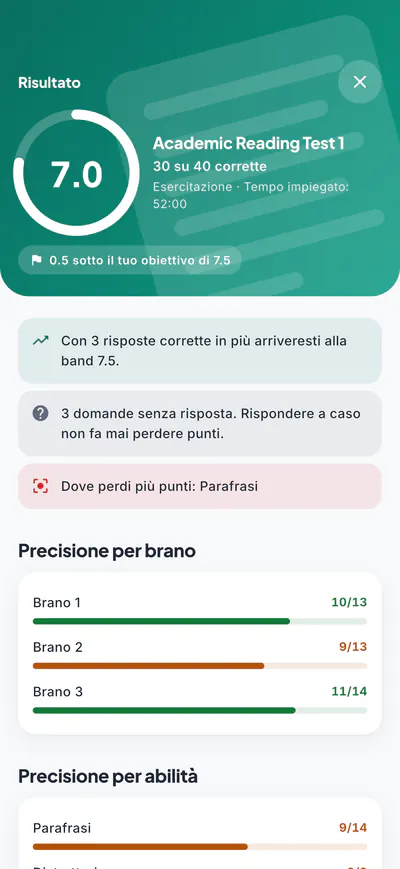
Risultato di un test di esercitazione IELTS nell'app Fleydo: Preparazione IELTS: band stimata e precisione per ogni parte
Lezione di prova gratuita

Scopri il tuo vero band IELTS prima dell'esame

Una lezione individuale online gratuita con un insegnante madrelingua inglese, specialista IELTS certificato Band 8.5+. Ricevi una diagnosi dello Speaking nel formato reale, una stima onesta del tuo band e un piano mirato ai criteri che ti costano punti. Nessun pagamento, nessun impegno.

Online · Individuale · Academic e General Training

IELTS è un marchio registrato del British Council, di IDP: IELTS Australia e di Cambridge University Press & Assessment. Questi test di esercitazione sono scritti da Fleydo e non sono approvati né sostenuti da queste organizzazioni.

App mobile

Fleydo English School in tasca

Lezioni, compiti, messaggi e giochi per gli studenti Fleydo e i loro genitori. Gratuita su iPhone e Android.

Scarica su App StoreDisponibile su Google Play
Scopri di più sull'app
Codice QR che apre l'app Fleydo English School su App Store o Google PlayInquadra per scaricareApre lo store giusto per il tuo telefono.fleydo.com/app
Icona dell'app Fleydo IELTS
Fleydo: Preparazione IELTS

Ti prepari all'IELTS?

Fleydo: Preparazione IELTS è un'app separata con simulazioni per tutte e quattro le abilità. Per usarla non ti serve un account Fleydo.

Scopri l'app IELTS
Scarica su App StoreDisponibile su Google Play
Test di esercitazione IELTS

Esercitati in tutte e quattro le abilità IELTS

311 test con band immediata, soluzioni spiegate e risposte modello. Senza registrazione.

Tutti i test di esercitazione
Il FleyPath

La roadmap personale di tuo figlio — 3, 6 o 12 mesi

🚀Partenza
👋Hello
😊Body
🦁Animals
🔢Numbers
🏆Inglese sicuro
Pratica di inglese gamificata

Come un gioco — solo che stanno davvero imparando