1. Home
  2. IELTS
  3. Test di esercitazione
  4. Reading
  5. Reading Flow-Chart Completion: esercizio 5

IELTS Reading · Completare il diagramma di flusso

IELTS Reading Flow-Chart Completion: esercizio 5

Pressing a vinyl record

  • 11 domande
  • 15 min
  • Academic

In questo test

  1. PassageDomande 1–11Copies of a copy

Tipi di domanda

  • Completare il diagramma di flusso
ReadingIELTS Reading Flow-Chart Completion: esercizio 5
Tempo rimasto15:00

Passage

Copies of a copy

A A pressed record never touches the disc on which its music was first cut. What reaches the buyer is a copy of a copy, made through a chain of metal parts. The chain starts with a disc known simply as a lacquer: an aluminium plate under a coating of that material. On a cutting lathe a tiny stylus, usually of sapphire, carves the sound into grooves as the disc turns. Only one face of a lacquer is cut, so a two-sided album needs a pair.

B A lacquer is far too fragile to go in a press, and even playing it a few times would wear it down. It serves instead as the pattern for the metal parts. First it is carefully washed, for dust must be kept away from its surface, and any residue can turn up later as a pop or click on the record. It then gets a fine spray of silver, without which it could not carry the electric current that the next stage depends on.

C That stage is a bath of nickel solution. Under the current, nickel settles on the silver and fills every groove. When this layer is pulled away, it proves to be a reversed copy of the lacquer, with ridges in place of the grooves. This negative is called the father, and once it has been removed the lacquer is no longer fit for use.

D Accounts of what follows differ in some details. Some say that on smaller orders the father can itself press the records. A 2025 radio report on United Record Pressing in Nashville, however, describes three plating steps. The father is plated to produce the mother, a positive in metal that has grooves like the lacquer, and the mother is plated in turn to produce the stamper, another ridged negative. The plant's sales director says that about ten sets of stampers can come from one mother. Stampers wear out as they work. Most accounts put their useful life at about 1,000 to 2,000 records, and a replacement can be made from the mother.

E The plastic arrives as pellets of PVC, which are loaded into a hopper and fed to an extruder. This heats them and forms them into a thick, soft lump that the trade calls a biscuit. The paper labels have been baked beforehand to drive out moisture, which might otherwise make them bubble, and one goes on each side of the biscuit. No glue is needed: pressure holds them in place.

F The two stampers, one for each side of the record, are fixed in the press, and when it closes they squeeze biscuit and labels between them. A 2016 article from the German National Library gives a mould temperature of 180°C and a pressure of 110 tonnes, adding that such figures vary from one system to another. Each record takes about half a minute. Water cools it and the rim of surplus vinyl is trimmed off; these trimmings can be melted down for later pressings. Before any of this happens on a large scale, however, the plant makes test pressings, which go to the artist and record label for approval.

Glossario
lathe
a machine that turns an object while a tool cuts it
stylus
a small, hard point, here used to cut a groove
plated
covered with a thin layer of metal, here using electricity
negative
a copy in which raised and hollow parts are reversed
PVC
a common type of plastic, polyvinyl chloride
hopper
a large container that feeds material into a machine
extruder
a machine that heats a material and pushes it out in a shape
PassageDomande 1–11
Domande 1–11 Max 2 parole

Complete the flow-chart below. Choose NO MORE THAN TWO WORDS from the passage for each answer.

HOW A VINYL RECORD IS MADE
A stylus on a lathe cuts the sound into an aluminium disc coated with 1.
The disc is washed to keep it free of 2, then sprayed with 3 so that it can carry a current.
In a bath, 4 builds up on the surface and is pulled away as a ridged negative called the 5.
This is plated to give a grooved disc called the 6, and plating that disc produces the parts called 7, which go into the press.
PVC 8 are heated and shaped into a biscuit.
Labels that have already been 9 to remove moisture are placed on the biscuit, one on each side.
The press closes. Then 10 cools the disc, and the extra vinyl is cut from its edge.
11 are sent out, and the artist and label must approve them before the full run.

Soluzioni e spiegazioni

Prima prova a fare il test: le soluzioni sono più utili dopo che hai risposto.

Mostra le soluzioni e le spiegazioni
  1. 1
    a lacquer / lacquer

    Paragraph A describes a lacquer as 'an aluminium plate under a coating of that material', and that material is lacquer. Silver is tempting, but it is sprayed on later, after the sound has been cut.

  2. 2
    dust / any residue / residue

    Paragraph B says the disc is washed because 'dust must be kept away from its surface'. The chart's 'free of' matches 'kept away from'. Residue also fits. Pop and click are only the results of leaving it there.

  3. 3
    silver

    Paragraph B says 'It then gets a fine spray of silver', without which it could not carry the current. Nickel is tempting, but nickel comes in the next step, in the bath, and is not sprayed.

  4. 4
    nickel

    Paragraph C says 'nickel settles on the silver and fills every groove'. Silver is already on the disc by this stage, so it is not the metal that builds up in the bath.

  5. 5
    father

    Paragraph C says 'This negative is called the father', after describing ridges in place of the grooves. The stamper is also a ridged negative, but it comes later and is not the layer pulled from the lacquer.

  6. 6
    mother

    Paragraph D says 'The father is plated to produce the mother', which 'has grooves like the lacquer'. The lacquer also has grooves, but it is not made by plating, and it comes first.

  7. 7
    stampers / stamper

    Paragraph D says 'the mother is plated in turn to produce the stamper', and paragraph F says stampers are fixed in the press. Father is tempting, but the father is the plate made before the mother.

  8. 8
    pellets

    Paragraph E says 'The plastic arrives as pellets of PVC'. The chart prints PVC before the gap, so the order of the words is changed, but the missing word is pellets, the form the plastic arrives in.

  9. 9
    baked beforehand / baked

    Paragraph E says 'The paper labels have been baked beforehand to drive out moisture'. The chart's 'already' matches beforehand, and 'to remove' matches 'to drive out', so the verb needed is baked.

  10. 10
    water

    Paragraph F says 'Water cools it', after describing how the press closes on the biscuit. The same sentence says the rim is trimmed off, and the chart's 'cut from its edge' paraphrases this.

  11. 11
    test pressings

    Paragraph F says 'test pressings' go to the artist and record label for approval, before work on a large scale. Pressings alone is not enough, because it does not separate these early copies from the full run.

Parole chiave di questo test

Passage

fragile
easily broken or damaged
residue
a small amount of something left behind
reversed
turned the opposite way
moisture
small amounts of water in something
surplus
more than is needed
Completare il diagramma di flusso: come rispondereFollow a sequence of steps, using time words, even when the text tells it out of order.

What the task looks like

You get a series of boxes joined by arrows, showing the stages of a process or a sequence of events. Some boxes have gaps, and there is a limit such as NO MORE THAN TWO WORDS.

The task tests details, main ideas and word type. You also need to follow how one stage leads to the next.

A method to try

1. Follow the arrows from start to finish, reading the boxes that are already complete. They tell you the story of the process.

2. Find where the text describes this process, and mark the time words: 'first', 'then', 'before', 'after', 'once', 'until', 'finally'.

3. Use the complete boxes as anchors. A gap between two of them must be a stage that comes between those two.

4. Use the wording of the box to decide what type of word the gap needs.

5. Read the whole chart in order with your answers in place. Does each stage lead sensibly to the next?

The traps

Text order: a text may mention the last stage first, or go back to explain an earlier one.

'Before' and 'after': 'Before the paint is applied, the wall is cleaned' names the paint first, but the cleaning happens first.

The neighbouring stage: a word from the sentence next door may fit the gap, but it belongs to a different stage.

Worked example

Text: Every loaf at the bakery ends up in a stone oven, but the work starts a day earlier. The flour is left overnight in a warm room, and the next morning it is mixed with water. The dough then rests under a damp cloth before the bakers shape it by hand.

Flow chart (the arrows run from box to box): Box 1: Flour placed in a ____ Box 2: Mixed with water Box 3: Dough rests under a damp cloth Box 4: Loaves shaped by hand Box 5: Loaves baked (NO MORE THAN TWO WORDS)

Debolestone oven. It comes first in the text, so it must belong in the first box.
Migliorewarm room. 'Ends up' shows that the oven is the last stage, and 'starts a day earlier' points to the next sentence, where the flour goes into a warm room.

A text does not have to tell the steps in order. Place each step by its time words, not by its position in the text.

Icona dell'app Fleydo IELTS Fleydo: Preparazione IELTS

Porta questi test con te sul telefono

Tutti i test di queste pagine sono anche nell'app Fleydo: Preparazione IELTS per iPhone, iPad e Android, insieme a 2.000 parole IELTS con audio.

  • Funziona offline una volta scaricato il test sul telefono
  • 2.000 parole IELTS con audio, ripetizione spaziata ed esercizi brevi
  • Registra le tue risposte di Speaking e riascoltale
  • Un piano giornaliero per la tua band obiettivo e la data dell'esame
Scarica su App StoreDisponibile su Google Play
Inquadra per scaricareApre App Store o Google Play, a seconda del telefono.

Non serve un account. Scopri l'app

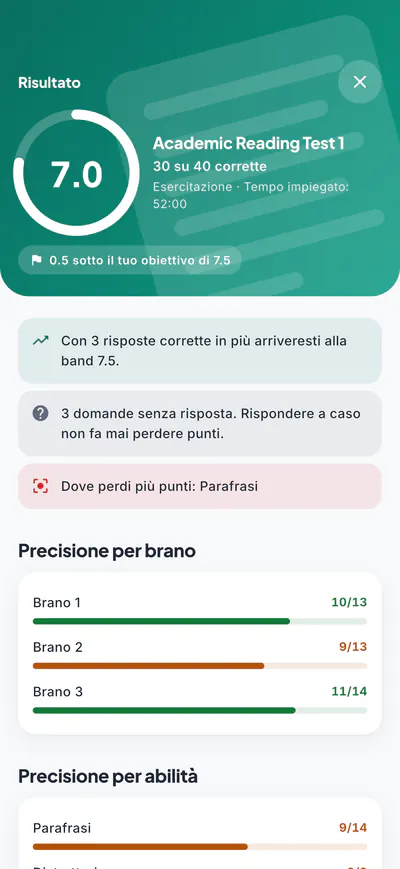
Risultato di un test di esercitazione IELTS nell'app Fleydo: Preparazione IELTS: band stimata e precisione per ogni parte
Lezione di prova gratuita

Scopri il tuo vero band IELTS prima dell'esame

Una lezione individuale online gratuita con un insegnante madrelingua inglese, specialista IELTS certificato Band 8.5+. Ricevi una diagnosi dello Speaking nel formato reale, una stima onesta del tuo band e un piano mirato ai criteri che ti costano punti. Nessun pagamento, nessun impegno.

Online · Individuale · Academic e General Training

IELTS è un marchio registrato del British Council, di IDP: IELTS Australia e di Cambridge University Press & Assessment. Questi test di esercitazione sono scritti da Fleydo e non sono approvati né sostenuti da queste organizzazioni.

App mobile

Fleydo English School in tasca

Lezioni, compiti, messaggi e giochi per gli studenti Fleydo e i loro genitori. Gratuita su iPhone e Android.

Scarica su App StoreDisponibile su Google Play
Scopri di più sull'app
Codice QR che apre l'app Fleydo English School su App Store o Google PlayInquadra per scaricareApre lo store giusto per il tuo telefono.fleydo.com/app
Icona dell'app Fleydo IELTS
Fleydo: Preparazione IELTS

Ti prepari all'IELTS?

Fleydo: Preparazione IELTS è un'app separata con simulazioni per tutte e quattro le abilità. Per usarla non ti serve un account Fleydo.

Scopri l'app IELTS
Scarica su App StoreDisponibile su Google Play
Test di esercitazione IELTS

Esercitati in tutte e quattro le abilità IELTS

311 test con band immediata, soluzioni spiegate e risposte modello. Senza registrazione.

Tutti i test di esercitazione
Il FleyPath

La roadmap personale di tuo figlio — 3, 6 o 12 mesi

🚀Partenza
👋Hello
😊Body
🦁Animals
🔢Numbers
🏆Inglese sicuro
Pratica di inglese gamificata

Come un gioco — solo che stanno davvero imparando