- হোম
- IELTS
- প্র্যাকটিস টেস্ট
- Listening
- Listening প্র্যাকটিস টেস্ট 9
IELTS Listening
IELTS Listening প্র্যাকটিস টেস্ট 9
River guide, a lantern festival, water-resistant fabrics, light pollution
- 40টি প্রশ্ন
- 31 মিনিট
- 4টি অংশ
- Listening
এই টেস্টে যা আছে
- অংশ 1প্রশ্ন 1–10You will hear a man phoning an outdoor centre to hire canoes and book a river guide for a family trip.
- অংশ 2প্রশ্ন 11–20You will hear an organiser presenting the programme of a town's winter lantern festival.
- অংশ 3প্রশ্ন 21–30You will hear two textile design students discussing the results of their tests on how well different outdoor fabrics resist water.
- অংশ 4প্রশ্ন 31–40You will hear a lecture about how artificial light at night affects insects, and what towns can change.
প্রশ্নের ধরন
বক্তা
আপনি শুনবেনYou will hear a man phoning an outdoor centre to hire canoes and book a river guide for a family trip.
Complete the form below. Write ONE WORD AND/OR A NUMBER for each answer.
Choose the correct letter, A, B or C.
আপনি শুনবেনYou will hear an organiser presenting the programme of a town's winter lantern festival.
Choose TWO letters, A-E.
2টি অক্ষর বেছে নিন
Choose TWO letters, A-E.
2টি অক্ষর বেছে নিন
Complete the notes below. Write ONE WORD ONLY for each answer.
আপনি শুনবেনYou will hear two textile design students discussing the results of their tests on how well different outdoor fabrics resist water.
Complete the sentences below. Write ONE WORD ONLY for each answer.
Choose TWO letters, A-E.
2টি অক্ষর বেছে নিন
Choose TWO letters, A-E.
2টি অক্ষর বেছে নিন
Choose the correct letter, A, B or C.
আপনি শুনবেনYou will hear a lecture about how artificial light at night affects insects, and what towns can change.
Complete the notes below. Write ONE WORD ONLY for each answer.
উত্তর ও ব্যাখ্যা
আগে টেস্টটি দিন: উত্তর দেওয়ার পরেই উত্তরমালা বেশি কাজে আসে।
উত্তরমালা ও ব্যাখ্যা দেখান
- 1Mazurek
Ryan spells his surname letter by letter: M-A-Z-U-R-E-K. Listen for the letter Z, which a North American speaker says as "zee". The spelling must be exact to score.
- 210 / 10th / tenth
Ryan asked for Saturday the ninth, but all the guides are booked that day, so he takes "Sunday the tenth". The form already says Sunday: listen for the date that goes with it.
- 3Canadian
Freya suggests "two Canadian canoes". Ryan is surprised by the name, and she explains that it is the British word for open canoes.
- 4barrel
The centre "used to hand out waterproof bags", but they leaked. Now "every boat gets a barrel with a screw-top lid". "Bag" fits the gap too, which is the trap.
- 59.30 / 9:30 / 09.30 / 09:30 / 9.30am / 9:30am / 9.30 am / 9:30 am / 9.30 a.m. / 9:30 a.m.
The guide leaves at ten, but the family must arrive "by half past nine" to get ready. Write it as 9.30: "half past nine" is three words, over the limit.
- 6B
Freya recommends the stretch to Hollin Bridge, which "runs through the woods nearly all the way". The gorge with rapids (A) needs paddlers aged twelve or over, and the lake (C) is too far and too windy for a first trip.
- 7B
The video was dropped. Instead, the guide "takes you down to the bank" to teach paddling and steering "before anyone gets into a boat". Capsize practice (C) is only on longer courses.
- 8C
"The main thing" is to "leave a whole spare outfit in your car". She says not to wear cotton (A), and wetsuits are not needed in August (B).
- 9C
Two canoes at £45 make £90, plus £85 for the guide: "a hundred and seventy-five pounds altogether". £150 is the weekday price on the website, and £155 is what is left to pay after the £20 deposit.
- 10A
Normally the centre moves people to another day (C), but Sunday is the family's last full day, so "we'd give you all your money back". Kayaking on the lake (B) is no longer offered.
- 11B
The parade used to go up the high street; "this year, it'll set off from the old railway station and follow the river". The festival is not moving to December (E) and is still three nights (A).
- 12D
"There'll be no candles in the parade at all": every lantern needs a battery light. The rumour about charging for the parade (C) is "simply not true".
- 13E
The library kept running out of space, so "this year they've moved to the sports hall at the high school", which holds three times as many people. You do not need to book (D).
- 14C
For the first time the workshops will be "led by a professional artist" instead of volunteers. They are free only for children (A), and young children can come with an adult (B).
- 15heron
The committee voted for a salmon, but the workshop leader talked them out of it: "So it's going to be a heron".
- 16hospital
The singing comes from "the hospital choir": doctors, nurses and porters, all people who work at the hospital.
- 17meadow
The craft stalls stay in the church hall, but the food stalls move out of the square: "They'll be in the meadow beside the river", on the new route.
- 18samba
The brass band usually leads the parade, but it is away at a competition, so "this year we've booked a samba band".
- 19conservatory
Storytelling moves indoors, "to the conservatory in Castle Park", which is heated and has palm trees.
- 20viaduct
The castle walls are normally used, but they are covered in scaffolding, "so the pictures will go up on the railway viaduct instead".
- 21surface
The treated polyester and the membrane fabric got the same spray score because the spray test "only tells you whether the surface gets wet". Tessa adds that it "tells you nothing about the membrane", so "membrane" is the trap.
- 22swell
Josh wonders whether the cotton had wax on it, but Tessa says it has no finish at all. "Once cotton fibres get wet, they swell", which closes the gaps between the threads.
- 23iron
Tessa "went over half of the washed samples with an iron", but it made almost no difference. Josh then says they never tried the tumble dryer, so "dryer" is wrong.
- 24oil / oils
Josh says that for keeping out water the new finishes are "about as good as the old finishes". "Where they're weaker is oil": they do not repel it at all.
- 25A
Tessa did every rating herself, and some were hard to call: "Someone else could easily have scored them differently." Josh agrees. Josh raises temperature (B) and loose samples (C), but Tessa shows neither was a problem: the water was the same temperature every time, and the samples were clamped tight in the hoop.
- 26D
They did the repeats one straight after another, so the second spray was "landing on fabric that was still damp from the first", and Tessa agrees. Josh wonders whether all the pieces came from one end of the roll (E), but they were taken from different parts of each fabric.
- 27B
Tessa suggests weighing each sample before and after spraying, and Josh agrees: "let's weigh them as well". A spray lasting an hour or two (C) is impossible because they only have the lab for one morning.
- 28D
Rubbing wears the finish away, so "some samples go on the abrasion machine before we spray them". Wearer trials (E) must wait because they have no jackets yet, and Josh rejects soap flakes (A) because the washing should be realistic.
- 29B
Josh is tempted to drop the cotton (A), but Tessa wants to keep it unchanged to compare the two rounds. A reproofing spray (C) would make it a different fabric, so "The cotton stays in, just as it is."
- 30A
The technician is busy (B), so Josh suggests: "Why don't we both score every sample, without looking at each other's numbers". He then suggests scoring from photographs (C), but Tessa rejects it because the small droplets do not show, and they stick to his first idea.
- 31stars
The evidence comes "from the ground", not from satellites: volunteers recorded "how many stars they could see with the naked eye".
- 32back / backs
Insects rarely fly straight at a light: "they kept tilting so that their back was turned towards it". The notes say "face the light" for "turned towards it".
- 33below
Light shone up "from below" made almost every kind flip over and crash. Light "from above" did not: they simply flew up towards it.
- 34sodium
The effect was strongest under white LEDs. "Under the older sodium lamps, it was weaker." The notes say "traditional" for "older".
- 35heavier
You might expect them to be "thinner", but "the ones from lit sites tended to be heavier", probably because the light sped up their development.
- 36eggs
The researchers' best guess is that "female moths lay fewer eggs in places that are lit", though more work is needed to confirm it. The notes say "lit habitats" for "places that are lit".
- 37compensate
The thistle is visited by many insects in the day, yet lit plants had about 13% fewer fruits: "the daytime visitors couldn't compensate for what was lost at night". The notes say "failed to" for "couldn't".
- 38residual
Unlike other ways we damage habitats, light "leaves no residual effects": switch it off and the pollution is gone.
- 39shields
Upward-facing light is wasted and harms insects, so "towns can fit shields to their street lamps" and the light falls only on the ground.
- 40blue
The study's lead author suggests "using filters to block the blue wavelengths of light", the ones most harmful to insects.
পুরো ট্রান্সক্রিপ্ট দেখান
অংশ 1
Narrator Part 1. You will hear a man phoning an outdoor centre to hire canoes and book a river guide for a family trip. First, you have some time to look at questions 1 to 5.
Narrator Now listen carefully and answer questions 1 to 5.
Freya Good morning, Fernhallow Outdoor Centre, Freya speaking. How can I help?
Ryan Hi there. I'd like to hire some canoes for my family, and your website says you can also send a guide out with us. Is that right?
Freya Yes, that's right. Most families who don't know the river like to have one with them. Can I start with your name?
Ryan Sure. It's Ryan Mazurek. That's M-A-Z-U-R-E-K.
Freya Thanks, Ryan. And which day were you thinking of?
Ryan We were hoping for Saturday the ninth of August.
Freya Let me have a look. The canoes are free that day, but I'm afraid all our guides are booked. There's a big school group in. Could you do the Sunday instead?
Ryan Sunday the tenth. Yeah, that works fine for us. We fly home on the Monday, so it'll be a nice way to finish the vacation.
Freya Lovely. And how many of you will there be?
Ryan Five. My wife and me, and our three kids. They're thirteen, ten and seven.
Freya Seven's fine, as long as she shares a boat with an adult. So for five of you, I'd suggest two Canadian canoes.
Ryan Canadian canoes? Back home we'd just call them canoes.
Freya Yes, over here that's what we call the open kind, where you sit on a seat or kneel, and use a paddle with one blade. Each one takes up to three people, so two will be perfect.
Ryan Great. And do we need to bring anything, like life jackets?
Freya No, it's all included: buoyancy aids, paddles, and something to keep your lunch and phones dry. We used to hand out waterproof bags, but too many of them leaked. So now every boat gets a barrel with a screw-top lid.
Ryan A barrel. OK, the kids will love that.
Freya Now, the guide sets off at ten o'clock. But please don't turn up at ten. We need everyone here by half past nine, so there's time to fit the buoyancy aids and sign the forms.
Ryan Half past nine. Got it.
Narrator Before you hear the rest of the conversation, you have some time to look at questions 6 to 10.
Narrator Now listen and answer questions 6 to 10.
Ryan So where on the river would we actually go?
Freya For a family with younger children, I'd recommend the stretch from here down to Hollin Bridge. It runs through the woods nearly all the way, so it's sheltered from the wind, and there's a little beach where you can stop for lunch.
Ryan My son's been reading about a gorge with rapids. He's really keen on that.
Freya That's the section above the weir. It's great fun, but you have to be twelve to do it, so your two younger ones couldn't go.
Ryan Fair enough. What about going all the way down to the lake? It looked beautiful in your photos.
Freya It is, but that's fourteen kilometres, and the lake gets really windy in the afternoons. It's too much for a first trip, honestly.
Ryan OK. And will there be some kind of safety briefing before we start? Like a video?
Freya We stopped showing the video a while ago. People found it a bit dull. Instead, your guide takes you down to the bank and spends about twenty minutes showing you how to hold the paddle and steer, before anyone gets into a boat.
Ryan Do we have to practise tipping over? My wife's a little nervous about that.
Freya No, capsize practice is only on our longer courses. On a family trip, the guide just explains what to do if it happens.
Ryan That's a relief. And what should we wear?
Freya Something light that dries quickly. Not cotton, if you can avoid it, and definitely not jeans. Once they're wet, they stay wet all day. People sometimes ask about wetsuits, but in August you really won't need one.
Ryan Good to know.
Freya The main thing is to leave a whole spare outfit in your car, socks and all. Somebody always ends up in the water, usually the person who said they wouldn't.
Ryan That'll be me, then. OK, and what's the total cost?
Freya The canoes are forty-five pounds each for the day, so that's ninety, and the guide is eighty-five. So that's a hundred and seventy-five pounds altogether.
Ryan Oh, the website said a hundred and fifty.
Freya That's our weekday price, I'm afraid. Weekends cost a bit more. If you pay a twenty-pound deposit today, there'll be a hundred and fifty-five left to pay on the day.
Ryan OK, let's do that. One more thing. What happens if the weather's bad?
Freya Rain doesn't stop us. You'll get wet anyway! But if the river's too high, it isn't safe, so we cancel. Normally we'd just move people to another day.
Ryan Well, that won't work for us. Sunday's our last full day.
Freya Of course. In that case, we'd give you all your money back, including the deposit.
Ryan And could we do something else instead, like kayaking on the lake?
Freya We used to offer that, but the sailing club has the lake on Sundays now, so I'm afraid not. Right, I'll email you a confirmation. Thanks for calling, Ryan.
Ryan Thanks, Freya. Bye.
Narrator That is the end of Part 1. You now have half a minute to check your answers.
অংশ 2
Narrator Part 2. You will hear an organiser presenting the programme of a town's winter lantern festival. First, you have some time to look at questions 11 to 14.
Narrator Now listen carefully and answer questions 11 to 14.
Scott Good evening, everyone, and thanks for coming out on such a cold night. I'm Scott, and I chair the committee that runs the Brindlemoor Winter Lantern Festival. For anyone who's new to the town, the festival began eleven years ago, when one primary school class made paper lanterns and carried them round the market square. Last year, around eight thousand people came.
Scott Now, I know there've been a few rumours going round, so let me start with what's changing and what isn't. Quite a few of you asked us to move the festival to December. We looked at that very seriously, but December's already so full of other events that we're staying with the last weekend in January.
Scott And it's still three nights, Friday to Sunday. We'd love to add a Thursday, but we simply haven't got the volunteers.
Scott What is changing is the parade. For eleven years it's gone from the market square straight up the high street. This year, it'll set off from the old railway station and follow the river to Castle Park instead, because the high street just can't cope with the crowds any more. It also means the lanterns will be reflected in the water, which should look lovely. There'll be marshals all along the riverbank.
Scott And while we're on safety, from this year there'll be no candles in the parade at all. Every lantern must be lit by a small battery light. Last year a big lantern caught fire near the bandstand. Nobody was hurt, but we took it as a warning.
Scott One more thing. Someone's been telling people online that we're going to start charging for the parade. That's simply not true. Watching it is free, and it always will be. There'll be collection buckets along the route, if you'd like to give something.
Scott Right, the lantern-making workshops, which are really the heart of the festival. They run on the two Saturdays before the festival. In the past they've been in the library, but we kept running out of space, so this year they've moved to the sports hall at the high school, which holds about three times as many people.
Scott You don't need to book. Just turn up any time between ten and four. Children take part for free, but we ask adults for three pounds, which covers the willow and tissue paper.
Scott And this year, for the first time, the workshops will be led by a professional artist who's made giant lanterns for festivals all over Europe. Until now, it's always been volunteers like me doing our best, so it's a real step up.
Scott Parents often ask whether little ones can join in. They certainly can, as long as an adult stays with them.
Narrator Before you hear the rest of the talk, you have some time to look at questions 15 to 20.
Narrator Now listen and answer questions 15 to 20.
Scott So, let's go through the programme. On Friday at six, we open with the lighting of our giant lantern in the market square. It's a different shape every year. The committee voted for a salmon this time, because of the river, but our new workshop leader talked us out of it. She said a fish would be hard to make out from a distance.
Scott So it's going to be a heron, standing about four metres tall. There's one on the town's crest, so it seemed right. I'm told it'll look wonderful against the night sky.
Scott While it's being lit, there'll be singing from the hospital choir. That's doctors, nurses and porters, and they've been rehearsing since September.
Scott Saturday is parade day. The craft stalls will be in the church hall, as usual, but the food stalls are moving out of the square this year. They'll be in the meadow beside the river, right on the new parade route.
Scott The parade itself starts at half past five. For as long as anyone can remember, it's been led by the town's brass band, but they're away at a competition that weekend. So this year we've booked a samba band from the university, and believe me, you'll hear them coming. They've promised to keep everyone moving, even in the cold.
Scott On Sunday afternoon, there's storytelling for younger children. It's moving indoors this year, to the conservatory in Castle Park. It's heated, thank goodness, and the lanterns look magical among the palm trees.
Scott And finally, Sunday night's finale. People often ask whether we'll release sky lanterns. The answer is no. They're not allowed on council land, and they end up in farmers' fields. Instead, we'll project giant pictures of this year's lanterns.
Scott We'd normally use the castle walls for that, but they're covered in scaffolding until the spring. So the pictures will go up on the railway viaduct instead, and the best view will be from the footbridge.
Scott Right, that's the programme. I'm happy to take any questions.
Narrator That is the end of Part 2. You now have half a minute to check your answers.
অংশ 3
Narrator Part 3. You will hear two textile design students discussing the results of their tests on how well different outdoor fabrics resist water. First, you have some time to look at questions 21 to 24.
Narrator Now listen carefully and answer questions 21 to 24.
Josh Tessa, have you got the lab results? I'd like to understand them before we write anything.
Tessa Yep. So, just to remind ourselves, there were four fabrics. The plain polyester, which was our control. The same polyester with a fluorine-free water-repellent finish. The densely woven cotton. And the nylon with a waterproof membrane bonded to the back.
Josh And two tests on each: the spray test and the pressure test. Spray test first.
Tessa Well, the treated polyester did really well. The water formed little beads and rolled off, so it scored ninety. And the membrane fabric got exactly the same.
Josh That surprised me. I thought the membrane would be way ahead.
Tessa But the spray test only tells you whether the surface gets wet. It tells you nothing about the membrane. The nylon has a water-repellent finish too, so they looked the same.
Josh Fair enough. And the cotton was soaked almost at once. Lowest score of the lot.
Tessa Until the pressure test.
Josh Exactly. The plain polyester let water through first, and the treated one didn't last much longer. But the cotton held out far longer than either of them. Had the supplier put wax on it or something?
Tessa No, it's got no finish at all. The technician explained it. Once cotton fibres get wet, they swell, so the tiny gaps between the threads close up. Apparently that's why this kind of cotton was used for pilots' survival suits.
Josh And the membrane fabric never leaked at all, even with the pressure turned right up.
Tessa Then we washed everything ten times and did the spray test again.
Josh And the treated polyester dropped to seventy. You could see patches where the water soaked in instead of beading.
Tessa So I went over half of the washed samples with an iron on a low setting, because lots of brands say heat brings the finish back. For our finish, though, it made almost no difference.
Josh We never tried the tumble dryer. That might have worked better. Anyway, brands are switching to fluorine-free finishes because of concerns about the chemicals in the older ones.
Tessa So what's the catch? There must be one.
Josh Well, for keeping out water, they're about as good as the old finishes. Where they're weaker is oil. They don't repel it at all, so things like sun cream can soak straight in.
Tessa That's worth a paragraph in the report, then.
Narrator Before you hear the rest of the discussion, you have some time to look at questions 25 to 30.
Narrator Now listen and answer questions 25 to 30.
Tessa Before any conclusions, we need a section on what went wrong. Our tutor's bound to ask.
Josh Well, the first thing I'd say is temperature. The lab was freezing that morning.
Tessa It was, but I measured the water before each spray, and it was the same every time.
Josh What about the way the samples were held? A couple looked a bit loose.
Tessa No, they were clamped in the hoop, so they were tight. What worries me more is the scoring. I did every rating myself, comparing the wet patches with the photos on the chart, and some were really hard to call. Someone else could easily have scored them differently.
Josh True. And did we cut all the pieces from one end of the roll? I can't remember.
Tessa No, we took three pieces from different parts of each fabric, so that's fine.
Josh But here's something that wasn't fine. We were short of time, so we did the repeats one straight after another. The second spray was landing on fabric that was still damp from the first.
Tessa Oh, you're right. That would push the scores down.
Josh So, for the next round, what do we change? Apart from letting everything dry, obviously.
Tessa Well, I found a PhD thesis from Leeds. The researcher tested finishes like ours, and one thing she did was spray the samples for an hour, or even two, instead of half a minute, because real rain lasts longer.
Josh An hour per sample? We've only got the lab for one morning. That's not going to happen.
Tessa No. But here's something that only takes a minute. We could weigh each sample before and after spraying, to see how much water it's actually taken up. That's how she told apart fabrics that got the same score.
Josh Yes, let's weigh them as well. And what about getting people to wear the fabrics, out in real rain?
Tessa That's what the big brands do, but we haven't made any jackets yet. One thing I would add, though. On my own jacket, water soaks in on the shoulders, right where my backpack straps rub. That thesis found rubbing wears the finish away too.
Josh Right, so some samples go on the abrasion machine before we spray them.
Tessa Great. Should we change the detergent as well? Some people swear by soap flakes.
Josh No, we want the washing to be realistic, and most people just use ordinary detergent. Now, the cotton. Honestly, I'd be tempted to drop it. Nobody wants a jacket that looks soaked.
Tessa But it's our most interesting result. I think we keep it in, exactly as it is, so we can compare the two rounds properly.
Josh We could spray it with a reproofing product, though, so the water beads on it.
Tessa But then it wouldn't be the same fabric any more, and we'd lose the comparison.
Josh OK, fair point. The cotton stays in, just as it is.
Tessa Last thing: the scoring. Could we ask the technician to do all the ratings? She must have done hundreds.
Josh I already asked. She's teaching first-years all next week. Why don't we both score every sample, without looking at each other's numbers, and then compare?
Tessa Much better than me doing it alone.
Josh Or we could photograph each one and score them later.
Tessa I tried that with my phone. You can't see the small droplets at all. No, let's stick to your first idea.
Narrator That is the end of Part 3. You now have half a minute to check your answers.
অংশ 4
Narrator Part 4. You will hear a lecture about how artificial light at night affects insects, and what towns can change. First, you have some time to look at questions 31 to 40.
Narrator Now listen carefully and answer questions 31 to 40.
Dr Ashby Good afternoon, everyone. Today I'm going to talk about artificial light at night, and in particular what it does to insects. Insects are declining in many parts of the world, and habitat loss, pesticides and climate change have all probably played a part. But some researchers now argue that light at night is another of the drivers of that decline.
Dr Ashby And as we'll see at the end, it's also one of the easiest to do something about. So, let's start with the scale of the problem. You might expect the best measurements to come from satellites, but satellites seem to miss part of the change.
Dr Ashby Some of the most striking evidence actually comes from the ground. Between 2011 and 2022, volunteers around the world made more than fifty thousand observations of how many stars they could see with the naked eye.
Dr Ashby From those reports, researchers worked out that the night sky is getting brighter by somewhere between seven and ten percent a year. That's faster than the satellite data had suggested.
Dr Ashby So why do flying insects gather round lamps in the first place? For a long time, the popular explanation was that insects steer by the moon and mistake a lamp for it. Another idea was that they're drawn to the heat. But insects crowd round LED lamps too, and those give off very little radiant heat, so that can't be the explanation.
Dr Ashby A study published in 2024 looked at this in detail. The team filmed insects flying round lights, using motion capture in the laboratory and pairs of cameras in the field, in Costa Rica. And what they found was that the insects hardly ever flew straight towards the light. Instead, they kept tilting so that their back was turned towards it.
Dr Ashby That makes sense in nature. Throughout insects' history, the brightest part of what they could see has been the sky, so keeping your back towards the brightest light is a good way of staying the right way up. Next to a lamp, though, the same reflex sends them round in circles.
Dr Ashby The researchers also changed the direction of the light. When ultraviolet light was shone up at the insects from below, almost every kind they tested flipped over and crashed to the floor. When the light came from above, they simply flew up towards it.
Dr Ashby Now, does any of this affect whole populations? A study in southern England compared hedgerows and grassy margins lit by street lights with similar unlit places nearby, and counted the moth caterpillars living in them. In the lit hedgerows, there were forty-seven percent fewer caterpillars, and in the grass, about a third fewer.
Dr Ashby The effect was strongest under white LED street lights. Under the older sodium lamps, it was weaker, and in the grassy margins, the sodium lamps made no clear difference.
Dr Ashby Here's something you might not expect. You'd think caterpillars living under lights would be thinner, if anything, since light seems to disturb their feeding. In fact, the ones from lit sites tended to be heavier, probably because the light had sped up their development.
Dr Ashby So why were there fewer of them? That's the real puzzle. The researchers' best guess is that female moths lay fewer eggs in places that are lit, although they say more work is needed to confirm this.
Dr Ashby There's also evidence that these effects build up slowly. In one five-year field experiment, lighting had no effect on moth populations in the first two years. But in the last three, the populations under the lights were smaller than those kept in the dark. So a shorter study might have found nothing at all.
Dr Ashby And it isn't only the insects that lose out. Many moths are pollinators. In Switzerland, researchers set up LED street lamps in meadows in an area that was still fairly dark, and compared them with meadows left unlit. On the lit meadows, visits to flowers at night were sixty-two percent lower than on the dark ones.
Dr Ashby They then looked closely at one plant, the cabbage thistle, which is also visited by plenty of insects during the day. Even so, the thistles on the lit meadows produced around thirteen percent fewer fruits. In other words, the daytime visitors couldn't compensate for what was lost at night.
Dr Ashby So, finally, what can towns change? The good news is that light is unusual among the ways we damage habitats. It's fairly easy to deal with, and it leaves no residual effects. Switch a light off, and that pollution is gone.
Dr Ashby First, light only what needs lighting, and only when it's needed. Street lights can be dimmed, or switched on only for limited hours, and modern LEDs are easier to dim than the old sodium lamps.
Dr Ashby Second, direction. Remember those insects crashing when the light came from below? Light that shines upwards doesn't help anyone on the ground, and the 2024 study concluded that cutting down on unshielded, upward-facing lights would help. So towns can fit shields to their street lamps, so that the light falls only on the ground.
Dr Ashby Third, colour. This is where LEDs have an advantage, because their light can be adjusted. The lead author of the English study suggests using filters to block the blue wavelengths of light, which are the most harmful to insects.
Dr Ashby And finally, place. Wherever possible, keep lighting away from important habitats, such as hedgerows. So, to sum up: light at night confuses flying insects, reduces their numbers and weakens pollination, but unlike most threats, it can be reduced quickly. Next week, we'll look at what light at night does to birds.
Narrator That is the end of Part 4. You now have half a minute to check your answers.
Narrator That is the end of the Listening test.
এই টেস্টের মূল শব্দ
অংশ 1
- buoyancy aid
- a padded jacket that helps you float in water
- stretch (of a river)
- a continuous part of a river between two places
- weir
- a low wall built across a river to control the flow of water
- capsize
- (of a boat) to turn over in the water
- deposit
- part of a price that you pay in advance to keep a booking
অংশ 2
- chair (a committee)
- to lead a committee and run its meetings
- rumour
- a story that people pass on, which may not be true
- cope with
- to deal successfully with something difficult
- a step up
- a clear improvement on what there was before
- scaffolding
- a temporary metal frame put up around a building during repairs
- finale
- the last, most exciting part of an event
অংশ 3
- control
- in a test, the sample left unchanged so that the others can be compared with it
- membrane
- a very thin layer of material; in a jacket, one that stops water getting through
- bead
- (of water) to form small round drops on a surface
- abrasion
- damage caused by rubbing
- reproofing product
- something put on a garment to make it repel water again
অংশ 4
- artificial light at night
- light from lamps, buildings and roads after dark
- with the naked eye
- without a telescope or other instrument
- reflex
- an action the body makes automatically, without thinking
- caterpillar
- the young, worm-like form of a moth or butterfly
- pollinator
- an animal that carries pollen between flowers so that plants can make seeds
- habitat
- the natural home of a plant or animal
 Fleydo: IELTS প্রস্তুতি
এই টেস্টগুলো ফোনে সঙ্গে রাখুন
এই পেজগুলোর প্রতিটি টেস্ট iPhone, iPad ও Android-এর জন্য Fleydo: IELTS প্রস্তুতি অ্যাপেও আছে, সঙ্গে অডিওসহ 2,000টি IELTS শব্দ।
- কোনো টেস্ট ফোনে নামানো হয়ে গেলে অফলাইনে চলে
- অডিওসহ 2,000টি IELTS শব্দ, ক্রমশ বাড়তে থাকা বিরতিতে রিভিশন আর ছোট অনুশীলন
- Speaking-এর উত্তর রেকর্ড করে আবার শুনুন
- আপনার লক্ষ্য ব্যান্ড ও পরীক্ষার তারিখ ধরে প্রতিদিনের পরিকল্পনা


 ডাউনলোড করতে স্ক্যান করুনআপনার ফোন অনুযায়ী App Store বা Google Play খোলে।
অ্যাকাউন্ট লাগে না। অ্যাপটি সম্পর্কে
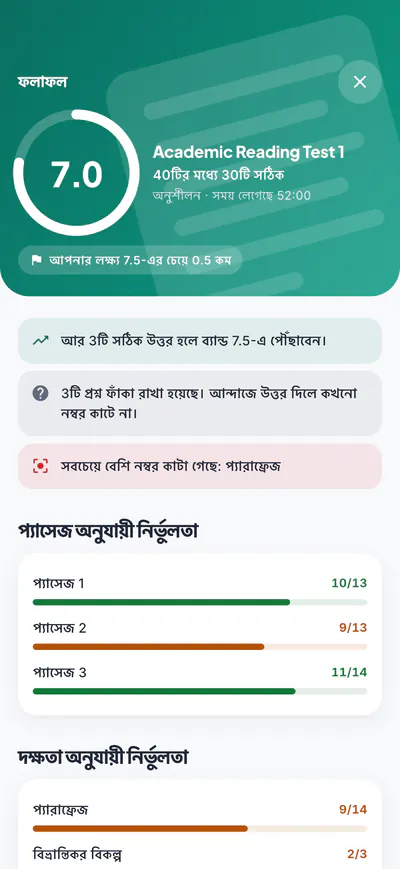
পরীক্ষার আগেই আপনার আসল IELTS ব্যান্ড জেনে নিন
একজন নেটিভ ইংরেজিভাষী শিক্ষকের সাথে বিনামূল্যে একটি ওয়ান-টু-ওয়ান অনলাইন ক্লাস, যিনি Band 8.5+ সার্টিফাইড IELTS বিশেষজ্ঞ। আপনি পাবেন আসল পরীক্ষার ফরম্যাটে Speaking ডায়াগনস্টিক, একটি সৎ ব্যান্ড অনুমান এবং ঠিক যে মানদণ্ডগুলোতে আপনার নম্বর কাটা যাচ্ছে সেগুলোর জন্য একটি পরিকল্পনা। কোনো পেমেন্ট নেই, কোনো বাধ্যবাধকতা নেই।
অনলাইন · ওয়ান-টু-ওয়ান · Academic ও General TrainingIELTS হলো British Council, IDP: IELTS Australia এবং Cambridge University Press & Assessment-এর নিবন্ধিত ট্রেডমার্ক। এই প্র্যাকটিস টেস্টগুলো Fleydo-র নিজের লেখা; এগুলো ওই সংস্থাগুলোর অনুমোদিত বা সমর্থিত নয়।

 ডাউনলোড করতে স্ক্যান করুন
