- হোম
- IELTS
- প্র্যাকটিস টেস্ট
- Listening
- Listening প্র্যাকটিস টেস্ট 8
IELTS Listening
IELTS Listening প্র্যাকটিস টেস্ট 8
Sign language class, a community fridge, heat in cities, long-lived animals
- 40টি প্রশ্ন
- 30 মিনিট
- 4টি অংশ
- Listening
এই টেস্টে যা আছে
- অংশ 1প্রশ্ন 1–10You will hear a woman phoning an adult education centre to ask about a beginners' course in sign language.
- অংশ 2প্রশ্ন 11–20You will hear a volunteer explaining how a new community fridge works and how local people can use it.
- অংশ 3প্রশ্ন 21–30You will hear a geography student and her tutor planning how to measure differences in temperature across a city.
- অংশ 4প্রশ্ন 31–40You will hear a lecture about why some animals live exceptionally long lives, and what researchers have found.
প্রশ্নের ধরন
বক্তা
আপনি শুনবেনYou will hear a woman phoning an adult education centre to ask about a beginners' course in sign language.
Complete the notes below. Write ONE WORD AND/OR A NUMBER for each answer.
The course
Before the course starts
Other information
আপনি শুনবেনYou will hear a volunteer explaining how a new community fridge works and how local people can use it.
What does the speaker say about each of the following types of food? Choose SIX answers from the box and write the correct letter, A-H, next to Questions 11-16.
- AThey are never accepted.
- BThey must have a list of what is in them.
- CThey have their own storage outside the fridge.
- DThey are taken very soon after they arrive.
- ESomeone from the team checks them first.
- FAny left over are given to a farm.
- GThey must still be unopened.
- HThey are picked up by volunteers.
Choose the correct letter, A, B or C.
আপনি শুনবেনYou will hear a geography student and her tutor planning how to measure differences in temperature across a city.
Choose the correct letter, A, B or C.
Choose TWO letters, A-E.
2টি অক্ষর বেছে নিন
Complete the summary below. Write ONE WORD ONLY for each answer.
আপনি শুনবেনYou will hear a lecture about why some animals live exceptionally long lives, and what researchers have found.
Complete the notes below. Write ONE WORD ONLY for each answer.
The general pattern
Bats
Reptiles and amphibians (two 2022 studies)
Greenland shark
Bowhead whale
Ocean quahog ('Ming')
উত্তর ও ব্যাখ্যা
আগে টেস্টটি দিন: উত্তর দেওয়ার পরেই উত্তরমালা বেশি কাজে আসে।
উত্তরমালা ও ব্যাখ্যা দেখান
- 1Thursday
Harriet hoped for Monday, but "the Monday beginners' group is full". Tyler offers the new group "on Thursday evenings", and she says Thursday suits her better.
- 215 / 15th / fifteenth / fifteen
The group "was supposed to begin on the eighth of January", but the teacher is away that week, "so the first class is now the fifteenth". Write 15 or 15th.
- 3Pelletier
Tyler spells the surname letter by letter: P-E-L-L-E-T-I-E-R. Note the double L. The spelling must be exact to score.
- 412 / twelve
The groups are kept small: "There are never more than twelve learners in a group." So the maximum is 12.
- 5195 / $195
The standard fee is $240, but Harriet lives in the county, so she pays "the resident rate, which is $195". The notes ask for the fee for people living in the county.
- 6questionnaire
There is no test, but everyone must "fill in a short questionnaire on our website" before the course starts. Check the spelling: double N.
- 7jewellery / jewelry
Colours "aren't a problem at all". What Dana asks is "that you don't wear any jewellery", because it catches the light. Both spellings, jewellery and jewelry, are accepted.
- 8gym
Tyler says "You can park for free in the lot behind the gym", a two-minute walk from the classroom. In North American English a "lot" here is a parking lot, a car park.
- 9bakery
The social "used to be held in the library", but "it's moved to a bakery on Elm Street". The notes ask where it is held now.
- 10555-0149 / 5550149 / 555 0149
555-0182 is Tyler's own line, but he will be on vacation, so "it's better to call the enrolment office". Their number is 555-0149.
- 11B
Many community fridges refuse home-cooked meals, but this one takes them "as long as there's a label on the container showing every single ingredient": a list of what is in them (B). A is the trap. E is wrong too: the volunteers "can't open every container to check".
- 12A
"Even if they're still sealed in the supermarket packaging, we simply can't take them." Raw meat and fish are never accepted (A). Being sealed (G) makes no difference.
- 13G
Milk, yoghurt and cheese are welcome, but "the seal mustn't have been broken": they must still be unopened (G). They are not taken quickly (D): "they don't disappear as fast as you'd think".
- 14C
Bread should not go in the fridge: "There's a wooden cabinet on the wall right beside it, and that's where bread goes" (C). Leftover bread no longer goes to the city farm, so F is wrong.
- 15D
A volunteer "used to check every bag", but not any more, so E is wrong here. Fruit and vegetables are usually "gone within an hour of someone dropping them off": taken very soon after they arrive (D).
- 16E
The volunteers do not collect this food (H): the businesses' own staff bring it. But "one of our volunteers goes through every box" before it goes in, so someone from the team checks it first (E). It does not have to be sealed, so G is wrong.
- 17B
"The biggest headache so far has been food that's past its use-by date": food too old to eat (B). Nobody has damaged the fridge, and one person emptying it "really hasn't been a problem".
- 18A
The whiteboard did not work and an app was too expensive. Now volunteers "take a photo of the shelves and post it on our social media page": pictures on the internet (A).
- 19B
No experience is needed, and there is no minimum commitment. But "everyone comes to a one-hour food safety session before their first shift": they must complete some training first (B).
- 20C
A fridge at the station "won't be this year", and the gate will still be locked at night. What is going ahead is "a small freezer right next to the fridge": a place to store frozen items (C).
- 21C
"It really started on my way home from work": she cycles home from her job, and near the river "the air suddenly feels several degrees cooler". That is her own experience on her daily commute (C). She read the heatwave article after she had decided, and the planning department has not replied.
- 22A
Cost is not a problem (B), and "Coverage isn't a problem" either (C). The real issue is that "It gives you the temperature of surfaces like roofs and roads", not of the air: the land and buildings rather than the atmosphere (A).
- 23C
There are ten loggers, and only one has gone missing in ten years. The problem is the lampposts: "you need written permission, which can take up to three months". Approval would take too long (C).
- 24B
The height "doesn't matter much" if it is the same on every ride (A), and the loggers are "perfectly good" (C). "What does matter is keeping the logger well away from you", because her body gives off heat (B).
- 25C
Wind is left out (B) because the readings change every few seconds. Brooke will "note what's underfoot at each point": asphalt, paving stones, grass or gravel. That is the material covering the ground (C).
- 26A
Traffic is left out (D), and building heights come from open data, not the ride (E). Her photo straight up will show "how much of the sky is hidden by branches and leaves": tree cover (A).
- 27evenings
Her first idea was "the middle of the afternoon", but the gap builds after sunset and is strongest with no wind and no cloud. "So I should ride on calm, clear evenings." The summary says "still, cloudless" for "calm, clear".
- 28reverse
The tutor says to go round again "the opposite way", and Brooke will "ride it again in reverse". Only "reverse" fits "repeat the route in ...". The summary says "calculate a mean" for "average".
- 29minute
She planned "About thirty seconds", but the logger needs time to adjust, so she will "wait a full minute at every point". The summary says "a whole" for "a full".
- 30roommate / room-mate
Her brother "said he'd come", but he is away all summer. "My roommate has offered, though."
- 31trees
Among species that can't fly, "two other ways of life were linked to longer lives: burrowing underground, and living in trees". The notes say "dig burrows" for "burrowing underground" and "make their homes in" for "living in", so the gap is the other way of life: trees.
- 32hibernation
In bats, "Longer lives were linked to larger body size, the occasional use of caves, and hibernation". Diet is mentioned straight after, but it "made no difference", so it is not the answer.
- 33shells / shell
Slow metabolism did not explain slow ageing; protection did: "Species with physical defences, like the hard shells of most turtles, tended to age more slowly." The notes say "body armour" for "physical defences". Only one word is allowed, so the answer is "shells", not "hard shells".
- 34negligible
"About three-quarters of these species aged very slowly, or showed what's called negligible ageing": their risk of dying stays about the same as they get older. The notes say "three in four" for "three-quarters" and "captive" for "in zoos and aquariums".
- 35lens
The shark has no hard parts with growth layers, so the team "turned to the eye, and specifically to the lens". The centre of the lens is formed before birth and its proteins are never replaced, so it can be radiocarbon dated. The notes say "core" for "centre".
- 36cancer
"Bowheads don't seem to be especially prone to cancer", even though an animal with so many more cells "ought to be at much greater risk". The notes say "not unusually likely to get" for "don't seem to be especially prone to".
- 37repairing
Bowhead cells were "better than those of other mammals at repairing broken DNA, and they did it more accurately". Copying DNA is mentioned earlier, as the source of the errors that can lead to cancer, and "protecting their DNA" comes after as a summary; the notes ask what the cells did more accurately, which is repairing.
- 38cold
The whale cells had high levels of "a protein that cells make more of when they're cold". The notes say "whose level goes up" for "make more of".
- 39hinge
"The first count, of about four hundred and five years, was made at the hinge", where the two halves of the shell are joined. The lines there were too tightly packed, so the later count of 507 years used "the lines on the outside of the shell". The notes ask about the first estimate, so "outside" is wrong.
- 40frozen
The lecturer says the story that "the scientists killed it by opening its shell" was wrong: "It died when it was frozen on board the ship." The notes' "True cause of death" points to the correction, not the first report.
পুরো ট্রান্সক্রিপ্ট দেখান
অংশ 1
Narrator Part 1. You will hear a woman phoning an adult education centre to ask about a beginners' course in sign language. First, you have some time to look at questions 1 to 5.
Narrator Now listen carefully and answer questions 1 to 5.
Tyler Good afternoon, Alderwick Adult Education Centre, this is Tyler. How can I help you?
Harriet Oh, hello. I'm calling about your sign language classes. I picked up a leaflet at the library, and I'd like to know a bit more about the course for beginners.
Tyler Sure, I can help with that. Have you done any signing before?
Harriet Not really. I did a few lessons in British Sign Language years ago, back in England, but I've forgotten nearly all of it. And I gather it's quite different here anyway.
Tyler It is. We teach American Sign Language, which is a completely different language from British Sign Language. So you'd be starting from scratch, but that's fine. Can I ask why you're interested?
Harriet Well, I've just started working in a bookshop, and one of my colleagues is Deaf. She's very patient with me, but I'd love to be able to have a proper conversation with her.
Tyler That's a great reason. A lot of our learners have a Deaf friend or someone in the family.
Harriet So, when are the classes? I was hoping for Monday evenings, if possible.
Tyler Let me see. I'm afraid the Monday beginners' group is full, and there's already a waiting list. But we've just opened a second group on Thursday evenings, and that one still has places. It's the same time, six thirty to eight thirty.
Harriet Thursday would actually suit me better. I sometimes have to work late on Mondays anyway.
Tyler Great. Now, the Thursday group was supposed to begin on the eighth of January. But the teacher is away that week, so the first class is now the fifteenth. The course runs for ten weeks from then.
Harriet That's fine. And who's the teacher?
Tyler Her name's Dana Pelletier. She's Deaf herself, and she's been teaching here for about six years. Her students love her.
Harriet Could you spell her surname for me? I'd like to look her up online.
Tyler Sure. Her surname's Pelletier, P-E-L-L-E-T-I-E-R.
Harriet Thanks. And will she speak at all in class, or is it all in sign?
Tyler It's all in sign, right from the first evening. That sounds scary, but people are always amazed at how quickly they pick it up.
Harriet I hope I'm one of them! How big are the groups?
Tyler We keep them small, because everyone has to be able to see the teacher's hands and face clearly. There are never more than twelve learners in a group.
Harriet That makes sense. And what does the course cost?
Tyler The standard fee is $240 for the ten weeks. Do you live here in the county?
Harriet I do, yes. We moved here from Bristol in April.
Tyler Then you pay the resident rate, which is $195. And that includes access to our online video library, so you can practise at home between classes.
Harriet Oh, that's very reasonable.
Narrator Before you hear the rest of the conversation, you have some time to look at questions 6 to 10.
Narrator Now listen and answer questions 6 to 10.
Harriet Is there anything I need to do before the first class? I won't have to take a test, will I?
Tyler No, there's no test for the beginners' course. But we do ask everyone to fill in a short questionnaire on our website before they start. It just tells Dana a little about each person and why they're learning.
Harriet That's easy enough. Should I bring anything with me? A notebook?
Tyler You can, but you won't write much. Oh, and one more thing. People often ask if they should avoid bright colours, but Dana says colours aren't a problem at all. What she does ask is that you don't wear any jewellery, because it catches the light and pulls everyone's eyes away from your hands.
Harriet I'll remember that. And I'll be driving. Is there anywhere to park?
Tyler There is. You can park for free in the lot behind the gym, and from there it's only a two-minute walk to the classroom. Just follow the signs for the east entrance.
Harriet Great. Is there any way to practise outside class? I'm worried I'll forget everything between one Thursday and the next.
Tyler Definitely. On the last Friday of every month, there's a signing social, where learners and Deaf people from the area meet up and chat. It used to be held in the library, but it's moved to a bakery on Elm Street, and they stay open late especially.
Harriet Oh, that sounds lovely.
Tyler It's a lot of fun, and it's free. You just buy your own coffee.
Harriet So how do I actually enrol?
Tyler You can do it online, or over the phone. My direct line is 555-0182, but I'm on vacation for the next two weeks, so it's better to call the enrolment office. Their number is 555-0149, and they're open until five every weekday.
Harriet Lovely. I'll ring them tomorrow. Thanks so much for your help, Tyler.
Tyler You're welcome. I hope we'll see you in January.
Narrator That is the end of Part 1. You now have half a minute to check your answers.
অংশ 2
Narrator Part 2. You will hear a volunteer explaining how a new community fridge works and how local people can use it. First, you have some time to look at questions 11 to 16.
Narrator Now listen carefully and answer questions 11 to 16.
Leanne Hi everyone, and thanks for coming along tonight. I'm Leanne, and I'm one of the volunteers who've been setting up the Ferncastle Community Fridge. It's the big glass-fronted fridge on the side wall of the neighbourhood house.
Leanne So what is a community fridge? Anyone can put food in, and anyone can take food out. You don't need to register, and nobody will ask why you're taking something. You can use it any time between seven in the morning and ten at night, when the side gate gets locked.
Leanne Now, what can you put in it? I'll go through the main kinds of food. Let's start with meals you've cooked at home. A lot of community fridges won't accept them, but we've decided we will, as long as there's a label on the container showing every single ingredient. That's mainly for people with allergies, so please don't skip it. We can't open every container to check, so we're trusting you on that.
Leanne Raw meat and fish are a different story. Even if they're still sealed in the supermarket packaging, we simply can't take them. If someone leaves the door open for a while, they can go off very quickly, and we've no way of knowing.
Leanne Milk, yoghurt and cheese are all welcome. The one rule here is that the seal mustn't have been broken. So no half-finished bottles of milk, please, even if they smell perfectly fine. Funnily enough, they don't disappear as fast as you'd think. Cheese can sit there for days.
Leanne We get loads of bread. But bread doesn't need to be kept cold, so please don't put it in the fridge. There's a wooden cabinet on the wall right beside it, and that's where bread goes, along with tins and packets.
Leanne People sometimes ask whether leftover bread goes to the city farm for the pigs. It did at first, but the farm's stopped taking it.
Leanne As for fruit and vegetables, when we first opened, a volunteer used to check every bag before it went in. We've stopped that now, and honestly, there's no need, because fruit and veg hardly ever stay in the fridge for long. Most of the time, they're gone within an hour of someone dropping them off.
Leanne Finally, a few local businesses give us food at the end of the day. People sometimes assume we go round and collect it, but in fact their staff bring it over themselves. What we do insist on is that one of our volunteers goes through every box before anything goes into the fridge, just to make sure it's all in date. It doesn't have to be in sealed packets, though. A lot of it is sandwiches made that morning.
Narrator Before you hear the rest of the talk, you have some time to look at questions 17 to 20.
Narrator Now listen and answer questions 17 to 20.
Leanne We've been open for six weeks now, and it's going well, but it hasn't all been smooth. By far the biggest headache so far has been food that's past its use-by date. People clear out their own fridges before going on holiday, and we find yoghurts that ran out the week before.
Leanne Before we opened, the council warned us about vandalism, but touch wood, nobody's laid a finger on the fridge. And a few people worried that someone might empty the whole thing in one go. That's happened maybe once, and it really hasn't been a problem.
Leanne Another thing we've had to work out is how to let people know what's in the fridge, so they don't make a trip for nothing. At first we put a whiteboard on the side of the fridge, but you had to be standing next to it to read it. Someone suggested we build our own app, but we got a quote, and it was way beyond our budget.
Leanne So what we do now is really simple. Every time a volunteer restocks the fridge, they take a photo of the shelves and post it on our social media page. People tell us they always check it before they leave home.
Leanne Now, we're always looking for more volunteers, so I'll finish with a bit about that. You don't need any experience of working with food. What we do ask is that everyone comes to a one-hour food safety session before their first shift. We run one every month.
Leanne And there's no minimum commitment. Some people do a shift every week, others just once a month, and that's absolutely fine.
Leanne Finally, a word about what's coming next. We've had lots of requests for a second fridge at the train station, and we'd love to do that one day, but the station's owners haven't agreed yet, so it won't be this year.
Leanne What is going ahead, thanks to a grant from the council, is a small freezer right next to the fridge, so people can donate things like ready meals and ice cream. That should arrive in March. Some of you have also asked whether we could open twenty-four hours a day, but the side gate has to be locked at night, so I'm afraid that won't change.
Leanne If you'd like to get involved, grab a sign-up sheet on your way out. Thanks for listening.
Narrator That is the end of Part 2. You now have half a minute to check your answers.
অংশ 3
Narrator Part 3. You will hear a geography student and her tutor planning how to measure differences in temperature across a city. First, you have some time to look at questions 21 to 24.
Narrator Now listen carefully and answer questions 21 to 24.
Dr Whitfield Come in, Brooke. So, your project's on heat in the city. Remind me how that came about.
Brooke Well, it really started on my way home from work. I cycle back from my job downtown, and on hot evenings there's a point near the river where the air suddenly feels several degrees cooler. I started wondering how big the differences across the city really are, and what causes them.
Dr Whitfield I'd assumed it was that newspaper piece on last summer's heatwave.
Brooke I did read that, and it was really interesting, but I'd already made up my mind by then. I also emailed the city's planning department to see if they'd be interested in my results, but they haven't replied yet.
Dr Whitfield Now, your outline mentions satellite images.
Brooke Yes, my first idea was to download satellite maps of temperature for the whole city. I'd assumed I'd have to pay for them, but a lot of that data's free, so cost isn't a problem.
Dr Whitfield True. But think about what the satellite's actually measuring. It gives you the temperature of surfaces like roofs and roads, and that's not the same as the temperature of the air people are walking around in.
Brooke Oh, I see. So a dark roof could look really hot, even if the air around it isn't.
Dr Whitfield Exactly. And there are practical limits too. A satellite only captures the moment it passes overhead, and only when the sky's clear. Coverage isn't a problem, since one image takes in the whole city, but it can't show the finer detail you'd want street by street.
Brooke Right. So my second idea was to borrow the department's temperature loggers and fix them to lampposts at different points around the city for a few weeks.
Dr Whitfield How many have we got now? Eight?
Brooke Ten, actually, and the technician said I could have all of them.
Dr Whitfield And you weren't worried about them disappearing?
Brooke I was at first, but he said that in ten years only one's ever gone missing. The real problem is the lampposts. They belong to the city, and to attach anything to them, you need written permission, which can take up to three months. I'd miss most of the summer.
Dr Whitfield So what's the alternative?
Brooke I'm going to fix one logger to my bike and ride a set route across the city, stopping at the same twenty points every time.
Dr Whitfield A mobile traverse. That's a sensible approach. Researchers do much the same thing with sensors on cars.
Brooke I did wonder about the height, though. Official weather stations measure the air at a set height above the ground, don't they? My handlebars are probably lower than that.
Dr Whitfield They do, but for your purposes it doesn't matter much, as long as the height is exactly the same on every ride. What does matter is keeping the logger well away from you. Your own body gives off heat, so fix it on a bracket out in front of the handlebars, where the air flows freely past it.
Brooke OK. And will it be accurate enough? I could ask the technician whether there's a better model.
Dr Whitfield No need. You're comparing places with each other, and for that, the department's loggers are perfectly good.
Narrator Before you hear the rest of the discussion, you have some time to look at questions 25 to 30.
Narrator Now listen and answer questions 25 to 30.
Dr Whitfield Now, apart from temperature, what else are you going to record at each of your twenty points?
Brooke Well, I'd thought about measuring wind speed, since wind must carry heat away.
Dr Whitfield It does, but a hand-held wind meter on a street corner gives you a number that changes every few seconds. I don't think it would tell you much.
Brooke OK, I'll leave that out. But I'll definitely note what's underfoot at each point, whether it's asphalt, paving stones, grass or gravel.
Dr Whitfield Good. What about traffic? Cars and buses give off a lot of heat.
Brooke I thought about counting vehicles, but doing that for ten minutes at every stop would take all night.
Dr Whitfield Fair enough. And the buildings?
Brooke The city's open data already has the height of every building, so I don't need to record that on the ride. But I will take a photo straight up at each point, so I can work out how much of the sky is hidden by branches and leaves.
Dr Whitfield Good. Now, timing. When are you planning to ride?
Brooke My first thought was the middle of the afternoon, because that's when it feels hottest.
Dr Whitfield It may feel hottest then, but the difference in air temperature between the centre and the outskirts is usually quite small during the day. It builds up after sunset, as buildings and roads slowly give back the heat they've stored, and it's strongest when there's no wind and no cloud.
Brooke So I should ride on calm, clear evenings, starting about an hour after sunset.
Dr Whitfield Yes. But there's a catch. The whole city keeps cooling down while you're riding, so the points at the end of your route will look cooler, just because you got to them later.
Brooke I hadn't thought of that. Should I just ride faster?
Dr Whitfield That wouldn't solve it. One way round it is to do the loop once, then straight away go round again the opposite way, and average the two readings at each point.
Brooke Right. So each evening I'll ride the loop, and then ride it again in reverse.
Dr Whitfield And how long were you going to stop at each point?
Brooke About thirty seconds, just long enough to note the reading.
Dr Whitfield I'd make it longer. A logger takes a little while to adjust when it moves from one street to the next, so after only thirty seconds, you'd partly be measuring the last place you stopped.
Brooke OK, I'll wait a full minute at every point, then.
Dr Whitfield Good. One last thing: safety. I'm not keen on you cycling round the city on your own after dark.
Brooke My brother said he'd come with me, but he's away all summer. My roommate has offered, though. She cycles everywhere, and she's got really good lights.
Dr Whitfield Good. Send me your route by Friday.
Narrator That is the end of Part 3. You now have half a minute to check your answers.
অংশ 4
Narrator Part 4. You will hear a lecture about why some animals live exceptionally long lives, and what researchers have found. First, you have some time to look at questions 31 to 40.
Narrator Now listen carefully and answer questions 31 to 40.
Dr Brennan Good morning, everyone. Today we're looking at animals that live far longer than we'd expect. As a general rule, larger species tend to live longer than smaller ones. So when biologists call an animal long-lived, they usually mean that it lives much longer than its size would predict.
Dr Brennan A study published in 2014 compared lifespans across more than thirteen hundred species of birds and mammals. After body size, the most important factor it found was the ability to fly. And among species that can't fly, two other ways of life were linked to longer lives: burrowing underground, and living in trees.
Dr Brennan What do these have in common? They all help an animal escape danger. The usual explanation is that when fewer animals die young from outside causes, such as predators, evolution favours bodies that are built to last.
Dr Brennan Bats are a good example. One analysis found that, on average, a bat's longest recorded lifespan is about three and a half times that of a mammal of similar size that can't fly. The record holder, Brandt's bat, weighs between four and eight grams, yet one wild male was found to be at least forty-one years old.
Dr Brennan The same analysis asked which bats live longest. Longer lives were linked to larger body size, the occasional use of caves, and hibernation. Diet, on the other hand, made no difference, and neither did the size of the colony.
Dr Brennan Now, from flight to armour. Two large studies of reptiles and amphibians came out together in 2022. The first used records from more than a hundred wild populations. These animals are cold-blooded, so you might assume that a slow metabolism explains why some of them age so slowly. But across the group as a whole, the researchers found no support for that idea.
Dr Brennan What did seem to matter was protection. Species with physical defences, like the hard shells of most turtles, tended to age more slowly. The explanation is the one we've already met: animals that aren't being eaten are more likely to live longer, and that favours slower ageing.
Dr Brennan The second study looked at turtles and tortoises in zoos and aquariums, fifty-two species in all. About three-quarters of these species aged very slowly, or showed what's called negligible ageing. That means an animal's risk of dying stays about the same as it gets older.
Dr Brennan Several of the longest-lived animals we know of live in cold northern seas. Take the Greenland shark, the largest fish native to Arctic waters. It grows a centimetre a year at most, which suggested a very long life. But in many fish, age is read from yearly growth layers in hard parts of the body, and the Greenland shark has no such parts.
Dr Brennan So a team publishing in 2016 turned to the eye, and specifically to the lens. The centre of the lens forms before the shark is born, and its proteins are never replaced. By radiocarbon dating this tissue, they estimated that the largest of their twenty-eight sharks, just over five metres long, was about three hundred and ninety years old, though with a wide margin of error.
Dr Brennan If so, females may not breed until they're around a hundred and fifty. The researchers called for caution, because these sharks are often caught by accident in fisheries targeting other fish.
Dr Brennan Another Arctic animal, the bowhead whale, has the longest known lifespan of any mammal. In 2007, hunters in Alaska caught one with a fragment of an old weapon lodged near its neck, probably fired around 1890. Other bowheads have been aged from chemical changes in their eyes, and the oldest are thought to have lived for more than two hundred years.
Dr Brennan Now, here's a puzzle. Bowheads don't seem to be especially prone to cancer. Yet each time a cell divides, it has to copy its DNA, and errors in copying can lead to cancer. So an animal with vastly more cells ought to be at much greater risk.
Dr Brennan A study published in 2025 offers part of the answer. In the laboratory, bowhead cells were better than those of other mammals at repairing broken DNA, and they did it more accurately. Yet they weren't harder to turn cancerous: they needed fewer genetic changes than human cells did. So their strength seems to be protecting their DNA.
Dr Brennan The whale cells also contained high levels of a protein that cells make more of when they're cold. And when fruit flies were made to produce more of it, they lived longer.
Dr Brennan Finally, an animal that outlives even the Greenland shark: a clam called the ocean quahog. In 2006, a team collected one off Iceland. Like a tree, this clam adds a growth line every year, in its case to its shell.
Dr Brennan The first count, of about four hundred and five years, was made at the hinge, where the two halves of the shell are joined. But there, the lines were squeezed so tightly together that they were hard to read. So the team later counted the lines on the outside of the shell instead, and arrived at five hundred and seven years.
Dr Brennan The clam was named Ming, after the Chinese dynasty in power when it was born, in 1499. You may have read that the scientists killed it by opening its shell. In fact, that report was wrong. It died when it was frozen on board the ship.
Dr Brennan So, to sum up. Animals with exceptionally long lives tend to be well protected from outside dangers, whether by flight or by armour. Several of the record holders live in cold northern seas. And some have cells that are unusually good at looking after their DNA. Next week: what this might mean for us.
Narrator That is the end of Part 4. You now have half a minute to check your answers.
Narrator That is the end of the Listening test.
এই টেস্টের মূল শব্দ
অংশ 1
- start from scratch
- begin something new with no knowledge or work done before
- waiting list
- a list of people who will get a place if one becomes free
- pick something up
- learn something without much effort, often just by being around it
- resident rate
- a lower price for people who live in the area
- enrol
- officially put your name down for a course
অংশ 2
- neighbourhood house
- (Australian) a local community centre that runs activities and services
- go off
- (of food) become bad and unsafe to eat
- use-by date
- the last day on which food is safe to eat
- touch wood
- said when you hope your good luck will continue
- restock
- fill something up again with new supplies
- grant
- money given by an organisation for a particular purpose
অংশ 3
- downtown
- (North American) the centre of a city
- outskirts
- the outer parts of a city, far from the centre
- logger
- a small device that records measurements over a period of time
- mobile traverse
- a survey in which a sensor is carried along a route, recording as it goes
- open data
- information that anyone is free to use
অংশ 4
- lifespan
- the length of time that a person or animal lives
- burrow
- to dig a hole or tunnel in the ground to live in
- metabolism
- the chemical processes in a body that turn food into energy
- radiocarbon dating
- finding the age of something by measuring a form of carbon in it
- prone to
- likely to suffer from something
- margin of error
- how far a figure may be above or below the true value
 Fleydo: IELTS প্রস্তুতি
এই টেস্টগুলো ফোনে সঙ্গে রাখুন
এই পেজগুলোর প্রতিটি টেস্ট iPhone, iPad ও Android-এর জন্য Fleydo: IELTS প্রস্তুতি অ্যাপেও আছে, সঙ্গে অডিওসহ 2,000টি IELTS শব্দ।
- কোনো টেস্ট ফোনে নামানো হয়ে গেলে অফলাইনে চলে
- অডিওসহ 2,000টি IELTS শব্দ, ক্রমশ বাড়তে থাকা বিরতিতে রিভিশন আর ছোট অনুশীলন
- Speaking-এর উত্তর রেকর্ড করে আবার শুনুন
- আপনার লক্ষ্য ব্যান্ড ও পরীক্ষার তারিখ ধরে প্রতিদিনের পরিকল্পনা


 ডাউনলোড করতে স্ক্যান করুনআপনার ফোন অনুযায়ী App Store বা Google Play খোলে।
অ্যাকাউন্ট লাগে না। অ্যাপটি সম্পর্কে
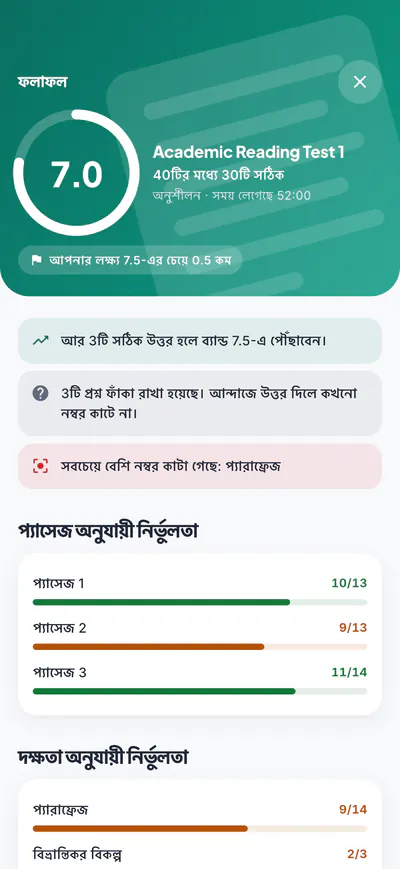
পরীক্ষার আগেই আপনার আসল IELTS ব্যান্ড জেনে নিন
একজন নেটিভ ইংরেজিভাষী শিক্ষকের সাথে বিনামূল্যে একটি ওয়ান-টু-ওয়ান অনলাইন ক্লাস, যিনি Band 8.5+ সার্টিফাইড IELTS বিশেষজ্ঞ। আপনি পাবেন আসল পরীক্ষার ফরম্যাটে Speaking ডায়াগনস্টিক, একটি সৎ ব্যান্ড অনুমান এবং ঠিক যে মানদণ্ডগুলোতে আপনার নম্বর কাটা যাচ্ছে সেগুলোর জন্য একটি পরিকল্পনা। কোনো পেমেন্ট নেই, কোনো বাধ্যবাধকতা নেই।
অনলাইন · ওয়ান-টু-ওয়ান · Academic ও General TrainingIELTS হলো British Council, IDP: IELTS Australia এবং Cambridge University Press & Assessment-এর নিবন্ধিত ট্রেডমার্ক। এই প্র্যাকটিস টেস্টগুলো Fleydo-র নিজের লেখা; এগুলো ওই সংস্থাগুলোর অনুমোদিত বা সমর্থিত নয়।

 ডাউনলোড করতে স্ক্যান করুন
