1. Αρχική
  2. IELTS
  3. Τεστ εξάσκησης
  4. Reading
  5. Εξάσκηση IELTS Reading True/False/Not Given 4

IELTS Reading · True / False / Not Given

Εξάσκηση IELTS Reading True/False/Not Given 4

Portuguese tiles

  • 12 ερωτήσεις
  • 15 λεπ.
  • Academic

Τι περιέχει αυτό το τεστ

  1. PassageΕρωτήσεις 1–12From palace wall to street front

Τύποι ερωτήσεων

  • True / False / Not Given
ReadingΕξάσκηση IELTS Reading True/False/Not Given 4
Υπόλοιπος χρόνος15:00

Passage

From palace wall to street front

A The word azulejo looks as if it ought to come from azul, the Portuguese for blue, but it does not. Its source is an Arabic term for a small polished stone, and the blue-and-white look now so closely tied to Portuguese tiles took shape in the late seventeenth century. Tiles have been fixed to buildings in Portugal for about five hundred years, and for part of that time the country did not make them itself.

B In the first half of the sixteenth century, Spain was a common source. Manuel I, who reigned from 1495 to 1521, had tiles brought from Seville for rooms in his palace at Sintra. Many such imports were Hispano-Moresque: each area of the design received its own coloured glaze, and in one common type, ridges pressed into the clay held the colours apart during firing.

C Local manufacture followed a change of technique. Majolica, developed in Italy and spread by migrating potters, allowed painters to work directly on the tile, and so opened the way to many more figurative subjects. In Portugal, its production began in the second half of the sixteenth century, after Flemish potters settled in Lisbon. One sixteenth-century maker whose name survives is João de Góis: his monogram appears on panels in the city's Graça church.

D The traditional method has several stages. A clay tile is shaped and fired. A white glaze containing tin and lead is then applied, and the painter works on top of it with a brush and metal-oxide pigments. Mistakes are hard to correct, because the raw glaze absorbs the pigment at once. Only a further firing fuses this layer and reveals the final colours. In the nineteenth century, factories making tiles for street fronts began to paint through stencils, which was faster and cheaper than freehand work.

E Blue and white arrived partly as a fashion. By the end of the seventeenth century, enthusiasm for Chinese porcelain and Dutch tiles was turning Portuguese workshops towards those two colours. The Dutch imports were also technically finer, and local workshops reacted by hiring academically trained painters. In 1687, after Portuguese craftsmen asked for protection, imported tiles were banned, but the ban was lifted in 1698 and orders to Holland continued. The years from the late seventeenth to the early eighteenth century became known as the golden age of Portuguese tiles. Under João V, palaces and churches wanted decorative panels in such numbers that workshops turned to high-volume production, and large orders from Brazil added to the demand.

F The move outdoors came later. After the 1755 earthquake, which caused massive damage across Lisbon, the city's rebuilding under the Marquis of Pombal favoured simple pattern tiles that were quick to make, although these mostly lined interiors. Outside, small devotional panels were set on house fronts as protection against further disasters. Production then collapsed in the early nineteenth century, amid invasion and civil war. When it recovered, from around the 1840s, tiles spread across the fronts of city buildings. That fashion is often credited to emigrants coming back from Brazil, but later Portuguese research argues that it began in Portugal and spread the other way. Tiles stood up to the weather, were relatively cheap to produce, and could make one plain building stand out from its neighbours.

Γλωσσάριο
glaze
a thin, glassy coating that is fixed to clay by heat
Hispano-Moresque
made in Spain in a style with Islamic roots
majolica
pottery with a white glaze containing tin, painted in colours
figurative
showing people, animals or objects, not just patterns
monogram
a design made from the first letters of a person's name
PassageΕρωτήσεις 1–12
Ερωτήσεις 1–12

Do the following statements agree with the information given in the text? TRUE if the statement agrees with the information FALSE if the statement contradicts the information NOT GIVEN if there is no information on this

1The word azulejo comes from the Portuguese name of a colour.
2Tiles for the palace at Sintra were obtained from outside Portugal.
3Hispano-Moresque tiles cost more than those later produced in Lisbon.
4Raised lines on some Hispano-Moresque tiles stopped the colours from running together.
5Portugal was already making majolica tiles at the start of the sixteenth century.
6João de Góis taught the majolica method to Portuguese-born potters.
7While painting a tile in the traditional way, the artist can see exactly how the finished colours will look.
8Stencils helped factories to reduce the cost of making tiles.
9A restriction on foreign tiles followed requests from Portuguese craftsmen.
10Orders from Brazil were mainly for churches.
11The rebuilding of Lisbon relied mainly on elaborate tiles that took a long time to produce.
12Tiled façades helped to keep the rooms behind them cool.

Απαντήσεις και επεξηγήσεις

Κάντε πρώτα το τεστ: οι λύσεις είναι πιο χρήσιμες αφού έχετε απαντήσει.

Εμφάνιση των λύσεων και των επεξηγήσεων
  1. 1
    FALSE

    Paragraph A says the word does not come from azul, the Portuguese for blue. Its source is an Arabic term for a stone. The text gives a different origin, so this is FALSE, not NOT GIVEN.

  2. 2
    TRUE

    Paragraph B says Spain was a common source and that Manuel I had tiles 'brought from Seville' for the palace. Tiles from Spain came from outside Portugal, so the statement agrees with the text.

  3. 3
    NOT GIVEN

    Paragraph B explains how these tiles were coloured, but the text does not compare their price with Lisbon tiles. 'Relatively cheap' in paragraph F describes much later tiles. So this is NOT GIVEN, not FALSE.

  4. 4
    TRUE

    Ridges are raised lines, and holding colours apart means they do not run together. Paragraph B says this of 'one common type', not of every tile, which fits the statement, so it is TRUE.

  5. 5
    FALSE

    Paragraph C says Portugal's production of majolica began in the second half of the sixteenth century. The start of that century is decades too early, so the text contradicts the statement.

  6. 6
    NOT GIVEN

    Paragraph C names João de Góis as a maker whose monogram survives. It does not mention any pupils. Teaching may seem likely, but it is not stated, so NOT GIVEN, not TRUE.

  7. 7
    FALSE

    Paragraph D says the final colours appear only after a further firing, which comes after the painting. So the artist cannot see them while working. The text contradicts the statement, which makes it FALSE.

  8. 8
    TRUE

    Paragraph D says painting through stencils was faster and cheaper than painting freehand. Cheaper work means a lower cost for the factory, so the statement agrees with the text.

  9. 9
    TRUE

    A ban on imported tiles is a restriction on foreign tiles, and paragraph E says it came after Portuguese craftsmen asked for protection. The later lifting of the ban does not change this, so the statement agrees with the text.

  10. 10
    NOT GIVEN

    Paragraph E mentions churches as customers under João V and, separately, large orders from Brazil. It does not say what the Brazilian orders were for. Do not join the two facts: this is NOT GIVEN, not TRUE.

  11. 11
    FALSE

    Paragraph F says the rebuilding favoured 'simple pattern tiles that were quick to make'. Simple is the opposite of elaborate, and quick the opposite of slow, so the text contradicts the statement.

  12. 12
    NOT GIVEN

    Paragraph F gives reasons for tiled fronts: weather, low cost and standing out. It does not mention the temperature inside. You may have read this elsewhere, but only the text counts, so NOT GIVEN, not TRUE.

Λέξεις-κλειδιά από αυτό το τεστ

Passage

imports
goods brought in from another country
fuses
joins things together, usually by heat
stencils
sheets with cut-out shapes, used to copy a design onto a surface
fashion
a style that is popular at a particular time
emigrants
people who leave their own country to live in another
Πώς απαντάτε σε ερωτήσεις «True / False / Not Given»Compare each statement with the text, and tell a real clash from simple silence.

What the task looks like

You get a list of statements and this instruction:

Do the following statements agree with the information given in Reading Passage 1? TRUE if the statement agrees with the information FALSE if the statement contradicts the information NOT GIVEN if there is no information on this

In General Training, the instruction says 'the text' instead of naming a passage.

'Contradicts' means the text says something that cannot be true at the same time as the statement.

The task tests whether you can compare a statement with what the text says, using the text alone. What you know about the subject does not count. In our papers, the statements follow the order of the text.

FALSE or NOT GIVEN: three questions

FALSE and NOT GIVEN can both feel like 'the text does not say this'. So use a sharper test. Ask these questions in order:

1. Does the text say the same thing, perhaps in different words? If so, the answer is TRUE.

2. Imagine the statement is true. Would the text then be wrong? If so, there is a clash, and the answer is FALSE.

3. Could the statement be true or untrue, and the text still be right either way? Then the text is silent on this point, and the answer is NOT GIVEN.

In short: FALSE means the text tells you otherwise. NOT GIVEN means the text does not tell you.

Κάντε
  • Answer FALSE only when you can point to the words that clash with the statement.
Αποφύγετε
  • Do not answer FALSE only because the text fails to mention something.

Worked example 1: silence is not a clash

Text: The town library moved to the old post office in spring. The new building has twice as many seats as the old one, but fewer shelves, so some rarely borrowed books are now kept in a store room. Visitors must ask staff to fetch them.

Statement: Visitors have to pay when a book is brought from the store room.

ΑδύναμοFALSE. Visitors only have to ask staff. The text does not mention money, so the service must be free.
ΚαλύτεροNOT GIVEN. The text does not say whether there is a charge. With a fee or without one, every sentence in the text would still be right.

Not mentioning something is not the same as denying it. FALSE needs words in the text that clash with the statement.

Worked example 2: a clash in different words

Same text. Statement: Every book in the library can be collected without help from staff.

ΑδύναμοNOT GIVEN. I cannot find 'every book' or 'without help' anywhere in the text.
ΚαλύτεροFALSE. Some books are in a store room, and visitors must ask staff to fetch them. If every book could be collected without help, the text would be wrong.

A clash does not have to use the statement's words. Compare the meanings, not the wording.

Worked example 3: do not join the dots

Same text. Statement: The library moved because it needed more seats.

ΑδύναμοTRUE. The new building has twice as many seats, so that must be the reason.
ΚαλύτεροNOT GIVEN. The text gives the move and it gives the seats, but it never says why the library moved. The reason could be something else.

Two facts side by side do not make a cause. A 'because' in the statement needs a reason in the text.

A method to try

1. Read the statement and find its main point. Mark the small words that limit it, such as 'only', 'all', 'most', 'before' or 'more than'.

2. Find the place. Choose a word that is easy to spot, such as a name or a number, and start looking after the last place you used.

3. Read the whole sentence, and the sentences on each side of it.

4. Ask the three questions, and answer from the text alone.

5. If you have read the likely part of the text closely and found neither agreement nor a clash, choose NOT GIVEN and move on. You cannot find what is not there.

The traps

Your own knowledge: a statement can be true in real life and still be NOT GIVEN, if the text does not say it.

Limiting words: if the text says 'some' and the statement says 'all', that is a clash. 'Usually' against 'always' works the same way.

Comparisons: the text may describe two things without comparing them. 'A is more popular than B' needs the text to make that comparison.

Same topic, different point: a NOT GIVEN statement can use the text's topic and even its words. Finding the topic is not the same as finding the answer.

Information, not opinion

This task is about the information in the text. Yes/No/Not Given is about what the writer claims. The difference matters.

Take this sentence: Some shop owners want the market moved, but I think this would be a mistake.

In a True/False task, 'Some shop owners want the market moved' is TRUE, because the text gives that information. In a Yes/No task, 'The market should be moved' is NO, because the writer argues against it.

Εικονίδιο της εφαρμογής Fleydo IELTS Fleydo: Προετοιμασία IELTS

Πάρτε αυτά τα τεστ μαζί σας στο κινητό

Κάθε τεστ αυτών των σελίδων υπάρχει και στην εφαρμογή Fleydo: Προετοιμασία IELTS για iPhone, iPad και Android, μαζί με 2.000 λέξεις IELTS με ήχο.

  • Λειτουργεί χωρίς σύνδεση μόλις ένα τεστ βρίσκεται στο κινητό σας
  • 2.000 λέξεις IELTS με ήχο, επανάληψη σε αυξανόμενα διαστήματα και σύντομες ασκήσεις
  • Ηχογραφήστε τις απαντήσεις σας στο Speaking και ακούστε τες ξανά
  • Καθημερινό πλάνο για το band-στόχο σας και την ημερομηνία της εξέτασης
Λήψη στο App StoreΑποκτήστε το στο Google Play
Σαρώστε για λήψηΑνοίγει το App Store ή το Google Play, ανάλογα με το κινητό σας.

Δεν χρειάζεται λογαριασμός. Σχετικά με την εφαρμογή

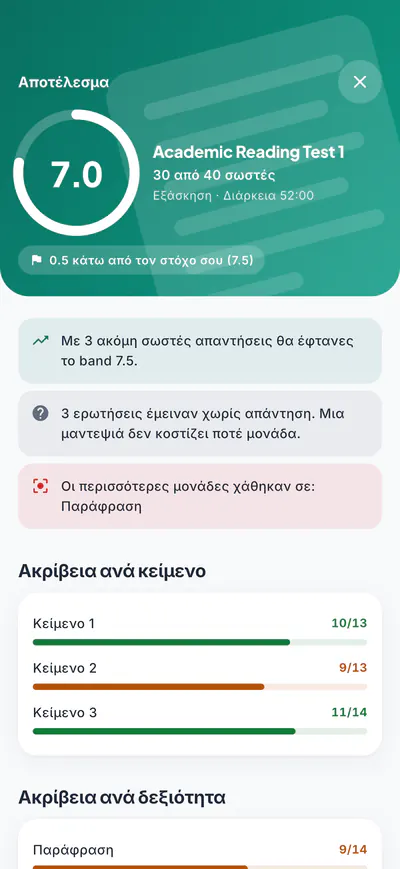
Αποτέλεσμα τεστ εξάσκησης IELTS στην εφαρμογή Fleydo: Προετοιμασία IELTS: εκτιμώμενο band και ακρίβεια για κάθε μέρος
Δωρεάν δοκιμαστικό μάθημα

Μάθετε το πραγματικό σας band στο IELTS πριν σας το πει η εξέταση

Ένα δωρεάν ατομικό διαδικτυακό μάθημα με καθηγητή με μητρική γλώσσα τα Αγγλικά, πιστοποιημένο ειδικό IELTS με Band 8.5+. Λαμβάνετε διαγνωστικό Speaking σε πραγματική μορφή εξέτασης, μια ειλικρινή εκτίμηση band και ένα πλάνο για τα ακριβή κριτήρια που σας κοστίζουν βαθμούς. Χωρίς πληρωμή, χωρίς δέσμευση.

Διαδικτυακά · Ατομικά · Academic και General Training

Το IELTS είναι σήμα κατατεθέν των British Council, IDP: IELTS Australia και Cambridge University Press & Assessment. Αυτά τα τεστ εξάσκησης είναι γραμμένα από τη Fleydo και δεν έχουν εγκριθεί ούτε υποστηριχθεί από τους οργανισμούς αυτούς.

Εφαρμογή για κινητά

Η Fleydo English School στην τσέπη σας

Μαθήματα, εργασίες, μηνύματα και παιχνίδια για τους μαθητές της Fleydo και τους γονείς τους. Δωρεάν σε iPhone και Android.

Λήψη στο App StoreΑποκτήστε το στο Google Play
Περισσότερα για την εφαρμογή
Κωδικός QR που ανοίγει την εφαρμογή Fleydo English School στο App Store ή στο Google PlayΣαρώστε για λήψηΑνοίγει το κατάλληλο κατάστημα για το κινητό σας.fleydo.com/app
Εικονίδιο της εφαρμογής Fleydo IELTS
Fleydo: Προετοιμασία IELTS

Προετοιμάζεστε για το IELTS;

Το Fleydo: Προετοιμασία IELTS είναι ξεχωριστή εφαρμογή με τεστ εξάσκησης και για τις τέσσερις δεξιότητες. Δεν χρειάζεστε λογαριασμό Fleydo για να τη χρησιμοποιήσετε.

Δείτε την εφαρμογή IELTS
Λήψη στο App StoreΑποκτήστε το στο Google Play
Τεστ εξάσκησης IELTS

Εξασκηθείτε και στις τέσσερις δεξιότητες του IELTS

311 τεστ με άμεσο band score, επεξηγήσεις στις απαντήσεις και πρότυπες απαντήσεις. Χωρίς εγγραφή.

Όλα τα τεστ εξάσκησης
Το FleyPath

Ο προσωπικός οδικός χάρτης του παιδιού σας — 3, 6 ή 12 μήνες

🚀Έναρξη
👋Hello
😊Body
🦁Animals
🔢Numbers
🏆Αγγλικά με Αυτοπεποίθηση
Παιχνιδοποιημένη εξάσκηση Αγγλικών

Σαν παιχνίδι — μόνο που μαθαίνουν πραγματικά