1. Αρχική
  2. IELTS
  3. Τεστ εξάσκησης
  4. Reading
  5. Εξάσκηση IELTS Reading True/False/Not Given 3

IELTS Reading · True / False / Not Given

Εξάσκηση IELTS Reading True/False/Not Given 3

The first escalators

  • 11 ερωτήσεις
  • 15 λεπ.
  • Academic

Τι περιέχει αυτό το τεστ

  1. PassageΕρωτήσεις 1–11How the staircase learned to move

Τύποι ερωτήσεων

  • True / False / Not Given
ReadingΕξάσκηση IELTS Reading True/False/Not Given 3
Υπόλοιπος χρόνος15:00

Passage

How the staircase learned to move

A Patents for moving stairs appeared long before anybody rode on them. Nathan Ames of Massachusetts obtained one for "revolving stairs" in 1859, and Leamon Souder another for a "stairway" in 1889. Neither device was ever constructed.

B The machine that did get built came from Jesse Reno, who had graduated from Lehigh University in 1883. His patent, granted on 15 March 1892 after an application filed in January 1891, described an endless belt of hinged cast-iron sections, set at a slope of about 25 degrees, with a handrail moving at the same speed and comb-like landings whose prongs fitted into channels in the belt. There were no steps: passengers simply rode on an incline, and Reno called the device an "inclined elevator". In 1896 he submitted plans to New York City officials for a double-decker subway with such machines linking street and platform, but they were rejected.

C That same year his machine carried the public at the Old Iron Pier on Coney Island in New York. Rising about seven feet, it ran for two weeks at most, and by some estimates as many as 75,000 people rode it. It looked like a seaside novelty, but a trade journal, the Street Railway Review, reported that the aim was to show its practicality to the trustees of the Brooklyn Bridge, and also to officers of elevated railways and of Boston's subway. The journal put the capacity of a single-file machine at 3,000 people an hour and observed that no attendant was required. A few months later what seems to have been the same machine was tried for about a month on the Manhattan side of the bridge, and in 1898 the Bloomingdale Bros store in New York installed a Reno machine.

D A rival line began with George Wheeler, who patented a moving staircase with flat steps a few months after Reno's patent, and never built it. Charles Seeberger bought Wheeler's patents and struck a deal with the Otis Elevator Company, which in 1899 built a prototype incorporating some of Wheeler's features. Its flat treads were smooth, with no comb at the landing. Instead of walking straight ahead at the end, riders stepped off to one side, steered by a triangular divider.

E Both approaches reached Paris for the Exposition Universelle of 1900, where the Seeberger-Otis machine took first prize and Reno's inclined elevator was also on show. Seeberger trademarked the word "escalator" that year, having built it on the Latin scala, a word for ladders and stairs. Otis came to hold the rights, which obliged competitors to sell their machines under other names, among them Motorstair and Electric Stairway. In 1950 the US Patent Office cancelled the trademark, ruling that the public recognised the word as the name for a moving stairway.

F London had its own beginnings. Harrods unveiled a moving staircase in November 1898, in fact a woven leather belt, and nervous customers were reportedly offered brandy at the top. The first escalators on the London Underground entered service at Earl's Court on 4 October 1911: two machines with flat steps and a side exit. Twenty more followed at nine other stations by 1915.

G By then both Americans' patents had passed to Otis, which bought Seeberger's rights in 1910 and bought out Reno in 1911. In the early 1920s it joined Reno's cleats and combs to Seeberger's flat steps, producing the forerunner of today's machines.

Γλωσσάριο
elevated railways
railways built on raised structures above the streets
treads
the flat parts of steps that you put your feet on
cleats
raised strips on a surface that give feet a firmer hold
combs
rows of metal teeth at the end of a moving surface, which fit into its grooves
PassageΕρωτήσεις 1–11
Ερωτήσεις 1–11

Do the following statements agree with the information given in the text? TRUE if the statement agrees with the information FALSE if the statement contradicts the information NOT GIVEN if there is no information on this

1Of the designs patented by Ames and Souder, only the earlier one was ever built.
2Reno got the idea for his machine from having to climb long flights of steps at university.
3Passengers on Reno's patented machine travelled on a sloping belt rather than on separate stairs.
4According to a trade journal, the Coney Island machine was intended to persuade those running transport systems that it would work in practice.
5The trade journal said the machine needed a member of staff to look after it.
6On the 1899 prototype, riders got off by continuing forward in the direction of travel.
7Wheeler gave Otis advice on how to build the 1899 prototype.
8Both Reno's and Seeberger's machines were shown at the 1900 exhibition in Paris.
9While Otis held the trademark, competing firms were free to call their products escalators.
10Early passengers on the London Underground were afraid to use the escalators.
11Seeberger's rights went to Otis before Reno sold out to the company.

Απαντήσεις και επεξηγήσεις

Κάντε πρώτα το τεστ: οι λύσεις είναι πιο χρήσιμες αφού έχετε απαντήσει.

Εμφάνιση των λύσεων και των επεξηγήσεων
  1. 1
    FALSE

    Paragraph A says 'Neither device was ever constructed'. 'Neither' covers both designs, so the word 'only' makes the statement wrong: Ames's earlier design was not built either. The text contradicts it, so FALSE, not NOT GIVEN.

  2. 2
    NOT GIVEN

    Paragraph B says Reno graduated from Lehigh University, but it does not say where his idea came from. The university is mentioned only as part of his background, so the answer is NOT GIVEN, not TRUE.

  3. 3
    TRUE

    Paragraph B describes a belt set at a slope and says 'There were no steps'. Passengers 'rode on an incline', which is the same as travelling on a sloping belt, so the statement agrees.

  4. 4
    TRUE

    Paragraph C says it 'looked like a seaside novelty', but the journal reported that the aim was to show its practicality to bridge trustees and railway and subway officers. These people run transport systems, so the statement agrees.

  5. 5
    FALSE

    Paragraph C says the journal 'observed that no attendant was required'. An attendant is a member of staff who looks after something, so the text contradicts the statement. It is FALSE, not NOT GIVEN.

  6. 6
    FALSE

    Paragraph D says riders 'stepped off to one side', steered by a divider, instead of walking straight ahead. So they did not carry on forward, and the text contradicts the statement: FALSE, not NOT GIVEN.

  7. 7
    NOT GIVEN

    Paragraph D says the prototype used some of Wheeler's features, but these could have come from the patents Seeberger bought. It does not say Wheeler gave advice, and never building his own design does not rule it out: NOT GIVEN, not TRUE or FALSE.

  8. 8
    TRUE

    Paragraph E says the Seeberger-Otis machine won a prize in Paris and that Reno's inclined elevator 'was also on show'. So both machines were displayed there, and the statement agrees.

  9. 9
    FALSE

    Paragraph E says Otis's rights 'obliged competitors to sell their machines under other names'. If they had to use other names, they were not free to say escalator, so it is FALSE, not NOT GIVEN.

  10. 10
    NOT GIVEN

    Paragraph F mentions nervous customers at Harrods, a shop, but it does not say how Underground passengers felt at Earl's Court. With no information about them, the answer is NOT GIVEN, not TRUE.

  11. 11
    TRUE

    Paragraph G gives 1910 for Seeberger's rights and 1911 for buying out Reno, which means Reno sold out to Otis. The first came a year before the second, so the statement agrees.

Λέξεις-κλειδιά από αυτό το τεστ

Passage

practicality
how useful and workable something is in real situations
capacity
the largest number or amount that something can hold or carry
rival
competing with another person or thing
prototype
the first version of a machine, built to test the design
trademark
a name that a company has the legal right to use for its product
Πώς απαντάτε σε ερωτήσεις «True / False / Not Given»Compare each statement with the text, and tell a real clash from simple silence.

What the task looks like

You get a list of statements and this instruction:

Do the following statements agree with the information given in Reading Passage 1? TRUE if the statement agrees with the information FALSE if the statement contradicts the information NOT GIVEN if there is no information on this

In General Training, the instruction says 'the text' instead of naming a passage.

'Contradicts' means the text says something that cannot be true at the same time as the statement.

The task tests whether you can compare a statement with what the text says, using the text alone. What you know about the subject does not count. In our papers, the statements follow the order of the text.

FALSE or NOT GIVEN: three questions

FALSE and NOT GIVEN can both feel like 'the text does not say this'. So use a sharper test. Ask these questions in order:

1. Does the text say the same thing, perhaps in different words? If so, the answer is TRUE.

2. Imagine the statement is true. Would the text then be wrong? If so, there is a clash, and the answer is FALSE.

3. Could the statement be true or untrue, and the text still be right either way? Then the text is silent on this point, and the answer is NOT GIVEN.

In short: FALSE means the text tells you otherwise. NOT GIVEN means the text does not tell you.

Κάντε
  • Answer FALSE only when you can point to the words that clash with the statement.
Αποφύγετε
  • Do not answer FALSE only because the text fails to mention something.

Worked example 1: silence is not a clash

Text: The town library moved to the old post office in spring. The new building has twice as many seats as the old one, but fewer shelves, so some rarely borrowed books are now kept in a store room. Visitors must ask staff to fetch them.

Statement: Visitors have to pay when a book is brought from the store room.

ΑδύναμοFALSE. Visitors only have to ask staff. The text does not mention money, so the service must be free.
ΚαλύτεροNOT GIVEN. The text does not say whether there is a charge. With a fee or without one, every sentence in the text would still be right.

Not mentioning something is not the same as denying it. FALSE needs words in the text that clash with the statement.

Worked example 2: a clash in different words

Same text. Statement: Every book in the library can be collected without help from staff.

ΑδύναμοNOT GIVEN. I cannot find 'every book' or 'without help' anywhere in the text.
ΚαλύτεροFALSE. Some books are in a store room, and visitors must ask staff to fetch them. If every book could be collected without help, the text would be wrong.

A clash does not have to use the statement's words. Compare the meanings, not the wording.

Worked example 3: do not join the dots

Same text. Statement: The library moved because it needed more seats.

ΑδύναμοTRUE. The new building has twice as many seats, so that must be the reason.
ΚαλύτεροNOT GIVEN. The text gives the move and it gives the seats, but it never says why the library moved. The reason could be something else.

Two facts side by side do not make a cause. A 'because' in the statement needs a reason in the text.

A method to try

1. Read the statement and find its main point. Mark the small words that limit it, such as 'only', 'all', 'most', 'before' or 'more than'.

2. Find the place. Choose a word that is easy to spot, such as a name or a number, and start looking after the last place you used.

3. Read the whole sentence, and the sentences on each side of it.

4. Ask the three questions, and answer from the text alone.

5. If you have read the likely part of the text closely and found neither agreement nor a clash, choose NOT GIVEN and move on. You cannot find what is not there.

The traps

Your own knowledge: a statement can be true in real life and still be NOT GIVEN, if the text does not say it.

Limiting words: if the text says 'some' and the statement says 'all', that is a clash. 'Usually' against 'always' works the same way.

Comparisons: the text may describe two things without comparing them. 'A is more popular than B' needs the text to make that comparison.

Same topic, different point: a NOT GIVEN statement can use the text's topic and even its words. Finding the topic is not the same as finding the answer.

Information, not opinion

This task is about the information in the text. Yes/No/Not Given is about what the writer claims. The difference matters.

Take this sentence: Some shop owners want the market moved, but I think this would be a mistake.

In a True/False task, 'Some shop owners want the market moved' is TRUE, because the text gives that information. In a Yes/No task, 'The market should be moved' is NO, because the writer argues against it.

Εικονίδιο της εφαρμογής Fleydo IELTS Fleydo: Προετοιμασία IELTS

Πάρτε αυτά τα τεστ μαζί σας στο κινητό

Κάθε τεστ αυτών των σελίδων υπάρχει και στην εφαρμογή Fleydo: Προετοιμασία IELTS για iPhone, iPad και Android, μαζί με 2.000 λέξεις IELTS με ήχο.

  • Λειτουργεί χωρίς σύνδεση μόλις ένα τεστ βρίσκεται στο κινητό σας
  • 2.000 λέξεις IELTS με ήχο, επανάληψη σε αυξανόμενα διαστήματα και σύντομες ασκήσεις
  • Ηχογραφήστε τις απαντήσεις σας στο Speaking και ακούστε τες ξανά
  • Καθημερινό πλάνο για το band-στόχο σας και την ημερομηνία της εξέτασης
Λήψη στο App StoreΑποκτήστε το στο Google Play
Σαρώστε για λήψηΑνοίγει το App Store ή το Google Play, ανάλογα με το κινητό σας.

Δεν χρειάζεται λογαριασμός. Σχετικά με την εφαρμογή

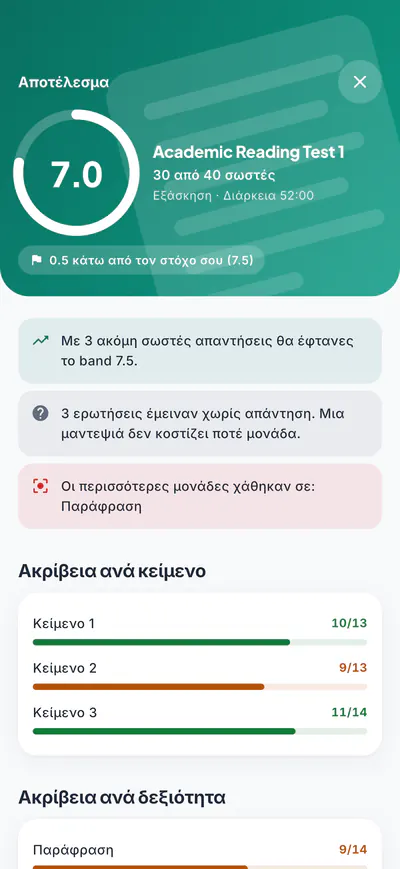
Αποτέλεσμα τεστ εξάσκησης IELTS στην εφαρμογή Fleydo: Προετοιμασία IELTS: εκτιμώμενο band και ακρίβεια για κάθε μέρος
Δωρεάν δοκιμαστικό μάθημα

Μάθετε το πραγματικό σας band στο IELTS πριν σας το πει η εξέταση

Ένα δωρεάν ατομικό διαδικτυακό μάθημα με καθηγητή με μητρική γλώσσα τα Αγγλικά, πιστοποιημένο ειδικό IELTS με Band 8.5+. Λαμβάνετε διαγνωστικό Speaking σε πραγματική μορφή εξέτασης, μια ειλικρινή εκτίμηση band και ένα πλάνο για τα ακριβή κριτήρια που σας κοστίζουν βαθμούς. Χωρίς πληρωμή, χωρίς δέσμευση.

Διαδικτυακά · Ατομικά · Academic και General Training

Το IELTS είναι σήμα κατατεθέν των British Council, IDP: IELTS Australia και Cambridge University Press & Assessment. Αυτά τα τεστ εξάσκησης είναι γραμμένα από τη Fleydo και δεν έχουν εγκριθεί ούτε υποστηριχθεί από τους οργανισμούς αυτούς.

Εφαρμογή για κινητά

Η Fleydo English School στην τσέπη σας

Μαθήματα, εργασίες, μηνύματα και παιχνίδια για τους μαθητές της Fleydo και τους γονείς τους. Δωρεάν σε iPhone και Android.

Λήψη στο App StoreΑποκτήστε το στο Google Play
Περισσότερα για την εφαρμογή
Κωδικός QR που ανοίγει την εφαρμογή Fleydo English School στο App Store ή στο Google PlayΣαρώστε για λήψηΑνοίγει το κατάλληλο κατάστημα για το κινητό σας.fleydo.com/app
Εικονίδιο της εφαρμογής Fleydo IELTS
Fleydo: Προετοιμασία IELTS

Προετοιμάζεστε για το IELTS;

Το Fleydo: Προετοιμασία IELTS είναι ξεχωριστή εφαρμογή με τεστ εξάσκησης και για τις τέσσερις δεξιότητες. Δεν χρειάζεστε λογαριασμό Fleydo για να τη χρησιμοποιήσετε.

Δείτε την εφαρμογή IELTS
Λήψη στο App StoreΑποκτήστε το στο Google Play
Τεστ εξάσκησης IELTS

Εξασκηθείτε και στις τέσσερις δεξιότητες του IELTS

311 τεστ με άμεσο band score, επεξηγήσεις στις απαντήσεις και πρότυπες απαντήσεις. Χωρίς εγγραφή.

Όλα τα τεστ εξάσκησης
Το FleyPath

Ο προσωπικός οδικός χάρτης του παιδιού σας — 3, 6 ή 12 μήνες

🚀Έναρξη
👋Hello
😊Body
🦁Animals
🔢Numbers
🏆Αγγλικά με Αυτοπεποίθηση
Παιχνιδοποιημένη εξάσκηση Αγγλικών

Σαν παιχνίδι — μόνο που μαθαίνουν πραγματικά