1. হোম
  2. IELTS
  3. প্র্যাকটিস টেস্ট
  4. Speaking
  5. Speaking প্র্যাকটিস টেস্ট 36: Small pleasures

IELTS Speaking

IELTS Speaking প্র্যাকটিস টেস্ট 36: Small pleasures

Describe a small treat you give yourself, or used to give yourself, after something difficult or tiring.

  • 3টি অংশ
  • 11–14 মিনিট
  • পরীক্ষক
  • চারজন পরীক্ষার্থী, একটি টেস্ট

টেস্টটি দিন

পরীক্ষকের প্রশ্নগুলো একটি একটি করে বাজবে। পরীক্ষার মতোই মুখে উত্তর দিন। রেকর্ড করা ঐচ্ছিক, আর রেকর্ডিং থাকে শুধু এই ব্রাউজার ট্যাবে।

আপনার রেকর্ডিং থাকে শুধু এই ট্যাবে। কিছুই আপলোড হয় না। রাখতে চাইলে ডাউনলোড করে নিন।

নিজের পারফরম্যান্স মূল্যায়ন করুন

আপনার উত্তর পরীক্ষার্থীদের সঙ্গে মিলিয়ে দেখুন, তারপর প্রতিটি মানদণ্ডে আপনার সঙ্গে মানানসই ব্যান্ডটি বেছে নিন।

৬.০আপনার আনুমানিক ব্যান্ড
Fluency and coherence

Lexical resource

Grammatical range and accuracy

Pronunciation

প্রতিটি পরীক্ষার্থী আলাদা বক্তা, তাই গল্প ও মতামত ভিন্ন। ব্যান্ডগুলো প্রকাশিত ডেসক্রিপ্টর অনুযায়ী আমাদের অনুমান, পরীক্ষকের দেওয়া অফিসিয়াল নম্বর নয়। ট্রান্সক্রিপ্টে উচ্চারণ বোঝা যায় না। এই ব্যান্ডগুলোতে ধরে নেওয়া হয়েছে যে উচ্চারণ বাকি তিনটি মানদণ্ডের সমান মানের।

প্রশ্ন, কিউ কার্ড ও নমুনা উত্তর

Part 1: সাক্ষাৎকার

Your home

  • Do you live in a house or a flat?
  • Which part of your home do you like least?
  • Who chose the furniture in your home?
  • Where did you like to spend time at home when you were a child?

The beach

  • How often do you go to the beach?
  • Do you prefer a busy beach or a quiet one?
  • Did your family go to the beach when you were a child?
  • Would you like to live near a beach? (Why?)

Numbers

  • How many phone numbers do you know by heart?
  • Is there a number you think of as lucky, or unlucky?
  • When you need to add something up, do you do it in your head or use your phone?

টিপস

  • The beach questions work even if you hardly ever go. 'Not often, the sea is a long way from us' becomes a full answer once you add where you go instead, or the one trip you remember.
  • For the numbers questions, a short, specific answer beats a general one: say whose numbers you know by heart, or which number someone in your family thinks is lucky, and why.
  • Two questions look back at childhood: where you spent time at home and beach trips with your family. Use past forms such as 'used to' and 'would', and keep them going to the end of the answer instead of sliding back into the present.

Part 2: দীর্ঘ বক্তব্য (কিউ কার্ড)

Describe a small treat you give yourself, or used to give yourself, after something difficult or tiring.

You should say:

  • what the treat is
  • what the difficult or tiring thing is
  • how this habit started

and explain whether looking forward to it makes the difficult thing any easier.

সম্পূরক প্রশ্ন

  • Do you ever share this treat with anyone?
  • Would you mind if you had to give it up?

একজন দক্ষ পরীক্ষার্থী যে নোট নিতে পারেন

  • hair wash + head massage, near home
  • lemongrass, warm water, twenty minutes
  • after a tour group leaves
  • 20 people, 10 days, every problem
  • first year: older guide took me
  • phone off, nobody can ask
  • in a crisis? not thinking about it
  • but the tour finally ends

টিপস

  • The treat can be tiny: a cold drink, a bowl of soup, the comfortable way home. Nobody marks you on how special it is, only on how clearly you describe it. If you have no habit like this now, talk about one you used to have, as the card allows.
  • The difficult or tiring part usually gives you more to say than the treat itself. Describe what makes it hard in a few concrete details, then move on to how the habit started, which is a short story with a clear beginning.
  • The explain line asks about the waiting, not the treat. Think about the middle of the difficult thing: do you think about the treat then, or not at all? Either answer works if you say why, and 'it doesn't make it easier, but it does ...' is a perfectly good answer.

Part 3: আলোচনা

Treats and spending

  • Why do you think small treats matter so much to people? ব্যাখ্যা করা
  • Do you think people treat themselves more often now than people did in the past? তুলনা করা
  • Some people say that spending money on small treats every day is a waste. What's your view? মতামত দেওয়া

Experiences and things

  • Why would some people rather pay for an experience, like a concert or a meal out, than for something they can keep? ব্যাখ্যা করা
  • Is an experience a better present to give someone than an object? ভালো-মন্দ বিচার
  • Do you think people will spend more on experiences or on things in the future? ভবিষ্যৎ নিয়ে অনুমান

টিপস

  • Several questions ask about people in general. Start from what you have noticed around you, at work, in your family or in your city, then say whether you think it is true more widely.
  • For the question about presents, avoid a flat yes or no. Say who an experience suits and who it does not, or what it depends on, and give one example.
  • The last question asks about the future. Give a direction first ('experiences, but smaller ones'), then a reason, and only then any doubt. An answer that is only doubt runs out quickly.

চারজন পরীক্ষার্থী, একটি টেস্ট

চারটি ভিন্ন ব্যান্ডের বক্তারা প্রতিটি প্রশ্নের উত্তর কীভাবে দিয়েছেন।

Part 1Do you live in a house or a flat?

A house. It's my mother's house, in Godoy Cruz, er, that's part of Mendoza, the city. I live with my mother and my little sister there. Is not very big, but it has a small garden at the back.

Part 1Which part of your home do you like least?

The bathroom, I think. It's very small and the... the hot water take a long time to come. In winter you wait and wait and it's still cold. And my sister is inside one hour every morning, so...

Part 1Who chose the furniture in your home?

My mother, everything, er... she decides. Only in my room I chose the bed, and a desk, but the desk I made it with my uncle, with wood from one job.

Part 1Where did you like to spend time at home when you were a child?

In the patio. We had a big fig tree there, and I played with my cousins under the tree all the afternoon, er, in summer. Inside was too hot.

Part 1How often do you go to the beach?

Almost never. Mendoza is very far from the sea. The beach more close is in Chile, I think, you cross the mountains... so, er, maybe one time in five years, more or less.

Part 1Do you prefer a busy beach or a quiet one?

Quiet, I prefer. But not empty, er, some people is OK. When it's very busy you can't... there is no place for put your towel, and the music from everybody, no, I don't like.

Part 1Did your family go to the beach when you were a child?

One time, to Chile, when I was nine or ten. We go in the car of my uncle, er, a very long trip. And the water was so cold, I didn't expect. I put my feet and I run out.

Part 1Would you like to live near a beach? (Why?)

For holidays, yes. But to live... no, I don't think. My family is here, my work also. And I'm used to see the mountains every day, er, I would miss them.

Part 1How many phone numbers do you know by heart?

Er... two? My mother's number, and my number. No, my number I don't know, I always look in the phone. So only one, the number of my mother.

Part 1Is there a number you think of as lucky, or unlucky?

Not really. Er, maybe seven, because I was born on the seventh of July. But I don't believe in this, it's only for fun.

Part 1When you need to add something up, do you do it in your head or use your phone?

In my head, for small things. In my work I measure all the time, the walls, the windows, so I'm OK with numbers. But for the bills I use the phone, because if I make a mistake, er, is a problem.

Part 2Describe a small treat you give yourself, or used to give yourself, after something difficult or tiring.

Er, OK. My treat is ice cream, on Friday, in the summer. I work with my uncle, we put air conditioners in the houses, and in summer is... it's terrible. We go up on the roofs, the sun is very strong, and the machines are heavy, very heavy. Sometimes we carry them three, four floors by the stairs. In January and February everybody want air conditioning at the same time, so we work every day until, er, until the night. So on Friday when we finish, I go to an ice cream shop near my house and I buy a quarter kilo, chocolate and dulce de leche. I eat it in the patio, slowly, alone. The first summer with my uncle I was very tired, I want – I was thinking to leave the job. And one Friday he stop the truck and buy two ice creams, and he said, OK, the week is finished. My uncle is like this, he don't talk much, but... He worked on the roofs thirty years, now his back is – he has problems with the back, er, so... Er, yes. The ice cream helps, I think, because on Friday afternoon, on the roof, I think only about the ice cream and the time pass more fast.

Part 2Do you ever share this treat with anyone?

Sometimes with my sister. But she eats half, er, so now I buy for two.

Part 2Would you mind if you had to give it up?

Yes, a little. But in winter I don't have it, and I'm OK, so it's not a big problem.

Part 3Why do you think small treats matter so much to people?

Because the life is hard for many people. You work, you pay the bills, and in the week there is not much... not many happy moments. So a small thing, a coffee, a chocolate, or my ice cream on Friday, it's like a little prize for you. It's cheap, and you feel good, er, one moment at least.

Part 3Do you think people treat themselves more often now than people did in the past?

Yes, more now. My mother, when she was young, she never buy things for her, er, everything was for the children, for the house. Now the young people, er, they buy a coffee every day, they order food with the app... My mother says we spend all the money in nothing. Maybe she's right, I don't know.

Part 3Some people say that spending money on small treats every day is a waste. What's your view?

Er... a little bit, yes. If you buy every day a coffee in a café, er, at the end of the month it's a lot of money. But it depends... if your work is very hard, you need something, no? And for the people with not much money, the small thing is the only thing they can buy, so for them is not a waste. For me one time in the week is OK.

Part 3Why would some people rather pay for an experience, like a concert or a meal out, than for something they can keep?

Because you remember them. A trip with your friends, a football match, you – you talk about it many years after. A thing, er, like clothes, shoes, after two months it's old, you don't care anymore. And with experiences you are with other people, so is more fun.

Part 3Is an experience a better present to give someone than an object?

For me, no. I prefer a thing, because the thing... it stays. My girlfriend gave me for my birthday a dinner in a restaurant, er, very nice, but one night and finish. The watch she gave me before, I use it every day, I look at it and I remember her.

Part 3Do you think people will spend more on experiences or on things in the future?

Experiences, I think. Er, because young people now, they live in small flats, there is no space for more things. They prefer to go out, to travel, to eat in, er, restaurants, bars. But I'm not sure, because the things also are very cheap now, on internet. So maybe both. I don't know.

এই টেস্টের শব্দ

treat yourself (to something)
buy or do something nice for yourself, often as a small reward
something to look forward to
a pleasant thing you know is coming, which helps you through a hard time
get through (the day or week)
manage to reach the end of something difficult or tiring
drained
so tired, especially after stress, that you have no energy left
wind down
relax gradually after work or a stressful time
a little luxury
something pleasant you do not really need but enjoy, usually not expensive
splash out on
spend more money than usual on something you enjoy (informal)
add up
become a large amount when small amounts are put together, as in 'small treats add up'
out of reach
too expensive or difficult for someone to get
a ritual
something you always do in the same way, at the same point in your day or week
possessions
the things that you own
a voucher
a card or code that can be exchanged for a meal, a service or goods

দরকারি বাক্যাংশ

  • After ___, I usually reward myself with ___.
  • It started when ___, and since then ___.
  • It doesn't make ___ any easier, but it does ___.
  • Knowing that ___ is coming helps me ___.
  • It's not much, but ___.
  • For some people it's a waste, but if ___, then ___.
  • When my parents were my age, ___ was much more of a special occasion.
  • An experience makes a better present if ___. Otherwise ___.
  • I can see people spending more on ___ in future, partly because ___.

Fleydo IELTS অ্যাপের আইকন Fleydo: IELTS প্রস্তুতি

এই টেস্টগুলো ফোনে সঙ্গে রাখুন

এই পেজগুলোর প্রতিটি টেস্ট iPhone, iPad ও Android-এর জন্য Fleydo: IELTS প্রস্তুতি অ্যাপেও আছে, সঙ্গে অডিওসহ 2,000টি IELTS শব্দ।

  • কোনো টেস্ট ফোনে নামানো হয়ে গেলে অফলাইনে চলে
  • অডিওসহ 2,000টি IELTS শব্দ, ক্রমশ বাড়তে থাকা বিরতিতে রিভিশন আর ছোট অনুশীলন
  • Speaking-এর উত্তর রেকর্ড করে আবার শুনুন
  • আপনার লক্ষ্য ব্যান্ড ও পরীক্ষার তারিখ ধরে প্রতিদিনের পরিকল্পনা
App Store থেকে ডাউনলোড করুনএটি Google Play তে পান
ডাউনলোড করতে স্ক্যান করুনআপনার ফোন অনুযায়ী App Store বা Google Play খোলে।

অ্যাকাউন্ট লাগে না। অ্যাপটি সম্পর্কে

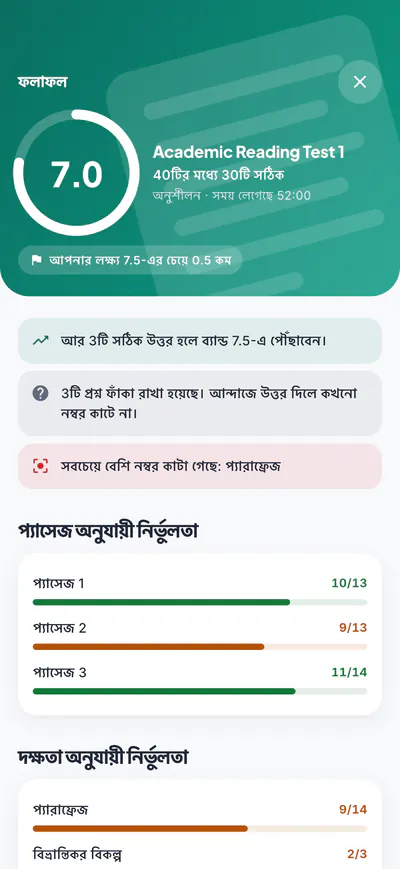
Fleydo: IELTS প্রস্তুতি অ্যাপে একটি IELTS প্র্যাকটিস টেস্টের ফলাফল: আনুমানিক ব্যান্ড ও প্রতিটি অংশের নির্ভুলতা
বিনামূল্যে ট্রায়াল ক্লাস

পরীক্ষার আগেই আপনার আসল IELTS ব্যান্ড জেনে নিন

একজন নেটিভ ইংরেজিভাষী শিক্ষকের সাথে বিনামূল্যে একটি ওয়ান-টু-ওয়ান অনলাইন ক্লাস, যিনি Band 8.5+ সার্টিফাইড IELTS বিশেষজ্ঞ। আপনি পাবেন আসল পরীক্ষার ফরম্যাটে Speaking ডায়াগনস্টিক, একটি সৎ ব্যান্ড অনুমান এবং ঠিক যে মানদণ্ডগুলোতে আপনার নম্বর কাটা যাচ্ছে সেগুলোর জন্য একটি পরিকল্পনা। কোনো পেমেন্ট নেই, কোনো বাধ্যবাধকতা নেই।

অনলাইন · ওয়ান-টু-ওয়ান · Academic ও General Training

IELTS হলো British Council, IDP: IELTS Australia এবং Cambridge University Press & Assessment-এর নিবন্ধিত ট্রেডমার্ক। এই প্র্যাকটিস টেস্টগুলো Fleydo-র নিজের লেখা; এগুলো ওই সংস্থাগুলোর অনুমোদিত বা সমর্থিত নয়।

মোবাইল অ্যাপ

Fleydo English School আপনার পকেটে

Fleydo-র শিক্ষার্থী ও অভিভাবকদের জন্য ক্লাস, হোমওয়ার্ক, মেসেজ ও গেম। iPhone ও Android-এ বিনামূল্যে।

App Store থেকে ডাউনলোড করুনএটি Google Play তে পান
অ্যাপ সম্পর্কে আরও জানুন
QR কোড, যা App Store বা Google Play-তে Fleydo English School অ্যাপ খোলেডাউনলোড করতে স্ক্যান করুনআপনার ফোনের জন্য সঠিক স্টোর খুলে দেয়।fleydo.com/app
Fleydo IELTS অ্যাপের আইকন
Fleydo: IELTS প্রস্তুতি

IELTS-এর প্রস্তুতি নিচ্ছেন?

Fleydo: IELTS প্রস্তুতি একটি আলাদা অ্যাপ, যেখানে চারটি দক্ষতারই মক টেস্ট আছে। এটি ব্যবহার করতে Fleydo অ্যাকাউন্ট লাগে না।

IELTS অ্যাপটি দেখুন
App Store থেকে ডাউনলোড করুনএটি Google Play তে পান
IELTS প্র্যাকটিস টেস্ট

IELTS-এর চারটি দক্ষতাই অনুশীলন করুন

তাৎক্ষণিক ব্যান্ড স্কোর, ব্যাখ্যাসহ উত্তর ও মডেল উত্তর নিয়ে 311টি টেস্ট। সাইন-আপ লাগে না।

সব প্র্যাকটিস টেস্ট
FleyPath

আপনার সন্তানের ব্যক্তিগত রোডম্যাপ — ৩, ৬ বা ১২ মাস

🚀শুরু
👋Hello
😊Body
🦁Animals
🔢Numbers
🏆আত্মবিশ্বাসী ইংরেজি
গেমিফায়েড ইংরেজি অনুশীলন

একটি গেমের মতো — কিন্তু তারা সত্যিই শিখছে