1. হোম
  2. IELTS
  3. প্র্যাকটিস টেস্ট
  4. Speaking
  5. Speaking প্র্যাকটিস টেস্ট 2: Patience and reward

IELTS Speaking

IELTS Speaking প্র্যাকটিস টেস্ট 2: Patience and reward

Describe the first time you enjoyed the result of something that took a long time to achieve.

  • 3টি অংশ
  • 11–14 মিনিট
  • পরীক্ষক
  • চারজন পরীক্ষার্থী, একটি টেস্ট

টেস্টটি দিন

পরীক্ষকের প্রশ্নগুলো একটি একটি করে বাজবে। পরীক্ষার মতোই মুখে উত্তর দিন। রেকর্ড করা ঐচ্ছিক, আর রেকর্ডিং থাকে শুধু এই ব্রাউজার ট্যাবে।

আপনার রেকর্ডিং থাকে শুধু এই ট্যাবে। কিছুই আপলোড হয় না। রাখতে চাইলে ডাউনলোড করে নিন।

নিজের পারফরম্যান্স মূল্যায়ন করুন

আপনার উত্তর পরীক্ষার্থীদের সঙ্গে মিলিয়ে দেখুন, তারপর প্রতিটি মানদণ্ডে আপনার সঙ্গে মানানসই ব্যান্ডটি বেছে নিন।

৬.০আপনার আনুমানিক ব্যান্ড
Fluency and coherence

Lexical resource

Grammatical range and accuracy

Pronunciation

প্রতিটি পরীক্ষার্থী আলাদা বক্তা, তাই গল্প ও মতামত ভিন্ন। ব্যান্ডগুলো প্রকাশিত ডেসক্রিপ্টর অনুযায়ী আমাদের অনুমান, পরীক্ষকের দেওয়া অফিসিয়াল নম্বর নয়। ট্রান্সক্রিপ্টে উচ্চারণ বোঝা যায় না। এই ব্যান্ডগুলোতে ধরে নেওয়া হয়েছে যে উচ্চারণ বাকি তিনটি মানদণ্ডের সমান মানের।

প্রশ্ন, কিউ কার্ড ও নমুনা উত্তর

Part 1: সাক্ষাৎকার

Home town

  • Where is your home town?
  • Which part of your home town do you know best?
  • How has your home town changed since you were a child?
  • If a friend came to visit, where would you take them first?

Rain

  • Does it rain a lot where you live?
  • How do you usually spend a rainy day?
  • Did you like playing in the rain when you were a child?
  • Would you like to live somewhere it hardly ever rains? (Why?)

Snacks

  • What kind of snacks do you usually eat?
  • Did you have a favourite snack as a child?
  • Do you ever make snacks yourself, or do you usually buy them?

টিপস

  • Home town questions are about what you know, not facts and figures. Skip the population and the history and talk about streets, food and people you actually know.
  • Rain and snacks are small topics, so give a detail or a reason rather than stopping at 'Yes, I do'. Two or three sentences is about right, and a short answer is fine when that is all the question needs.
  • Listen for the tense in the question: 'Did you ... as a child' needs past forms, 'How has it changed' invites the present perfect, and 'Would you like ...' needs would.

Part 2: দীর্ঘ বক্তব্য (কিউ কার্ড)

Describe the first time you enjoyed the result of something that took a long time to achieve.

You should say:

  • what the goal was, and whose goal it was
  • why it took so long to achieve
  • what happened that first time

and explain whether it felt worth the wait.

সম্পূরক প্রশ্ন

  • Do you think you're a patient person?
  • Is there anything you're working towards at the moment?

একজন দক্ষ পরীক্ষার্থী যে নোট নিতে পারেন

  • tomatoes on my balcony
  • my goal, three summers
  • too little sun, snails, cheap soil
  • neighbour's tips, moved the pots
  • first ripe ones, last August
  • salad for flatmates, nobody impressed
  • worth it? taste + proud + patience

টিপস

  • The card asks about the first time you enjoyed the result, not only about the achievement. Give that moment real time: where you were, what you did, what surprised you or went wrong. Many candidates spend the whole two minutes on the effort and give the reward one sentence.
  • If nothing big comes to mind, a small goal works just as well: a plant that finally flowered, a song you can finally play, money saved for something modest. The goal can also be someone else's, a parent's or a friend's, as long as you were there to share the result.
  • The explain line asks for a judgement. 'Yes, it was worth it' on its own is thin. Say what made it worth it, or admit what was disappointing, as a real person would.

Part 3: আলোচনা

Recognising achievement

  • Why do you think schools give children prizes and certificates? ব্যাখ্যা করা
  • Does praise from a teacher mean more to children than a prize or a certificate? তুলনা করা
  • How should employers show staff that their hard work is appreciated? পরামর্শ দেওয়া

Patience and long-term goals

  • Why do you think some people give up on long-term goals? ব্যাখ্যা করা
  • Are people today less patient than people were thirty or forty years ago? তুলনা করা
  • Do you think it will be easier or harder for people to be patient in the future? ভবিষ্যৎ নিয়ে অনুমান

টিপস

  • These questions move from you to people in general. You can start from your own experience, but then widen it: say whether you think it is true for most people, and why.
  • For the comparison questions, give both sides a real reason before you decide. 'People are less patient now' is only a start: say in what ways, and whether any part of it is not true.
  • For the future question, use the language of possibility (might, could, I'd guess, I suspect) and base it on something you can see happening now.

চারজন পরীক্ষার্থী, একটি টেস্ট

চারটি ভিন্ন ব্যান্ডের বক্তারা প্রতিটি প্রশ্নের উত্তর কীভাবে দিয়েছেন।

Part 1Where is your home town?

Alexandria. It's in the north of Egypt, on the sea. It's a very old city and very beautiful. In the evening I love walk on the Corniche, next to the sea, with my friends.

Part 1Which part of your home town do you know best?

Near my parents' house. I lived there until twenty-two, all the streets, the shops, I know them. The man who sells falafel in the morning, he know me since I was very small.

Part 1How has your home town changed since you were a child?

Oh, it change a lot. Many new buildings now, and more cars, so the traffic is terrible. When I was a child the street was quiet, we play football in the street. Now you can't, er... no place.

Part 1If a friend came to visit, where would you take them first?

Er, first to eat fish. There are many fish restaurant near the sea, and the fish is very fresh. After that we walk by the sea, maybe in the evening, when it's not so hot.

Part 1Does it rain a lot where you live?

Where I live now? No. I work in Hurghada, and it's, um – all around is desert, it almost never rains there. But in Alexandria yes, in winter it rain a lot, sometimes the streets have, er, flood.

Part 1How do you usually spend a rainy day?

In Hurghada, no rainy day, so... In Alexandria I stay home. Tea, er, TV with my brother. My mother make lentil soup, always, when it's cold or raining.

Part 1Did you like playing in the rain when you were a child?

Yes, very much. When the rain was heavy, me and my brother we run outside and play football in the water. My mother was angry because the clothes was all dirty, but we didn't care.

Part 1Would you like to live somewhere it hardly ever rains? (Why?)

No, I don't think so. Now I live like this, in Hurghada. Every day sunny, the same weather, it's, er, boring a little. I miss the rain, and the grey sky in winter.

Part 1What kind of snacks do you usually eat?

Not so much, because in the kitchen we taste the food all day, er, to check the salt. Sometimes fruit, banana, or biscuit with my tea.

Part 1Did you have a favourite snack as a child?

Yes, a chocolate wafer, the cheap one, er... I forget the name. Every day after school I buy one from the small shop near the school. Me and my brother.

Part 1Do you ever make snacks yourself, or do you usually buy them?

Buy, usually. After work I'm too tired, I don't want cook again, I cook all day already. On my day off maybe I make, er, something simple, like fried potato.

Part 2Describe the first time you enjoyed the result of something that took a long time to achieve.

OK. Er, I want to talk about my knife. A Japanese knife, for cooking. I'm a cook in a hotel, and the head chef in our kitchen has this kind of knife, and I always wanted one. But it's very expensive, nearly the same like my salary, um, of one month. Why it take so long... because every month I send money to my parents in Alexandria, so I can save only a little. I was saving for – one year and a half I was saving. Sometimes I want to stop and buy the cheap one, my friend says it's the same thing, er, but I didn't do it. The first time I use it was a very busy day, er, the hotel was full, there was a wedding. I cut the onions, the fish, and the knife was – it was very sharp, like cutting the butter. My hand was not tired like before. The head chef saw it and he say, oh, nice knife, and he, erm, he wanted to try. I was very proud. So yes, it was worth it. Now I don't leave it in the kitchen, I take it home every day, because the other cooks, if they use it... they don't take care. Er... I think that's all.

Part 2Do you think you're a patient person?

In the kitchen, no. Er, when it's busy and the waiters shout, I'm not patient at all. For money, yes.

Part 2Is there anything you're working towards at the moment?

Yes, um... a fish restaurant with my brother, a small one. Maybe after two year, if we have the money.

Part 3Why do you think schools give children prizes and certificates?

Er... to make the children happy, and so they study more. When I was in school, the best students take a certificate at the end of the year, and the parents was very proud. My mother put my certificate on the wall in the living room, er, it's still there now. So the prize give... motivation, I think.

Part 3Does praise from a teacher mean more to children than a prize or a certificate?

Hmm... the praise, I think. No, er, the prize. The children like something they can hold, they can show it to the mother, to the friends. The words from the teacher, they forget quickly, after one day. So the prize, yes.

Part 3How should employers show staff that their hard work is appreciated?

Money. Er, a bonus, or more salary. Because people work for the money, for the family, so this is the best thank you. In my hotel sometimes the manager gives us a free dinner after a busy month. It's nice, er, but the money is more useful.

Part 3Why do you think some people give up on long-term goals?

Because it's long time, and people, er – they lose the energy. They work all day, they come home, they are tired. And also they don't see the result quickly, so they think, it's not working, and they stop. Like the gym, many people go, um, two month and then stop, because the body doesn't change.

Part 3Are people today less patient than people were thirty or forty years ago?

Yes, I think so. Now everything is fast. The internet, the delivery. In the restaurant if the food is late, er, ten minutes, the guest is already angry, he call the manager. Before, my father – when my father was young, if he want a TV he must save money for two years, er, little by little. So erm they learn to wait, I think.

Part 3Do you think it will be easier or harder for people to be patient in the future?

More harder, I think. Because the technology will be more fast, and everything come quick, quick, the food, the shopping, all in the phone. So nobody want to wait. Maybe in the future, er, the robot cook the food also, I don't know. So... yes. Harder.

এই টেস্টের শব্দ

work towards something
make steady efforts over time to reach a goal
save up (for something)
put money aside over a period so you can buy something
stick with it
keep going and not give up when it gets hard
a setback
something that slows you down or puts your progress back
it paid off
the effort brought a good result in the end
worth the wait
good enough to justify the time it took
get the hang of something
learn how to do something after some practice
a sense of achievement
the good feeling you get after doing something difficult
instant gratification
getting what you want immediately, without waiting
a pat on the back
praise for doing something well
drizzle
light, fine rain
a downpour
a sudden, heavy fall of rain

দরকারি বাক্যাংশ

  • It took me ___ to ___, mostly because ___.
  • The first time I actually ___, I ___.
  • I nearly gave up on ___ when ___.
  • Looking back, it was worth it because ___.
  • When I was a kid I used to ___, but these days I ___.
  • The thing I'd miss most about ___ is ___.
  • For younger children ___, but for older ones ___.
  • In some ways ___, but when it comes to ___, I'm not so sure.
  • It's hard to say, but I suspect ___ will ___.

Fleydo IELTS অ্যাপের আইকন Fleydo: IELTS প্রস্তুতি

এই টেস্টগুলো ফোনে সঙ্গে রাখুন

এই পেজগুলোর প্রতিটি টেস্ট iPhone, iPad ও Android-এর জন্য Fleydo: IELTS প্রস্তুতি অ্যাপেও আছে, সঙ্গে অডিওসহ 2,000টি IELTS শব্দ।

  • কোনো টেস্ট ফোনে নামানো হয়ে গেলে অফলাইনে চলে
  • অডিওসহ 2,000টি IELTS শব্দ, ক্রমশ বাড়তে থাকা বিরতিতে রিভিশন আর ছোট অনুশীলন
  • Speaking-এর উত্তর রেকর্ড করে আবার শুনুন
  • আপনার লক্ষ্য ব্যান্ড ও পরীক্ষার তারিখ ধরে প্রতিদিনের পরিকল্পনা
App Store থেকে ডাউনলোড করুনএটি Google Play তে পান
ডাউনলোড করতে স্ক্যান করুনআপনার ফোন অনুযায়ী App Store বা Google Play খোলে।

অ্যাকাউন্ট লাগে না। অ্যাপটি সম্পর্কে

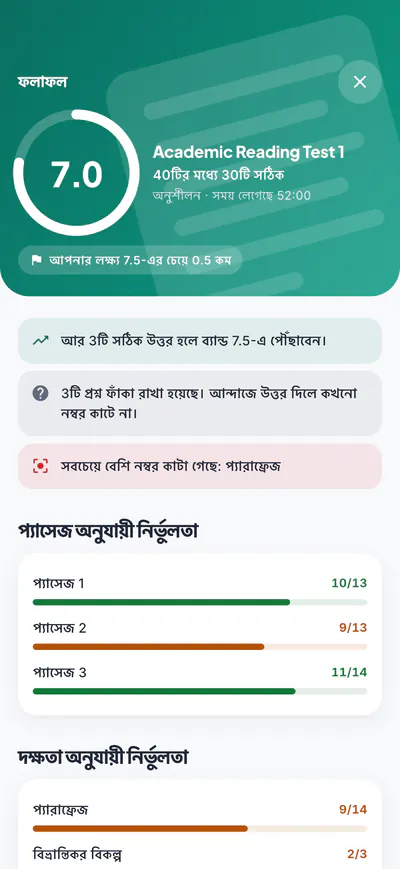
Fleydo: IELTS প্রস্তুতি অ্যাপে একটি IELTS প্র্যাকটিস টেস্টের ফলাফল: আনুমানিক ব্যান্ড ও প্রতিটি অংশের নির্ভুলতা
বিনামূল্যে ট্রায়াল ক্লাস

পরীক্ষার আগেই আপনার আসল IELTS ব্যান্ড জেনে নিন

একজন নেটিভ ইংরেজিভাষী শিক্ষকের সাথে বিনামূল্যে একটি ওয়ান-টু-ওয়ান অনলাইন ক্লাস, যিনি Band 8.5+ সার্টিফাইড IELTS বিশেষজ্ঞ। আপনি পাবেন আসল পরীক্ষার ফরম্যাটে Speaking ডায়াগনস্টিক, একটি সৎ ব্যান্ড অনুমান এবং ঠিক যে মানদণ্ডগুলোতে আপনার নম্বর কাটা যাচ্ছে সেগুলোর জন্য একটি পরিকল্পনা। কোনো পেমেন্ট নেই, কোনো বাধ্যবাধকতা নেই।

অনলাইন · ওয়ান-টু-ওয়ান · Academic ও General Training

IELTS হলো British Council, IDP: IELTS Australia এবং Cambridge University Press & Assessment-এর নিবন্ধিত ট্রেডমার্ক। এই প্র্যাকটিস টেস্টগুলো Fleydo-র নিজের লেখা; এগুলো ওই সংস্থাগুলোর অনুমোদিত বা সমর্থিত নয়।

মোবাইল অ্যাপ

Fleydo English School আপনার পকেটে

Fleydo-র শিক্ষার্থী ও অভিভাবকদের জন্য ক্লাস, হোমওয়ার্ক, মেসেজ ও গেম। iPhone ও Android-এ বিনামূল্যে।

App Store থেকে ডাউনলোড করুনএটি Google Play তে পান
অ্যাপ সম্পর্কে আরও জানুন
QR কোড, যা App Store বা Google Play-তে Fleydo English School অ্যাপ খোলেডাউনলোড করতে স্ক্যান করুনআপনার ফোনের জন্য সঠিক স্টোর খুলে দেয়।fleydo.com/app
Fleydo IELTS অ্যাপের আইকন
Fleydo: IELTS প্রস্তুতি

IELTS-এর প্রস্তুতি নিচ্ছেন?

Fleydo: IELTS প্রস্তুতি একটি আলাদা অ্যাপ, যেখানে চারটি দক্ষতারই মক টেস্ট আছে। এটি ব্যবহার করতে Fleydo অ্যাকাউন্ট লাগে না।

IELTS অ্যাপটি দেখুন
App Store থেকে ডাউনলোড করুনএটি Google Play তে পান
IELTS প্র্যাকটিস টেস্ট

IELTS-এর চারটি দক্ষতাই অনুশীলন করুন

তাৎক্ষণিক ব্যান্ড স্কোর, ব্যাখ্যাসহ উত্তর ও মডেল উত্তর নিয়ে 311টি টেস্ট। সাইন-আপ লাগে না।

সব প্র্যাকটিস টেস্ট
FleyPath

আপনার সন্তানের ব্যক্তিগত রোডম্যাপ — ৩, ৬ বা ১২ মাস

🚀শুরু
👋Hello
😊Body
🦁Animals
🔢Numbers
🏆আত্মবিশ্বাসী ইংরেজি
গেমিফায়েড ইংরেজি অনুশীলন

একটি গেমের মতো — কিন্তু তারা সত্যিই শিখছে