1. হোম
  2. IELTS
  3. প্র্যাকটিস টেস্ট
  4. Reading
  5. Reading Matching Headings অনুশীলন 3

IELTS Reading · শিরোনাম মেলানো

IELTS Reading Matching Headings অনুশীলন 3

The Beaufort scale

  • 7টি প্রশ্ন
  • 15 মিনিট
  • Academic

এই টেস্টে যা আছে

  1. Passageপ্রশ্ন 1–7Fixing a number to the wind

প্রশ্নের ধরন

  • শিরোনাম মেলানো
ReadingIELTS Reading Matching Headings অনুশীলন 3
বাকি সময়15:00

Passage

Fixing a number to the wind

A Naval logbooks of around 1800 described the wind in terms that sounded exact and were not. A "stiff breeze" or a "half gale" had no agreed meaning, so what one officer wrote down could not safely be set beside another's record. Francis Beaufort, an Irish-born Royal Navy commander, grew increasingly unhappy with this. He was a skilled surveyor who prized accurate measurement, and at 15 he had been shipwrecked because of a faulty chart.

B He did not start from nothing. On 13 January 1806, aboard HMS Woolwich, he entered in his private log a slightly amended version of a scale that the hydrographer Alexander Dalrymple had set out in a privately printed work of about 1789. Dalrymple's scale, intended for use at sea, had in turn followed one that the engineer John Smeaton designed for windmills. Numbered winds, in short, were not Beaufort's invention.

C What he added was a yardstick. Within a few years the numbers had been tied to the behaviour of a fully rigged warship. In the form the navy later adopted, light winds were defined by the speed she would reach in smooth water, stronger ones by how much sail she could still carry, and the strongest by how little she could bear, down to nothing at all. The wind's own velocity was not mentioned. In effect the ship was the measuring instrument, and Britain's Met Office calls the result the earliest "impact scale".

D Official recognition took far longer. For years the scale seems to have been Beaufort's alone. A magazine article urged its general use in 1832, by which time he was Hydrographer of the Navy, and HMS Beagle used it on her voyage of 1831-36 under Robert FitzRoy. Only on 28 December 1838, almost 33 years after that log entry, did a memorandum make it compulsory in the logbooks of every Royal Navy ship. British merchant vessels were first advised to adopt it in a manual of 1862, and a conference on marine meteorology in London recommended it for weather reports in 1874.

E By then the ship that defined it was on its way out. In 1880 steamers made up about two-fifths of the tonnage registered in Britain, and their crews had to judge the wind by other features of their surroundings. In 1927 a German captain, Peter Petersen, published a scale based on how the sea surface looks at each force. It was adopted internationally in 1947.

F Another gap was harder to close: turning estimated forces into measured speeds. Cup anemometers spread to coastal and inland stations after 1846, and between 1845 and 1894 more than 20 wind scales were published. By about 1913 two conversion tables were in general use, one compiled by W. Köppen and one by George Simpson for Britain's Meteorological Office. A compromise by Simpson was accepted in Vienna in 1926, then replaced in 1946 by the Meteorological Office's table. Even this did not end the matter. When anemometers were fitted to two Dutch light-vessels in 1950-51, the conversions that emerged differed markedly from the international table, and the instruments' presence eventually shook the observers' confidence in their own estimates.

G The scale now earns its keep mainly on the water. The Met Office gives wind force in its marine forecasts, issues gale warnings for force 8 and above, and lists for each force a probable wave height and a description of the sea, while cautioning that waves take time to build once the wind rises. A 1995 guide from the US National Weather Service noted that most ships had no anemometer, so observers usually judged force from the look of the sea. On land, its descriptions include smoke rising straight up at force 0 and whole trees in motion at force 7. An extension to force 17, made in 1946, is not widely used.

শব্দকোষ
hydrographer
a person who surveys seas and makes charts of them
fully rigged
of a sailing ship: carrying a complete set of masts and square sails
anemometers
instruments that measure wind speed
light-vessels
ships anchored in one place to serve as lighthouses
Passageপ্রশ্ন 1–7
প্রশ্ন 1–7

The text has seven paragraphs, A-G. Choose the correct heading for each paragraph from the list of headings below.

বিকল্প
  • iA debt to earlier scales
  • iiSpeeds a warship could reach
  • iiiVague words in ships' records
  • ivA long wait for formal acceptance
  • vWhy sailing ships disappeared
  • viA new point of reference as sail declines
  • viiMaking a vessel the standard of comparison
  • viiiThe struggle to link scale numbers with instrument readings
  • ixA shipwreck caused by a poor chart
  • xWhere the scale still has a job to do
  • xiSailors' distrust of new instruments
1Paragraph A
2Paragraph B
3Paragraph C
4Paragraph D
5Paragraph E
6Paragraph F
7Paragraph G

উত্তর ও ব্যাখ্যা

আগে টেস্টটি দিন: উত্তর দেওয়ার পরেই উত্তরমালা বেশি কাজে আসে।

উত্তরমালা ও ব্যাখ্যা দেখান
  1. 1
    iii

    Paragraph A explains the problem Beaufort faced: wind terms in logbooks meant different things to different officers. Heading ix fails because the wreck is one small fact about Beaufort, not the point of the paragraph.

  2. 2
    i

    Paragraph B traces Beaufort's scale back through Dalrymple's to Smeaton's windmill scale, so it stresses what he owed to others. Heading vii fails because his own idea of using a ship only appears in the next paragraph.

  3. 3
    vii

    Paragraph C shows each number tied to what one type of warship could do, so the ship became the measure. Heading ii fails because the ship's speed applies only to the light winds, the first of three groups.

  4. 4
    iv

    Paragraph D follows the slow path from a private log to compulsory use in 1838, then to merchant ships and weather reports. Heading x fails because these are nineteenth-century steps, not present-day uses.

  5. 5
    vi

    Paragraph E explains that a scale based on sailing ships did not suit steamships, and that a later scale was based on the sea instead. Heading v fails because the paragraph says steam spread but never explains why sail declined.

  6. 6
    viii

    Paragraph F covers rival conversion tables, a 1926 compromise and a later test that still disagreed. Heading xi is a reversal: the observers lost confidence in 'their own estimates', not in the anemometers.

  7. 7
    x

    Paragraph G shows how the scale serves people now: marine forecasts, gale warnings and descriptions of sea and land. Heading vi fails because judging force from the sea is only one present-day use, and sail is not mentioned here.

এই টেস্টের মূল শব্দ

Passage

surveyor
a person who measures and maps land or water
amended
changed slightly, usually to improve something
memorandum
a written message giving official instructions within an organisation
compromise
an agreement in which each side gives up part of what it wants
estimates
judgements of size or amount made without exact measurement
শিরোনাম মেলানো প্রশ্নের উত্তর কীভাবে দেবেনFind each paragraph's main idea and choose the heading that covers all of it.

What the task looks like

You get a list of headings and a set of paragraphs or sections. You choose the right heading for each one.

The task tests whether you can tell a paragraph's main topic from its supporting ideas. A heading states the main idea of the whole paragraph.

In our papers, there are at least two spare headings, each heading is used only once, and the headings are not listed in the order of the text. Sometimes one paragraph is done for you as an example.

A method to try

1. Read the list of headings once, so that you know the choices. If there is an example, take its heading off your list.

2. Read one paragraph to the end. Before you look at the list again, say its main idea in a few words of your own.

3. Compare your words with the list. Look for the heading that is closest in meaning.

4. Test your choice. Go through the paragraph sentence by sentence and ask: does this sentence belong under that heading?

5. If two headings seem possible, note both beside the paragraph and move on. A later match may rule one out.

6. When you are sure of a match, take that heading off your list.

The traps

The detail: a wrong heading may fit one sentence or one example very well. It is still only a supporting idea.

The borrowed word: a wrong heading may repeat a striking word from the paragraph. A shared word does not make a match.

The first sentence: it may link back to the paragraph before, or the paragraph may change direction after a word such as 'however'. That is why you read to the end.

Two similar headings: look at the job each one describes. 'Causes' and 'effects' can share a topic, and so can 'a problem' and 'a solution'. Which job is this paragraph doing?

Worked example

Text: The market square floods after heavy rain because the old drains are too narrow. Last autumn, stall owners lost stock for the third time, and one bakery stall moved away for good. The council has now agreed to replace the drains next summer.

Headings: i. Why one trader left the market ii. A repeated problem and a plan to fix it iii. The early history of the square iv. How much new drains will cost

Which heading fits this paragraph?

দুর্বলi. A bakery stall moved away, and that is the most striking thing in the paragraph.
আরও ভালোii. The first sentence gives the problem, the second shows it has happened again and again, and the third gives the plan. Every sentence fits.

Check the heading against every sentence. Heading i fits only part of one sentence, so it is a detail. Heading iv borrows 'drains', but the paragraph gives no cost.

Fleydo IELTS অ্যাপের আইকন Fleydo: IELTS প্রস্তুতি

এই টেস্টগুলো ফোনে সঙ্গে রাখুন

এই পেজগুলোর প্রতিটি টেস্ট iPhone, iPad ও Android-এর জন্য Fleydo: IELTS প্রস্তুতি অ্যাপেও আছে, সঙ্গে অডিওসহ 2,000টি IELTS শব্দ।

  • কোনো টেস্ট ফোনে নামানো হয়ে গেলে অফলাইনে চলে
  • অডিওসহ 2,000টি IELTS শব্দ, ক্রমশ বাড়তে থাকা বিরতিতে রিভিশন আর ছোট অনুশীলন
  • Speaking-এর উত্তর রেকর্ড করে আবার শুনুন
  • আপনার লক্ষ্য ব্যান্ড ও পরীক্ষার তারিখ ধরে প্রতিদিনের পরিকল্পনা
App Store থেকে ডাউনলোড করুনএটি Google Play তে পান
ডাউনলোড করতে স্ক্যান করুনআপনার ফোন অনুযায়ী App Store বা Google Play খোলে।

অ্যাকাউন্ট লাগে না। অ্যাপটি সম্পর্কে

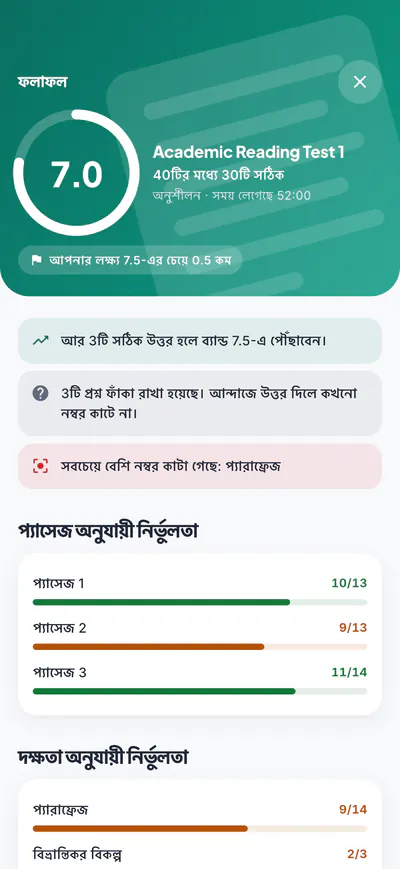
Fleydo: IELTS প্রস্তুতি অ্যাপে একটি IELTS প্র্যাকটিস টেস্টের ফলাফল: আনুমানিক ব্যান্ড ও প্রতিটি অংশের নির্ভুলতা
বিনামূল্যে ট্রায়াল ক্লাস

পরীক্ষার আগেই আপনার আসল IELTS ব্যান্ড জেনে নিন

একজন নেটিভ ইংরেজিভাষী শিক্ষকের সাথে বিনামূল্যে একটি ওয়ান-টু-ওয়ান অনলাইন ক্লাস, যিনি Band 8.5+ সার্টিফাইড IELTS বিশেষজ্ঞ। আপনি পাবেন আসল পরীক্ষার ফরম্যাটে Speaking ডায়াগনস্টিক, একটি সৎ ব্যান্ড অনুমান এবং ঠিক যে মানদণ্ডগুলোতে আপনার নম্বর কাটা যাচ্ছে সেগুলোর জন্য একটি পরিকল্পনা। কোনো পেমেন্ট নেই, কোনো বাধ্যবাধকতা নেই।

অনলাইন · ওয়ান-টু-ওয়ান · Academic ও General Training

IELTS হলো British Council, IDP: IELTS Australia এবং Cambridge University Press & Assessment-এর নিবন্ধিত ট্রেডমার্ক। এই প্র্যাকটিস টেস্টগুলো Fleydo-র নিজের লেখা; এগুলো ওই সংস্থাগুলোর অনুমোদিত বা সমর্থিত নয়।

মোবাইল অ্যাপ

Fleydo English School আপনার পকেটে

Fleydo-র শিক্ষার্থী ও অভিভাবকদের জন্য ক্লাস, হোমওয়ার্ক, মেসেজ ও গেম। iPhone ও Android-এ বিনামূল্যে।

App Store থেকে ডাউনলোড করুনএটি Google Play তে পান
অ্যাপ সম্পর্কে আরও জানুন
QR কোড, যা App Store বা Google Play-তে Fleydo English School অ্যাপ খোলেডাউনলোড করতে স্ক্যান করুনআপনার ফোনের জন্য সঠিক স্টোর খুলে দেয়।fleydo.com/app
Fleydo IELTS অ্যাপের আইকন
Fleydo: IELTS প্রস্তুতি

IELTS-এর প্রস্তুতি নিচ্ছেন?

Fleydo: IELTS প্রস্তুতি একটি আলাদা অ্যাপ, যেখানে চারটি দক্ষতারই মক টেস্ট আছে। এটি ব্যবহার করতে Fleydo অ্যাকাউন্ট লাগে না।

IELTS অ্যাপটি দেখুন
App Store থেকে ডাউনলোড করুনএটি Google Play তে পান
IELTS প্র্যাকটিস টেস্ট

IELTS-এর চারটি দক্ষতাই অনুশীলন করুন

তাৎক্ষণিক ব্যান্ড স্কোর, ব্যাখ্যাসহ উত্তর ও মডেল উত্তর নিয়ে 311টি টেস্ট। সাইন-আপ লাগে না।

সব প্র্যাকটিস টেস্ট
FleyPath

আপনার সন্তানের ব্যক্তিগত রোডম্যাপ — ৩, ৬ বা ১২ মাস

🚀শুরু
👋Hello
😊Body
🦁Animals
🔢Numbers
🏆আত্মবিশ্বাসী ইংরেজি
গেমিফায়েড ইংরেজি অনুশীলন

একটি গেমের মতো — কিন্তু তারা সত্যিই শিখছে