- হোম
- IELTS
- প্র্যাকটিস টেস্ট
- Listening
- Listening প্র্যাকটিস টেস্ট 19
IELTS Listening
IELTS Listening প্র্যাকটিস টেস্ট 19
Retirement dinner, a science festival, a local currency, pigeon navigation
- 40টি প্রশ্ন
- 30 মিনিট
- 4টি অংশ
- Listening
এই টেস্টে যা আছে
- অংশ 1প্রশ্ন 1–10You will hear a man phoning a riverside restaurant to arrange a retirement dinner for a colleague.
- অংশ 2প্রশ্ন 11–20You will hear an organiser introducing a family science festival and explaining where its events take place.
- অংশ 3প্রশ্ন 21–30You will hear two economics students discussing a case study of a town that introduced its own local currency.
- অংশ 4প্রশ্ন 31–40You will hear a lecture about how homing pigeons find their way home.
প্রশ্নের ধরন
বক্তা
আপনি শুনবেনYou will hear a man phoning a riverside restaurant to arrange a retirement dinner for a colleague.
Complete the form below. Write ONE WORD AND/OR A NUMBER for each answer.
Complete the table below. Write ONE WORD AND/OR A NUMBER for each answer.
| Extra | Details | Cost |
|---|---|---|
| Boat trip | 10 minutes; maximum of 7 on board | £6 per person |
| Cake | lemon sponge; 8 design on top | £9 (large) |
| Music | a college student on the 10 | £90 for the evening |
আপনি শুনবেনYou will hear an organiser introducing a family science festival and explaining where its events take place.
Choose the correct letter, A, B or C.
Label the map below. Write the correct letter, A-I, next to Questions 15-20.
আপনি শুনবেনYou will hear two economics students discussing a case study of a town that introduced its own local currency.
What do the students think about each of the following features of the Totnes pound scheme? Choose FIVE answers from the box and write the correct letter, A-G, next to Questions 21-25.
- AIt was mainly a way of attracting press coverage.
- BIt undermined the main aim of the scheme.
- CIt cost more than it was worth.
- DIt was necessary to win people's trust.
- EIt was done too hastily.
- FIt attracted too few participants.
- GIt showed good judgement.
Choose the correct letter, A, B or C.
আপনি শুনবেনYou will hear a lecture about how homing pigeons find their way home.
Complete the table below. Write ONE WORD ONLY for each answer.
| Cue | Role | Evidence |
|---|---|---|
| The sun | main compass | Birds with a six-hour clock shift: departure off course by a predictable 31 |
| The Earth's magnetic field | probable back-up compass | 1971 study (later disputed): magnets on experienced birds' 32 caused disorientation in overcast weather, but not in 33 |
| Iron-rich cells in the beak | proposed magnetic sensor | 2012 study: cells are in fact part of the 34 system |
| Smell | map | Smell-deprived birds lost when released in 35 areas |
Complete the notes below. Write ONE WORD ONLY for each answer.
উত্তর ও ব্যাখ্যা
আগে টেস্টটি দিন: উত্তর দেওয়ার পরেই উত্তরমালা বেশি কাজে আসে।
উত্তরমালা ও ব্যাখ্যা দেখান
- 1Lassiter
Alistair spells his surname: L-A-S-S-I-T-E-R, with a double S in the middle. The spelling must be exact to score.
- 228 / twenty-eight
Twenty-eight have "said they're definitely coming", which is the confirmed number. Thirty-five is only possible if the Bristol team come, and Alistair says to go with "the lower number for now".
- 3mushrooms / mushroom
Alistair says one colleague is "allergic to mushrooms", so the kitchen must keep them away from her food. The vegetarians are a separate point.
- 4Otter
The Kingfisher Room "only seats twenty-four", so it is too small for 28 guests. Alistair chooses the upstairs room: "Then the Otter Room it is."
- 57.15 / 7:15 / 7.15pm / 7:15pm / 7.15 pm / 7:15 pm / 7.15p.m. / 7:15p.m. / 7.15 p.m. / 7:15 p.m.
Jacinta suggests "a quarter past seven for drinks", and Alistair agrees. Eight o'clock is when dinner starts, not the drinks. Write the time as 7.15: "quarter past seven" is over the word limit.
- 6120 / £120
What Alistair pays is "a deposit of £120", which comes off the final bill. The room hire charge of £250 is mentioned after it, but it is waived for groups of twenty or more.
- 712 / twelve
The launch "carries twelve passengers each time", which is why they need three trips for 28 people.
- 8bicycle / bicycles
Alistair was going to ask for a sailing boat, but changes his mind: "the thing everyone connects with her is her bicycle". Jacinta confirms: "a bicycle it is."
- 952 / £52
The table asks for the large cake: it "serves forty and costs £52". The £38 cake is the small one, and it would not be big enough.
- 10harp
There is a piano, but the pianist only works on Saturdays. The dinner is on a Friday, when "a student from the music college who plays the harp" performs.
- 11C
The "biggest change" is the Saturday evening programme "aimed squarely at teenagers", which means older children. A third day is "not this year", and the festival is not moving: "We're staying right here in Larkholm Park."
- 12A
Finding future engineers is what the sponsors might say, "but honestly, that's not what drives us." The aim is "children getting their hands on things, trying out their own ideas". It is "not meant to feel like school", so B is wrong too.
- 13A
Entry is free, so there is nothing to pay, and online booking was dropped. Children need "a wristband" for the workshops, picked up "from the information tent when you arrive": a pass collected on arrival.
- 14B
Russell's "really important" advice is not to drive: there is no parking, but a free shuttle bus runs from the railway station. Food is optional, and there is "no need to be here the moment the gates open".
- 15H
Coming through the main gate, the information tent is on the right, and "on your left is the first building you'll come to": H, the robot workshop.
- 16E
Turn right at the bandstand. "Just past the bandstand, on your left" is the dome, E. The tent opposite it, G, is first aid.
- 17F
At the end of the path the playground is on the right. "Opposite the playground, right at the end of the path" is F.
- 18D
Going the other way from the bandstand, the museum is on the left. "Directly opposite the museum, on your right" is the long tent, D.
- 19A
Last year the launches were by the boat-hire hut, C, but "this year they've moved". Up the narrow path, "on the lawn on your left, near the water": A. The lawn on the right of the path, I, is on the wrong side.
- 20B
Meet the Scientists is in the old boathouse, "right at the top of the main path, on the edge of the lake": B.
- 21B
Spencer says the money is meant to keep moving round the town, so half the notes sitting in drawers are "working against the very thing it was set up for". Maeve then suggests the collectors were good publicity (A), but Spencer replies that the first notes "were meant to be spent", and she agrees.
- 22D
Spencer first thinks the security features were "a bit over the top" (C). Maeve explains that "Nobody takes a note they think might be fake", so the features were "essential": people had to trust the notes.
- 23A
Maeve calls the note "a waste of money" (C), but Spencer disagrees: it was never "meant to be practical" and was there "to get newspapers and radio stations interested in Totnes", which is press coverage. Maeve accepts this: "fair point".
- 24F
Spencer thinks the phone version was just for attention (A), but Maeve disagrees: "it never got enough people signed up", so it did not reach "critical mass". His next idea, that it came in too early (E), she rejects too: a town moving away from cash should have suited it.
- 25G
Maeve says they "were right to wind it up properly instead of letting it fade away". Spencer wonders if they "gave up too soon" (E), but Maeve points out that by 2019 far fewer people paid in cash, and he accepts this: "Fair enough." Closing it was a wise decision.
- 26B
Legally, local currencies have "much the same status as vouchers, like a book token": you are "paying in advance" for goods. Spencer thought they were "proper banknotes" (C), but only the Bank of England may issue banknotes, and Maeve also says they are not like money put away in an account (A).
- 27C
The exchange fee applies only in some schemes and is "just a few per cent", and businesses that have signed up "can normally change them back". The bigger risk is that a shop "may have to put its own prices up": it must charge customers more.
- 28A
Maeve says the 2013 figure is "a fair picture" (not B), and challenges Spencer's idea that it was a lot (not C): it is about fifty pence a person, so "it couldn't have made much difference to the town's economy as a whole".
- 29C
Hopkins says it failed as a currency for the whole town, but "he calls it a success as a community arts project". Spencer expected him to blame the council (A), but that is "not his view", and it "mattered well beyond Totnes" (not B).
- 30A
Spencer wanted to start with the numbers, but Maeve finds that "a bit dry". They choose the picture of the note from 1810: "Let's open with the old note". The question for the audience is kept "for the end".
- 31angle
Clock-shifted birds do not fly off at random. "They head off at an angle to the correct route", and the size of the angle "can be worked out in advance": it is predictable.
- 32backs / back
Keeton "glued small magnets to the backs of experienced pigeons". The lecturer stresses: "Not to their heads, as you might expect, but to their backs."
- 33sunshine
Under total cloud, many birds with magnets "became disoriented". But "released in bright sunshine", experienced birds wearing the same magnets "mostly oriented without trouble", because they could use the sun. The lecturer adds that a later analysis disputes the overcast result, but the question is about what the 1971 study reported.
- 34immune
The cells were hoped to be "part of the nervous system", but "They weren't part of the nervous system at all". They were macrophages, "a type of cell that belongs to the immune system".
- 35unfamiliar
Pigeons that could not smell were "unable to find their way home from unfamiliar places". Close to home, losing the sense of smell "makes little difference", so the table asks about unfamiliar areas.
- 36habitual
You might expect the bird to find "the most direct line home", but instead "each bird gradually settles on a habitual route" and keeps to it "even when it isn't the quickest".
- 37roads
Routes follow "long, straight features": "Birds will often fly along roads, for instance, or along the edges of fields." The notes call the field edges "field boundaries".
- 38intermediate
Routes are "learned best in landscapes of intermediate complexity". The lecturer then mentions "a highly complex landscape", but only to say it is not the easiest: a city may be "too complex".
- 39lead
Birds that "stick most faithfully to their own route" alone are "most likely to lead when pigeons fly together". It is the birds with less consistent routes that "tend to follow".
- 40confusion
Birds learned routes from three sites "in parallel", and "this caused them no added confusion". Each route seems to be stored separately.
পুরো ট্রান্সক্রিপ্ট দেখান
অংশ 1
Narrator Part 1. You will hear a man phoning a riverside restaurant to arrange a retirement dinner for a colleague. First, you have some time to look at questions 1 to 6.
Narrator Now listen carefully and answer questions 1 to 6.
Jacinta Good afternoon, the Mallowbrook Boathouse, Jacinta speaking.
Alistair Oh, hello. I'm hoping to book your private dining room for an evening in December. A colleague of mine is retiring after thirty-one years, and a few of us thought somewhere on the river would suit her perfectly.
Jacinta How lovely. Well, I look after all our private events, so you've come to the right person. Can I start with your name?
Alistair Of course. It's Alistair Lassiter. That's L-A-S-S-I-T-E-R.
Jacinta Thanks, Alistair. And which date did you have in mind?
Alistair Friday the fourth of December. It's her last day in the office, so it really has to be that evening.
Jacinta Let me have a look. Yes, the fourth is still free. And roughly how many guests are you expecting?
Alistair Well, so far twenty-eight people have said they're definitely coming. It could go up to thirty-five if the team from our Bristol office decide to make the trip, but they won't know until the end of the month. I'd go with the lower number for now.
Jacinta That's fine. You can change the numbers up to a week before, so there's no problem there. Does anyone in the group have any allergies we should know about?
Alistair There are a few vegetarians, and I'll email you their names. But the important one is a colleague who's allergic to mushrooms. It's quite serious, so the kitchen will need to keep them well away from her food.
Jacinta I'll put a note on the booking for the chef. Now, we have two private rooms. The Kingfisher Room is on the ground floor and opens onto the garden, which is gorgeous in summer, but it only seats twenty-four. So I'm afraid that one's too small for you.
Alistair Oh, that's a shame. What's the other one like?
Jacinta That's upstairs. It seats up to forty, and it has a balcony that hangs right out over the water. To be honest, most of our guests prefer it anyway.
Alistair Sorry, what's that one called?
Jacinta The Otter Room.
Alistair Then the Otter Room it is. She'll love the view.
Jacinta Now, timing. In December it's far too cold for the terrace, so we usually serve drinks downstairs in the bar first. Shall we say a quarter past seven for drinks, and then everyone sits down to eat at eight?
Alistair That works well. Most people will be coming straight from the office, so that gives them time to get across town.
Jacinta Perfect. Then there's the money side. We ask for a deposit of £120, just to hold the room, and that comes off your final bill. There'd normally be a room hire charge of £250 on top of that, but we waive it for groups of twenty or more, so you won't pay it.
Alistair That sounds very reasonable. I'll pay the deposit today, if I can.
Jacinta Of course. I'll send you a payment link when we've finished.
Narrator Before you hear the rest of the conversation, you have some time to look at questions 7 to 10.
Narrator Now listen and answer questions 7 to 10.
Alistair Now, I noticed on your website that you do boat trips. Would that be possible before the dinner?
Jacinta It would. Our launch, the Moorhen, does a ten-minute trip up to the old mill and back, and in the evening the lights along the river are really pretty. She carries twelve passengers each time, so with twenty-eight of you we'd run three trips while the others have their drinks.
Alistair Great. Is there a charge for that?
Jacinta It's £6 a head. You can just add it to the bill on the night.
Alistair Let's do it. The other thing is a cake. Do you make those?
Jacinta We do. Our pastry chef does a lovely lemon sponge, and she can put a decoration on top if you like.
Alistair Oh, good. I was going to ask for a sailing boat, because Bernadette's a keen sailor. But actually, the thing everyone connects with her is her bicycle. She's cycled into work every single day for thirty-one years, whatever the weather.
Jacinta Then a bicycle it is. Chef's done those before, and they always look great. As for the size, the large cake serves forty and costs £52. There's a smaller one for £38, but that only serves twenty, so it wouldn't go round.
Alistair The large one, then. And one last thing. Bernadette loves live music. Is there any chance of having someone play during the meal?
Jacinta There's a piano in the Otter Room, but I'm afraid our pianist only works on Saturdays. On Fridays we book a student from the music college who plays the harp. She's very talented, and it's quiet enough that people can still chat.
Alistair A harp! Bernadette will be thrilled. What does that cost?
Jacinta It's £90 for the whole evening.
Alistair Perfect. Please book her.
Jacinta Lovely. I'll email you a confirmation this afternoon, Alistair.
Alistair Thanks so much, Jacinta. Bye.
Narrator That is the end of Part 1. You now have half a minute to check your answers.
অংশ 2
Narrator Part 2. You will hear an organiser introducing a family science festival and explaining where its events take place. First, you have some time to look at questions 11 to 14.
Narrator Now listen carefully and answer questions 11 to 14.
Russell Hi, everyone, and thanks for coming out on a cold evening. My name's Russell, and I'm one of the volunteer organisers of the Larkholm Family Science Festival, which takes place on the second weekend in June. I'll start with a few general points, and then I'll walk you through the map, so you'll know where everything is on the day.
Russell So, what's new this year? The biggest change is on the Saturday, when we'll be staying open until nine at night with a programme aimed squarely at teenagers. There'll be a crime-scene lab, a disco powered by exercise bikes, that kind of thing. We'd noticed that kids over about thirteen felt the daytime events were a bit young for them, and this is our answer to that.
Russell A lot of people have asked whether we're adding a third day. Not this year, I'm afraid. It's still just the Saturday and the Sunday. And despite a rumour that's been going round online, we're not moving to the college sports ground. We're staying right here in Larkholm Park.
Russell Now, why do we do all this? Our main sponsors are engineering firms, and they'd probably tell you it's about finding the engineers of the future. We're very grateful to them, but honestly, that's not what drives us. What we care about is children getting their hands on things, trying out their own ideas and seeing what happens, even when it all goes wrong.
Russell And it's definitely not meant to feel like school. There are no worksheets, and nobody's going to quiz anyone on what they've learned.
Russell Next, tickets. Entry to the park is completely free, so there's nothing to pay at the gate. A few years ago we tried asking families to book online, but we found it put a lot of people off, so we dropped the idea.
Russell The one thing you will need is a wristband for every child who wants to join the indoor workshops. You pick those up from the information tent when you arrive, and they don't cost anything.
Russell Finally, a couple of practical points. You don't need to bring food, because there'll be plenty of stalls, though you're very welcome to bring a picnic if you'd like.
Russell The really important thing is please don't come by car. The car park on Quarry Road is being used for the food stalls this year, so there's nowhere to leave a car, but there's a free shuttle bus from the railway station every fifteen minutes.
Russell And there's no need to be here the moment the gates open at ten. Everything runs all day, so you won't miss out by arriving later.
Narrator Before you hear the rest of the talk, you have some time to look at questions 15 to 20.
Narrator Now listen and answer questions 15 to 20.
Russell OK, if you'd like to look at the map in your programme. We'll start at the main gate on Station Road, at the bottom of the map. As you come through the gate, the information tent is just on your right. And on your left is the first building you'll come to, the old stable block. That's where the robot workshop will be.
Russell Then walk straight up the main path until you reach the bandstand, where the two paths cross, and turn right there. Just past the bandstand, on your left, you'll see a big inflatable dome, and that's the planetarium. Please don't confuse it with the tent opposite, on the other side of the path. That one's first aid.
Russell If you keep going along that path, right to the end, you'll come to the playground, on your right. Opposite the playground, right at the end of the path, is the fossil dig. It's a big sandpit with replica dinosaur bones buried in it, and it's always the most popular thing at the festival.
Russell Now head back to the bandstand and go straight across, onto the path on the other side. You'll have the museum on your left. Directly opposite the museum, on your right, there's a long tent, and that's kitchen chemistry, where children can make things like slime and sherbet.
Russell Just after that tent, a narrow path goes off to the right, towards the lake. Last year the rocket launches were down by the boat-hire hut, further along the shore, but there were complaints about the noise, so this year they've moved. Follow the narrow path, and they'll be on the lawn on your left, near the water.
Russell And finally, Meet the Scientists, where you can ask real researchers anything you like, is in the old boathouse. You can't miss it. It's right at the top of the main path, on the edge of the lake.
Russell Right, that's the map. I'll be around afterwards if anyone has questions.
Narrator That is the end of Part 2. You now have half a minute to check your answers.
অংশ 3
Narrator Part 3. You will hear two economics students discussing a case study of a town that introduced its own local currency. First, you have some time to look at questions 21 to 25.
Narrator Now listen carefully and answer questions 21 to 25.
Maeve Right, Spencer, for the seminar we need to go through the main features of the Totnes case and say what we think of each. Shall we take them in order?
Spencer Sure. Totnes is a small town in Devon, and its pound ran for about twelve years, until 2019. Each Totnes pound was worth one pound sterling, backed by real pounds kept in a bank account.
Maeve First, the very first print run. There were only three hundred notes, and roughly half of them were never spent. People kept them as souvenirs, and some later sold for as much as £1,000.
Spencer That's a bit of a problem, isn't it? The money's supposed to keep moving round the town, from customer to shop to supplier. If half of it's sitting in drawers, it's working against the very thing it was set up for.
Maeve True. Although you could argue all those collectors were brilliant publicity for the town.
Spencer Maybe, but that's not what the first notes were for. They were meant to be spent.
Maeve Fair enough. Next, the security side. The later notes had watermarks, a hologram, special ink.
Spencer For notes worth a pound or five, that seemed a bit over the top to me. Think of the printing bill.
Maeve I thought so too, at first. But the Bank of England article points out that anything printed on paper that's worth more than it costs to print is a target for forgers. And if shopkeepers suspected fakes were going round, they'd refuse to take any of them.
Spencer So the whole thing would fall apart.
Maeve Exactly. Nobody takes a note they think might be fake. So I'd say those features were essential, not a luxury.
Spencer OK. Then there's the twenty-one pound note, from the relaunch in 2014. I love that one.
Maeve It's fun, but nobody needs a twenty-one pound note. They borrowed the idea from Lewes, another town with its own currency. A whole extra note for a joke seems a waste of money to me.
Spencer Is it a waste, though? I don't think it was ever meant to be practical. It was there to get people talking, and to get newspapers and radio stations interested in Totnes.
Maeve OK, fair point. What about going digital? Rob Hopkins, one of the founders, says they tried a mobile phone version, like the one in Bristol.
Spencer Wasn't that mostly about looking modern? Another way of getting attention?
Maeve I don't think so. The trouble was that it never got enough people signed up to make it worth using. Hopkins says it didn't reach critical mass.
Spencer Maybe they just brought it in too early, before people were used to paying by phone.
Maeve I doubt it. If anything, a phone version should have suited a town that was moving away from cash.
Spencer True. And last, the decision to close it in 2019.
Maeve Hopkins says they chose to bow out gracefully, and I think they were right to wind it up properly instead of letting it fade away.
Spencer Part of me thinks they gave up too soon. At one point more than a hundred and twenty businesses were taking it.
Maeve That was back in 2014, though. By 2019 far fewer people were paying in cash, and that's partly why fewer and fewer notes were changing hands.
Spencer Fair enough.
Narrator Before you hear the rest of the discussion, you have some time to look at questions 26 to 30.
Narrator Now listen and answer questions 26 to 30.
Spencer OK, the economics section. What did you make of the Bank of England article on the legal side?
Maeve That was the bit that surprised me. Legally, local currencies have much the same status as vouchers, like a book token. You're paying in advance for things from the shops in the scheme.
Spencer Really? I'd always assumed they were proper banknotes, just issued by the town.
Maeve Lots of people do. But only the Bank of England is allowed to issue banknotes in England and Wales. And it's not like money you've put away in an account either, even though there's sterling held behind it.
Spencer Then there's the risk for businesses. I'd assumed the big problem was the fee for changing the notes back into pounds.
Maeve That's only in some schemes, like Bristol and Stroud, and it's just a few per cent. The bigger risk is that a shop holding a lot of local currency gets pushed into buying from local suppliers, who may charge more. So the shop may have to put its own prices up, and then it's less competitive than shops outside the scheme.
Spencer But it can still swap the notes back if it really needs to?
Maeve Yes, businesses that have signed up can normally change them back. The problem is the cost of staying local.
Spencer Did you see the table of scheme sizes? Totnes had about £8,000 in circulation.
Maeve I did. The article's from 2013, roughly halfway through the scheme's life, so I think it's a fair picture.
Spencer My first reaction was that eight thousand sounded like quite a lot for a small town.
Maeve Is it, though? The table puts the population of the area at about fifteen thousand, so that's roughly fifty pence each. Even if every note changed hands several times a week, it couldn't have made much difference to the town's economy as a whole.
Spencer So how does Hopkins sum it up?
Maeve He's very honest. He says that if the aim was a currency the whole town used, it failed. But he calls it a success as a community arts project, one that got people asking what if.
Spencer So he doesn't blame anyone? I half expected him to say the council should have done more.
Maeve That's not his view, though. He puts it down to the decline of cash. And it mattered well beyond Totnes. Lewes, Brixton and Bristol all followed with pounds of their own.
Spencer Right. How should we open the presentation? I thought we'd go straight in with the numbers.
Maeve That's a bit dry for the first minute. What about starting with a picture of the original Totnes note from 1810? Hopkins saw one, and it helped give him the idea.
Spencer Oh, I like that. It shows the town had its own money two hundred years ago. Let's open with the old note, then.
Maeve And we could ask the audience whether they'd use a local currency themselves.
Spencer Let's keep that for the end, to start the discussion.
Narrator That is the end of Part 3. You now have half a minute to check your answers.
অংশ 4
Narrator Part 4. You will hear a lecture about how homing pigeons find their way home. First, you have some time to look at questions 31 to 40.
Narrator Now listen carefully and answer questions 31 to 40.
Dr Lockwood Good morning, everyone. Today we're looking at a classic puzzle in animal behaviour. Take a homing pigeon from its loft, drive it in a closed box to a place it has never seen, perhaps a hundred kilometres away, and let it go. Typically, it circles for a while, then sets off for home. So how does it know which way to go?
Dr Lockwood Biologists usually split this into two problems. Think of a walker with a map and a compass. The map tells you where you are in relation to home, and the compass tells you which direction is which. A pigeon needs both. I'll start with the compass, because that's the part we understand best.
Dr Lockwood The pigeon's main compass is the sun. But there's a complication: the sun moves across the sky during the day. So to use it for direction, a bird also has to know what time it is, and pigeons do, thanks to an internal clock.
Dr Lockwood That gives researchers a neat way to test the idea, called a clock-shift experiment. For several days, the birds are kept in a room where the lights come on and go off six hours later than the real sunrise and sunset, and their internal clock adjusts. Then they're released on a sunny day.
Dr Lockwood Now, you might expect birds with a confused clock to wander off in any direction at all. That isn't what happens. They make a consistent mistake. They head off at an angle to the correct route, and the size of that angle can be worked out in advance from the size of the shift.
Dr Lockwood So what happens when the sun is hidden? Pigeons still get home on cloudy days, so there must be a back-up. In 1971, an American biologist, William Keeton, published a study in which he glued small magnets to the backs of experienced pigeons. Not to their heads, as you might expect, but to their backs.
Dr Lockwood The idea was to interfere with any sense of the Earth's magnetic field. Under total cloud, many of the birds carrying magnets became disoriented. But released in bright sunshine, wearing exactly the same magnets, experienced birds mostly oriented without trouble.
Dr Lockwood The results suggested that pigeons have a magnetic sense they can fall back on when the sun isn't available. But Keeton's finding is disputed. In 1988, after Keeton's death, another researcher analysed thirty-five of his overcast experiments together, and found that overall the magnets made no significant difference. Even so, many researchers still think pigeons probably do have a magnetic compass.
Dr Lockwood Some went further, and suggested that the magnetic field might give pigeons a map as well. For a while there even seemed to be a sensor: clusters of iron-rich cells in the upper beak. The hope was that these were part of the nervous system, sending magnetic information to the brain.
Dr Lockwood Then, in 2012, researchers examined these cells closely. They weren't part of the nervous system at all. They turned out to be macrophages, a type of cell that belongs to the immune system. Their number and position also varied a lot from bird to bird, which doesn't fit a sense organ. More broadly, one leading researcher, writing in 2014, described the idea of a magnetic map as largely without support after decades of experiments.
Dr Lockwood So if not magnetism, what gives the pigeon its map? The leading answer is smell. In the early 1970s, a research team found that pigeons which couldn't smell were unable to find their way home from unfamiliar places. Close to home, by contrast, losing the sense of smell makes little difference.
Dr Lockwood The theory is that at the loft, pigeons learn which smells arrive on which winds. Later, wherever they're released, the mix of smells there tells them roughly which way they've been moved. And pigeons given air from the wrong place fly off in the wrong direction. Not everyone is convinced, though, and nobody yet knows which smells are involved.
Dr Lockwood That brings me to the second half of today's lecture: what happens on familiar ground. Here, the big change has been technology. Researchers can now fit pigeons with tiny GPS loggers, which record the bird's whole flight path, not just the point where it vanished from view.
Dr Lockwood One of the clearest findings comes from releasing the same bird again and again from the same site. You might expect it to work out the most direct line home. Instead, each bird gradually settles on a habitual route, and it keeps to that route even when it isn't the quickest. What's more, different birds learn quite different routes from the same place.
Dr Lockwood Looking at the tracks, many routes follow long, straight features in the landscape. Birds will often fly along roads, for instance, or along the edges of fields. My own guess is that lines like these are easy to pick out from the air.
Dr Lockwood Landscape matters too. Routes seem to be learned best in landscapes of intermediate complexity, which may surprise you. You might think a highly complex landscape, with lots to see, would be easiest to learn. But a city, for example, may simply be too complex.
Dr Lockwood There's also a link with flying in groups. Birds that stick most faithfully to their own route when they fly alone turn out to be the ones most likely to lead when pigeons fly together. Birds with less consistent routes tend to follow.
Dr Lockwood And finally, how much can a pigeon remember? In one study, birds learned routes from three different sites in parallel, and this caused them no added confusion. Each route seems to be stored separately.
Dr Lockwood So, to sum up: a sun compass, perhaps with a magnetic back-up, a map that probably depends on smell, and, close to home, a memory for the landscape itself. Next week, we'll turn to wild birds on migration.
Narrator That is the end of Part 4. You now have half a minute to check your answers.
Narrator That is the end of the Listening test.
এই টেস্টের মূল শব্দ
অংশ 1
- private dining room
- a separate room in a restaurant that a group can book for itself
- waive a charge
- decide not to make someone pay something they would normally pay
- deposit
- money paid in advance to keep a booking, taken off the final bill
- launch
- a small motor boat that carries passengers short distances
- it wouldn't go round
- there would not be enough for everyone
অংশ 2
- sponsor
- a company that pays towards an event, often in return for advertising
- aimed squarely at
- planned clearly and directly for a particular group
- wristband
- a band worn round the wrist to show that someone may enter or take part
- shuttle bus
- a bus that goes back and forth between two places
- inflatable
- filled with air to give it its shape
- replica
- an exact copy of something
অংশ 3
- back a currency
- keep real money or other assets to guarantee its value
- print run
- the number of copies printed at one time
- forger
- someone who makes illegal copies of money or documents
- critical mass
- the number of users needed for something to keep going by itself
- bow out gracefully
- stop doing something in a calm and dignified way
- in circulation
- being used and passed from person to person
অংশ 4
- loft
- the building where pigeons are kept and to which they return
- internal clock
- an animal's inner sense of the time of day
- disoriented
- confused about direction or position
- macrophage
- a kind of cell that swallows and destroys germs and damaged cells
- GPS logger
- a small device that records where something travels, using satellite signals
- in parallel
- at the same time, side by side
 Fleydo: IELTS প্রস্তুতি
এই টেস্টগুলো ফোনে সঙ্গে রাখুন
এই পেজগুলোর প্রতিটি টেস্ট iPhone, iPad ও Android-এর জন্য Fleydo: IELTS প্রস্তুতি অ্যাপেও আছে, সঙ্গে অডিওসহ 2,000টি IELTS শব্দ।
- কোনো টেস্ট ফোনে নামানো হয়ে গেলে অফলাইনে চলে
- অডিওসহ 2,000টি IELTS শব্দ, ক্রমশ বাড়তে থাকা বিরতিতে রিভিশন আর ছোট অনুশীলন
- Speaking-এর উত্তর রেকর্ড করে আবার শুনুন
- আপনার লক্ষ্য ব্যান্ড ও পরীক্ষার তারিখ ধরে প্রতিদিনের পরিকল্পনা


 ডাউনলোড করতে স্ক্যান করুনআপনার ফোন অনুযায়ী App Store বা Google Play খোলে।
অ্যাকাউন্ট লাগে না। অ্যাপটি সম্পর্কে
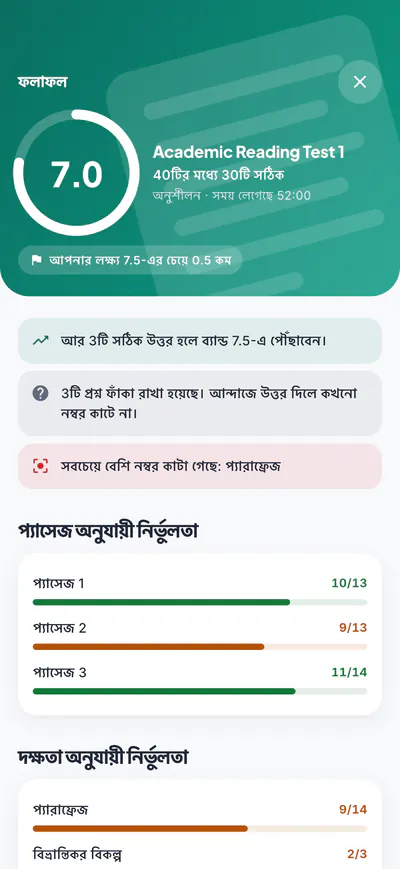
পরীক্ষার আগেই আপনার আসল IELTS ব্যান্ড জেনে নিন
একজন নেটিভ ইংরেজিভাষী শিক্ষকের সাথে বিনামূল্যে একটি ওয়ান-টু-ওয়ান অনলাইন ক্লাস, যিনি Band 8.5+ সার্টিফাইড IELTS বিশেষজ্ঞ। আপনি পাবেন আসল পরীক্ষার ফরম্যাটে Speaking ডায়াগনস্টিক, একটি সৎ ব্যান্ড অনুমান এবং ঠিক যে মানদণ্ডগুলোতে আপনার নম্বর কাটা যাচ্ছে সেগুলোর জন্য একটি পরিকল্পনা। কোনো পেমেন্ট নেই, কোনো বাধ্যবাধকতা নেই।
অনলাইন · ওয়ান-টু-ওয়ান · Academic ও General TrainingIELTS হলো British Council, IDP: IELTS Australia এবং Cambridge University Press & Assessment-এর নিবন্ধিত ট্রেডমার্ক। এই প্র্যাকটিস টেস্টগুলো Fleydo-র নিজের লেখা; এগুলো ওই সংস্থাগুলোর অনুমোদিত বা সমর্থিত নয়।

 ডাউনলোড করতে স্ক্যান করুন
