- হোম
- IELTS
- প্র্যাকটিস টেস্ট
- Listening
- Listening Diagram Labelling অনুশীলন 2
IELTS Listening · ডায়াগ্রামে লেবেল দেওয়া
IELTS Listening Diagram Labelling অনুশীলন 2
Inside a beehive
- 6টি প্রশ্ন
- 4 মিনিট
- Listening
এই টেস্টে যা আছে
- অংশ 1প্রশ্ন 1–6You will hear a beekeeper explaining the parts of a modern wooden beehive to a group of visitors.
প্রশ্নের ধরন
বক্তা
আপনি শুনবেনYou will hear a beekeeper explaining the parts of a modern wooden beehive to a group of visitors.
Label the diagram below. Choose SIX answers from the box and write the correct letter, A-H, next to Questions 1-6.
- Abrood box
- Bentrance reducer
- Cfeeder
- Dhoney super
- Einner cover
- Fmesh floor
- Gqueen excluder
- Hsolid floor
উত্তর ও ব্যাখ্যা
আগে টেস্টটি দিন: উত্তর দেওয়ার পরেই উত্তরমালা বেশি কাজে আসে।
উত্তরমালা ও ব্যাখ্যা দেখান
- 1F
Many hives have "a solid wooden floor" (H), but Grant has stopped using those: "The floor on all my hives is made of wire mesh." Gap 1 is the mesh floor.
- 2B
The strip of wood drawn beside the floor "slots into the gap to make the doorway smaller". It reduces the entrance, so it is the entrance reducer.
- 3A
Visitors guess the big box holds the honey, but "it's the brood box: the queen lays her eggs in here". The honey is stored higher up, in the honey super (D).
- 4G
Workers can squeeze through the slots in the thin sheet, "But the queen is bigger than the workers, so she can't get through." It keeps the queen out of the boxes above: a queen excluder.
- 5D
The shallower box above the grid is "where the bees store their spare honey, the honey we take": the honey super. A second deep box is only what other beekeepers use, not what the drawing shows.
- 6E
Gap 6 is "a thin wooden board that sits on the top box, just under the roof", which keeps the bees off the roof: the inner cover. Grant sometimes puts a feeder (C) there in autumn, but "there's no feeder in this drawing".
পুরো ট্রান্সক্রিপ্ট দেখান
অংশ 1
Narrator You will hear a beekeeper explaining the parts of a modern wooden beehive to a group of visitors. First, you have some time to look at questions 1 to 6.
Narrator Now listen carefully and answer questions 1 to 6.
Grant Morning, everyone, and welcome. I'm Grant, and I've kept bees for about fifteen years now. Before we put our bee suits on and open up a real hive, I want you to know what you're looking at. So have a look at the drawing I've handed out. It shows one of my own hives, taken apart, so you can see each piece separately.
Grant This type of hive is called a Langstroth hive. It's named after an American minister, Lorenzo Langstroth, who patented the design in 1852. The secret of his design was what beekeepers call the bee space. If you leave a gap of between about six and nine millimetres, the bees will simply walk through it.
Grant Make it any wider, and they'll fill it with comb. Any narrower, and they'll seal it up with propolis, a sort of sticky bee glue. Every part of the hive is built around that gap.
Grant Right, let's start at the bottom and work our way up. The whole hive stands on a wooden stand, which lifts it up off the ground. On top of the stand is the floor. Plenty of hives have a solid wooden floor, but I've stopped using those. The floor on all my hives is made of wire mesh.
Grant That does two jobs. It lets in fresh air in hot weather, and pests that drop off the bees, mites for example, fall straight through it and out of the hive.
Grant At the front of the floor, there's a gap where the bees come and go. You'll see a short strip of wood drawn just beside it. That slots into the gap to make the doorway smaller, which really helps a young or weak colony, because the guard bees have less space to defend. In the busy, hot months of the year, I take it out again.
Grant Next comes the big, deep box. Most visitors guess that this is where all the honey is kept. In fact, it's the brood box: the queen lays her eggs in here, and the young bees are raised here too. Inside it, and inside every box, there's a row of wooden frames hanging side by side, and that's where the bees build their wax comb.
Grant Above the brood box, there's a thin, flat sheet with lots of narrow slots in it, a bit like a grill. The slots are just wide enough for the worker bees to squeeze through. But the queen is bigger than the workers, so she can't get through. That way, she can't lay eggs in the boxes above.
Grant Now, the box above that is the one most of you came to hear about. It's where the bees store their spare honey, the honey we take. You'll notice it's quite a bit shallower than the brood box. Some beekeepers put a second deep box on top instead, but a deep box full of honey is far too heavy for my back.
Grant Then, right at the top, there's a thin wooden board that sits on the top box, just under the roof. It keeps the bees away from the roof itself. Without it, they'd glue the roof down with propolis, and you'd have a real struggle to get it off. In autumn, if the bees are short of food, I sometimes put a feeder in that spot, but there's no feeder in this drawing.
Grant And finally, on top of everything, there's the roof, which keeps out the rain and the sun. Right, any questions before we get our suits on?
Narrator That is the end of the recording. You now have half a minute to check your answers.
এই টেস্টের মূল শব্দ
অংশ 1
- patent
- to get the legal right to be the only person who can make or sell an invention
- comb
- the wax structure of six-sided cells that bees build
- colony
- a group of bees that live together in one hive
- slot
- a long, narrow opening
- squeeze through
- to get through a small space with difficulty
- short of food
- not having enough food
ডায়াগ্রামে লেবেল দেওয়া প্রশ্নের উত্তর কীভাবে দেবেনMatch a spoken description to a drawing, and name each part you hear.
What the task looks like
Labelling tasks ask you to complete labels on a visual, such as a diagram or a set of pictures. The instruction follows the usual pattern: 'Label the diagram below.'
In the official description, you choose the labels from a list. In this app's diagram sets, you type the word you hear, within a word limit, so spelling counts too.
The task tests whether you can relate a description to the drawing: what each part is, where it is and what it does.
A method to try
Before you listen: 1. Study the drawing. What is it, and which way does it work: top to bottom, or left to right? 2. Read the labels that are already there. They are your anchors. 3. A label names a part, so expect a noun. If there is a list, read it and think of other ways to say each item.
While you listen: 4. Follow the speaker across the drawing, part by part. 5. Listen for position words ('at the top', 'underneath', 'inside') and order words ('then', 'next', 'finally'). 6. For each gap, ask two questions: what is it next to, and what does it do?
The traps
Where it is, or what it is: in 'a valve at the base of the tank', 'base' tells you the position and 'valve' names the part.
The neighbour: the part next to your gap may be named in the same sentence.
Familiar words in a new use: 'arm', 'neck' or 'foot' may name parts of a machine.
Worked example
Recording: Speaker: Dirty water is poured in at the top, through a cloth bag that catches the mud. Below the bag there's a thick layer of sand, and under the sand, a thinner layer of charcoal, which removes smells. Clean water then drips out of a small tap.
Diagram: imagine a tall container, cut open. Under the bag is a thick layer, and under that a thin one. Label 1 points to the thin layer. Label 1: ____ (ONE WORD ONLY)
A position word points to a place, and the noun after it names the part. Check details such as 'thick' and 'thinner' against the drawing too.
 Fleydo: IELTS প্রস্তুতি
এই টেস্টগুলো ফোনে সঙ্গে রাখুন
এই পেজগুলোর প্রতিটি টেস্ট iPhone, iPad ও Android-এর জন্য Fleydo: IELTS প্রস্তুতি অ্যাপেও আছে, সঙ্গে অডিওসহ 2,000টি IELTS শব্দ।
- কোনো টেস্ট ফোনে নামানো হয়ে গেলে অফলাইনে চলে
- অডিওসহ 2,000টি IELTS শব্দ, ক্রমশ বাড়তে থাকা বিরতিতে রিভিশন আর ছোট অনুশীলন
- Speaking-এর উত্তর রেকর্ড করে আবার শুনুন
- আপনার লক্ষ্য ব্যান্ড ও পরীক্ষার তারিখ ধরে প্রতিদিনের পরিকল্পনা


 ডাউনলোড করতে স্ক্যান করুনআপনার ফোন অনুযায়ী App Store বা Google Play খোলে।
অ্যাকাউন্ট লাগে না। অ্যাপটি সম্পর্কে
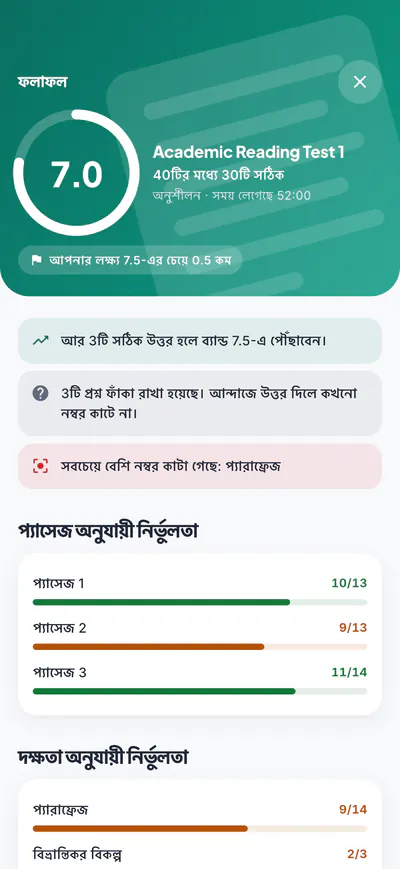
পরীক্ষার আগেই আপনার আসল IELTS ব্যান্ড জেনে নিন
একজন নেটিভ ইংরেজিভাষী শিক্ষকের সাথে বিনামূল্যে একটি ওয়ান-টু-ওয়ান অনলাইন ক্লাস, যিনি Band 8.5+ সার্টিফাইড IELTS বিশেষজ্ঞ। আপনি পাবেন আসল পরীক্ষার ফরম্যাটে Speaking ডায়াগনস্টিক, একটি সৎ ব্যান্ড অনুমান এবং ঠিক যে মানদণ্ডগুলোতে আপনার নম্বর কাটা যাচ্ছে সেগুলোর জন্য একটি পরিকল্পনা। কোনো পেমেন্ট নেই, কোনো বাধ্যবাধকতা নেই।
অনলাইন · ওয়ান-টু-ওয়ান · Academic ও General TrainingIELTS হলো British Council, IDP: IELTS Australia এবং Cambridge University Press & Assessment-এর নিবন্ধিত ট্রেডমার্ক। এই প্র্যাকটিস টেস্টগুলো Fleydo-র নিজের লেখা; এগুলো ওই সংস্থাগুলোর অনুমোদিত বা সমর্থিত নয়।

 ডাউনলোড করতে স্ক্যান করুন
