1. होम
  2. IELTS
  3. प्रैक्टिस टेस्ट
  4. Speaking
  5. Speaking प्रैक्टिस टेस्ट 7: Seasons

IELTS Speaking

IELTS Speaking प्रैक्टिस टेस्ट 7: Seasons

Describe an outdoor place you know that looks very different at different times of the year.

  • 3 भाग
  • 11–14 मिनट
  • परीक्षक
  • चार उम्मीदवार, एक टेस्ट

टेस्ट दें

परीक्षक के प्रश्न एक-एक करके चलते हैं। परीक्षा की तरह ज़ोर से उत्तर दें। रिकॉर्डिंग वैकल्पिक है और इसी ब्राउज़र टैब में रहती है।

आपकी रिकॉर्डिंग सिर्फ़ इसी टैब में रहती हैं। कुछ भी अपलोड नहीं होता। रखना चाहें तो उन्हें डाउनलोड कर लें।

अपने प्रदर्शन को अंक दें

अपने उत्तरों की तुलना उम्मीदवारों से करें, फिर हर मानदंड के लिए वह बैंड चुनें जो आप पर सही बैठता है।

6.0आपका अनुमानित बैंड
Fluency and coherence

Lexical resource

Grammatical range and accuracy

Pronunciation

हर उम्मीदवार एक अलग वक्ता है, इसलिए कहानियाँ और राय अलग-अलग हैं। बैंड सार्वजनिक डिस्क्रिप्टर के आधार पर हमारा अनुमान हैं, परीक्षक के आधिकारिक अंक नहीं। ट्रांसक्रिप्ट उच्चारण नहीं दिखा सकती। ये बैंड मानकर चलते हैं कि उच्चारण बाक़ी तीन मानदंडों के स्तर का ही है।

प्रश्न, क्यू कार्ड और नमूना उत्तर

Part 1: इंटरव्यू

Your home

  • Do you live in a house or a flat?
  • What can you see from the windows of your home?
  • What do you usually do when you get home in the evening?
  • Do you think you'll still be living there in five years' time?

Jewellery

  • Do you wear any jewellery?
  • Did anyone in your family wear a lot of jewellery when you were a child?
  • Have you ever been given a piece of jewellery as a present?
  • Do you prefer simple jewellery or something people will notice? (Why?)

The sky at night

  • Can you see many stars from where you live?
  • When did you last stop to look at the night sky?
  • Would you ever stay up late to watch something special in the sky, like a meteor shower?

सुझाव

  • The home questions are about where you live now, whatever it is: a shared flat, a student room or your parents' house. Say what it is and add one real detail, such as what you see from the window, rather than describing every room.
  • Jewellery includes small things: a ring, a watch, a pair of earrings. If you never wear any, say so and say why, or talk about someone in your family who does. A short, true answer with a reason is better than an invented one.
  • The night sky questions need no science. Talk about what you notice: how dark it gets where you live, the moon on the way home, a night when you saw a lot of stars. If a word in the question is new to you, ask to hear the question again. If it is still not clear, say what you think the word means and answer that, rather than stopping.

Part 2: लंबा उत्तर (क्यू कार्ड)

Describe an outdoor place you know that looks very different at different times of the year.

You should say:

  • where it is and how you know it
  • what it is like at two different times of the year
  • what people do there at those times

and explain when you would take a visitor there, and why.

अनुवर्ती प्रश्न

  • Do you usually go there alone or with other people?
  • Which season do you like least where you live?

एक मज़बूत उम्मीदवार ऐसे नोट्स बना सकता है

  • riverbank, 15 min from flat
  • walked to school along it
  • March: high water, brown, fast
  • August: low, sandbanks, families
  • fishing, swimming, barbecues
  • visitor? late September
  • still warm, no crowds

सुझाव

  • Not everywhere has four clear seasons. A wet and a dry season, the holiday months and the rest of the year, or a festival that takes over a place for a week all count as different times of the year.
  • Pick two times of year and make them really different: what you see, what you hear, who is there and what they are doing. Going through all four seasons one by one usually turns into a list of weather.
  • The explain line asks you to choose. Say when you would take a visitor and why, and what they would miss at the other time. It is fine to say that the obvious choice is not the one you would make.

Part 3: चर्चा

Green space in towns and cities

  • Why do you think parks matter so much to people who live in cities? समझाना
  • Do children today spend more or less time in parks and green spaces than children did in the past? तुलना करना
  • What could be done to make parks pleasant to use at every time of year? सुझाव देना

Seasons and the way people live

  • In what ways do people's habits change from one season to another? समझाना
  • Is it a good thing that people can now buy most fruit and vegetables at any time of year? फ़ायदे-नुकसान तौलना
  • Do you think seasonal traditions, such as festivals or special foods, will matter less to people in the future? भविष्य के बारे में अनुमान लगाना

सुझाव

  • For the question about making parks pleasant all year, start from your own climate and be concrete. Shade, lighting, paths, shelter from rain or opening hours say much more than 'the government should improve parks'.
  • When you are asked whether something is a good thing, look at who gains, who loses and what might be lost, then say where you stand. 'It's good' with one reason runs out quickly.
  • For the question about the future, link your guess to something you can already see happening, and use might, could or I'd expect rather than will for everything.

चार उम्मीदवार, एक टेस्ट

चार अलग-अलग बैंड के वक्ताओं ने हर प्रश्न का उत्तर कैसे दिया।

Part 1Do you live in a house or a flat?

A house. We have a villa in the north of Riyadh, er, two floors, and I live there with my family, my parents, my three brothers and my sister.

Part 1What can you see from the windows of your home?

Not much, er... from my room I see only the wall of our neighbour and a little bit of the street. Here every house have a high wall around it, so you can't see far.

Part 1What do you usually do when you get home in the evening?

I take a shower first, because outside is very hot. Then I eat with my family, and after I go to my room, er, I share it with my small brother, so we play PlayStation, or I study a little.

Part 1Do you think you'll still be living there in five years' time?

I think yes. Usually here the young man stays in the family house until he gets married, and, er, I'm not in a hurry for this. Maybe when I find a good job, I will think about it.

Part 1Do you wear any jewellery?

Not really. Only a watch, er, every day. Men here... we don't wear a lot, it's more for the women.

Part 1Did anyone in your family wear a lot of jewellery when you were a child?

Yes, my mother and my aunts. In weddings they wear a lot of gold, necklace, bracelets, and the, er, the rings for the ear. When I was small I think it's very heavy, how they can dance with this?

Part 1Have you ever been given a piece of jewellery as a present?

Yes, one time. When I finished the high school, my father gave me a silver ring, er, with a black stone. I don't wear it every day, I'm afraid to lose it.

Part 1Do you prefer simple jewellery or something people will notice? (Why?)

Simple, I think. Big things, gold chain, er, it's not my style. People look at you and they... they think you want to show your money.

Part 1Can you see many stars from where you live?

No, not really. In Riyadh there is a lot of lights, and also the dust, er, so at night the sky is not black, it's like... grey. Maybe you see two, three stars, that's it.

Part 1When did you last stop to look at the night sky?

Er... last week, I think. I was waiting my friend in the car outside his house, and I look up and I saw the moon, very big and, um, yellow. It was nice.

Part 1Would you ever stay up late to watch something special in the sky, like a meteor shower?

Yes, maybe, if my friends go also. But for this you have to drive far, to the desert, because in the city you don't see it. We can make camping there, er, it will be nice.

Part 2Describe an outdoor place you know that looks very different at different times of the year.

OK, so... the place is in the desert, about one hour from Riyadh, to the north. I know it from when I was a child, because every winter my family goes there for camping, we put the tents and stay maybe two or three days. In winter it's very nice. In the night it's cold, you need a jacket, and if there is rain, er, the sand become a little bit green, small grass and small flowers, yellow and white. Many families come, you see tents everywhere, and the young men they drive the, um... the small motorbike with four wheels, on the sand hills. We sit around the fire, drinking tea and talking until late. But in summer, er, it's completely different. Nobody goes there. It's very, very hot, the sand is burning, you can't walk on it. Everything is brown, no green, nothing. Only, er, some camels maybe. So if a visitor come to Riyadh, I will take him in winter, for example in January, after the rain. Because in winter the desert is... is alive, there is people, there is green. In summer it's just empty. So yes, winter is the best, for sure, because in summer it's too hot and nobody is there.

Part 2Do you usually go there alone or with other people?

With my family, always. Alone, no, er, it's dangerous a little, you can lose the way.

Part 2Which season do you like least where you live?

The summer, of course. It's too hot, you stay inside all day and go out only in the night.

Part 3Why do you think parks matter so much to people who live in cities?

Er, because in the city everything is buildings and cars and, er, noise. People need a place to relax, to walk a little. And for example the children, they need a place to run. In the apartment they cannot run, the neighbours will be angry.

Part 3Do children today spend more or less time in parks and green spaces than children did in the past?

Less, I think. Now the children, for example my small brother, he is all the time with the PlayStation or with the phone. When I was small we played outside more, in the street, er, near the house. But now there is too much cars, it's dangerous, so the parents keep the children inside. It's not healthy for them.

Part 3What could be done to make parks pleasant to use at every time of year?

Hmm. Here the big problem is the sun. So, er, more trees, and maybe they can put a... a roof, like a big umbrella, over the playground for the children. And the small machine that – that spray water on the people, er, it's very nice in summer. And more lights, because people go to the park in the night, not in the day.

Part 3In what ways do people's habits change from one season to another?

In Riyadh the summer and the winter is very different. In summer, er, people sleep late and wake up late, and they go out only in the night, because in the day it's too hot. They go to the mall, everything inside. In winter people go outside more, camping, or sitting in the gardens. So the life change a lot, um, with the weather.

Part 3Is it a good thing that people can now buy most fruit and vegetables at any time of year?

I think it's good. If you want watermelon in winter, you can buy it, er, no problem. But sometimes the taste is not the same, it's not sweet, because it come from far, from other country, I don't know. Old people say the fruit before was more... more delicious. But for me it's OK, it's good to have the choice.

Part 3Do you think seasonal traditions, such as festivals or special foods, will matter less to people in the future?

Er... maybe a little bit less. The young people now, they are busy, they have the phone, the games. But I think some traditions will stay, for example the camping in winter, everybody love it, old and young. Maybe the way will change, now some people take big tents with electricity, TV, everything, er, not like before. But it's in our... how to say... in our culture, so I don't think it will finish.

इस टेस्ट के शब्द

come to life
become busy and full of activity, as in 'the square comes to life in August'
deserted
completely empty of people
bare
(of trees) without leaves
in blossom
(of fruit trees) covered in flowers
humid
(of the air or weather) wet and heavy, so you feel hot and sticky
unbearable
too hot, cold or unpleasant to put up with
the off-season
the quiet part of the year when few visitors come
light pollution
artificial light that makes the night sky too bright to see the stars
green space
an area of grass, trees or plants in a town
in season
(of fruit and vegetables) growing naturally at this time of year
stay in
spend the day or evening at home instead of going out
make the most of something
use a good time or situation as fully as you can

उपयोगी वाक्यांश

  • Most of the year it's ___, but in ___ it turns into ___.
  • You'd hardly recognise it in ___, because ___.
  • The best time to see it is ___, when ___.
  • If someone came to visit, I'd take them in ___, mainly because ___.
  • What I notice most in ___ is ___.
  • Where I live, people tend to ___ in summer and ___ in winter.
  • There's something nice about ___, even though ___.
  • I can see the point of ___, but ___.
  • I'd expect ___ to ___, at least in ___.

Fleydo IELTS ऐप का आइकन Fleydo: IELTS की तैयारी

ये टेस्ट अपने फ़ोन पर साथ ले जाएँ

इन पेजों का हर टेस्ट iPhone, iPad और Android के लिए Fleydo: IELTS की तैयारी ऐप में भी है, साथ में ऑडियो वाले 2,000 IELTS शब्द।

  • कोई टेस्ट फ़ोन पर आ जाने के बाद ऑफ़लाइन चलता है
  • ऑडियो वाले 2,000 IELTS शब्द, बढ़ते अंतराल पर दोहराव और छोटे अभ्यास
  • अपने Speaking उत्तर रिकॉर्ड करें और फिर से सुनें
  • आपके लक्ष्य बैंड और परीक्षा की तारीख़ के हिसाब से रोज़ की योजना
App Store से डाउनलोड करेंइसे Google Play पर पाएं
डाउनलोड करने के लिए स्कैन करेंआपके फ़ोन के अनुसार App Store या Google Play खोलता है।

अकाउंट की ज़रूरत नहीं। ऐप के बारे में

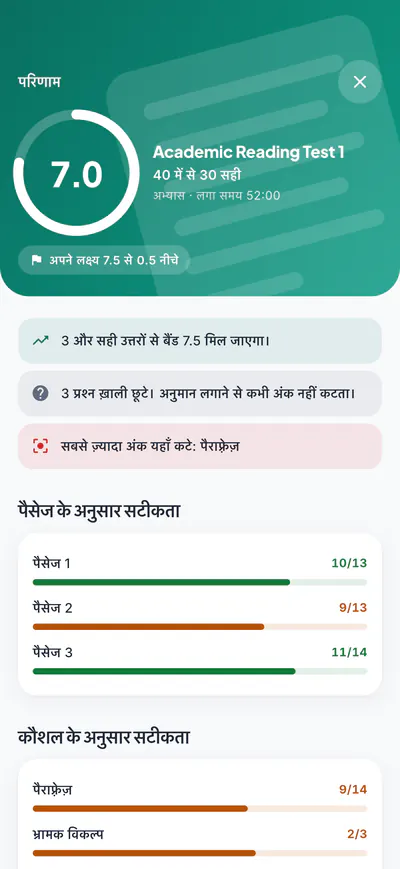
Fleydo: IELTS की तैयारी ऐप में IELTS प्रैक्टिस टेस्ट का परिणाम: अनुमानित बैंड और हर भाग की सटीकता
मुफ़्त ट्रायल लेसन

परीक्षा से पहले अपना असली IELTS बैंड जानें

एक मूल अंग्रेज़ी-भाषी शिक्षक के साथ मुफ़्त वन-टू-वन ऑनलाइन लेसन, जो Band 8.5+ प्रमाणित IELTS विशेषज्ञ हैं। आपको असली परीक्षा फ़ॉर्मैट में Speaking डायग्नोस्टिक, ईमानदार बैंड अनुमान और ठीक उन मानदंडों के लिए योजना मिलती है जो आपके अंक काट रहे हैं। कोई भुगतान नहीं, कोई प्रतिबद्धता नहीं।

ऑनलाइन · वन-टू-वन · Academic और General Training

IELTS, British Council, IDP: IELTS Australia और Cambridge University Press & Assessment का पंजीकृत ट्रेडमार्क है। ये प्रैक्टिस टेस्ट Fleydo ने तैयार किए हैं; इन संस्थाओं ने न तो इन्हें अनुमोदित किया है और न ही इनका समर्थन किया है।

मोबाइल ऐप

Fleydo English School आपकी जेब में

Fleydo के छात्रों और पैरेंट्स के लिए लेसन, होमवर्क, मैसेज और गेम्स। iPhone और Android पर मुफ़्त।

App Store से डाउनलोड करेंइसे Google Play पर पाएं
ऐप के बारे में और जानें
QR कोड जो App Store या Google Play में Fleydo English School ऐप खोलता हैडाउनलोड करने के लिए स्कैन करेंआपके फ़ोन के लिए सही स्टोर खोलता है।fleydo.com/app
Fleydo IELTS ऐप का आइकन
Fleydo: IELTS की तैयारी

IELTS की तैयारी कर रहे हैं?

Fleydo: IELTS की तैयारी एक अलग ऐप है, जिसमें चारों कौशल के मॉक टेस्ट हैं। इसे इस्तेमाल करने के लिए Fleydo अकाउंट की ज़रूरत नहीं है।

IELTS ऐप देखें
App Store से डाउनलोड करेंइसे Google Play पर पाएं
IELTS प्रैक्टिस टेस्ट

IELTS के चारों कौशलों का अभ्यास करें

तुरंत बैंड स्कोर, व्याख्या सहित उत्तरों और मॉडल उत्तरों के साथ 311 टेस्ट। साइन-अप की ज़रूरत नहीं।

सभी प्रैक्टिस टेस्ट
FleyPath

आपके बच्चे का व्यक्तिगत रोडमैप — 3, 6 या 12 महीने

🚀शुरुआत
👋Hello
😊Body
🦁Animals
🔢Numbers
🏆आत्मविश्वासी अंग्रेज़ी
गेमिफाइड अंग्रेज़ी अभ्यास

गेम जैसा — बस फ़र्क इतना कि वे सच में सीख रहे हैं