1. होम
  2. IELTS
  3. प्रैक्टिस टेस्ट
  4. Speaking
  5. Speaking प्रैक्टिस टेस्ट 23: Places then and now

IELTS Speaking

IELTS Speaking प्रैक्टिस टेस्ट 23: Places then and now

Describe an old photograph you have seen of a place you know.

  • 3 भाग
  • 11–14 मिनट
  • परीक्षक
  • चार उम्मीदवार, एक टेस्ट

टेस्ट दें

परीक्षक के प्रश्न एक-एक करके चलते हैं। परीक्षा की तरह ज़ोर से उत्तर दें। रिकॉर्डिंग वैकल्पिक है और इसी ब्राउज़र टैब में रहती है।

आपकी रिकॉर्डिंग सिर्फ़ इसी टैब में रहती हैं। कुछ भी अपलोड नहीं होता। रखना चाहें तो उन्हें डाउनलोड कर लें।

अपने प्रदर्शन को अंक दें

अपने उत्तरों की तुलना उम्मीदवारों से करें, फिर हर मानदंड के लिए वह बैंड चुनें जो आप पर सही बैठता है।

6.0आपका अनुमानित बैंड
Fluency and coherence

Lexical resource

Grammatical range and accuracy

Pronunciation

हर उम्मीदवार एक अलग वक्ता है, इसलिए कहानियाँ और राय अलग-अलग हैं। बैंड सार्वजनिक डिस्क्रिप्टर के आधार पर हमारा अनुमान हैं, परीक्षक के आधिकारिक अंक नहीं। ट्रांसक्रिप्ट उच्चारण नहीं दिखा सकती। ये बैंड मानकर चलते हैं कि उच्चारण बाक़ी तीन मानदंडों के स्तर का ही है।

प्रश्न, क्यू कार्ड और नमूना उत्तर

Part 1: इंटरव्यू

Work or studies

  • Do you work or are you a student?
  • Do you do most of it in one place, or do you move around?
  • Has it turned out the way you expected?
  • If you could change one thing about your typical day, what would it be?

Ice cream

  • How often do you eat ice cream?
  • What flavours do you usually choose?
  • Did you eat a lot of ice cream when you were a child?
  • After a meal, would you rather have ice cream or a hot dessert? (Why?)

Jokes

  • Do you enjoy telling jokes, or do you prefer listening to them?
  • When you were at school, was there someone in your class who was always making jokes?
  • Do you find it easy to understand jokes in English?

सुझाव

  • Ice cream and jokes are light topics, and a short, relaxed answer is fine. Add one real detail, such as a flavour, a place or a person, instead of a general statement like 'everybody loves ice cream'.
  • Three questions look back: how what you do has turned out, ice cream when you were a child, and the joker in your class. Use past forms, and 'used to' or 'would' for habits, then come back to the present if it helps.
  • If you find jokes in English hard to follow, say so and give the reason, such as wordplay or fast speech. An honest answer is easier to develop than pretending to find everything easy.

Part 2: लंबा उत्तर (क्यू कार्ड)

Describe an old photograph you have seen of a place you know.

You should say:

  • where you saw the photograph and roughly when it was taken
  • what the place looked like in it
  • what is different there now

and explain what the photograph tells you about everyday life at that time.

अनुवर्ती प्रश्न

  • Did anyone else find the photograph as interesting as you did?
  • Do you take photos of places, or mostly of people?

एक मज़बूत उम्मीदवार ऐसे नोट्स बना सकता है

  • postcard, flea market, 1960s?
  • station square, trams, newspaper kiosk
  • men in hats, hardly any cars
  • now: taxis, glass front, coffee chain
  • kiosk gone, tram lines covered
  • life: travel = an occasion
  • dressed up, waited together, slower

सुझाव

  • The photograph does not have to be your own. A picture on the wall of a café or restaurant, a postcard, a photo in a local book, or one a relative shared online all count, as long as you know the place it shows.
  • Split your time. Describe the photograph briefly, then move to the place as it is now, using contrasts such as 'where there used to be ___, there's now ___'. Many candidates spend the whole talk on the photo and never reach the change or the explain line.
  • The explain line asks you to read the photograph for clues: what people are wearing, how they travel, what they are buying or doing. Guess with 'it looks as if', 'they must have' and 'I suppose', and say what those clues tell you about an ordinary day.

Part 3: चर्चा

Recording memories

  • Why do people take photos of so many ordinary things these days, such as their meals? समझाना
  • Do printed photos mean more to people than the ones they keep on their phones? तुलना करना
  • Do you think people fifty years from now will still be able to look at the photos and videos we take today? भविष्य के बारे में अनुमान लगाना

Museums and everyday life

  • Should museums show more about the lives of ordinary people, and less about famous people and events? राय देना
  • How good are museums at making the past interesting for young people? फ़ायदे-नुकसान तौलना
  • If your town opened a museum of everyday life, what do you think it should include? सुझाव देना

सुझाव

  • The first three questions are about people in general. You can start from your own phone or a family album, but then widen it to people your age or people in your country.
  • The question about the future has no right answer. Choose a likely outcome and give a reason, with 'I'd guess', 'there's a good chance' or 'I doubt'. You do not need any technical knowledge about storage or the internet.
  • For the museum questions, use any museum you have been to, even on one school trip. If you never go to museums, say why: that is part of an answer about young people too.

चार उम्मीदवार, एक टेस्ट

चार अलग-अलग बैंड के वक्ताओं ने हर प्रश्न का उत्तर कैसे दिया।

Part 1Do you work or are you a student?

I work. I'm a salesman in a tile shop in Dongguan, er, we sell tiles for the floor, the bathroom, the kitchen. It's my uncle's shop, I work there about three years.

Part 1Do you do most of it in one place, or do you move around?

In the shop, mostly. But sometimes I go to the customer's home, to, er, to measure the floor, how big it is. So maybe two days a week I'm outside, driving.

Part 1Has it turned out the way you expected?

Er... not really. Before I start, I think selling is easy, just talk. But customers compare everything, the price, the colour, and they come back three, four times before they buy. So it's more tiring than I expect.

Part 1If you could change one thing about your typical day, what would it be?

Lunch time. Now we only have half an hour, and if a customer comes in, I have to stop eating and go. I want one hour. And, um... finish early on Saturday, because my friends all are free that day.

Part 1How often do you eat ice cream?

Not so often. In summer maybe once a week. Er, in winter almost never, I prefer to drink something hot.

Part 1What flavours do you usually choose?

Mango, always mango. Green tea flavour also is OK. Chocolate is too sweet for me, after two or three... spoon I don't want any more.

Part 1Did you eat a lot of ice cream when you were a child?

Yes, a lot. Every summer holiday I stayed with my grandmother, and in her fridge always have ice cream, er, on a stick. Me and my cousin, we eat two each day.

Part 1After a meal, would you rather have ice cream or a hot dessert? (Why?)

Ice cream. Here is hot for many months, so after dinner I want something cold. Hot dessert, er, my mother make sometimes, it's OK, but ice cream is better.

Part 1Do you enjoy telling jokes, or do you prefer listening to them?

Listening. When I tell a joke, er, I always forget the end, the – the funny part, so nobody laugh. My cousin is very good, he can make everybody laugh in one minute.

Part 1When you were at school, was there someone in your class who was always making jokes?

Yes, a boy who sit behind me. When the teacher was writing on the board, he made a, er, small noise, like a cat, and everybody laughing. She never found out who did it.

Part 1Do you find it easy to understand jokes in English?

No, very difficult. Sometimes I watch an American comedy show, and the audience laugh, but I don't know why. Maybe it's about, er, some famous person there, I don't know him.

Part 2Describe an old photograph you have seen of a place you know.

Er, every Sunday morning my family go to an old tea restaurant near our home, for dim sum. And on the wall, next to the, er... the desk where you pay, I don't know the name, there is a big black and white photo of the same street. I think it's from – the owner told my father the restaurant is open since nineteen eighty-something, so maybe that time. In the photo the street is very narrow, and the houses are low, only two or three floor. Everybody ride bicycle, I count maybe twenty bicycle and, er, no car, only one small truck. Some people are selling vegetables by the road. Now it's totally different. The road is very wide, six lanes, and there is a metro station, big buildings, a shopping mall... If you – if you never see this photo, you cannot believe it's the same place. Er, what it tells about the life... I think before, people live more slowly. They buy vegetables every day, fresh, from the street, not from supermarket. And neighbours know each other, they stop and – and talk. Now everybody is busy, um... looking at the phone. So I think the life before is more simple. Simple, but... not so convenient. Er... only the restaurant is still there.

Part 2Did anyone else find the photograph as interesting as you did?

My father, yes. He grow up near there, so he show me where is his school before.

Part 2Do you take photos of places, or mostly of people?

Mostly food, er, and my friends. Places not so much.

Part 3Why do people take photos of so many ordinary things these days, such as their meals?

Er, I think because the phone is always in the hand, it's very easy. And the young people, they like to post on WeChat, er, Moments, to show the friends, look, I eat this, I go there. I also do it sometimes, for nice dessert. But my father never do this, he just eat.

Part 3Do printed photos mean more to people than the ones they keep on their phones?

Er... for my parents, yes. For me, no, I like the phone more. All my photos are with me, I can look on the bus, or in the shop when no customer. At home we have a box of old photos, er, nobody open it, never. My mother keep only one, my baby photo, in her wallet, and she show everybody... for twenty years.

Part 3Do you think people fifty years from now will still be able to look at the photos and videos we take today?

I think yes. Because now everything is save in the internet, er, the cloud, so it's not lost. Paper photo, after many years, the colour become yellow, not clear. But... maybe the company close? Then the photos... I don't know. But I think mostly yes, they can see.

Part 3Should museums show more about the lives of ordinary people, and less about famous people and events?

Er... both are important. Famous people is history, the students need to learn it. But for me ordinary people is more interesting. Like what they wear, what the children play... because my grandparents, when they – er, it's like their life, so I can imagine it. If the museum only show the emperor and big events, I feel it's far from me. So maybe a little bit more ordinary, yes.

Part 3How good are museums at making the past interesting for young people?

Not very good, I think. Many museum is boring for young people, just old things, very quiet, er, and a lot of words to read. When I was in middle school, the school take us to – we went to a museum, and, er, everybody just play the phone and wait to go home.

Part 3If your town opened a museum of everyday life, what do you think it should include?

Er... maybe old things from before. Like the old bicycle, the radio, the old money, er, the coins. And the photos of the streets, like the photo I talk before. And maybe the snacks from before, er, the children can try it, they will like. I think it's... it will be popular, more than the normal museum.

इस टेस्ट के शब्द

faded
having lost its colour or brightness over time, as old photos often do
black-and-white
without colour, as many older photos are
in the background
at the back of a picture, behind the main thing you see
unrecognisable
changed so much that you cannot tell it is the same place
knocked down
destroyed on purpose, of a building
built up
covered with buildings, as in 'the area is very built up now'
back then
at that time in the past (informal)
a snapshot of
something that shows what a place or time was like at one moment
nostalgic
feeling a pleasant sadness when you think about the past
everyday life
the ordinary things people do every day
an exhibit
an object shown in a museum
hands-on
letting visitors touch and use things, not only look at them

उपयोगी वाक्यांश

  • In the photo you can see ___, and in the background there's ___.
  • It must have been taken around ___, judging by ___.
  • Where there used to be ___, there's now ___.
  • If you stood in the same spot today, you'd see ___.
  • It looks as if people back then ___.
  • What surprised me most was ___.
  • For my parents' generation ___, whereas these days ___.
  • I'd guess that in ___ years' time ___, mainly because ___.
  • If it were up to me, I'd ___.

Fleydo IELTS ऐप का आइकन Fleydo: IELTS की तैयारी

ये टेस्ट अपने फ़ोन पर साथ ले जाएँ

इन पेजों का हर टेस्ट iPhone, iPad और Android के लिए Fleydo: IELTS की तैयारी ऐप में भी है, साथ में ऑडियो वाले 2,000 IELTS शब्द।

  • कोई टेस्ट फ़ोन पर आ जाने के बाद ऑफ़लाइन चलता है
  • ऑडियो वाले 2,000 IELTS शब्द, बढ़ते अंतराल पर दोहराव और छोटे अभ्यास
  • अपने Speaking उत्तर रिकॉर्ड करें और फिर से सुनें
  • आपके लक्ष्य बैंड और परीक्षा की तारीख़ के हिसाब से रोज़ की योजना
App Store से डाउनलोड करेंइसे Google Play पर पाएं
डाउनलोड करने के लिए स्कैन करेंआपके फ़ोन के अनुसार App Store या Google Play खोलता है।

अकाउंट की ज़रूरत नहीं। ऐप के बारे में

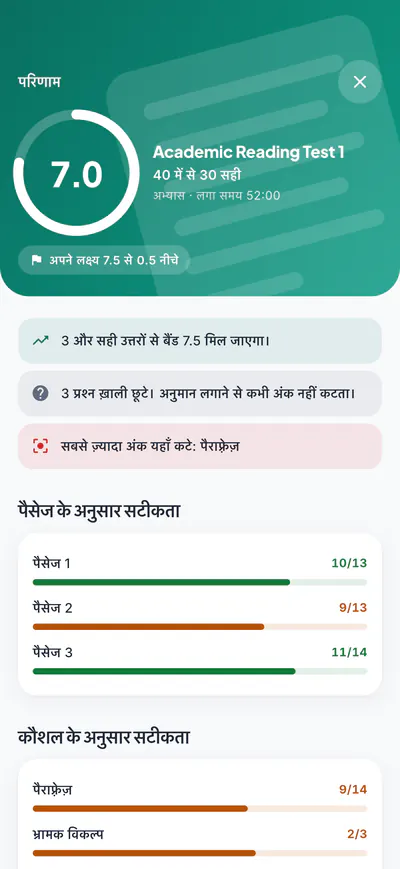
Fleydo: IELTS की तैयारी ऐप में IELTS प्रैक्टिस टेस्ट का परिणाम: अनुमानित बैंड और हर भाग की सटीकता
मुफ़्त ट्रायल लेसन

परीक्षा से पहले अपना असली IELTS बैंड जानें

एक मूल अंग्रेज़ी-भाषी शिक्षक के साथ मुफ़्त वन-टू-वन ऑनलाइन लेसन, जो Band 8.5+ प्रमाणित IELTS विशेषज्ञ हैं। आपको असली परीक्षा फ़ॉर्मैट में Speaking डायग्नोस्टिक, ईमानदार बैंड अनुमान और ठीक उन मानदंडों के लिए योजना मिलती है जो आपके अंक काट रहे हैं। कोई भुगतान नहीं, कोई प्रतिबद्धता नहीं।

ऑनलाइन · वन-टू-वन · Academic और General Training

IELTS, British Council, IDP: IELTS Australia और Cambridge University Press & Assessment का पंजीकृत ट्रेडमार्क है। ये प्रैक्टिस टेस्ट Fleydo ने तैयार किए हैं; इन संस्थाओं ने न तो इन्हें अनुमोदित किया है और न ही इनका समर्थन किया है।

मोबाइल ऐप

Fleydo English School आपकी जेब में

Fleydo के छात्रों और पैरेंट्स के लिए लेसन, होमवर्क, मैसेज और गेम्स। iPhone और Android पर मुफ़्त।

App Store से डाउनलोड करेंइसे Google Play पर पाएं
ऐप के बारे में और जानें
QR कोड जो App Store या Google Play में Fleydo English School ऐप खोलता हैडाउनलोड करने के लिए स्कैन करेंआपके फ़ोन के लिए सही स्टोर खोलता है।fleydo.com/app
Fleydo IELTS ऐप का आइकन
Fleydo: IELTS की तैयारी

IELTS की तैयारी कर रहे हैं?

Fleydo: IELTS की तैयारी एक अलग ऐप है, जिसमें चारों कौशल के मॉक टेस्ट हैं। इसे इस्तेमाल करने के लिए Fleydo अकाउंट की ज़रूरत नहीं है।

IELTS ऐप देखें
App Store से डाउनलोड करेंइसे Google Play पर पाएं
IELTS प्रैक्टिस टेस्ट

IELTS के चारों कौशलों का अभ्यास करें

तुरंत बैंड स्कोर, व्याख्या सहित उत्तरों और मॉडल उत्तरों के साथ 311 टेस्ट। साइन-अप की ज़रूरत नहीं।

सभी प्रैक्टिस टेस्ट
FleyPath

आपके बच्चे का व्यक्तिगत रोडमैप — 3, 6 या 12 महीने

🚀शुरुआत
👋Hello
😊Body
🦁Animals
🔢Numbers
🏆आत्मविश्वासी अंग्रेज़ी
गेमिफाइड अंग्रेज़ी अभ्यास

गेम जैसा — बस फ़र्क इतना कि वे सच में सीख रहे हैं