1. होम
  2. IELTS
  3. प्रैक्टिस टेस्ट
  4. Speaking
  5. Speaking प्रैक्टिस टेस्ट 11: Keeping things

IELTS Speaking

IELTS Speaking प्रैक्टिस टेस्ट 11: Keeping things

Describe an ordinary object that someone you know well has kept for years and refuses to throw away.

  • 3 भाग
  • 11–14 मिनट
  • परीक्षक
  • चार उम्मीदवार, एक टेस्ट

टेस्ट दें

परीक्षक के प्रश्न एक-एक करके चलते हैं। परीक्षा की तरह ज़ोर से उत्तर दें। रिकॉर्डिंग वैकल्पिक है और इसी ब्राउज़र टैब में रहती है।

आपकी रिकॉर्डिंग सिर्फ़ इसी टैब में रहती हैं। कुछ भी अपलोड नहीं होता। रखना चाहें तो उन्हें डाउनलोड कर लें।

अपने प्रदर्शन को अंक दें

अपने उत्तरों की तुलना उम्मीदवारों से करें, फिर हर मानदंड के लिए वह बैंड चुनें जो आप पर सही बैठता है।

6.0आपका अनुमानित बैंड
Fluency and coherence

Lexical resource

Grammatical range and accuracy

Pronunciation

हर उम्मीदवार एक अलग वक्ता है, इसलिए कहानियाँ और राय अलग-अलग हैं। बैंड सार्वजनिक डिस्क्रिप्टर के आधार पर हमारा अनुमान हैं, परीक्षक के आधिकारिक अंक नहीं। ट्रांसक्रिप्ट उच्चारण नहीं दिखा सकती। ये बैंड मानकर चलते हैं कि उच्चारण बाक़ी तीन मानदंडों के स्तर का ही है।

प्रश्न, क्यू कार्ड और नमूना उत्तर

Part 1: इंटरव्यू

Your home

  • What kind of place do you live in at the moment?
  • Who do you live with?
  • Is it easy to keep your home tidy?
  • Was the home you grew up in very different from where you live now?

Keys

  • How many keys do you usually carry with you?
  • Do you keep anything on your key ring?
  • Have you ever locked yourself out?
  • Would you leave a spare key with a neighbour? (Why?/Why not?)

Perfume and smells

  • Do you ever wear perfume?
  • Is there a smell that you really dislike?
  • Would you ever give someone perfume as a present?

सुझाव

  • The home questions are about your life, not the building. Say who you share it with or what is hard about it, and give the one detail that makes the answer yours: a balcony, a noisy kitchen, a child's toys on the floor.
  • Keys and smells are small topics, so one reason or one detail is enough. 'Have you ever locked yourself out?' asks for a short story: two or three sentences in the past tense, then stop.
  • Listen for the form of the question. 'Have you ever locked yourself out?' wants a past story, 'Do you ever wear perfume?' is about habits, and 'Would you ever give someone perfume as a present?' needs would. If the answer is no, say no and give the reason: that is a full answer.

Part 2: लंबा उत्तर (क्यू कार्ड)

Describe an ordinary object that someone you know well has kept for years and refuses to throw away.

You should say:

  • what the object is and who keeps it
  • what condition it is in and where it is kept
  • what other people say about it

and explain why you think this person won't get rid of it.

अनुवर्ती प्रश्न

  • Have you ever tried to persuade them to get rid of it?
  • Have you ever thrown something away and later wished you hadn't?

एक मज़बूत उम्मीदवार ऐसे नोट्स बना सकता है

  • aunt, old biscuit tin of buttons
  • lid rusty, picture faded
  • same kitchen shelf, 30+ years
  • cousins: junk, laugh at it
  • she hardly sews now
  • why? hates waste, grew up with little
  • tin = her routine, her kitchen

सुझाव

  • The object belongs to someone else, so the explain line asks you to guess their reasons. Say that it is a guess ('my guess is', 'I've never asked, but') and give your evidence: what the person says or does when someone suggests getting rid of it.
  • Choose something ordinary, not a valuable antique or a family treasure. A dented tin, an old coat or a folder of papers works well, because the interesting part is why anyone would keep it. If no one in your family comes to mind, think of a friend, a neighbour or a colleague.
  • The third point gives you a scene. One short moment, such as a time someone tried to give the thing away or use it for something else, fills the time better than a list of opinions about it.

Part 3: चर्चा

Possessions and memories

  • Why do you think people keep things that have no practical use? समझाना
  • Is a photo of a special object just as good as keeping the object itself? तुलना करना
  • Do you think people in the future will keep fewer objects to remind them of the past? भविष्य के बारे में अनुमान लगाना

Owning less

  • Do you think most people own more things than they need nowadays? राय देना
  • Does owning fewer things really make life easier? फ़ायदे-नुकसान तौलना
  • How can parents teach children not to want more and more things? सुझाव देना

सुझाव

  • These questions are about people in general. A personal example can support a point, but you do not need one in every answer, and the person from your Part 2 story should not appear in all of them.
  • For 'Does owning fewer things really make life easier?', say for whom and when. What works for a student in one rented room may not work for a family with young children or for someone who cannot afford to buy things twice.
  • For the question about the future, base your guess on something you can already see, such as how people store messages and photos now, and use might, could and I'd guess.

चार उम्मीदवार, एक टेस्ट

चार अलग-अलग बैंड के वक्ताओं ने हर प्रश्न का उत्तर कैसे दिया।

Part 1What kind of place do you live in at the moment?

Now I live in a kos. It's like, er, a boarding house, I rent one room only. It's in Surabaya, near my work. The room is small but it's OK, and the bathroom is inside, so I'm lucky.

Part 1Who do you live with?

Alone, only me in my room. But in the building there are, um, maybe fifteen people, students and workers, and we share one kitchen. Sometimes at night we cook instant noodles together and watch football.

Part 1Is it easy to keep your home tidy?

Yes, easy, because I don't have many thing. Clothes, my laptop, a small fan... that's all. Every Sunday I clean it, er, twenty minutes and it's done.

Part 1Was the home you grew up in very different from where you live now?

Yes, very different. In Malang I live – I lived with my family in a house with a big yard, and there is a, er, mango tree. Here I have only one window, and I see the motorbike parking.

Part 1How many keys do you usually carry with you?

Three. My room key, my motorbike key, and one small key for my locker at the warehouse. I put all of them on one ring, so I don't lose them.

Part 1Do you keep anything on your key ring?

Yes, a small shoe, er, made from rubber. My friend from work gave it to me as a joke, because our shop sells shoes online and I pack shoes all day.

Part 1Have you ever locked yourself out?

Yes, one time. I went out to buy food at night, and the door is close behind me, er, the key still on the table. So I sleep in my friend's room, and in the morning the owner opened it.

Part 1Would you leave a spare key with a neighbour? (Why?/Why not?)

Hmm, no. I don't know very well my neighbours, er, they always change, the students come and go. Maybe I can give it to my cousin, because he also lives in Surabaya, not far.

Part 1Do you ever wear perfume?

Not perfume, no. Only, er, deodorant, because in the warehouse it's very hot and I sweat a lot. My cousin uses perfume every day, very strong one, er, too much for me.

Part 1Is there a smell that you really dislike?

Yes, the smell from the... the canal near my kos, when it rains. Very bad, like old rubbish. I close my window, but the smell still come in.

Part 1Would you ever give someone perfume as a present?

Maybe for my mother, for her birthday. But I don't know which smell she likes, er, so maybe I ask the shop to choose, or I give her something else.

Part 2Describe an ordinary object that someone you know well has kept for years and refuses to throw away.

My father has a helmet, er, a motorbike helmet, and he never throw it away. It's very old, I think more old than me. Before the colour is, er, white, but now it's more like yellow, and there is a crack in the back, so it's not safe. My father doesn't wear it. He hangs it on a nail behind the... the front door, in our house in Malang, like a, um... like a decoration. My mother hates it. Every time she clean the house she say, why we keep this trash? One time she put it outside with the trash, and, um, my father saw it when he come home, and he bring it inside again. He didn't say anything, er, just put it back on the nail. So until now it's still there. Why he keep it... I think because it's from his first motorbike. When he was young he worked in a factory in Surabaya, and with his first money, er, his salary, he bought a motorbike and this helmet. Then he drive to Malang to visit my mother's family, er, before they marry. So for him it's not only a helmet, it's, how to say... his young time. Er... so, yes. It's still there, on the nail.

Part 2Have you ever tried to persuade them to get rid of it?

Me? No, never. I'm on my father's side. It's only small, er, it's not disturbing anybody.

Part 2Have you ever thrown something away and later wished you hadn't?

Yes, my phone box. When I sell my phone, the buyer ask for the box, but I already throw it.

Part 3Why do you think people keep things that have no practical use?

Because of the memory, I think. Like my father, the helmet is not, er, useful, but when he see it he remember the old time. And, er, some people think maybe one day they need it, so they don't want to throw. My mother is like that, she keeps all the glass jar from jam, from coffee... many jars in the kitchen.

Part 3Is a photo of a special object just as good as keeping the object itself?

Hmm... I think not the same. A photo you can only look, you cannot touch it, cannot hold it. But it's better than nothing. If you move to small house and there is no space, you can take a photo, and then... give the thing to, er, other people. So you still have the memory, a little bit.

Part 3Do you think people in the future will keep fewer objects to remind them of the past?

Yes, fewer, I think. Now everything is in the phone, the photo, the message, the video, so, um, people don't need to keep the real thing. And the young people, they don't like old things. Er, but some people maybe still keep, the old people. I don't know.

Part 3Do you think most people own more things than they need nowadays?

Yes, many people. Because now shopping is very easy, only in the phone. Every month there is big discount, er, free delivery, so people buy and buy, also when they don't need. In my work, before the discount day we are very busy, um, many order. Sometimes one customer buy five pair of shoes.

Part 3Does owning fewer things really make life easier?

Yes, I think more easy. If you have less things, you clean fast, and when you move you don't need a car, er, a truck, only motorbike. Like me, when I moved to Surabaya I bring only one bag. But for a family with small children it's difficult, they need many things, er, for the baby, for school.

Part 3How can parents teach children not to want more and more things?

Er... parents must say no sometimes, they cannot give everything the children want. And maybe the children can use old things from the brother or sister, clothes, shoes, school bag, so they learn it's OK, um, not everything must be new. I think this is good for the children, and for the money also.

इस टेस्ट के शब्द

hold on to something
keep something instead of throwing it away or giving it away
get rid of something
throw away, sell or give away something you no longer want
sentimental value
the importance something has because of memories, not because of its price
a keepsake
a small object you keep to remember a person or an event
clutter
too many things lying around, making a place look untidy
declutter
get rid of things you do not need so that a place is tidier
clear out
empty a cupboard, drawer or room of the things you no longer need
falling apart
in very bad condition, breaking into pieces
just in case
because something might happen or be needed later
hand-me-downs
clothes or things passed on from an older person, usually a brother, sister or cousin
a spare key
an extra key you keep in case you lose the first one
lock yourself out
close a door that locks by itself and leave your keys inside

उपयोगी वाक्यांश

  • It's nothing special, just ___, but ___.
  • It's been ___ for as long as I can remember.
  • Whenever someone suggests ___, she ___.
  • My guess is that ___, although I've never asked.
  • For him it's not really about the ___, it's more about ___.
  • I can see why ___, but personally I'd ___.
  • It depends what ___ means to you. If ___, then ___.
  • It might be easier for ___, but for ___ it's a different story.
  • In the future, I can imagine people ___, mainly because ___.

Fleydo IELTS ऐप का आइकन Fleydo: IELTS की तैयारी

ये टेस्ट अपने फ़ोन पर साथ ले जाएँ

इन पेजों का हर टेस्ट iPhone, iPad और Android के लिए Fleydo: IELTS की तैयारी ऐप में भी है, साथ में ऑडियो वाले 2,000 IELTS शब्द।

  • कोई टेस्ट फ़ोन पर आ जाने के बाद ऑफ़लाइन चलता है
  • ऑडियो वाले 2,000 IELTS शब्द, बढ़ते अंतराल पर दोहराव और छोटे अभ्यास
  • अपने Speaking उत्तर रिकॉर्ड करें और फिर से सुनें
  • आपके लक्ष्य बैंड और परीक्षा की तारीख़ के हिसाब से रोज़ की योजना
App Store से डाउनलोड करेंइसे Google Play पर पाएं
डाउनलोड करने के लिए स्कैन करेंआपके फ़ोन के अनुसार App Store या Google Play खोलता है।

अकाउंट की ज़रूरत नहीं। ऐप के बारे में

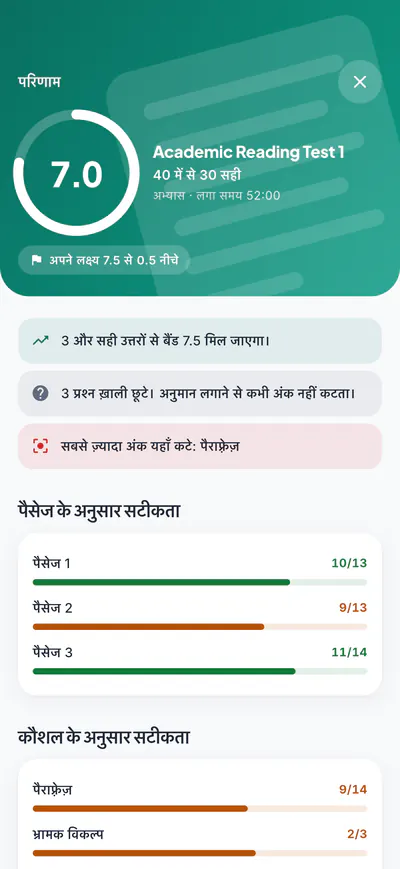
Fleydo: IELTS की तैयारी ऐप में IELTS प्रैक्टिस टेस्ट का परिणाम: अनुमानित बैंड और हर भाग की सटीकता
मुफ़्त ट्रायल लेसन

परीक्षा से पहले अपना असली IELTS बैंड जानें

एक मूल अंग्रेज़ी-भाषी शिक्षक के साथ मुफ़्त वन-टू-वन ऑनलाइन लेसन, जो Band 8.5+ प्रमाणित IELTS विशेषज्ञ हैं। आपको असली परीक्षा फ़ॉर्मैट में Speaking डायग्नोस्टिक, ईमानदार बैंड अनुमान और ठीक उन मानदंडों के लिए योजना मिलती है जो आपके अंक काट रहे हैं। कोई भुगतान नहीं, कोई प्रतिबद्धता नहीं।

ऑनलाइन · वन-टू-वन · Academic और General Training

IELTS, British Council, IDP: IELTS Australia और Cambridge University Press & Assessment का पंजीकृत ट्रेडमार्क है। ये प्रैक्टिस टेस्ट Fleydo ने तैयार किए हैं; इन संस्थाओं ने न तो इन्हें अनुमोदित किया है और न ही इनका समर्थन किया है।

मोबाइल ऐप

Fleydo English School आपकी जेब में

Fleydo के छात्रों और पैरेंट्स के लिए लेसन, होमवर्क, मैसेज और गेम्स। iPhone और Android पर मुफ़्त।

App Store से डाउनलोड करेंइसे Google Play पर पाएं
ऐप के बारे में और जानें
QR कोड जो App Store या Google Play में Fleydo English School ऐप खोलता हैडाउनलोड करने के लिए स्कैन करेंआपके फ़ोन के लिए सही स्टोर खोलता है।fleydo.com/app
Fleydo IELTS ऐप का आइकन
Fleydo: IELTS की तैयारी

IELTS की तैयारी कर रहे हैं?

Fleydo: IELTS की तैयारी एक अलग ऐप है, जिसमें चारों कौशल के मॉक टेस्ट हैं। इसे इस्तेमाल करने के लिए Fleydo अकाउंट की ज़रूरत नहीं है।

IELTS ऐप देखें
App Store से डाउनलोड करेंइसे Google Play पर पाएं
IELTS प्रैक्टिस टेस्ट

IELTS के चारों कौशलों का अभ्यास करें

तुरंत बैंड स्कोर, व्याख्या सहित उत्तरों और मॉडल उत्तरों के साथ 311 टेस्ट। साइन-अप की ज़रूरत नहीं।

सभी प्रैक्टिस टेस्ट
FleyPath

आपके बच्चे का व्यक्तिगत रोडमैप — 3, 6 या 12 महीने

🚀शुरुआत
👋Hello
😊Body
🦁Animals
🔢Numbers
🏆आत्मविश्वासी अंग्रेज़ी
गेमिफाइड अंग्रेज़ी अभ्यास

गेम जैसा — बस फ़र्क इतना कि वे सच में सीख रहे हैं