1. होम
  2. IELTS
  3. प्रैक्टिस टेस्ट
  4. Reading
  5. Reading Yes/No/Not Given अभ्यास 5

IELTS Reading · Yes / No / Not Given

IELTS Reading Yes/No/Not Given अभ्यास 5

School league tables

  • 12 प्रश्न
  • 15 मिनट
  • Academic

इस टेस्ट में क्या है

  1. Passageप्रश्न 1–12What a ranking is good for

प्रश्न प्रकार

  • Yes / No / Not Given
ReadingIELTS Reading Yes/No/Not Given अभ्यास 5
बचा समय15:00

Passage

What a ranking is good for

A A school league table, the published ranking of schools by examination results, is an easy thing to dislike. It squeezes years of teaching into a single position and turns education into a sports competition. Even so, I have come to think that publication probably does raise results, though not by the route its supporters usually describe. Such tables should be judged as a form of public scrutiny, and not as a shopping guide for families.

B The most persuasive evidence comes from a comparison nobody planned. In 2001 the government of Wales stopped publishing its school tables, while England carried on. Simon Burgess, Deborah Wilson and Jack Worth matched Welsh secondary schools with similar English ones and compared pupils' progress before and after the change. They estimated a loss in Wales of nearly two grades per pupil per year in GCSEs, taken at sixteen: roughly a D instead of a B in one subject. Welsh schools in the top quarter appeared unaffected, while the poorest and lowest-attaining fell behind most. One episode in one country cannot settle the question, but the pattern is what I would expect, since exposure worries most those with most to fear.

C The authors suggest two routes to improvement: parents may avoid low-scoring schools, and public identification may itself press those schools to improve. I suspect the second counts for more, because the first has weak foundations. A table describes pupils who have just sat their examinations, whereas parents want to know how a school will perform when their own child does, a gap of some seven years. George Leckie and Harvey Goldstein concluded that, once this is allowed for, almost no schools can be reliably told apart. Rebecca Allen and Simon Burgess, studying half a million children who chose schools in 2003, found that using the tables did beat picking a local school at random, especially where local schools differed widely. Both findings may hold, for beating chance is a modest achievement.

D Fairness is a harder matter. England's Progress 8 measure, introduced in 2016 and paused for 2025 and 2026, adjusts GCSE results for tests taken at the end of primary school but ignores other aspects of pupils' backgrounds. When Leckie and Goldstein added such information to 2016 data for 3,098 state secondary schools, about a fifth of schools moved more than 500 places, and over a third of those judged underperforming left that category. Part of a school's standing, it seems, depends on whom it teaches. Yet I would not simply substitute the adjusted score, which could appear to expect less of poorer children. The authors' own proposal, to publish both side by side, strikes me as right.

E Distortion is the objection I find most serious. When ratings rest on pass rates, schools have a reason to concentrate on pupils near the pass mark, and Burgess and colleagues reported in 2005 that accountability in England slightly reduced gains for very low-ability pupils. In 23 sampled Virginia school districts in 2000, lunches in those with schools threatened by penalties averaged 863 calories during testing periods, against 761 before and 745 after. That system used sanctions and not a ranking, and the authors urged caution over the link with pass rates, so I offer it as an illustration and not as proof. In defence of the tables, the Wales study's authors found similar falls in an unpublished measure, which they take as a sign that more than gaming was involved.

F My conclusion is to keep publication and change what is published: ranges in place of single positions, measures that count every pupil's progress in place of a pass line, and adjusted figures beside raw ones. One cost remains that I cannot weigh. The Wales study's authors admit that they do not know whether less emphasis on examinations improved teachers' and pupils' wellbeing. If it did, that gain would have to be set against the grades lost.

शब्दावली
GCSEs
examinations taken by school pupils in England and Wales at about the age of sixteen
Progress 8
a measure used in England of how much progress pupils make at secondary school
gaming
using the rules of a system to look better without really improving
Passageप्रश्न 1–12
प्रश्न 1–12

Do the following statements agree with the claims of the writer in the text? YES if the statement agrees with the claims of the writer NO if the statement contradicts the claims of the writer NOT GIVEN if it is impossible to say what the writer thinks about this

1League tables are most valuable as a means of helping families to select a school.
2Teachers in Wales generally welcomed the decision made in 2001.
3It is unsurprising that weaker schools in Wales lost more than stronger ones.
4Public exposure probably affects schools more than the choices of parents do.
5Most parents consult league tables before choosing a school.
6The findings of Leckie and Goldstein and of Allen and Burgess cannot both be correct.
7A school's place in a table appears partly to reflect the kind of pupils it admits.
8A score that also takes account of pupils' backgrounds ought to replace Progress 8.
9Linking teachers' pay to table position would make distortion worse.
10The Virginia lunch figures are firm evidence that league tables distort what schools do.
11Schools should be shown within a range and not given one exact rank.
12League tables should be published less often than they are at present.

उत्तर और व्याख्याएँ

पहले टेस्ट दें: उत्तर देने के बाद कुंजी ज़्यादा काम की होती है।

उत्तर कुंजी और व्याख्याएँ दिखाएँ
  1. 1
    NO

    The writer says the tables should be judged as public scrutiny and 'not as a shopping guide', meaning a guide for choosing. This contradicts the statement, so the answer is NO, not YES.

  2. 2
    NOT GIVEN

    Paragraph B describes the decision and its effect on results, but it never mentions how teachers felt about it. We cannot say what the writer thinks about their reaction, so this is NOT GIVEN, not YES.

  3. 3
    YES

    The stronger schools 'appeared unaffected' while the poorest fell behind most, and the writer says this is what one would expect. Something expected is unsurprising, so the statement agrees and the answer is YES.

  4. 4
    YES

    The two routes are parents avoiding schools and public identification. 'The second' is public identification, and 'I suspect' matches 'probably' in the statement. The answer is therefore YES, not NOT GIVEN.

  5. 5
    NOT GIVEN

    Paragraph C discusses how useful the tables are for parents, but it does not say how many parents actually use them. The writer's view on this cannot be known, so the answer is NOT GIVEN, not YES.

  6. 6
    NO

    The two studies seem to disagree, which makes YES tempting. But the writer says 'Both findings may hold', because beating chance is only a modest achievement. This contradicts the statement, so the answer is NO.

  7. 7
    YES

    'Standing' means a school's position, and 'whom it teaches' means the kind of pupils it has. The word appears in the statement matches 'it seems', so the two agree and the answer is YES.

  8. 8
    NO

    The writer accepts that background matters, which makes YES tempting. But the writer rejects replacing Progress 8 with the adjusted score and prefers to publish both 'side by side'. This contradicts the statement, so the answer is NO.

  9. 9
    NOT GIVEN

    Paragraph E discusses pass rates and penalties, which makes pay seem a natural next point. However, the writer never mentions teachers' pay, so we cannot know the writer's view. The answer is NOT GIVEN, not YES.

  10. 10
    NO

    The writer gives the Virginia lunches as an example of distortion, which makes YES tempting. But that system was not a ranking, and the writer offers the figures as 'an illustration' and 'not as proof'. The answer is NO.

  11. 11
    YES

    Among the writer's proposed changes are 'ranges in place of single positions'. A single position is one exact rank, so the statement says the same thing in other words and the answer is YES.

  12. 12
    NOT GIVEN

    Paragraph F says publication should continue and proposes changes to what is published. It does not mention how often this should happen, so the writer's view is unknown and the answer is NOT GIVEN, not NO.

इस पेपर के मुख्य शब्द

Passage

scrutiny
careful and critical examination
distortion
a change that makes something less true or less accurate
sanctions
official penalties for breaking a rule or missing a target
modest
fairly small; not large or impressive
substitute
to use one thing in place of another
Yes / No / Not Given प्रश्नों के उत्तर कैसे देंWork out what the writer claims, and keep it apart from what others say.

What the task looks like

You get a list of statements and this instruction:

Do the following statements agree with the claims of the writer in Reading Passage 2? YES if the statement agrees with the claims of the writer NO if the statement contradicts the claims of the writer NOT GIVEN if it is impossible to say what the writer thinks about this

The task tests whether you can identify the writer's views and claims, so it suits a text that argues a case. In our papers, the statements follow the order of the text.

Preparing for General Training? Our General Training papers do not include this type. Official sources do not all agree on whether the real General Training test can include it, so it is still worth knowing how it works.

Information or claims?

True/False/Not Given is about information: what does the text report? Yes/No/Not Given is about the writer: what does the writer claim or believe? So the question changes from 'Does the text mention this?' to 'Would the writer agree with this?'

Take this sentence: Some visitors say that museums should remove written labels, but this idea is misguided.

In a True/False task, 'Some visitors want labels removed' is TRUE, because the text reports it. In a Yes/No task, 'Museums should remove written labels' is NO, because the writer rejects it.

A claim is not only an opinion. If the writer states that something is so, that is a claim too, even when it sounds like a plain fact.

NO or NOT GIVEN: three questions

NO works like FALSE, except that the clash is with the writer's position. Ask these questions in order:

1. Does the writer say this, or clearly show this view? If so, the answer is YES.

2. Imagine the writer reading the statement. Would it go against what the writer has claimed? If so, the answer is NO.

3. Is the writer's view on this exact point impossible to tell? Perhaps the writer does not deal with it, or only reports what other people think. Then the answer is NOT GIVEN.

In short: NO means the writer has taken the opposite position. NOT GIVEN means the writer has not shown a position.

करें
  • Before you answer YES or NO, point to the words that show the writer's own position.

Worked example 1: who is speaking?

Text: Some visitors say that museums should remove written labels so that people can simply look. This is an appealing idea, but it is misguided. A label takes seconds to read, and without one an object can remain a mystery.

Statement: Museums ought to take away their written labels.

कमज़ोरYES. The first sentence says museums should remove labels, so the statement agrees with the text.
बेहतरNO. Those are the words of 'some visitors'. The writer then calls the idea 'misguided', so the writer's own claim goes against the statement.

Words in the text are not always the writer's own view. First find out who is speaking.

Worked example 2: do not build a view for the writer

Same text. Statement: Museums with written labels attract more visitors.

कमज़ोरYES. The writer is clearly in favour of labels, so the writer must believe they bring in more people.
बेहतरNOT GIVEN. The writer's reasons are about how quickly a label can be read and how it helps people understand an object. Nothing shows what the writer thinks about visitor numbers.

Knowing the writer's general attitude is not enough. The writer's view on this exact point must be clear.

Worked example 3: reporting without taking sides

Text: Some visitors enjoy audio guides, while others find them distracting. The museum now offers both audio guides and printed maps.

Statement: Audio guides are distracting.

कमज़ोरYES. The text says that people find them distracting.
बेहतरNOT GIVEN. The writer reports two groups with opposite feelings and does not side with either. It is impossible to say what the writer thinks.

A reported view is not the writer's view. In a True/False task, 'Some visitors find audio guides distracting' would be TRUE. Here the question is about the writer, and the writer has not said.

A method to try

1. Skim the text for the writer's overall position. What is the writer arguing for or against?

2. Take a statement and find the part of the text that deals with its idea.

3. Sort the voices. 'Some argue', 'critics say' and 'it is often claimed' introduce other people's ideas. 'I believe', 'in fact', 'should' and 'this is mistaken' may show the writer's own.

4. Read on after a reported view. A word such as 'but' or 'however' may mean the writer is about to reply.

5. Ask the three questions.

The traps

A view rejected later: the writer may set out an idea fairly in one sentence and reject it in the next.

Your own opinion: you may agree strongly with a statement, but only the writer's view counts.

Attitude words: 'sadly', 'surprisingly', 'so-called' and 'merely' can show what the writer feels, even in a sentence that looks like plain information.

Half agreement: the writer may accept part of an idea. 'Labels help in small museums, but not in large ones' goes against a statement about all museums, so compare the whole statement.

Fleydo IELTS ऐप का आइकन Fleydo: IELTS की तैयारी

ये टेस्ट अपने फ़ोन पर साथ ले जाएँ

इन पेजों का हर टेस्ट iPhone, iPad और Android के लिए Fleydo: IELTS की तैयारी ऐप में भी है, साथ में ऑडियो वाले 2,000 IELTS शब्द।

  • कोई टेस्ट फ़ोन पर आ जाने के बाद ऑफ़लाइन चलता है
  • ऑडियो वाले 2,000 IELTS शब्द, बढ़ते अंतराल पर दोहराव और छोटे अभ्यास
  • अपने Speaking उत्तर रिकॉर्ड करें और फिर से सुनें
  • आपके लक्ष्य बैंड और परीक्षा की तारीख़ के हिसाब से रोज़ की योजना
App Store से डाउनलोड करेंइसे Google Play पर पाएं
डाउनलोड करने के लिए स्कैन करेंआपके फ़ोन के अनुसार App Store या Google Play खोलता है।

अकाउंट की ज़रूरत नहीं। ऐप के बारे में

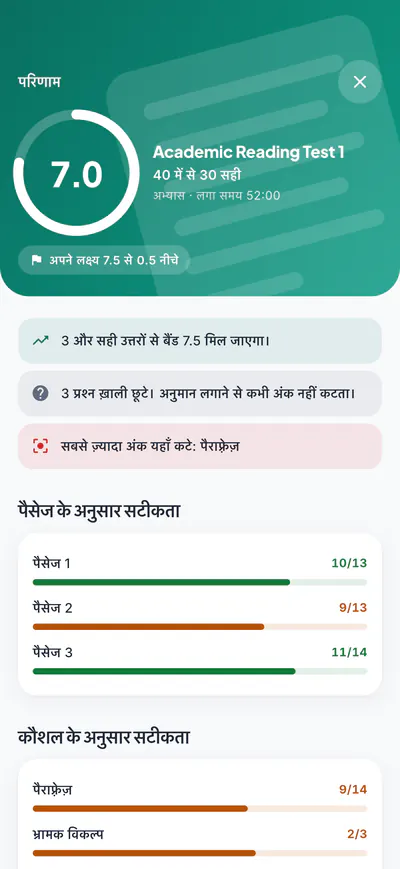
Fleydo: IELTS की तैयारी ऐप में IELTS प्रैक्टिस टेस्ट का परिणाम: अनुमानित बैंड और हर भाग की सटीकता
मुफ़्त ट्रायल लेसन

परीक्षा से पहले अपना असली IELTS बैंड जानें

एक मूल अंग्रेज़ी-भाषी शिक्षक के साथ मुफ़्त वन-टू-वन ऑनलाइन लेसन, जो Band 8.5+ प्रमाणित IELTS विशेषज्ञ हैं। आपको असली परीक्षा फ़ॉर्मैट में Speaking डायग्नोस्टिक, ईमानदार बैंड अनुमान और ठीक उन मानदंडों के लिए योजना मिलती है जो आपके अंक काट रहे हैं। कोई भुगतान नहीं, कोई प्रतिबद्धता नहीं।

ऑनलाइन · वन-टू-वन · Academic और General Training

IELTS, British Council, IDP: IELTS Australia और Cambridge University Press & Assessment का पंजीकृत ट्रेडमार्क है। ये प्रैक्टिस टेस्ट Fleydo ने तैयार किए हैं; इन संस्थाओं ने न तो इन्हें अनुमोदित किया है और न ही इनका समर्थन किया है।

मोबाइल ऐप

Fleydo English School आपकी जेब में

Fleydo के छात्रों और पैरेंट्स के लिए लेसन, होमवर्क, मैसेज और गेम्स। iPhone और Android पर मुफ़्त।

App Store से डाउनलोड करेंइसे Google Play पर पाएं
ऐप के बारे में और जानें
QR कोड जो App Store या Google Play में Fleydo English School ऐप खोलता हैडाउनलोड करने के लिए स्कैन करेंआपके फ़ोन के लिए सही स्टोर खोलता है।fleydo.com/app
Fleydo IELTS ऐप का आइकन
Fleydo: IELTS की तैयारी

IELTS की तैयारी कर रहे हैं?

Fleydo: IELTS की तैयारी एक अलग ऐप है, जिसमें चारों कौशल के मॉक टेस्ट हैं। इसे इस्तेमाल करने के लिए Fleydo अकाउंट की ज़रूरत नहीं है।

IELTS ऐप देखें
App Store से डाउनलोड करेंइसे Google Play पर पाएं
IELTS प्रैक्टिस टेस्ट

IELTS के चारों कौशलों का अभ्यास करें

तुरंत बैंड स्कोर, व्याख्या सहित उत्तरों और मॉडल उत्तरों के साथ 311 टेस्ट। साइन-अप की ज़रूरत नहीं।

सभी प्रैक्टिस टेस्ट
FleyPath

आपके बच्चे का व्यक्तिगत रोडमैप — 3, 6 या 12 महीने

🚀शुरुआत
👋Hello
😊Body
🦁Animals
🔢Numbers
🏆आत्मविश्वासी अंग्रेज़ी
गेमिफाइड अंग्रेज़ी अभ्यास

गेम जैसा — बस फ़र्क इतना कि वे सच में सीख रहे हैं