1. होम
  2. IELTS
  3. प्रैक्टिस टेस्ट
  4. Reading
  5. Reading Note Completion अभ्यास 1

IELTS Reading · नोट्स पूर्ति

IELTS Reading Note Completion अभ्यास 1

Growing wasabi

  • 12 प्रश्न
  • 15 मिनट
  • Academic

इस टेस्ट में क्या है

  1. Passageप्रश्न 1–12The crop that stays close to the spring

प्रश्न प्रकार

  • नोट्स पूर्ति
ReadingIELTS Reading Note Completion अभ्यास 1
बचा समय15:00

Passage

The crop that stays close to the spring

A Left to itself, wasabi keeps to the edges of cold mountain streams, where the ground is wet and the light is poor. Most of the land under wasabi in Japan is still kept in something close to those surroundings: running water and stones rather than a field of soil. Shizuoka Prefecture dates the start of cultivation there to around 1600, and Japan's trade promotion agency says that Shizuoka and Nagano together produce over 90 per cent of the country's water-grown wasabi. What the grower is after is the rhizome, a thick stem that is grated to make a hot condiment.

B A widely used kind of bed, known as tatamiishi, was developed in the Izu region of Shizuoka. It turns a steep mountain slope into a flight of stone-walled terraces. Each terrace is built up in layers: large stones at the bottom, smaller stones on top of them, and finally a shallow covering of gravel and sand in which the plants are set. Spring water runs across the terrace without a break and drains away through the stones. It also brings nutrients with it, so growers can manage with very little fertiliser.

C Much depends on the condition of that water. The trade agency gives about 10 to 15°C throughout the year as the ideal. Warmer water holds less oxygen, which checks growth, and soft rot, a disease of the rhizome, becomes more severe once the water reaches 18 to 19°C. Terraces close to a spring stay at a steady temperature, while those further downstream swing more widely; a Japanese climate-adaptation report of 2019 described rot increasing in one Shizuoka district that lies far from its water sources. The volume of flow matters as well. If there is too little, the rhizomes stay small and the harvest is light. If the current is too strong, they take on an unwanted shrimp shape.

D Sun and cold make further demands. The plant cannot stand strong sunlight, so many beds are ringed with trees such as alder. It can also freeze, and a 2009 account of one Shizuoka farming family describes nets being spread over the plants in winter.

E Nor is the crop quick to bring in. The same account has seedlings spending two to three months in a greenhouse and then another 11 to 18 months on the terraces. Shizuoka's agricultural researchers report that varieties grown from seed have lacked uniformity in the growth of the rhizome, and they have bred one that grows more evenly. After harvest, the 2009 account says, the surface layer is dug over and washed with a sprayer, because a build-up of clay, dead insects and rotted leaves could block the flow and raise the risk of disease. Keeping the stone walls in repair remains an essential skill.

F Other dangers are harder to deal with. Stoneflies and other stream insects feed on the plants under water, killing seedlings and scarring rhizomes. A Shizuoka Prefecture report of 2013-14 explains that pesticides can hardly be used, because the water runs straight back into rivers, and it named growing young plants inside short plastic pipes as the simplest and most effective protection then available. Flooding is another threat. Typhoon Hagibis swept crops away in 2019, and the following year's harvest at Okutama, west of central Tokyo, was nearly 70 per cent lower, according to local figures reported by Reuters. Reuters also cited agriculture ministry data for 2020 putting national wasabi output at about half its 2005 level, and the people it interviewed pointed to warming water and to the ageing of those who farm it.

शब्दावली
rhizome
a thick stem of a plant, from which roots and shoots grow
soft rot
a plant disease that makes parts of the plant go soft and decay
stoneflies
insects whose young live in streams
Passageप्रश्न 1–12
प्रश्न 1–12 अधिकतम 1 शब्द

Complete the notes below. Choose ONE WORD ONLY from the passage for each answer.

GROWING WASABI IN WATER
MAIN AREAS
Shizuoka and 1
THE TERRACES
top layer: gravel and 2
plants fed mainly by 3 carried in the spring water
WATER
current too strong: crop takes the form of a 4
warm water: less 5, so plants grow more slowly
close to the source: temperature remains 6
SHADE
trees, for example 7
TIME AND UPKEEP
young plants begin in a 8
after harvest: surface cleaned with a 9
LOSSES
stream insects that pesticides cannot easily control, e.g. 10
Okutama: harvest down by nearly 70 per cent after a 11
national output about half its 2005 level; suggested causes: warmer water and the 12 of farmers

उत्तर और व्याख्याएँ

पहले टेस्ट दें: उत्तर देने के बाद कुंजी ज़्यादा काम की होती है।

उत्तर कुंजी और व्याख्याएँ दिखाएँ
  1. 1
    Nagano

    Paragraph A names Shizuoka and Nagano as the two places producing over 90 per cent of the water-grown crop. Izu is also named later, but it is a region inside Shizuoka, so it does not fit.

  2. 2
    sand

    Paragraph B lists the layers from the bottom up and ends with 'a shallow covering of gravel and sand'. The notes already give gravel, so sand is the missing word. Stones belong to the lower layers.

  3. 3
    nutrients

    Paragraph B says the spring water 'brings nutrients with it', so little fertiliser is needed. Being fed means getting food, as nutrients are for plants. Oxygen is also in the water, but the text does not link it with feeding.

  4. 4
    shrimp

    Paragraph C says a strong current gives the crop 'an unwanted shrimp shape'. The notes ask what it looks like. Small describes the result of too little water, not too much, and it would not follow 'a'.

  5. 5
    oxygen

    Paragraph C says 'Warmer water holds less oxygen, which checks growth'. 'Checks growth' means slows it, as the notes say. In the text this comes before the shrimp point, as notes need not follow text order.

  6. 6
    steady

    Paragraph C says terraces close to a spring 'stay at a steady temperature'. Close to the source means close to a spring. The other terraces 'swing more widely', which is the opposite idea, so steady is the word needed.

  7. 7
    alder

    Paragraph D says beds are 'ringed with trees such as alder'. The notes already give the word trees and ask for an example, so the answer is the name of the tree. The words 'such as' introduce an example.

  8. 8
    greenhouse

    Paragraph E says seedlings spend two to three months 'in a greenhouse' and only then go to the terraces. Young plants means seedlings, and the notes ask for their first home, so terraces, where they go next, is not the answer.

  9. 9
    sprayer

    Paragraph E says that after harvest the surface layer is 'washed with a sprayer'. Cleaned means washed here. The word needed is the tool, so it is sprayer, not clay or leaves, which are what gets removed.

  10. 10
    stoneflies

    Paragraph F names stoneflies as stream insects that feed on the plants, and says pesticides can hardly be used. Copy the spelling exactly, as a wrong spelling loses the mark. The notes already give the word insects, so the example is needed.

  11. 11
    typhoon

    Paragraph F links the 70 per cent fall at Okutama with Typhoon Hagibis in 2019. The 'a' before the gap needs a common noun, so the answer is typhoon. Hagibis is this storm's name, and it would not follow 'a'.

  12. 12
    ageing / aging

    Paragraph F says people pointed to warming water and 'to the ageing of those who farm it'. The notes give warmer water and need the second cause. 'Those who farm it' means farmers, so ageing fits after 'the'.

इस पेपर के मुख्य शब्द

Passage

cultivation
growing plants as a crop
terraces
flat levels cut into a hillside, one above another
fertiliser
a substance added to help plants grow
uniformity
being the same in size or shape
seedlings
very young plants grown from seed
नोट्स पूर्ति प्रश्नों के उत्तर कैसे देंUse the headings and labels in a set of notes to find the text's own word.

What the task looks like

The instruction says 'Complete the notes below.' You get short lines under headings, with gaps in them, and a limit such as ONE WORD ONLY.

Notes leave out small words such as 'the' and 'is', so you get fewer grammar clues than in a full sentence. As with a summary, the task tests details, main ideas and word type.

A method to try

1. Read the headings. They show how the notes are organised and which parts of the text you need.

2. Read the line around each gap. What is the label asking for: a place, a reason, a material?

3. Turn the note into a full sentence in your head. 'Reason: lack of ____' becomes 'The reason is that there is not enough ____'. This often shows what is missing.

4. Find that idea in the text, and take the word from there.

5. Check the word against the label as well as the line. Does it really answer what the label asks?

The traps

Your own word: a word that means the same is not the same as the word in the text.

The wrong heading: a detail that looks right may belong under a different heading in the notes. Use the headings to stay in the right place.

Fuller than the note: notes are short, so a long phrase from the text probably contains more than the gap needs.

Worked example

Text: The town's repair café opens on the first Saturday of each month. Volunteers fix small electrical items and clothes, but they cannot take furniture because the hall has no room for it. Visitors pay nothing, although many leave a donation.

Notes: REPAIR CAFÉ Open: first Saturday of the month Will fix: small electrical items, clothes Furniture not accepted. Reason: lack of ____ at the hall Cost: free, donations welcome (ONE WORD ONLY)

कमज़ोरspace. It means the same as the word in the text, and it sounds natural after 'lack of'.
बेहतरroom. The text says 'the hall has no room for it'. 'Lack of' rewords 'no', but the answer itself comes from the text.

Answers must be taken from words in the text, so a synonym of your own is not the answer, however close its meaning. Look back and find the text's word.

Fleydo IELTS ऐप का आइकन Fleydo: IELTS की तैयारी

ये टेस्ट अपने फ़ोन पर साथ ले जाएँ

इन पेजों का हर टेस्ट iPhone, iPad और Android के लिए Fleydo: IELTS की तैयारी ऐप में भी है, साथ में ऑडियो वाले 2,000 IELTS शब्द।

  • कोई टेस्ट फ़ोन पर आ जाने के बाद ऑफ़लाइन चलता है
  • ऑडियो वाले 2,000 IELTS शब्द, बढ़ते अंतराल पर दोहराव और छोटे अभ्यास
  • अपने Speaking उत्तर रिकॉर्ड करें और फिर से सुनें
  • आपके लक्ष्य बैंड और परीक्षा की तारीख़ के हिसाब से रोज़ की योजना
App Store से डाउनलोड करेंइसे Google Play पर पाएं
डाउनलोड करने के लिए स्कैन करेंआपके फ़ोन के अनुसार App Store या Google Play खोलता है।

अकाउंट की ज़रूरत नहीं। ऐप के बारे में

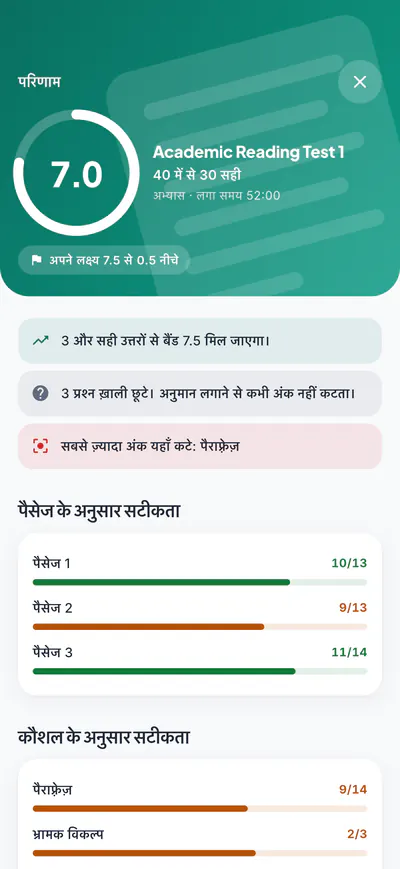
Fleydo: IELTS की तैयारी ऐप में IELTS प्रैक्टिस टेस्ट का परिणाम: अनुमानित बैंड और हर भाग की सटीकता
मुफ़्त ट्रायल लेसन

परीक्षा से पहले अपना असली IELTS बैंड जानें

एक मूल अंग्रेज़ी-भाषी शिक्षक के साथ मुफ़्त वन-टू-वन ऑनलाइन लेसन, जो Band 8.5+ प्रमाणित IELTS विशेषज्ञ हैं। आपको असली परीक्षा फ़ॉर्मैट में Speaking डायग्नोस्टिक, ईमानदार बैंड अनुमान और ठीक उन मानदंडों के लिए योजना मिलती है जो आपके अंक काट रहे हैं। कोई भुगतान नहीं, कोई प्रतिबद्धता नहीं।

ऑनलाइन · वन-टू-वन · Academic और General Training

IELTS, British Council, IDP: IELTS Australia और Cambridge University Press & Assessment का पंजीकृत ट्रेडमार्क है। ये प्रैक्टिस टेस्ट Fleydo ने तैयार किए हैं; इन संस्थाओं ने न तो इन्हें अनुमोदित किया है और न ही इनका समर्थन किया है।

मोबाइल ऐप

Fleydo English School आपकी जेब में

Fleydo के छात्रों और पैरेंट्स के लिए लेसन, होमवर्क, मैसेज और गेम्स। iPhone और Android पर मुफ़्त।

App Store से डाउनलोड करेंइसे Google Play पर पाएं
ऐप के बारे में और जानें
QR कोड जो App Store या Google Play में Fleydo English School ऐप खोलता हैडाउनलोड करने के लिए स्कैन करेंआपके फ़ोन के लिए सही स्टोर खोलता है।fleydo.com/app
Fleydo IELTS ऐप का आइकन
Fleydo: IELTS की तैयारी

IELTS की तैयारी कर रहे हैं?

Fleydo: IELTS की तैयारी एक अलग ऐप है, जिसमें चारों कौशल के मॉक टेस्ट हैं। इसे इस्तेमाल करने के लिए Fleydo अकाउंट की ज़रूरत नहीं है।

IELTS ऐप देखें
App Store से डाउनलोड करेंइसे Google Play पर पाएं
IELTS प्रैक्टिस टेस्ट

IELTS के चारों कौशलों का अभ्यास करें

तुरंत बैंड स्कोर, व्याख्या सहित उत्तरों और मॉडल उत्तरों के साथ 311 टेस्ट। साइन-अप की ज़रूरत नहीं।

सभी प्रैक्टिस टेस्ट
FleyPath

आपके बच्चे का व्यक्तिगत रोडमैप — 3, 6 या 12 महीने

🚀शुरुआत
👋Hello
😊Body
🦁Animals
🔢Numbers
🏆आत्मविश्वासी अंग्रेज़ी
गेमिफाइड अंग्रेज़ी अभ्यास

गेम जैसा — बस फ़र्क इतना कि वे सच में सीख रहे हैं