1. Αρχική
  2. IELTS
  3. Τεστ εξάσκησης
  4. Speaking
  5. Τεστ εξάσκησης IELTS Speaking 20: Sharing

IELTS Speaking

Τεστ εξάσκησης IELTS Speaking 20: Sharing

Describe something you regularly share with people who are not your family, such as a space, a tool or an online account.

  • 3 μέρη
  • 11–14 λεπ.
  • Εξεταστής
  • Τέσσερις υποψήφιοι, ένα τεστ

Κάντε το τεστ

Οι ερωτήσεις του εξεταστή ακούγονται μία μία. Απαντήστε φωναχτά, όπως θα κάνατε στην εξέταση. Η ηχογράφηση είναι προαιρετική και μένει σε αυτή την καρτέλα του προγράμματος περιήγησης.

Οι ηχογραφήσεις σας μένουν μόνο σε αυτή την καρτέλα. Δεν ανεβαίνει τίποτα. Κατεβάστε τες αν θέλετε να τις κρατήσετε.

Βαθμολογήστε την απόδοσή σας

Συγκρίνετε τις απαντήσεις σας με τους υποψηφίους και μετά επιλέξτε για κάθε κριτήριο το band που σας ταιριάζει.

6,0Το εκτιμώμενο band σας
Fluency and coherence

Lexical resource

Grammatical range and accuracy

Pronunciation

Κάθε υποψήφιος είναι διαφορετικός ομιλητής, γι' αυτό οι ιστορίες και οι απόψεις διαφέρουν. Τα band είναι δική μας εκτίμηση με βάση τις δημόσιες περιγραφές, όχι επίσημη βαθμολογία εξεταστή. Μια απομαγνητοφώνηση δεν μπορεί να δείξει την προφορά. Αυτά τα band υποθέτουν ότι είναι στο ίδιο επίπεδο με τα άλλα τρία κριτήρια.

Ερωτήσεις, κάρτα θέματος και ενδεικτικές απαντήσεις

Part 1: συνέντευξη

Your home

  • Can you describe the home you live in at the moment?
  • How long have you lived there?
  • Do you often invite people to your home?
  • Is there anything about your home that you'd miss if you moved?

Fruit

  • What fruit do you eat most often?
  • Was there any fruit you didn't like when you were a child?
  • Do you prefer fruit on its own, or in things like juice and desserts?
  • Have you ever picked fruit straight from a tree?

Mirrors

  • How often do you look in a mirror during the day?
  • Could you manage without a mirror for a whole week?
  • Would you put a large mirror in your living room? (Why?)

Συμβουλές

  • The home questions are about your own place, so give a couple of real details, such as the floor you live on, the view or who lives next door, rather than a list of rooms.
  • Fruit is an easy topic, so name one fruit and add one detail: where you buy it, when you eat it, or why you avoid it. The childhood question needs past forms ('I used to pick it out', 'I couldn't stand the smell').
  • Mirror questions can feel strange. It is fine to say you have never thought about it, and then say what you actually do: 'I only really look when I'm shaving' is a complete, natural answer.

Part 2: μακρά ομιλία (κάρτα θέματος)

Describe something you regularly share with people who are not your family, such as a space, a tool or an online account.

You should say:

  • what it is and who you share it with
  • how you decide who uses it and when
  • a time when sharing it caused a small problem

and explain whether you would rather have one of your own.

Επιπλέον ερώτηση

  • Are you usually the one who organises this kind of thing?
  • Did you have to share a lot of things when you were a child?

Σημειώσεις που θα μπορούσε να κρατήσει ένας δυνατός υποψήφιος

  • washing machine, building basement
  • eight flats, one machine
  • sheet on door: name + time
  • someone's wet clothes left inside
  • polite note, nobody owned up
  • own one? no space, tiny bathroom
  • would miss chats with neighbours

Συμβουλές

  • Everyone shares something, so do not panic if nothing big comes to mind: a printer at work, the fridge in a staff kitchen, a Wi-Fi password, a washing line on the roof. The more ordinary it is, the more real detail you will have.
  • The second point is about the arrangement, not the object. Say how it really works, even if there is no system at all: 'whoever gets there first' or 'we ask in the group chat' are real answers, and they lead straight into the problem.
  • Keep the problem small and leave time for the explain line. 'Would I rather have my own?' can have a mixed answer: say what you would gain and what you would lose.

Part 3: συζήτηση

Sharing instead of owning

  • Why do some people prefer to own things themselves rather than share them? Επεξήγηση
  • Do people take as much care of things they share as they do of things they own? Σύγκριση
  • In the future, do you think it will be normal to share things like cars, tools or even homes with strangers? Υποθέσεις για το μέλλον

Sharing within families

  • Is it a good idea to make young children share their toys? Στάθμιση υπέρ και κατά
  • Do people in a family share more or less with each other than they did in the past? Σύγκριση
  • What can a family do when one person needs more space or privacy than the others? Υποβολή προτάσεων

Συμβουλές

  • Two questions ask you to compare: shared things with owned things, and families now with families in the past. Give one concrete case for each side, then say which way you lean.
  • A question such as 'Is it a good idea to make children share?' does not need a plain yes or no. Say what your answer depends on, such as the child's age or the kind of toy, and give a case.
  • For the question about the future, start from something you can already see: a rental app, flatmates in your city, a tool someone lends round the street. Use might, could and I can imagine rather than will for everything.

Τέσσερις υποψήφιοι, ένα τεστ

Πώς απάντησαν σε κάθε ερώτηση ομιλητές σε τέσσερα διαφορετικά band.

Part 1Can you describe the home you live in at the moment?

It's only one room. I live in Kathmandu with my cousin sister, we rent a room in the second floor of a house, and the owner's family live downstairs. It's small, er, but OK for two people.

Part 1How long have you lived there?

Almost two year. Before, I was in a girls' hostel near my college, but the food was not good and there were, er, so many rules. When my cousin came to Kathmandu, we find this room together.

Part 1Do you often invite people to your home?

Not much. The room is very small, there is no... no place to sit, only the bed and one table. Sometimes my college friends come and we eat noodles, sitting on the floor. But not often.

Part 1Is there anything about your home that you'd miss if you moved?

Yes, the roof. In the evening I go up there to – for drying clothes, and when the sky is clear you can see the mountains. Also the house owner aunty, she is very kind, er, she gives us vegetables sometimes.

Part 1What fruit do you eat most often?

Banana, I think. It's cheap and I can buy from the cart, er, on the road near my college. I eat it, er, between the class and my job, because there is no time for proper lunch.

Part 1Was there any fruit you didn't like when you were a child?

Papaya. My mother always tell me it's good for the stomach, but the smell... I don't like. Even now I don't eat it.

Part 1Do you prefer fruit on its own, or in things like juice and desserts?

On its own. Juice from the shop has too much sugar, er, and fresh juice is expensive. Sometimes we put salt and chilli powder on the guava, um, it's very tasty, sour and spicy.

Part 1Have you ever picked fruit straight from a tree?

Yes, many times. In my village we have orange trees, er, behind the house. When we were small, me and my brother climb the tree and eat there only, we don't – we didn't bring them down.

Part 1How often do you look in a mirror during the day?

Er... maybe two, three times. In the morning before college, and before I go to the shop. I work in a clothes shop in the afternoon, and there are big mirrors everywhere, so I see myself all day.

Part 1Could you manage without a mirror for a whole week?

One week? I think yes, no problem. I only need it for the hair, er, in the morning, and my cousin can tell me if something is wrong in my face.

Part 1Would you put a large mirror in your living room? (Why?)

We don't have a living room. But if I have... yes, maybe. People say big mirror make the room look more big. So for a small room, it's good, I think.

Part 2Describe something you regularly share with people who are not your family, such as a space, a tool or an online account.

Er, I will talk about the bathroom on our floor. On the second floor there are three rooms and one bathroom only, so we all share. In one room is me and my cousin, in the next room there is a couple with a small baby, and the last room, two boys, they are students. How we decide... er, there is no real rule. Who wakes up first, he goes first. But my college start at half past six in the morning, so I wake up at five, before everybody. The problem is the hot water. The water is heating on the roof, er, from the sun, so in winter it's not much, after two people it's finish. One day last winter I had my exam, and that day one boy also woke up early, he was inside for long time, maybe twenty-five minute, and I was knocking, knocking... I took cold shower and, um, I was late also. After that I made a paper on the door, with the time for everybody. Now it's – now it's little bit better, but the boys don't follow every time. My own bathroom? Yes, of course I want. But the rent will be more, er, maybe double. So for now we share... it's OK. Yes, it's OK.

Part 2Are you usually the one who organises this kind of thing?

Yes, I think so. I made the paper for the door, with the time. Nobody else wants to do it.

Part 2Did you have to share a lot of things when you were a child?

Yes, everything. We are three children, so the books, the school bag, er, even the bed sometimes.

Part 3Why do some people prefer to own things themselves rather than share them?

Because they don't... they don't trust other people. Maybe the other person break it, or make it, um, dirty. Like my phone, I never give to anybody, not even my cousin. And when it's your own, er, you don't have to wait for other person.

Part 3Do people take as much care of things they share as they do of things they own?

No, I don't think. When it's – if it's your own thing, you paid the money, so you are careful. The shared things, everybody think, er, somebody else will clean, somebody else will... fix. In our bathroom also, er, nobody clean it, only me and the baby's mother.

Part 3In the future, do you think it will be normal to share things like cars, tools or even homes with strangers?

Er... maybe in the big cities. Already now in Kathmandu many students share the flat with, er, other people, because rent is very high. But cars... I'm not sure. In Nepal people like to have their own bike or car, because it show the family is, um, doing good. My brother saved money for two years to buy his motorbike. So maybe not so much.

Part 3Is it a good idea to make young children share their toys?

Yes, I think it's good. If the children learn to share when they are small, er, when they are big also they will be – they will not be selfish. But the parents should not, um... not force too much, because the child will cry and then... it's more problem.

Part 3Do people in a family share more or less with each other than they did in the past?

Less, I think. Before, the family is big, er, grandparents, uncles, everybody living in one house, and they share the kitchen, the land, money also. Now people go to the city or go to abroad, er, for work, so the family is... separate. Only in festival time, er, everybody come back to the village.

Part 3What can a family do when one person needs more space or privacy than the others?

Er, they can give that person one room, if the house has. But in a small house it's, um, difficult... In my village house we don't have this kind of privacy, everybody is together all the time, and nobody thinks it's a problem. So... maybe the family can talk, and try to understand that person, er, and not be angry.

Λέξεις για αυτό το τεστ

take turns
do something one after another, so that everyone gets a go
split the cost
each person pays part of the price
chip in
give some money towards something that several people will use (informal)
a rota
a list that shows who does a job, or uses something, and when
first come, first served
whoever gets there first can use it
communal
shared by everyone in a building or group, as in 'a communal kitchen'
wear and tear
the damage that comes from normal use over time
own up
admit that you did something wrong
privacy
being able to be on your own, without other people watching or listening
a free rider
someone who uses something without paying or doing their share
ripe
(of fruit) ready to eat
check yourself in the mirror
look quickly to see that your hair, face or clothes are all right

Χρήσιμες εκφράσεις

  • The way it works is that ___.
  • We take turns ___, so ___.
  • It's mostly fine, except when ___.
  • The only time it caused a problem was when ___.
  • If I had my own ___, I'd ___, but I'd miss ___.
  • People tend to look after ___ better than ___, because ___.
  • When I was little I couldn't stand ___, but now ___.
  • It depends on ___. With ___ sharing makes sense, but with ___ it doesn't.
  • I can imagine ___ becoming more common, especially if ___.

Εικονίδιο της εφαρμογής Fleydo IELTS Fleydo: Προετοιμασία IELTS

Πάρτε αυτά τα τεστ μαζί σας στο κινητό

Κάθε τεστ αυτών των σελίδων υπάρχει και στην εφαρμογή Fleydo: Προετοιμασία IELTS για iPhone, iPad και Android, μαζί με 2.000 λέξεις IELTS με ήχο.

  • Λειτουργεί χωρίς σύνδεση μόλις ένα τεστ βρίσκεται στο κινητό σας
  • 2.000 λέξεις IELTS με ήχο, επανάληψη σε αυξανόμενα διαστήματα και σύντομες ασκήσεις
  • Ηχογραφήστε τις απαντήσεις σας στο Speaking και ακούστε τες ξανά
  • Καθημερινό πλάνο για το band-στόχο σας και την ημερομηνία της εξέτασης
Λήψη στο App StoreΑποκτήστε το στο Google Play
Σαρώστε για λήψηΑνοίγει το App Store ή το Google Play, ανάλογα με το κινητό σας.

Δεν χρειάζεται λογαριασμός. Σχετικά με την εφαρμογή

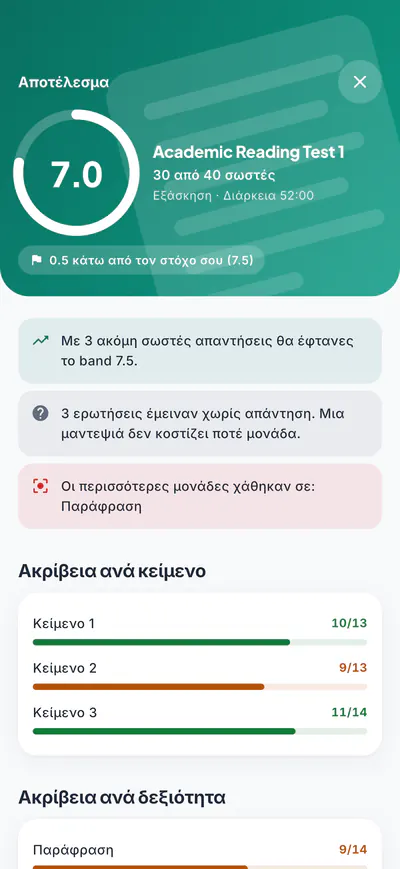
Αποτέλεσμα τεστ εξάσκησης IELTS στην εφαρμογή Fleydo: Προετοιμασία IELTS: εκτιμώμενο band και ακρίβεια για κάθε μέρος
Δωρεάν δοκιμαστικό μάθημα

Μάθετε το πραγματικό σας band στο IELTS πριν σας το πει η εξέταση

Ένα δωρεάν ατομικό διαδικτυακό μάθημα με καθηγητή με μητρική γλώσσα τα Αγγλικά, πιστοποιημένο ειδικό IELTS με Band 8.5+. Λαμβάνετε διαγνωστικό Speaking σε πραγματική μορφή εξέτασης, μια ειλικρινή εκτίμηση band και ένα πλάνο για τα ακριβή κριτήρια που σας κοστίζουν βαθμούς. Χωρίς πληρωμή, χωρίς δέσμευση.

Διαδικτυακά · Ατομικά · Academic και General Training

Το IELTS είναι σήμα κατατεθέν των British Council, IDP: IELTS Australia και Cambridge University Press & Assessment. Αυτά τα τεστ εξάσκησης είναι γραμμένα από τη Fleydo και δεν έχουν εγκριθεί ούτε υποστηριχθεί από τους οργανισμούς αυτούς.

Εφαρμογή για κινητά

Η Fleydo English School στην τσέπη σας

Μαθήματα, εργασίες, μηνύματα και παιχνίδια για τους μαθητές της Fleydo και τους γονείς τους. Δωρεάν σε iPhone και Android.

Λήψη στο App StoreΑποκτήστε το στο Google Play
Περισσότερα για την εφαρμογή
Κωδικός QR που ανοίγει την εφαρμογή Fleydo English School στο App Store ή στο Google PlayΣαρώστε για λήψηΑνοίγει το κατάλληλο κατάστημα για το κινητό σας.fleydo.com/app
Εικονίδιο της εφαρμογής Fleydo IELTS
Fleydo: Προετοιμασία IELTS

Προετοιμάζεστε για το IELTS;

Το Fleydo: Προετοιμασία IELTS είναι ξεχωριστή εφαρμογή με τεστ εξάσκησης και για τις τέσσερις δεξιότητες. Δεν χρειάζεστε λογαριασμό Fleydo για να τη χρησιμοποιήσετε.

Δείτε την εφαρμογή IELTS
Λήψη στο App StoreΑποκτήστε το στο Google Play
Τεστ εξάσκησης IELTS

Εξασκηθείτε και στις τέσσερις δεξιότητες του IELTS

311 τεστ με άμεσο band score, επεξηγήσεις στις απαντήσεις και πρότυπες απαντήσεις. Χωρίς εγγραφή.

Όλα τα τεστ εξάσκησης
Το FleyPath

Ο προσωπικός οδικός χάρτης του παιδιού σας — 3, 6 ή 12 μήνες

🚀Έναρξη
👋Hello
😊Body
🦁Animals
🔢Numbers
🏆Αγγλικά με Αυτοπεποίθηση
Παιχνιδοποιημένη εξάσκηση Αγγλικών

Σαν παιχνίδι — μόνο που μαθαίνουν πραγματικά