1. Αρχική
  2. IELTS
  3. Τεστ εξάσκησης
  4. Reading
  5. Εξάσκηση IELTS Reading Matching Information 4

IELTS Reading · Αντιστοίχιση πληροφοριών

Εξάσκηση IELTS Reading Matching Information 4

The three-point seat belt

  • 13 ερωτήσεις
  • 15 λεπ.
  • Academic

Τι περιέχει αυτό το τεστ

  1. PassageΕρωτήσεις 1–13Three points and a slow start

Τύποι ερωτήσεων

  • Αντιστοίχιση πληροφοριών
ReadingΕξάσκηση IELTS Reading Matching Information 4
Υπόλοιπος χρόνος15:00

Passage

Three points and a slow start

A Cars had belts well before Nils Bohlin designed his. Nash and Ford had offered them as extras by the mid-1950s, and Saab fitted a two-point type as standard in 1958. The commonest pattern was a single strap with a buckle over the stomach, which risked injuring internal organs in a fast crash. Two Americans, Roger Griswold and Hugh De Haven, had applied in 1951 to patent a combined shoulder and lap belt, with its buckle on the lap, where the two sections met.

B Bohlin came from the aircraft industry. At Saab, which he joined in 1942, he had worked on ejection seats for pilots, and Volvo took him on as a safety engineer in 1958. Its president, Gunnar Engellau, is reported to have lost a relative in a road accident. According to the Volvo Group's own account, Bohlin was asked to do the opposite of his work at Saab: to keep the driver in the seat during a collision.

C Comfort, he recognised, was part of the problem. Pilots, he said, would put on almost anything to stay safe, but motorists would not accept discomfort for even a minute. He settled on one strap across the chest and another across the hips, joined beside the hip and simple enough to fasten with one hand. His patent made a mechanical point as well. Older chest-and-hip arrangements passed much of the load to the seat back, which could bend forward or tear the seat from its fixings, so his belt was anchored to the floor or frame on either side of the seat.

D Accounts date the first car with the new three-point belt to 13 August 1959, and for a time it went only into cars for Volvo's home market. By 1963 all Volvos had belts in the front seats. The company held a patent, filed in Sweden in 1958 and granted in the United States in 1962, but it says it let other manufacturers use the design free of charge, a decision it still publicises.

E Figures followed in 1967, when Bohlin, still working for Volvo, presented a conference in California with an analysis of more than 28,000 accident cases, covering 37,511 front-seat occupants. He reported deaths among those without a belt at every speed in the data, but none among those wearing one in crashes below 60 miles per hour, and called the belt fully effective against being thrown from the car. One figure was less encouraging: almost all the cars had belts, yet on average only 26 per cent were being used.

F Such numbers did not change habits quickly. Consumers outside Scandinavia, at least, resisted, and rumours spread that belts could trap people. Some governments dealt first with equipment: from 1968, new cars in the UK needed belts in the outer front seats, and new passenger cars in the United States had to have them. Wearing them was a separate matter. The Australian state of Victoria legislated in 1970, and the whole country was covered by 1972. France followed in 1973, Sweden in 1975 and New York State in 1984, while the UK waited until 1983, after which about 90 per cent of drivers and front passengers were soon seen wearing a belt.

G A 2009 manual from the World Health Organization and partners cited a review finding that belts lower the probability of being killed by 40 to 50 per cent for drivers and front-seat passengers and by about 25 per cent for those in the rear. In the United States, an observational survey estimated that 91.3 per cent of adult front-seat occupants were wearing belts in daylight in 2025. The Volvo Group credits the three-point design with saving at least a million lives worldwide, a number that can only be an estimate. UN News reported in 2023 that, on WHO figures, 105 countries had seat belt laws in line with best practice.

Γλωσσάριο
ejection seats
aircraft seats that throw the pilot clear in an emergency
patent
a legal right to be the only one allowed to make or sell an invention for a set time
lap belt
a strap that goes across the hips of a person sitting down
three-point belt
a belt fixed to the car at three places
PassageΕρωτήσεις 1–13
Ερωτήσεις 1–13

The text has seven paragraphs, A-G. Which paragraph contains the following information? Choose the correct letter, A-G. NB You may use any letter more than once.

Επιλογές
  • AParagraph A
  • BParagraph B
  • CParagraph C
  • DParagraph D
  • EParagraph E
  • FParagraph F
  • GParagraph G
1a fear about the belt that circulated among the public
2a fault in older designs that could affect the seat itself
3a personal loss reported in connection with a company leader
4a choice not to earn money from an invention
5a low level of use among people who had a belt available
6a difference in benefit according to where someone sits
7rules on what had to be installed, as distinct from rules on behaviour
8the position of the fastening on a design from before Bohlin's
9an aim that reversed the purpose of someone's earlier work
10a contrast between two groups' tolerance of discomfort
11a period when the belt was limited to one market
12a worldwide total that cannot be exact
13a danger linked to the most usual type of belt at the time

Απαντήσεις και επεξηγήσεις

Κάντε πρώτα το τεστ: οι λύσεις είναι πιο χρήσιμες αφού έχετε απαντήσει.

Εμφάνιση των λύσεων και των επεξηγήσεων
  1. 1
    F

    Paragraph F says 'rumours spread that belts could trap people', which would make people unwilling to wear them. Paragraph E gives a low rate of use, but it offers no belief as the reason.

  2. 2
    C

    Paragraph C says older designs passed the load 'to the seat back', which could bend forward or tear the seat loose. Paragraph A also mentions a danger from older belts, but the danger is to the body, not the seat.

  3. 3
    B

    Paragraph B says Volvo's president 'is reported to have lost a relative in a road accident'. Paragraph E also concerns road deaths, but as statistics from a study, not as one person's loss.

  4. 4
    D

    Paragraph D says that, by its own statement, Volvo 'let other manufacturers use the design free of charge'. Paragraph A also mentions a patent, but says nothing about whether its owners charged anyone for using it.

  5. 5
    E

    Paragraph E says 'almost all the cars had belts', yet only 26 per cent were used. Paragraph F gives a wearing figure too, but that one is high, and it comes after a law.

  6. 6
    G

    Paragraph G gives 40 to 50 per cent for front seats and about 25 per cent for the rear. Paragraph F names front seats too, but only for what the law required, not for benefit.

  7. 7
    F

    Paragraph F says some governments 'dealt first with equipment', and that wearing belts was 'a separate matter'. Paragraph D says which Volvos had belts, but that was the company's own choice, not a rule.

  8. 8
    A

    Paragraph A says the American design had 'its buckle on the lap'. Paragraph C describes straps joined beside the hip, but that is Bohlin's own belt, not an earlier one.

  9. 9
    B

    Paragraph B says Bohlin was asked 'to do the opposite of his work at Saab': to keep the driver in the seat, not throw a pilot clear. Paragraph C also mentions pilots, but only to compare them with motorists on comfort.

  10. 10
    C

    Paragraph C contrasts pilots, who 'would put on almost anything', with motorists, who would not accept discomfort. Paragraph F mentions Scandinavia, but it does not compare groups on comfort.

  11. 11
    D

    Paragraph D says that 'for a time' the belt went only into cars for Volvo's home market. Paragraph F lists countries too, but those are places passing laws, not markets for one maker's cars.

  12. 12
    G

    Paragraph G says at least a million lives saved worldwide is 'a number that can only be an estimate'. Paragraph E gives counts as well, but they are of cases in one study, not a world total.

  13. 13
    A

    Paragraph A says the commonest belt 'risked injuring internal organs in a fast crash'. Paragraph C also describes a problem with older belts, but that problem is damage to the seat.

Λέξεις-κλειδιά από αυτό το τεστ

Passage

resisted
refused to accept or do something
legislated
made a law
anchored
fixed firmly in place
probability
how likely something is to happen
publicises
makes something widely known
Πώς απαντάτε σε ερωτήσεις «Αντιστοίχιση πληροφοριών»Find which paragraph holds a particular detail, example, reason or comparison.

What the task looks like

You get a list of items, and you say which lettered paragraph contains each one. An item might be 'a reason for ...', 'an example of ...' or 'a comparison between ...'. In General Training, the letters may mark separate short texts.

The task tests whether you can locate specific information: details, examples, reasons and comparisons.

This is not the same as matching headings. You are not looking for the main idea. The answer may be one small part of a paragraph that is mainly about something else.

In our papers, the items do not follow the order of the text, and there may be more letters than items. If a letter can be used more than once, the instructions will say so.

A method to try

1. Consider leaving this task until after the other questions on the same text. By then you may know where things are.

2. Read the items. For each one, mark the kind of information it asks for, such as a reason or an example, and then its topic.

3. Think of other ways to say the topic words.

4. Read one paragraph at a time and check it against all the items you have left. This can be quicker than searching the whole text for one item at a time.

5. Before you choose a letter, point to the exact words that match. If you cannot, keep reading.

The traps

The right topic, the wrong kind: several paragraphs may mention a topic, but only one gives the reason or the example that the item asks for.

The matching word: a word from the item may appear in a paragraph that says something quite different about it.

Small words in the item: 'a failed attempt' is not just any attempt, and 'a recent change' is not just any change. These words decide the match.

Worked example

Text: [A] Ticket sales at the town theatre were lower last year than the year before. [B] The main cause was the closed footbridge from the station, which left people arriving by train with a long walk. [C] The bridge reopened in March, and the theatre has since added an extra weekday performance.

Item: an explanation for a fall in audience numbers. Which paragraph contains this?

ΑδύναμοA. It talks about lower ticket sales, and that is the fall in audience numbers.
ΚαλύτεροB. Paragraph A only reports the fall. Paragraph B gives the reason: the closed footbridge made the theatre harder to reach.

The item asks for an explanation, so finding the topic is not enough. Mark the kind of information first, then look for that kind.

Εικονίδιο της εφαρμογής Fleydo IELTS Fleydo: Προετοιμασία IELTS

Πάρτε αυτά τα τεστ μαζί σας στο κινητό

Κάθε τεστ αυτών των σελίδων υπάρχει και στην εφαρμογή Fleydo: Προετοιμασία IELTS για iPhone, iPad και Android, μαζί με 2.000 λέξεις IELTS με ήχο.

  • Λειτουργεί χωρίς σύνδεση μόλις ένα τεστ βρίσκεται στο κινητό σας
  • 2.000 λέξεις IELTS με ήχο, επανάληψη σε αυξανόμενα διαστήματα και σύντομες ασκήσεις
  • Ηχογραφήστε τις απαντήσεις σας στο Speaking και ακούστε τες ξανά
  • Καθημερινό πλάνο για το band-στόχο σας και την ημερομηνία της εξέτασης
Λήψη στο App StoreΑποκτήστε το στο Google Play
Σαρώστε για λήψηΑνοίγει το App Store ή το Google Play, ανάλογα με το κινητό σας.

Δεν χρειάζεται λογαριασμός. Σχετικά με την εφαρμογή

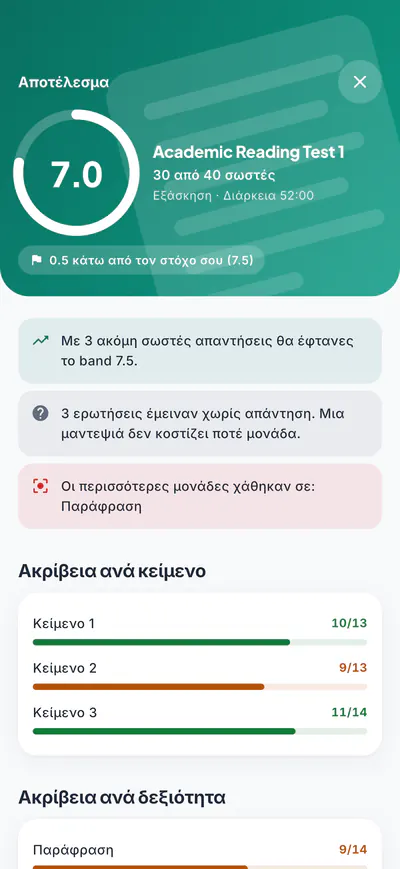
Αποτέλεσμα τεστ εξάσκησης IELTS στην εφαρμογή Fleydo: Προετοιμασία IELTS: εκτιμώμενο band και ακρίβεια για κάθε μέρος
Δωρεάν δοκιμαστικό μάθημα

Μάθετε το πραγματικό σας band στο IELTS πριν σας το πει η εξέταση

Ένα δωρεάν ατομικό διαδικτυακό μάθημα με καθηγητή με μητρική γλώσσα τα Αγγλικά, πιστοποιημένο ειδικό IELTS με Band 8.5+. Λαμβάνετε διαγνωστικό Speaking σε πραγματική μορφή εξέτασης, μια ειλικρινή εκτίμηση band και ένα πλάνο για τα ακριβή κριτήρια που σας κοστίζουν βαθμούς. Χωρίς πληρωμή, χωρίς δέσμευση.

Διαδικτυακά · Ατομικά · Academic και General Training

Το IELTS είναι σήμα κατατεθέν των British Council, IDP: IELTS Australia και Cambridge University Press & Assessment. Αυτά τα τεστ εξάσκησης είναι γραμμένα από τη Fleydo και δεν έχουν εγκριθεί ούτε υποστηριχθεί από τους οργανισμούς αυτούς.

Εφαρμογή για κινητά

Η Fleydo English School στην τσέπη σας

Μαθήματα, εργασίες, μηνύματα και παιχνίδια για τους μαθητές της Fleydo και τους γονείς τους. Δωρεάν σε iPhone και Android.

Λήψη στο App StoreΑποκτήστε το στο Google Play
Περισσότερα για την εφαρμογή
Κωδικός QR που ανοίγει την εφαρμογή Fleydo English School στο App Store ή στο Google PlayΣαρώστε για λήψηΑνοίγει το κατάλληλο κατάστημα για το κινητό σας.fleydo.com/app
Εικονίδιο της εφαρμογής Fleydo IELTS
Fleydo: Προετοιμασία IELTS

Προετοιμάζεστε για το IELTS;

Το Fleydo: Προετοιμασία IELTS είναι ξεχωριστή εφαρμογή με τεστ εξάσκησης και για τις τέσσερις δεξιότητες. Δεν χρειάζεστε λογαριασμό Fleydo για να τη χρησιμοποιήσετε.

Δείτε την εφαρμογή IELTS
Λήψη στο App StoreΑποκτήστε το στο Google Play
Τεστ εξάσκησης IELTS

Εξασκηθείτε και στις τέσσερις δεξιότητες του IELTS

311 τεστ με άμεσο band score, επεξηγήσεις στις απαντήσεις και πρότυπες απαντήσεις. Χωρίς εγγραφή.

Όλα τα τεστ εξάσκησης
Το FleyPath

Ο προσωπικός οδικός χάρτης του παιδιού σας — 3, 6 ή 12 μήνες

🚀Έναρξη
👋Hello
😊Body
🦁Animals
🔢Numbers
🏆Αγγλικά με Αυτοπεποίθηση
Παιχνιδοποιημένη εξάσκηση Αγγλικών

Σαν παιχνίδι — μόνο που μαθαίνουν πραγματικά